Wednesday, September 12, 2018

A Giant Success For One Small Municipality


By Gwen Anderson

The story we want to share with you this week is filled with hope and encouragement.  It has been exciting for us here at Harmony Valley Farm over the past few weeks as we’ve dug deeper into this rich story.  There is far too much for us to be able to sum up in one article, so we’ve shared some resources for you at the end of the article and encourage you to dive into this story and learn more.  The story is about a small township called Mals, which is (to our knowledge) the first municipality in the world to ban pesticides.  We first leaned about Mals when we read about it in an article in September’s issue of Acres U.S.A.  The article was an interview with Philip Ackerman-Leist, a farmer and professor of Sustainable Agriculture and Food Systems at Green Mountain College in Vermont, who is also the author of A Precautionary Tale.  Ackerman-Leist is very familiar with the area surrounding Mals, since he lived and worked in the area as a farmer in the early 1990s.  In both his book and the article we read, he highlights the struggles Mals went through on its long and difficult journey to become a pesticide free municipality.  Their story is one of perseverance, tenacity, convictions, and the desire to, as Farmer Richard would say, “do the right thing.”

Mals, photo from motherearthnews.com
Mals (pronounced Mahltz) is a township located in the Upper Vinschgau Valley of the Italian Alps, in a region called South Tirol.  The township is made up of 11 villages ranging in altitudes of 3,000 to 5,500 feet.  The largest of the villages lends its name to the municipality, so the villages are collectively known as Mals.  Even though the township is in Italy, the inhabitants speak German and retain their Austro-Hungarian heritage.  The residents of Mals have been farmers for 30-35 generations, tending their small family farms and carrying on traditions of rotating grain crops with vegetable crops and keeping their soil healthy.  Most of the farms are small dairy farms, owning 8-12 cows, who grow their own vegetables and have a handful of fruit trees near their homes.  The area surrounding Mals is also the driest in the Alps, with only about 50 days of rain a year, but the water coming down from glaciers and easy access to irrigation have made this a prime agricultural region.

Ulrich Veith, Mayor of Mals
Photo from thelexicon.org
Ulrich Veith became mayor of Mals in 2009.  He was elected because of his desire to create a sustainable municipality while keeping with the local traditions.  The township was building a micro-hydro-system to generate green energy to power their homes, businesses, and the new Swiss-built train that brought their long abandoned rail system back into use.  The train brought tourists who were interested in Mals’ picturesque landscape and the town responded by making bike trails and opening South Tirol’s first organic hotel.  It was a new renaissance period for the people of Mals.
Elsewhere in South Tirol, there was another sort of renaissance happening.  Climate change warmed the Alps and made South Tirol a perfect place to grow fruit, and apples were becoming the biggest money maker around.  The farmers’ cooperatives were building their brands and spreading their markets across Europe and Russia.  They borrowed the efficient tree trellis method developed by the Dutch and the small 3-4 acre orchards were rolling in money.  With money in hand and looking to expand, the apple farmers set their sights on Mals and the valley below, where they could snatch up land at a low price.  With the apples came the pesticides.  Apple farmers are able to legally spray up to 30 different pesticides, each one being sprayed 12-14 times a year.  While the rest of South Tirol was using 35 pounds of pesticides per acre per year, Mals was making a wide-spread movement to organic agriculture.

Gluderer family's herb farm, Castle of Herbs
photo from vinschgau.net
The valley below Mals, which had once mirrored Mals’ picturesque medieval farm landscape, had transformed into a sea of commercial apple orchards.  Urban Gluderer and his family, whom had started an organic herb farm down in the valley in the 1990s, were soon surrounded by conventional apple orchards and quickly found the pesticide drift was spreading to their land.  They planted hedges to protect their herbs, but the produce was still too tainted by pesticides to sell.  After several attempts to speak with government officials in the provincial capital failed to provide an adequate response, the Gluderers spent a quarter of a million dollars to cover their farm with greenhouses as a means to protect their livelihood from the chemical trespass.

In 2009, Günther Wallnöfer, an organic dairy farmer in Mals, watched as two commercial apple orchards went in next to his hay fields.  He didn’t feel the legal requirement of a 3 meter (10 feet) buffer between fields was going to protect his farm, and stories like the Gluderer’s only gave him justification to worry.  As Ackerman-Leist said in the article, “You can’t even turn your tractor around in a 10 foot radius!”  The next year, Wallnöfer had cuttings of his hay tested for pesticides.  The first came back tainted, as did the second and third.  Wallnöfer went to see the new mayor and asked him to do something.  In a community that has a wind named after them, everyone knew that no one was safe from chemical drift.  Per Ackerman-Leist, “Pesticides represented the death knell to the renaissance that [Veith, Wallnöfer] and others had worked so hard to bring about.”  So Veith went to the provincial and local governments for assistance.  What Veith received were two test orchards, supposedly to test pesticide drift, but also to trial new fruit varieties.  The people of Mals didn’t want more orchards, and didn’t see the need for further testing when there was already enough evidence of the dangers pesticide drift presented.  In the summer of 2012, much to the chagrin of the township, the test orchards were built.  In the end, the test orchards brought talks about changing the buffer law, but nothing substantial ever came from them.

Dr. Johannes Fragner-Untherpertinger
photo from thelexicon.org
It was clear that the provincial government didn’t have its sights on the same goal, so the citizens rallied; not just the farmers and environmentalists, but small business owners, the local medical community, and concerned parents.  The Advocacy Committee for a Pesticide-Free Mals was born in February of 2013, and Dr. Johannes Fragner-Unterpertinger, the local pharmacist, was elected as the spokesperson.  The Advocacy Committee started talking about a possible referendum to ban pesticides in Mals.  Speakers from around the world were brought in to educate the community of Mals on pesticides, from toxicologists (Dr. Irene Witte) and entomologists (Dr. Hans Rudolf Herren), to an EU food safety expert (Hermine Reich) who supported “safe pesticide use.”

In the summer of 2013, Dr. Unterpertinger, together with fellow activist Dr. Elisabeth Viertler, a pediatrician, wrote a Manifesto of Doctors and Pharmacists calling attention to the health dangers that pesticides present.  It was signed by 51 members of the local medical community.  Ackerman-Leist quoted the pharmacist as saying “When I see something jeopardizing the population here, which is coming in tiny increments, just in the same way the medicine I give out is prescribed in tiny increments, there is no way that I see that as appropriate.”  “None of these pesticides are harmless,” Dr. Unterpertinger said.  “Providing this information over the last years has borne its fruit. The community now understands how dangerous pesticides are. If you have a bit of a conscience, you cannot stay silent as a doctor.”

Meetings and education were not the only form of activism in Mals.  A group called Adam & Epfl (or Adam & Apple in English, is a play on words for ‘Adam and Eve’ in the local dialect) held cultural events to showcase Mals’ unique culture and support the sustainable economic development the township was striving for.  They have also been known to use a guerrilla art tactic or two, leaving painted snakes around the towns and apple orchards as a reminder not to be tempted by the “promises” of the Big Apple (a term coined to describe the commercial apple industry modeled after the term “Big Ag” in the US)
. 
5 members of Hollawint, from left: Pia Oswald, Dr. Elisabeth
Viertler, Beatrice Raas, Martina Hellrigl, and Margit Gasser
Photo from thelexicon.org
Martina Hellrigl and Beatrice Raas, the founders of a woman’s group called Hollawint (which means “Stop right there!”), wrote letters to the local newspapers pleading for the mayor to protect their health after the first submission of the referendum was declined.  Their first letter, which appeared multiple times with over 60 different signatures, read: “The increasing use of pesticides and herbicides in the municipality of Mals has us highly concerned for our health and especially the health of our children.  We ask our Mayor, who is responsible for the health of our citizens, to ensure that our environment and our health are not endangered.”  Another of their letters, sent to government officials during the referendum vote in September of 2014, focused on the highly profitable tourist trade: “We wish for everything that the tourist brochures have long promised: highly valued, healthy, and diverse foods that are grown in healthy soil and embedded in a landscape in which people, animals, and plants all have the possibility of a healthy life. We request that you publicly give us positive support in public and act accordingly.”  During the same time Dr. Unterpertinger was releasing his manifesto, the women of Hollawing hung over 100 recycled bedsheets throughout Mals stenciled with slogans promoting a pesticide-free future.  Hollawint also borrowed the guerrilla art tactic from Adam & Epfl by placing hay-stuffed pesticide suits sporting signs explaining the dangers of pesticides in high traffic areas around the township, and painted sunflowers to remind people to vote “Ja!” (or “Yes!”) for the pesticide ban referendum.

Eco-tourism was also a huge weapon the residents of Mals had in their arsenal.  “Probably the biggest mistake Big Apple made was overestimating their actual economic importance,” Ackerman-Leist stated.  “Agriculture only accounts for 6% of the South Tirolean economy, while tourism is closer to 25%.”  Elsewhere in South Tirol, stories were emerging about bicycling tourists being sprayed by pesticides while riding the countryside.  In April of 2013, a Swiss newspaper ran an article saying pesticides were ruining South Tirol as a vacation spot, which the region’s governor scoffed at.  Germany and Austria are also a huge tourism market for the South Tirol area.  When the Environmental Institute of Munich ran a campaign in April last year declaring many of the areas in South Tirol too filled with pesticides to visit, the South Tirolean government and tourism office were up in arms.  The institute then sponsored a bus trip to the villages of Mals in an effort to support their pesticide-free initiative.  A German tourism magazine interviewed Mayor Veith, which Ackerman-Leist summed up: “He essentially said, ‘We offer the perfect opportunity for eco-tourists.  Why wouldn’t you come to Mals, where you don’t have to worry about pesticide drift in your hotel or being sprayed when you’re out bicycling?’”

A Farmer's Future's logo
photo from thelexicon.org
Once Big Apple realized the citizens of Mals were serious about their referendum and were not going to just go away, groups were formed to fight back and put pressure on the government to intervene in their defense.  While the first attempt to submit a referendum failed, the second gained almost 3 times the signatures of support required in 2014.  In response, a media campaign called A Farmer’s Future was launched by the commercial fruit industry and allies of the South Tirolean Farmers Association.  This group tried to stop the referendum vote by requesting that the government invalidate Mals’ town council’s decision to allow the referendum only weeks before the vote.  The South Tirolean officials themselves had already stalled the vote on the referendum once by refusing to give Mayor Veith the voter list, saying the referendum was inadmissible.  When Veith countered the officials, they found an error on the request form and reminded the mayor that the voter list request must be completed, correctly, 45 days before the vote, thus forcing a reschedule.

Finally in September 2014, the citizens of Mals were able to pass the referendum to ban pesticides with 76% of voter’s support, but it still wasn’t enough to make it a law.  Mayor Veith and the town council had laid the groundwork for a referendum passed by the people to become law in 2012, but the change in the municipal code did not guarantee the referendum would be turned into law, only that it must be considered.  The ordinances imposing the referendum weren’t passed until March 2017.  According to Ackerman-Leist “it took more than a year and an election of town councilors before they actually voted to develop the ordinances to implement the referendum.”

Part of the issue slowing the referendum being turned into law was legal uncertainty.  The town council’s vote to change the municipality laws failed twice, in no small part due to lawsuits against the referendum (and a number of the activists) being paid for by the South Tirol Farmer’s Association, which supported commercial interests.  In 2016, the provincial courts even declared that the referendum was illegal because it was sponsored by the Advocacy Committee, six months after Mayor Veith and the town council had drafted the ordinances.  “The Malsers saw that as a technicality,” Ackerman-Leist stated.  “The ordinances for a pesticide-free Mals were not overturned.”

Ägidius Wellenzohn, photo from vip.coop
Lawsuits were not the only backlash the Mals activist saw.  Mayor Veith, a member of the region’s most prevalent political party, was under constant political pressure.  Dr. Unterpertinger, whose family had been pharmacists in the area for hundreds of years, received death threats and required police protection.  His garden was destroyed and his family’s graves were vandalized.  Ägidius Wellenzohn, another prominent activist, has been an organic fruit grower for 30 years.  Someone entered his orchard and sprayed it with glyphosate, not only destroying his crop for that year but also compromising his organic status for the next several years.  “Obviously, this is not something I ever wanted,” Ackerman-Leist quoted Wellenzohn as saying, “but I also realize that this is the price sometimes you pay for activism.  It’s still worth it to me to have been this involved.”
The town pulled together to support Wellenzohn, just as they had been supporting each other throughout the rest of their fight to live a life free of pesticides.  “I have the right not to be poisoned.  It would seem normal, but it’s something we need to fight for, not to be poisoned,” Dr. Unterpertinger says in a video from Friends of the Earth.  “They say that Bertol Brect says ‘[he] who fights may lose, but [he] who doesn’t fight [has] already lost.’  To say ‘Oh, well, there is nothing I can do,’ is unacceptable.” 

Mals, photo from independentsciencenews.org
Mals is a lesson for us all on how education and collective community persistence can win against even the seemingly unbeatable Goliath powers of commercialism and industry.  When we consider the negative impact “Big Ag” has in our own country, it can seem impossible that “we” can ever find success in opposing their efforts to influence government and support their cause with the power of the almighty dollar.  Mals’ success story is one that many European groups, including the Pesticide Action Network and Friends of the Earth, are trying to spread with the hope that this story will be emulated in other communities, much to the delight of many of the people of Mals.  “I see it almost as a gift, what happened here,” Martina Hellrigl says in the above video.  “It’s a beautiful story and we hope this beautiful story acts like a seed.  I hope Hollawint’s seed grows in other places also.”

Resources:

Philip Ackerman-Leist’s book, A Precautionary Tale: chelseagreen.com/product/a-precautionary-tale
                In audiobook format: amazon.com/precautionary-tale-pesticides-preserved-heritage/dp/1603587055

Lexicon Multimedia Project: topplinggoliath.org


Wednesday, September 5, 2018

September 6, 2018 - This Week's Box Contents, Featuring Korean Peppers


Cooking With This Week's Box:


Leeks: Chile & Leek Stir-Fry with Ginger (see below); Alice Water’s Classic Potato Leek Soup


Korean Peppers: Salt-Cured Chiles and HVF Fresh Korean Chili-Garlic Sauce (see below); Chile & Leek Stir-Fry with Ginger (see below)

Variety of Tomatoes: Cream of Tomato Soup


Green Top Red Beets: Roasted Beet & Avocado Salad
    
Orange Italian Frying Peppers & Red Bell Peppers: Roasted Red Pepper Alfredo with Linguine


It’s been an eventful week to say the least!  While the rain fell Monday night, I distracted myself by experimenting with the Korean chiles in my kitchen!  I hope you’ll take the time to read this week’s article about Korean peppers and consider trying the recipes for Salt-Cured Chiles and HVF Fresh Korean Chili-Garlic Sauce (see below).  These are great condiments to have in your refrigerator and I offer several resources in the article for finding recipes and ideas for how to use them.  You can also use this chile in the recipe for Chile & Leek Stir-Fry with Ginger (see below).  It seems like gentle, delicate leeks and hot chiles are on different ends of the spectrum, but they actually complement each other quite nicely in this dish.  This recipe calls for tofu, but you could make it with chicken if you prefer.

If you don’t use the leeks to make the stir-fry, then you might want to use them to make Alice Water’s Classic Potato Leek Soup.  Her recipe calls for yellow potatoes, but I specifically included the Purple Viking potatoes in this week’s box because I think they’re one of the best varieties for this soup!

Roasted Beet & Avocado Salad, photo from Food & Wine
This week we are fortunate to have avocados in the fruit share.  Avocados and beets pair together very nicely in dishes such as this Roasted Beet & Avocado Salad.  Don’t throw away the green tops!  Wilt them with in olive oil and use them as the base for serving this salad.

I have been craving roasted red peppers and this is the week to make this recipe for Roasted Red Pepper Alfredo with Linguine.  While the recipe calls for roasted peppers from a jar, please do yourself a favor and roast your orange Italian frying peppers and/or red bell peppers for this recipe!  This recipe also includes onions as the base and this week’s sweet yellow onions will really enhance this dish.

I shared some edamame with a friend last week who had never had them before.  As I was telling her how to cook them I mentioned how when you roast them you can add different seasonings.  In my early days at the farm, I created this recipe for Wasabi-Roasted Edamame to honor Richard’s love of wasabi.  This makes a nice little snack in the afternoon.

Caramelized Onion Grilled Cheese Sandwich
Photo from Land of Noms
It’s supposed to be a cool week, so this is the week to make Cream of Tomato Soup with fresh tomatoes!  Serve a bowl of this tasty soup along with a Caramelized Onion Grilled Cheese Sandwich and you’re set for a light lunch or dinner.

Hopefully you still have a little fresh basil remaining in your herb garden.  If so, pick a little and use it to make this recipe for Pesto Stir-Fried Carrots, Cauliflower & Cherry (Grape) Tomatoes.  This dish makes use of some of your carrots as well as cauliflower (or substitute broccoli Romanesco) and the grape tomatoes in this week’s box. Serve this dish as a vegetable side to go along with grilled chicken or fish.

I hope you enjoy this week’s cooking adventures.  Lets cross our fingers that we’ll be able to harvest peppers and tomatoes for a few more weeks, but it’s also time to start preparing your plans for some of our favorite fall vegetables!  Spaghetti squash, sweet potatoes, Kabocha squash, celeriac and more still coming your way!—Chef Andrea 

Exploring a new ingredient, HVF Korean Peppers

By Chef Andrea

Dang Jo Cheong Yang pepper photo from the
Osborne Seed catalog.
This week your CSA boxes include a beautiful bright red Korean Pepper called Dang Jo Cheong Yang.  Every year we look for some new, interesting vegetables to grow.  Last winter, as we were pouring over seed catalogs, this pepper caught my eye.  The picture in the Osborne Seed catalog showed a long, dark purple pepper that looked to be pretty prolific.  They described it as “a unique Asian pepper that is similar in pungency and appearance to a serrano. The fruit are purple in color and ripen to a deep dark red color. They are easy to harvest and uniform. Outstanding yield and good ripening ability in the Pacific Northwest make this a nice addition to a hot pepper program.”  We thought it would be fun to try something new and we don’t have any purple peppers so why not give it a try!  We have found that the plants are very prolific producers and just as the picture shows, they set on quite a lot of dark purple peppers.  Our next mission was to decide when to harvest them.  Since we’ve never experienced this pepper before we are basically doing our best to assess the qualities of the pepper at different stages and make our best judgements as to when it’s at its peak of ripeness.  I started trialing this pepper when it was just purple and found that it really didn’t have much flavor.  It tasted like a very green hot pepper.  Nothing really remarkable about it.  So we decided to let it ripen more and see what happened.  Now that they are fully red, the flavor has really changed and it not only has heat, but a much more complex flavor than when it was green.

As with every new vegetable we grow, we not only have to figure out how to grow it and when to harvest it, but we also have to figure out how to best put it to use in the kitchen.  Before we go any further, I should offer the disclaimer that I am very much a novice when it comes to the cuisine of most countries in Asia.  Yes, I had “Cuisines of Asia” in culinary school and I have a handful of Japanese, Thai and Chinese cookbooks, but I have to admit that I’m not very familiar with many of the cooking techniques and ingredients that are used in these cultures.  I’m also not familiar with the languages of this part of the world, so I just assumed this was probably some sort of a pepper from China.  I started researching more about this pepper, starting with the seed company.  Unfortunately they didn’t have much to offer beyond the description in their catalog.  When I looked up the name of the pepper, it actually pointed me in the direction of Korean cuisine.  So, based on my research I have concluded that this is likely a pepper variety coming to us from Korea.  Aside from knowing a few people from Korea and eating kim chi, I am not very familiar with the cuisine of Korea.  Thus began another culinary food adventure!  So for those of you who are in the same boat as I am and don’t know much about Korean cooking and ingredients, I’m going to do my best to share some of the information I learned from my research.  If you have more experience with Korean food and have additional information to share with me, I’d welcome your input, recipes and culinary expertise.

Gouchujang I brought home from Minneapolis
last winter.
One basic thing I learned about Korean cuisine is that it includes quite a lot of fermented foods as well as spicy hot foods.  Korean cuisine and its influence on food and cooking in the United States has been growing over the past few years as we see Korean influences crossing over into dishes from other origins, such as Korean tacos and pizza.  I suspect Chef Roy Choi holds some responsibility for this influence based on the success of his food truck business in Los Angeles, California that started with a Korean short rib taco and has now grown to include multiple food trucks as well as a catering business, restaurant and many features in cooking magazines and other media outlets.  Chefs and home cooks are taking some basic Korean ingredients and cooking techniques and applying them to other preparations.  One of these ingredients is called gochujang.  Gochujang is a savory, sweet, spicy condiment used in Korean cuisine.  It is considered a backbone ingredient to Korean cooking and one source I read likened it to sriracha mixed with miso, but with a more complex flavor.  Traditional gochujang takes quite a while to make because the complexity of its flavor comes from a fermenting process.  It’s made with glutinous rice, fermented soybeans, salt and the traditional dried Korean peppers.  If you’re interested in learning more about how this is made, you can find more description and pictures on this blog written by a Korean woman who is a simple home cook sharing the cuisine of her country.  Gochujang is used as a condiment in sauces, soups, dipping sauces, marinades and with roasted meats.  I am seeing this ingredient more in some of my cooking magazines, although I have limited experience using it and have not seen it in any of our local stores.  Last winter when I was in Minneapolis for sales meetings I found a jar of gochujang at one of the food co-ops.  It wasn’t organic, but it was made with non-GMO soybeans so I picked up a jar so I could see what it was like.  I have only used it once, but am glad I have a jar of it now that I’m learning more about what it actually is!

So back to the little bag of peppers in your box this week.  First of all, I want to make sure everyone understands that this is a hot pepper, with the heat level similar to a serrano pepper.  You can use this pepper anywhere you might need a fresh hot chile and I have been using it in recipes that call for jalapenos as well as fresh Thai chiles.  They have added a nice background heat to fresh salsas, scrambled eggs, Thai curry dishes and fried rice.  If you prefer less heat, just use a portion of the pepper or remove the seeds and white pith.  As with all hot chile peppers, handle them carefully and don’t rub your eyes with your hands for awhile after handling them!

Chile Ristra, photo from heb.com
In Korea, this pepper is often used as a dried chile.  This makes sense because it has a thinner wall which means it dries very easily.  I’ve actually dried some that have just been hanging out on my countertop, but you could also intentionally dry them in a dehydrator or low heat oven.  You could also use them to make a beautiful dried chile ristra.  Checkout this website for a step-by step guide for how to make a chile ristra.  You can string up the fresh chiles and hang them in your kitchen to dry naturally.  Once they are dried you can use them as a dried chile pepper including grinding them with a spice grinder to make hot chile flakes.  If you aren’t into hot peppers, you could also enjoy your dried chile ristra just as a decoration in your kitchen or use it as a Christmas gift for someone who does like a spicy culinary adventure!

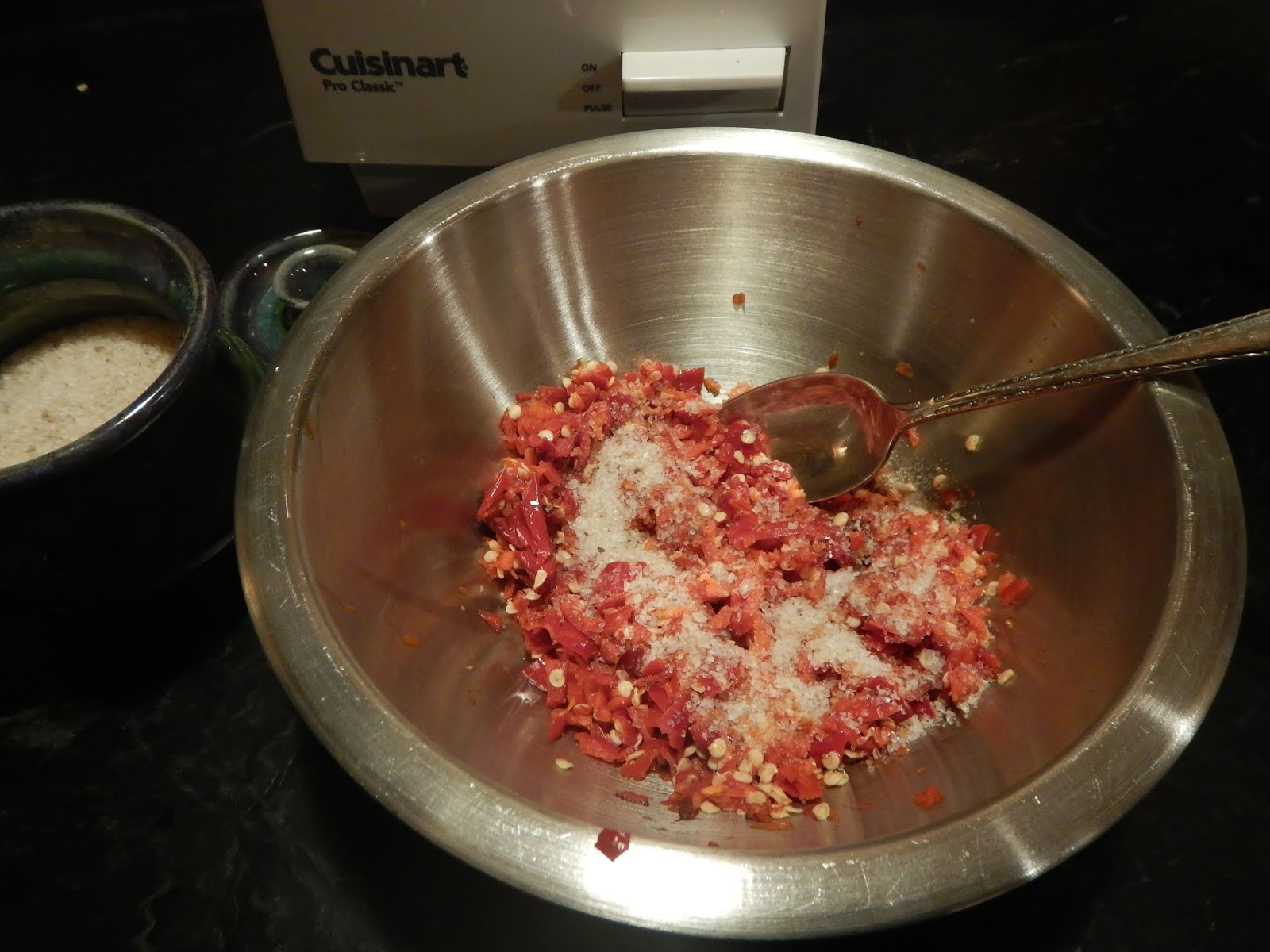
This week we’re featuring two different recipes that use these Korean peppers in their fresh form.  The first recipe is for Salt-Cured Chiles.  I’ve made these before using a fresh Thai chile that is actually very similar to these Korean chiles.  This is a quick, easy way to preserve your chiles and I like it for several reasons.  First, all you need are the chiles and salt.  Second, if you use a food processor this recipe will take you maybe 10 minutes to make, including clean up.  Third, these chiles will keep in your refrigerator for months and retain that fresh chile flavor.  You don’t need much to add heat to dishes, so a little jar can last quite a long time.  You can use them to add heat to stir-fries, marinades, sauces or use them to make your own homemade hot sauce.

Korean Tacos
photo from KIMCHIMARI
The second recipe is for a preparation I’m calling HVF Fresh Korean Chili-Garlic Sauce.  It’s based off of a recipe that is a quick version of gochujang that anyone can make at home.  This is another quick and easy recipe to make.  I think it only took me about 10-15 minutes to make it and clean up.  This sauce will keep for a couple weeks in the refrigerator or you can portion it into smaller containers and freeze it.  Traditional gochujang is a thick paste, but this sauce made with fresh chiles is more of a sauce and less of a paste.  The flavor of traditionally fermented gochujang is more complex, so I don’t want to misrepresent this recipe as the way to make traditional gochujang.  I do think this is a really tasty chili-garlic sauce and it can be used in any recipe that calls for gochujang.  It is pretty spicy, so when you use it in recipes, adjust the quantity to the amount that fits your tastes.  If you’re interested in learning more about how this condiment can be used, I’d encourage you to check out the blog I mentioned earlier that includes recipes such as Korean Tacos.  There is also a nice article entitled “10 Fresh Ways to Use Korean Gochujang.”

I had a lot of fun learning more about this pepper and a little more about Korean cooking.  I hope you have fun experimenting with this pepper in your own kitchens.  I invite you to share your experiences in our Facebook group so we can all learn a little more about this pepper as well as experiment with different recipes and ways to use our own homemade Salt-Cured Chiles and HVF Fresh Korean Chili-Garlic Sauce!  Have fun and thanks for trying something new!

Salt-Cured Chiles

Yield:  ½ cup

4 oz fresh Korean peppers
1 Tbsp kosher salt
  1. Thinly slice peppers with a knife or roughly chop them and then use a food processor to chop the peppers into smaller pieces.  If you use a food processor, process just enough to coarsely chop the peppers.  You do not want to make pepper paste or puree. 
  2. Put the peppers in a small bowl and add the salt.  Mix very well with a spoon.  Cover the bowl with a plate or a clean kitchen towel and leave out at room temperature for 24 hours. 
  3. After 24 hours, move the bowl to the refrigerator and mix the peppers once a day for 5 days, or until the salt has dissolved and the now softened chiles are completely covered in liquid. 
  4. Transfer to a glass jar with a lid, tamping the chiles down so that they remain well  below the level of the liquid.  These will keep for several months in the refrigerator.
This recipe was adapted from Andrea Reusing’s book, Cooking in the Moment, although she credit’s Fuchsia Dunlop (author of Land of Plenty) with this simple method for preserving chiles for use long into the winter months.  Reusing suggests pureeing some of the salted chiles along with cider vinegar, garlic, and a little sugar to make your own hot sauce.  Of course you can use these chiles anywhere you need a little heat. Add them to soups, stews, marinades, stir-fry, dipping sauces, vinaigrettes, etc.

HVF Fresh Korean Chili-Garlic Sauce

Yield: 1 cup

4 oz fresh Korean peppers
4 cloves garlic
⅓ cup miso
¼ cup maple syrup
¼ cup tamari or soy sauce
  1. Remove the stem and roughly chop Korean peppers into one inch pieces.  Put the peppers in a food processor or blender along with the garlic cloves and roughly chop them until they are a fine, yet chunky paste. 
  2. Add the miso, maple syrup, and tamari.  Blend together until smooth.
  3. Taste and adjust the flavor as needed to your liking.  Add tamari for more depth of flavor, maple syrup for more sweetness, garlic to get more “zing” or salt if it just needs a little enhancement to wake up all the other flavors.
  4. Put the sauce in a glass jar and store in the refrigerator for up to 2 weeks.  Alternatively, you can freeze it in smaller portions as a means of preserving it for later use. 
Note:  You may use this in place of the Korean fermented chili paste called gochujang.  It’s pretty hot, so a little bit will go a long way!

Recipe adapted from minimalistbaker.com

Chile & Leek Stir-Fry with Ginger


Yield:  4 servings


8 oz firm tofu (drained)*

3 Tbsp soy sauce

2 Tbsp sherry or dry vermouth
2 tsp honey
⅔ cup vegetable stock
2 tsp cornstarch
3 Tbsp sunflower oil
3-4 leeks, thinly sliced
1 red Korean pepper, sliced thinly
1-inch piece fresh ginger, peeled and shredded
Salt and freshly ground black pepper, to taste
  1. Cut tofu into cubes.  Combine the soy sauce and sherry or vermouth in a medium bowl.  Add the tofu and stir to make sure the tofu is well coated.  Leave to marinate for about 30 minutes. 
  2. Strain the tofu from the marinade and reserve the marinade and juices in a measuring cup.  Mix the marinade with the honey, stock, and cornstarch to make a paste. 
  3. Heat the oil in a wok or large frying pan and when hot, stir-fry the tofu until crispy.  Remove from the pan and set aside.
  4. Reheat the oil and add the chili, ginger and leeks.  Stir-fry over high heat for about 2 minutes, moving the vegetables frequently to keep them from burning.  Stir-fry just until the leeks have softened. 
  5. Return the tofu to the pan together with the marinade and stir well.  Continue to simmer the mixture, while stirring frequently, until the liquid is thick and glossy.  Serve hot over rice or egg noodles.
*Note:  You may also substitute chicken breast meat for tofu.

This recipe was adapted from Christine Ingram’s book, Vegetarian and Vegetable Cooking:  The definitive encyclopedia of healthy vegetarian food.

Weather Update From Farmer Richard…..

Last week we reported on the status of our farm after receiving 8” of rain earlier in the week.  This week I wanted to update you on our status over the past week.  Thankfully we had a few dry days at the end of last week.  We performed a few magic tricks to dry out some beds enough that we could do our scheduled weekly plantings on Friday, including our first planting of fall spinach.  We were proud of our efforts, accomplishments and had smiles on our face at the end of the week!  We had an immediate rain of 1.5” but thankfully the skies cleared on Saturday afternoon and we managed to harvest some beautiful winter squash and finished the potato harvest.  We have an abundant winter squash crop this year and we were pleased to find out it tastes really good just a few days after harvest!  Usually we wait several weeks to eat any as it needs a little time to cure and sweeten up.  All indications are that it is going to be a tasty winter squash season!  We also managed to fix all our field roads and after several days all our animal fences were fixed as well.

Unfortunately, we got more rain and severe storms again Monday night!  Thankfully it was only 4” of rain this time, but it came hard and fast and in several places the wash-outs were worse.  We had to cancel harvest on Tuesday morning and diverted all  available operators and equipment to clean up and fix roads, etc.  We made it through the last event without the bulldozer, which has been in the repair shop.  This time, however, there was some work that was best done with the bulldozer as tractors and skidsteers would’ve just sunk into the mud.  I called the shop and asked them to return it.  They dropped it off Tuesday afternoon and I was able to move enough mud from below our land dam with hopes that we could get through the night without problems if the predicted rain and storms really moved through our area.  Felix G was a trooper and worked with me throughout the day doing a lot of handwork and shoveling to clean up a fence line and clear debris and mud away from the inlet to our land dam that was plugged from the night before.  We were also able to resume harvest Tuesday afternoon! 

We did have about 1.5 inches of rain Tuesday night, but it wasn’t as much or as hard and fast as originally predicted so we fared pretty well.  Our total rainfall over the past two weeks is at about 15 inches now.  We have several days of sunny, dry and cool weather in the forecast, which will be a welcomed relief.

We’ve been pretty fortunate to not have lost as many crops as in previous events, but we are already seeing disease spots on many crops because of the prolonged hot/wet and humid weather.  We could still see more rot and disease spread in some areas if it doesn’t dry out soon.  Please be aware that the shelf life on some of your vegetables may not be what you’re accustomed to simply because of the wet conditions these crops have had to persevere through.  If you notice a spot forming on a tomato or pepper, that’s your cue to use them quickly.  This might be the week to make a batch of tomato sauce or saute all the peppers at one time and use them throughout the week.

I am writing this weather update to simply let you know what’s happening on our farm, which for our CSA members is also “your” farm.  We aren’t looking for pity, we only want to keep you informed and let you know we value your continued support.  Our crew has had some hard days and we all are in need of a spirit lift.  We appreciate the cards and emails of encouragement we have received.  They really help!

Wednesday, August 29, 2018

Severe Weather Event….Again


By Richard DeWilde

Well here we go again!  Another severe weather event, the third in 3 years.  This is starting to look like an annual event!  What started in 2007, 12 inches in 24 hours, was called at the time a “100 year event.”  Meteorologists no longer refer to 50 or 100 year events, because they now appear to be annual events!

Jack weathering out the storms Tuesday night at Richard's
feet, all snug in a comforting denim shirt.
So what is it like for us to deal with such an event?!  On Monday night it started to rain with possible “heavy rain” in the forecast.  It rained and rained, our weather man referred to it as a “trailer,” new to me but meaning that the band of showers did not just pass through, but the tail end continued to build into heavy showers for 12 hours!  I dumped the rain gauge at 10 PM, emptying 4.5 inches.  I tried to sleep, but our sweet dog Jack kept waking us to adjust his blanket covering because he was terrified by the constant thunder and lightning.  So after a troubled sleep, we rose before dawn to assess the damage.  By morning the total rainfall had risen to 8 inches rain in less than 12 hours.

From past events, the obvious first thing to check is the animal fencing that crosses the creek.  Yep, they were washed out!  Angel and Juan Pablo were here at the first light of dawn to contain our animals.  As of Tuesday night the pigs are in the corral, their two creek fences still not complete.  The cows are all accounted for and contained, but much more fencing work is needed!

One of our field roads off of Wire Hollow Road , completely
washed out from the storm.
Now, on to harvest!  Our pre-dawn assessment found that no fields were accessible.  River and creek crossings, roads to bench fields and the dry washes were all plugged with rock and debris.  We canceled morning harvest, pulled every skilled operator and utilized every piece of equipment to spend the morning fixing roads and our yard to make them passable while the rest of the crew worked in the packing shed and greenhouses to pack things harvested the previous day and worked on trimming and cleaning onions and shallots for storage.

In the afternoon, we loaded up the harvest wagons to resume harvest. Unfortunately, the rain started just as the crews were heading to the field.  It was a wet, muddy afternoon, but we were able to pick peppers, eggplant, tomatoes and tomatillos in the on again/off again rain!  We had to fix some of the tomato trellises that had tipped over with the soggy soil.  Not the most fun day of harvest, but the product was fine and the crew got it done.

Large branches and other debris from the dry wash just down
the road from the field road pictured above.
A disappointing moment in the day was the field report from the corn harvest crew.  We’ve worked very hard to grow the very best crops of corn we have ever grown this year.  Sadly, they found the remaining corn was tipped over from wind and saturated soil that couldn’t support the stalks anymore.  The crop scheduled for picking this week as well as our next and final crop, flattened!  They were and will be able to pick some of it for this week and we’re crossing our fingers that the last crop might perk up with a few sunny days.  Also on that farm, they found all of our beautiful sunchoke stalks laying flat as well.  Argh!

Greens?  We delayed harvest until Wednesday morning because the leaves showed signs of being  water-soaked.  Based on our prior experience, the plant usually recovers from this, but needs some hours of dry weather preferably with sun before we resume harvest.

Vincente blading a washed out field road.
Everything we harvested is muddy and needs to be washed.  No worries, we know how to do that.  Tuesday evening still a steady rain, another “trailer!”  The old “normal” weather, gone, prepare for the worst!  As we finish up this article on Wednesday morning, we’re thankful for blue skies and sunshine.  The crews are back in the fields and we’re preparing to pack the CSA boxes for our Twin Cities members.  We’re making plans to continue the cleanup and will revisit the berms and ditches that failed or were damaged.  We’ll put things back together, build the berms higher and clean out the ditches.  We can’t quit--We have families to feed!

Our changing weather patterns are for real, and I don’t see this erratic weather going away anytime soon.  Should we transition to inside, greenhouse production?  Can we really curb the excess atmospheric carbon and stabilize our climate?  That would be preferable!  The technology is there for clean energy, clean cars, and carbon capture.  Much of the civilized world is already making huge improvements.  But will we?  Do we have the political will and leadership to do it?  I sure hope so.