Showing posts with label Korean Peppers. Show all posts

Wednesday, September 15, 2021

September 16, 2021 - This Week's Box Contents, Featuring Korean & Guajillo Chili Peppers!

Cooking With This Week's Box

Korean Chili Peppers:
HVF Korean Chili Garlic Sauce (See Below)
15-Minute Hot Sauce (See Below)

Baby Arugula:

Italian Garlic:

Leeks:

Edamame:

Sweet Peppers:

Variety of Tomatoes:

Broccoli Romanesco, Cauliflower, and/ OR Broccoli:

Peter Wilcox Potatoes:

Orange Carrots:

Green Top Celeriac:

Green Savoy Cabbage OR Red Cabbage:

Red or Golden Grape Tomatoes:

Rainbow Chard:

Spicy-Korean Style Gochujang Meatballs
Summer and Fall have officially collided!  This past week we started harvesting burdock root, sunchokes, parsnips and even included celeriac in your box this week!  We also started winter squash harvest and the greenhouse is nearly full with bins and bins of squash!  Many of you are anxious to get these in your box……hold tight, we’ll start sending them your way in the next week or two.  While we still have some warm days ahead of us, it’s been nice to have a little chill wash over in the evening.  It prepares me for the transition into fall/winter cooking complete with pots of soup, braised meat, etc.

This week we’re heating things up a bit with our featured vegetable of Korean and Guajillo Peppers!  Our featured recipes this week are simple, 15 Minute Hot Sauce (See Below) and HVF Korean Chili Garlic Sauce (See Below).  These are basic recipes that you can use to make a whole host of recipes such as Spicy-Korean Style Gochujang Meatballs or Sweet and Spicy Gochujang Butter Popcorn.  If you haven’t done so already, I encourage you to take a moment to read this week’s Vegetable Feature article to learn a little more about both of these varieties.

Pear and Leek Galette with Goat cheese
and Walnuts (photo from coleycooks.com)
There is a wide variety of recipes in this week’s list of suggestions, ranging from soup to stir-fry, salads, tacos and more!  If you have been following along in our Facebook group, you’ll know that galettes have been a favorite item in many kitchens over the past week!  If you haven’t tried the Pear and Leek Galette with Goat Cheese and Walnuts recipe yet, I encourage you to do so this week.  This will be our final week of leeks.

I hope everyone has a great week and I encourage you to post the recipes you’re making in the Facebook Group!  It’s really fun to see what everyone’s doing with their vegetables and who knows, your creativity may be sparked as well! 

Have a good week—
Andrea

Vegetable Feature: Korean & Guajillo Chili Peppers

By:  Chef Andrea Yoder

Dried Guajillo Chili Peppers
While the majority of the peppers we grow are sweet ones, we do reserve a little space in our growing plan for some hot varieties too.  We understand some of you are more into hot peppers than others, but we’re hoping the selections we include in your boxes are ones everyone can enjoy.  If you are not a fan of spicy food and hot peppers, I encourage you to read on and learn more about our Korean and Guajillo Chili peppers as these are two selections you can learn to use in small quantities to enhance the flavor of your food without burning your mouth!

This week we’re featuring both Korean and Guajillo peppers.  You will receive one of these selections in your box this week.  They are just starting to ripen and the supply of each is a bit more limited, but we will be sending them again within the next few weeks so you’ll have an opportunity to try both.  While most of the information I’m going to share with you is relevant to both peppers, there are a few distinct differences so we’ll start with a little description about each.

Fresh Korean Chili Peppers
Korean chili peppers are a smaller, skinny, long red pepper often described as having a medium level of heat.  Personally, I think this is a pretty hot pepper that is at least equal to if not hotter than a jalapeño.  We’ve only been growing this pepper for several years and have come to appreciate it for its complexity which goes beyond being just hot, but also is flavorful with some sweetness when you let them ripen to fully red.  The “real” name for this pepper is Dang Jo Cheong Yang and it is one of the most consumed vegetables in Korea!  Guajillo chili peppers are a little larger in size both in length as well as width.  They are more mild than Korean and jalapeño peppers, but slightly hotter than poblano peppers.  They are ripe when they turn fully red.  We save seed for both of these pepper varieties and continue to refine the seed from year to year as we select peppers with the most desirable characteristics as the ones we save seeds from.  We still have some work to do on uniformity, so you may see some variability in the size and shape of the peppers you receive.  

Both Korean and guajillo peppers are typically used in their dried form.  Dried Korean peppers are used extensively in Korean food (eg kim chi, barbecue, gochujang sauce, etc.) and often in the form of a dry powder or dried flakes.  Guajillo peppers are used extensively in Mexican mole and sauces where the dried peppers are usually toasted in a hot cast iron skillet or on a griddle before they are rehydrated.  This helps to intensify the depth of flavor.  

Now that we’ve laid out some of the basics, it’s time to figure out what to do with these beauties!  While both peppers are most often used in the dried form, you can also eat them fresh.  In their fresh form you can use them in any recipe where you need/want the fresh chili flavor and heat.  Add them to salsas, sauces, soups, stir-fry, etc.  If you prefer to stick to tradition and/or you want to preserve them for use later, you can also dry them.  This can be accomplished using a low heat oven, dehydrator or just by air drying (see links below for more information).

Fizzeology's Fermented Chili Sauce
I would also like to recommend three other recipe ideas for things you can make with the fresh peppers.  You can use either guajillo or Korean peppers to make any of these recipes.  If you use guajillos the preparation will be more mild than if you use the Korean peppers.  The three preparations include HVF Fresh Korean Chili Garlic Sauce (See Below), Salt-Cured Chilies and 15 Minute Hot Sauce (See Below).  We have featured the first two recipes in previous years (recipes available on our website & blog), but they are the recipes I keep coming back to year after year.  For your convenience, we've included the recipe for the Chili Garlic Sauce in this post.  Fresh Korean Chili Garlic Sauce can be used in any recipe that calls for gochujang.  Gochujang is a traditional fermented chili paste that takes months to prepare properly and is typically made with dried peppers.    While this recipe does not fully match the traditional fermented chili paste, it is still very flavorful, can be kept in the refrigerator for several months, and once it’s made you can use it in any number of recipes.  The second preparation is for Salt-Cured Chiles.  This is super easy to make and I keep a jar of these in my refrigerator all year long.  It’s a great way to preserve the fresh chili flavor and you can use a little whenever you need to add a little heat to a recipe.  The third suggestion is to make your own hot sauce!  I’ve included one recipe in the newsletter this week, with some references below for where you can find more information about making hot sauce, including fermented hot sauce.  For the past few years we’ve worked with Fizzeology in Viroqua to turn our Korean chili peppers into a tasty fermented hot sauce.  The fermenting process enhances the flavor of the peppers, lasts a long time, and tastes great!  We are planning to make another batch this year and will offer it for purchase likely in December.
 
I hope you enjoy experimenting with these peppers and find uses for them this week as well as in the future if you preserve them!


15 Minute Hot Sauce


photo from dontwastethecrumbs.com
Yield:  1 cup
5 oz hot peppers (Korean, guajillo or jalapeño)
¾ cup white vinegar or apple cider vinegar
¼ tsp salt, plus more to taste
2 tsp minced fresh garlic

  1. Put on gloves and wash the peppers. 
  2. Cut the tops off of your peppers and slice in half lengthwise.
  3. Pour the vinegar into a saucepan/pot, add peppers, salt, and garlic.  Bring to a boil and reduce heat to a low boil until peppers are soft (about 10 minutes).
  4. Remove from heat and cool slightly.  Pour everything into a blender and blend until liquefied (seeds and all!).
  5. Taste the sauce.  If it is not hot enough, blend in additional fresh hot peppers. 
  6. Store in the refrigerator for about one week, or freeze it for later use.

Recipe adapted from dontwastethecrumbs.com.


HVF Fresh Korean Chili-Garlic Sauce--Updated


Yield: 1 cup

4 oz fresh Korean chili peppers
4 cloves garlic
⅓ cup miso
2 Tbsp honey
3 Tbsp tamari or soy sauce
1 tsp rice vinegar
  1. Remove the stem and roughly chop Korean chili peppers (seeds included) into one inch pieces.   Put the peppers in a food processor or blender along with the garlic cloves and roughly chop them until they are a fine, yet chunky paste. 
  2. Add the miso, honey, tamari and rice vinegar.  Blend together until smooth.
  3. Taste and adjust the flavor as needed to your liking.  Add tamari for more depth of flavor, honey for more sweetness, garlic to get more “zing” or salt if it just needs a little enhancement to wake up all the other flavors.
  4. Put the sauce in a glass jar and store in the refrigerator for up to 2-4 weeks.  Alternatively, you can freeze it in smaller portions as a means of preserving it for later use. 

Note:  You may use this in place of the Korean fermented chili paste called gochujang.  It’s pretty hot, so a little bit will go a long way! 

Recipe originally adapted from minimalistbaker.com.


Wednesday, September 16, 2020

September 17, 2020 - This Week's Box Contents, Featuring Korean Chili Peppers

Cooking With This Week's Box

Korean Chili Peppers: HVF Fresh Korean Chili-Garlic Sauce—Updated (see below); Spicy Korean-Style Gochujang Meatballs (see below); Sweet and Spicy Gochujang Butter Popcorn (see below)


Baby Bok Choi: Steamed Bok Choi


Steamed Bok Choi, photo from steamykitchen.com
I’m excited to kick off this week’s Cooking With the Box discussion by introducing you to Korean Chili Peppers!  We’ve only been growing this pepper for several years, but I it quickly became one of my favorites and I have had fun learning more about it each year.  If you haven’t had a chance to read this week’s Vegetable feature article about this pepper, please do so.  My top suggestion for what you can make with these is HVF Fresh Korean Chili-Garlic Sauce—Updated (see below).  I published a version of this sauce back in 2018, but I’ve updated it this year and think the results are quite tasty.  This is a homemade, quick version of gochujang, a fermented Korean chili paste.  No, it’s not the exact thing, but it can be used in any recipe that calls for gochujang.  Because this is a hot pepper, a little bit of this sauce will go a long way.  So if you make one recipe of this sauce you’ll have about one cup to work with.  You will be able to make several different recipes with this one batch.  Plus, there’s no rush to use it all right away.  Store it in the refrigerator for up to a month or freeze it in smaller portions so you can use it throughout the winter.  I have two recipes to share with you that you can make using some of your HVF Fresh Korean Chili-Garlic Sauce.  The first is this recipe for Spicy Korean-Style Gochujang Meatballs (see below).  I made this recipe last winter and we loved them!  You can serve them for dinner with Steamed Bok Choi or Korean Carrot Salad, or both!  You could also make them into smaller meatballs and serve them more as an appetizer or like cocktail meatballs for the holidays or a Super Bowl party!  The other recipe I tried this week was for Sweet and Spicy Gochujang Butter Popcorn (see below).  If you like popcorn, you’re going to love this.  It’s up to you how spicy you want to make it.

Grilled Salmon Tacos with Jalapeno Ranch
photo from honestcooking.com
While we’re talking about peppers we might as well cover the other selections in this week’s box.  You’ll find one jalapeno in the same bag with your Korean peppers.  Earlier this week I saw this recipe for Grilled Salmon Tacos with Jalapeno Ranch.  Of course you’ll want to dice up some fresh tomatoes to serve with these tacos.  As for the sweet peppers, one of my favorite things to make with mini sweet peppers is Sheet Pan Roasted Chicken with Potatoes & Mini Sweet Peppers.  I love how the peppers get silky and sweet to contrast the crispy roasted potatoes and crispy chicken.  I also like to stuff mini sweet peppers, such as with these Cheese Stuffed Mini Sweet Peppers with Roasted Corn Salsa.  Eat them as a snack or for dinner!  Your choice.

Pepper & Corn Pasta Salad, photo from ohmyveggies.com
There are also several other “sweet peppers” in the box this week.  This Pepper & Corn Pasta Salad looks simple and tasty.  Serve it with Garlic Thyme Burgers with Grilled Tomatoes.  You could also use them to make this Veggie Cream Cheese Spread along with red onions and carrots.  Spread this on a bagel for breakfast or lunch or use it as a spread for sandwiches or wraps!

We’ve had a pretty good year for tomatillos and couldn’t help but send them again this week.  We likely only have a few more weeks before we lose them to frost, so we might as well make the most of them while we can!  We’re whittling down the recipe list that we published earlier this year in our Tomatillo Vegetable Feature Article.  We haven’t had pizza for awhile, so maybe we’ll try this Tomatillo Pizza with Cilantro Pesto or if you want to include some sweet corn you can try my recipe for Corn & Tomatillo Pizza with Fresh Tomatoes & Basil.  We haven’t mentioned much about breakfast or brunch, but if you are looking for something to fill this meal slot consider making Green Tomatillo Shakshuka.  Shakshuka is a great one-pan meal that is good served at any meal of the day.  This version uses tomatillos as the base to cook the eggs in.

Borscht with Beet & Beet Green, photo from sharonpalmer.com
Several members mentioned Borscht in the Facebook Group recently.  They also said they used the beet greens in the soup.  I’ve never used the greens in this way, but what a great idea!  I’ve also never made borscht with golden beets, but why not?  Here’s a vegetarian version of Borscht with Beets & Beet Greens.  If you’re not into Borscht this week, perhaps you may prefer to make Golden Beet Soup with Carrot & Ginger.  Now that the evenings are a bit chilly, a bowl of warm soup with some crusty bread makes for a nourishing dinner.  Wait, I almost forgot to share this recipe for Cashew Corn Chowder with Cilantro Cream, courtesy of Sarah Britton.  I made this soup earlier this week using fresh corn.  It was so delicious and the soaked cashews gave it a nice body and creamy texture--no dairy!  This is the kind of soup that makes you feel alive and invigorated after eating it!

Despite the fact that summer is nearly officially over, we still have so many gorgeous vegetables to send your way!  Check out the picture of some of the things Richard brought in from the field earlier this week!  This is our first time growing Purple Napa Cabbage and it is absolutely GORGEOUS!  The purple cauliflower took us by surprise and some is ready to harvest.  There are a few red cabbage as well as green savoy cabbages that are ready to harvest.  We also have our eye on the return of baby arugula, spinach, salad mix and possibly saute mix.  We may start sending a few early winter squash next week and Richard and Rafael can’t seem to stop digging to check on the sweet potatoes!  While many farms start to wind down this time of the year, we rev up!  So don’t think it’s over, we still have so many delicious vegetables to enjoy!  Have a great week!--Chef Andrea

Vegetable Feature: Korean Chili Peppers

By Chef Andrea

Two years ago this pepper caught our eye in the seed catalog for no reason other than it had an interesting name (Dang Jo Cheong Yang) and it was a purple hot pepper.  We were looking for a different hot pepper to grow so decided to give it a try.  One of the fun parts of growing a new crop is figuring out when to harvest it, how to use it, etc.  Once the peppers turned purple we thought they were ready to harvest, but when we tasted them it was pretty disappointing.  They really didn’t have much flavor.  They just tasted like a boring green pepper with heat.  We decided to leave them and see what would happen.  I’m glad we did because they started to turn from purple to brilliant red and when they did the flavor changed dramatically!  In that first year we had no idea that we had stumbled upon a unique Korean pepper.  I had to really search and dig to figure out where this pepper came from and it was through both research and using it that we have come to love this hot pepper both for its history and origin, but also for its complex flavor.

This pepper is referred to as gochu in Korean.  While not all Korean food is spicy, many of the traditional foods in Korean cuisine are spicy and this pepper is one of the most widely used ingredients.  One source claims this pepper is “Korea’s most consumed vegetable when measured by weight (200 to 250,000 metric tons per year).”   I’m not sure how common it is to use it in its fresh form in Korea, but most references I found demonstrate that it is most commonly dried and used as dry flakes or powdered.  These forms are the way this pepper is used in traditional Kimchi (fermented cabbage and vegetables) and Gochujang (fermented chili paste).  Both of these foods have been part of Korean cuisine for thousands of years and originated out of a need to preserve and extend the shelf life of food.    The capsaicin (the component that makes it hot) in the peppers is an important part of the preservation process coupled with fermentation which not only preserves the food but also develops complex flavors.

I found some interesting information in the Journal of Ethnic Foods in an article entitled “History of Korean gochu, gochujang, and kimchi.”  Some sources debate the origin of this Korean pepper arguing that peppers are a New World fruit that must’ve been brought to Korea through trade.  In this article they state the belief that this pepper is actually indigenous to Korea and references to its use and cultivation in Korea are documented in records over 2,000 years old.  They also stated that “Based on scientific evidence, gochu started to grow on the Korean peninsula a few billions of years ago, and it is safe to say that it is original to Korea.”

I mentioned earlier that one of the reasons we love this pepper is for its complex flavor.  Yes, it’s a hot pepper, but you taste more than just hot when you eat it.  It has a unique flavor and a bit of sweetness that balances the heat in such a way that the heat doesn’t just burn your mouth.  I should also mention that while it is hotter than a poblano pepper, they are a modest heat pepper that are often more mild in heat than jalapenos.  Of course the heat can vary depending on the season.  We have received feedback from members over the past two years that individuals who don’t typically enjoy hot peppers actually like this one!  Since this pepper is traditionally used in fermented foods, we decided to see what would happen if we used it to make a fermented hot sauce.  We worked with Faith at Fizzeology Foods in Viroqua.  She made the most delicious Fermented Korean Chili Hot Sauce that was very well received by some of the “hot sauce experts” within our membership.  One of the great things about fermented foods is that they just continue to get better with time.  We are going to make more this year, but we do have a limited amount of last year’s batch remaining.  Check out our “Produce Plus” offerings if you’re interested.

So what can you do with these fresh peppers?  You can use them anywhere you need a fresh hot pepper in salsas, sauces, curries, soups, etc. I also have several simple suggestions for preserving them so you don’t have to use them all right now.  For starters, you can follow Korean tradition and dry them.  After they are dried you can turn them into pepper flakes or grind them into a powder.  When we first featured them in 2018 we published a recipe for Salt-Cured Chiles which is available on our website.  You can do this with nearly any chili pepper, but I really like to do this with the Korean peppers.  It’s super simple and all you need is salt and the peppers.  Once you’ve salt-cured them they will store for quite awhile in the refrigerator.  In fact, I still have a jar that I made last year!  The beauty of salt-cured chili peppers is you can use them to add heat to anything you want and they still have a fresh chili flavor.  I use them throughout the winter for stir-fries, fried rice, soups, stews, sauces, etc.

Salt-Cured Chiles
You can also use the fresh chiles to make a quick version of gochujang.  Since this chili pepper is most often either dried or fermented, you likely won’t come up with many recipes calling for just the fresh peppers.  Now, if you search for recipes using gochujang, I guarantee you’ll come up with a hearty list!  Gochujang is a fermented chili paste traditionally made from dried chili peppers, glutinous rice, fermented soybeans and salt.  I found references recommending fermenting it for 4-6 months or years!  While it may be hard for any of us to make the traditional gochujang in our homes, you can make a quick version of gochujang that uses the fresh chiles.  The flavor may not be as complex and the consistency will be more like a sauce and less of a paste, but it will still be delicious and you can use it in any recipe that calls for gochujang.  In this week’s newsletter I have included a recipe for HVF Fresh Korean Chili Sauce (see below) which may be used in place of gochujang in recipes.  You can store this sauce in the refrigerator for about a month, or divide it into smaller portions and freeze it.  I shared a similar recipe in 2018, but have updated the recipe a bit this year.

Here are a few recipes I have in the queue that call for gochujang.  The recipe in this week’s newsletter yields about 1 cup, but many of these recipes only call for a small amount which means you’ll have the opportunity to enjoy these peppers in many different recipes over the next few months!  Have fun and enjoy!


HVF Fresh Korean Chili-Garlic Sauce--Updated

Yield: 1 cup

4 oz fresh Korean chili peppers
4 cloves garlic
⅓ cup miso
2 Tbsp honey
3 Tbsp tamari or soy sauce
1 tsp rice vinegar
  1. Remove the stem and roughly chop Korean chili peppers (seeds included) into one inch pieces.  Put the peppers in a food processor or blender along with the garlic cloves and roughly chop them until they are a fine, yet chunky paste.
  2. Add the miso, honey, tamari and rice vinegar.  Blend together until smooth.
  3. Taste and adjust the flavor as needed to your liking.  Add tamari for more depth of flavor, honey for more sweetness, garlic to get more “zing” or salt if it just needs a little enhancement to wake up all the other flavors.
  4. Put the sauce in a glass jar and store in the refrigerator for up to 2-4 weeks.  Alternatively, you can freeze it in smaller portions as a means of preserving it for later use.  
Note:  You may use this in place of the Korean fermented chili paste called gochujang.  It’s pretty hot, so a little bit will go a long way!  
Recipe originally adapted from minimalistbaker.com.

Sweet and Spicy Gochujang Butter Popcorn

Yield: 2 Servings

2 Tbsp butter
1-2 tsp gochujang or HVF Fresh Korean Chili-Garlic Sauce (see note)
1 tsp toasted sesame oil
1 tsp honey
2 Tbsp vegetable oil
⅓ cup unpopped popcorn kernels
Fine sea salt, to taste
  1. Melt butter in a small saucepan over medium-low heat.  Add gochujang, sesame oil, and honey.  Whisk together until well combined.  Remove from heat and set aside in a warm place.  
  2. Pop popcorn by your method of choice.  If you are popping it on the stovetop, heat vegetable oil in a medium saucepot over medium heat.  When the oil shimmers on the bottom of the pan, add popcorn kernels.  Cover and shake intermittently until popping starts, then continue to shake the pan until popping stops or significantly slows.  Remove the pan from the heat and pour popcorn into a medium bowl.
  3. Whisk the butter mixture to ensure it is well-combined, then pour evenly over hot popcorn and toss to coat.  Season with salt to your liking.  Eat immediately!
NOTE: For milder gochujang butter, use only 1 tsp of gochujang.  If you like it spicier, use 2 tsp.
Recipe adapted from domesticdreamboat.com.

Spicy Korean-Style Gochujang Meatballs

Yield: 16-18 meatballs

Meatballs:
½ cup finely minced onion
1 egg, lightly beaten
1 lb ground beef or pork
½ cup panko breadcrumbs
1-2 Tbsp gochujang or HVF Fresh Korean Chili Garlic Sauce*
1 Tbsp minced fresh ginger
1 tsp kosher salt
½ tsp ground white pepper

Gochujang Glaze:
⅓ cup apricot preserves
1-2 Tbsp gochujang or HVF Fresh Korean Chili Garlic Sauce*
1 ½ Tbsp rice vinegar
1 Tbsp soy sauce

Garnish:
Sliced green onions (when in season) and/or toasted sesame seeds
  1. Preheat oven to 350°F.  In a large bowl, combine all meatball ingredients.  Using your hands, mix all ingredients until everything is well mixed.  Form the mixture into golf-ball sized meatballs and place on a cookie sheet.  You want to spread them out a bit so there is space in between them.  Bake for 25-30 minutes or until they are cooked through and firm.  
  2. While the meatballs are baking, make the glaze.  In a small saucepot, combine all glaze ingredients.  Cook over medium heat for 5-7 minutes or until mixture is bubbly and slightly thickened.  Remove from heat.
  3. Once the meatballs are cooked through, remove the pan from the oven and transfer the meatballs to an 8 x 8-inch baking dish or other small casserole.  Pour the glaze over the meatballs, making sure all are covered in the glaze.
  4. Return the pan to the oven and bake an additional 10 minutes.
  5. Sprinkle with green onions and toasted sesame seeds if desired.
*I made this recipe using 1 Tbsp of HVF Fresh Korean Chili Garlic Sauce in the meatballs and 1 Tbsp of the sauce in the glaze.  This will give you a spicy, but not over the top, meatball.  If you really like spice, increase the gochujang quantity.  
Recipe adapted from a recipe submitted to Food52 by foxeslovelemons.

Wednesday, September 5, 2018

September 6, 2018 - This Week's Box Contents, Featuring Korean Peppers


Cooking With This Week's Box:


Leeks: Chile & Leek Stir-Fry with Ginger (see below); Alice Water’s Classic Potato Leek Soup


Korean Peppers: Salt-Cured Chiles and HVF Fresh Korean Chili-Garlic Sauce (see below); Chile & Leek Stir-Fry with Ginger (see below)

Variety of Tomatoes: Cream of Tomato Soup


Green Top Red BeetsRoasted Beet & Avocado Salad
    
Orange Italian Frying Peppers & Red Bell Peppers: Roasted Red Pepper Alfredo with Linguine


It’s been an eventful week to say the least!  While the rain fell Monday night, I distracted myself by experimenting with the Korean chiles in my kitchen!  I hope you’ll take the time to read this week’s article about Korean peppers and consider trying the recipes for Salt-Cured Chiles and HVF Fresh Korean Chili-Garlic Sauce (see below).  These are great condiments to have in your refrigerator and I offer several resources in the article for finding recipes and ideas for how to use them.  You can also use this chile in the recipe for Chile & Leek Stir-Fry with Ginger (see below).  It seems like gentle, delicate leeks and hot chiles are on different ends of the spectrum, but they actually complement each other quite nicely in this dish.  This recipe calls for tofu, but you could make it with chicken if you prefer.

If you don’t use the leeks to make the stir-fry, then you might want to use them to make Alice Water’s Classic Potato Leek Soup.  Her recipe calls for yellow potatoes, but I specifically included the Purple Viking potatoes in this week’s box because I think they’re one of the best varieties for this soup!

Roasted Beet & Avocado Salad, photo from Food & Wine
This week we are fortunate to have avocados in the fruit share.  Avocados and beets pair together very nicely in dishes such as this Roasted Beet & Avocado Salad.  Don’t throw away the green tops!  Wilt them with in olive oil and use them as the base for serving this salad.

I have been craving roasted red peppers and this is the week to make this recipe for Roasted Red Pepper Alfredo with Linguine.  While the recipe calls for roasted peppers from a jar, please do yourself a favor and roast your orange Italian frying peppers and/or red bell peppers for this recipe!  This recipe also includes onions as the base and this week’s sweet yellow onions will really enhance this dish.

I shared some edamame with a friend last week who had never had them before.  As I was telling her how to cook them I mentioned how when you roast them you can add different seasonings.  In my early days at the farm, I created this recipe for Wasabi-Roasted Edamame to honor Richard’s love of wasabi.  This makes a nice little snack in the afternoon.

Caramelized Onion Grilled Cheese Sandwich
Photo from Land of Noms
It’s supposed to be a cool week, so this is the week to make Cream of Tomato Soup with fresh tomatoes!  Serve a bowl of this tasty soup along with a Caramelized Onion Grilled Cheese Sandwich and you’re set for a light lunch or dinner.

Hopefully you still have a little fresh basil remaining in your herb garden.  If so, pick a little and use it to make this recipe for Pesto Stir-Fried Carrots, Cauliflower & Cherry (Grape) Tomatoes.  This dish makes use of some of your carrots as well as cauliflower (or substitute broccoli Romanesco) and the grape tomatoes in this week’s box. Serve this dish as a vegetable side to go along with grilled chicken or fish.

I hope you enjoy this week’s cooking adventures.  Lets cross our fingers that we’ll be able to harvest peppers and tomatoes for a few more weeks, but it’s also time to start preparing your plans for some of our favorite fall vegetables!  Spaghetti squash, sweet potatoes, Kabocha squash, celeriac and more still coming your way!—Chef Andrea 

Exploring a new ingredient, HVF Korean Peppers

By Chef Andrea

Dang Jo Cheong Yang pepper photo from the
Osborne Seed catalog.
This week your CSA boxes include a beautiful bright red Korean Pepper called Dang Jo Cheong Yang.  Every year we look for some new, interesting vegetables to grow.  Last winter, as we were pouring over seed catalogs, this pepper caught my eye.  The picture in the Osborne Seed catalog showed a long, dark purple pepper that looked to be pretty prolific.  They described it as “a unique Asian pepper that is similar in pungency and appearance to a serrano. The fruit are purple in color and ripen to a deep dark red color. They are easy to harvest and uniform. Outstanding yield and good ripening ability in the Pacific Northwest make this a nice addition to a hot pepper program.”  We thought it would be fun to try something new and we don’t have any purple peppers so why not give it a try!  We have found that the plants are very prolific producers and just as the picture shows, they set on quite a lot of dark purple peppers.  Our next mission was to decide when to harvest them.  Since we’ve never experienced this pepper before we are basically doing our best to assess the qualities of the pepper at different stages and make our best judgements as to when it’s at its peak of ripeness.  I started trialing this pepper when it was just purple and found that it really didn’t have much flavor.  It tasted like a very green hot pepper.  Nothing really remarkable about it.  So we decided to let it ripen more and see what happened.  Now that they are fully red, the flavor has really changed and it not only has heat, but a much more complex flavor than when it was green.

As with every new vegetable we grow, we not only have to figure out how to grow it and when to harvest it, but we also have to figure out how to best put it to use in the kitchen.  Before we go any further, I should offer the disclaimer that I am very much a novice when it comes to the cuisine of most countries in Asia.  Yes, I had “Cuisines of Asia” in culinary school and I have a handful of Japanese, Thai and Chinese cookbooks, but I have to admit that I’m not very familiar with many of the cooking techniques and ingredients that are used in these cultures.  I’m also not familiar with the languages of this part of the world, so I just assumed this was probably some sort of a pepper from China.  I started researching more about this pepper, starting with the seed company.  Unfortunately they didn’t have much to offer beyond the description in their catalog.  When I looked up the name of the pepper, it actually pointed me in the direction of Korean cuisine.  So, based on my research I have concluded that this is likely a pepper variety coming to us from Korea.  Aside from knowing a few people from Korea and eating kim chi, I am not very familiar with the cuisine of Korea.  Thus began another culinary food adventure!  So for those of you who are in the same boat as I am and don’t know much about Korean cooking and ingredients, I’m going to do my best to share some of the information I learned from my research.  If you have more experience with Korean food and have additional information to share with me, I’d welcome your input, recipes and culinary expertise.

Gouchujang I brought home from Minneapolis
last winter.
One basic thing I learned about Korean cuisine is that it includes quite a lot of fermented foods as well as spicy hot foods.  Korean cuisine and its influence on food and cooking in the United States has been growing over the past few years as we see Korean influences crossing over into dishes from other origins, such as Korean tacos and pizza.  I suspect Chef Roy Choi holds some responsibility for this influence based on the success of his food truck business in Los Angeles, California that started with a Korean short rib taco and has now grown to include multiple food trucks as well as a catering business, restaurant and many features in cooking magazines and other media outlets.  Chefs and home cooks are taking some basic Korean ingredients and cooking techniques and applying them to other preparations.  One of these ingredients is called gochujang.  Gochujang is a savory, sweet, spicy condiment used in Korean cuisine.  It is considered a backbone ingredient to Korean cooking and one source I read likened it to sriracha mixed with miso, but with a more complex flavor.  Traditional gochujang takes quite a while to make because the complexity of its flavor comes from a fermenting process.  It’s made with glutinous rice, fermented soybeans, salt and the traditional dried Korean peppers.  If you’re interested in learning more about how this is made, you can find more description and pictures on this blog written by a Korean woman who is a simple home cook sharing the cuisine of her country.  Gochujang is used as a condiment in sauces, soups, dipping sauces, marinades and with roasted meats.  I am seeing this ingredient more in some of my cooking magazines, although I have limited experience using it and have not seen it in any of our local stores.  Last winter when I was in Minneapolis for sales meetings I found a jar of gochujang at one of the food co-ops.  It wasn’t organic, but it was made with non-GMO soybeans so I picked up a jar so I could see what it was like.  I have only used it once, but am glad I have a jar of it now that I’m learning more about what it actually is!

So back to the little bag of peppers in your box this week.  First of all, I want to make sure everyone understands that this is a hot pepper, with the heat level similar to a serrano pepper.  You can use this pepper anywhere you might need a fresh hot chile and I have been using it in recipes that call for jalapenos as well as fresh Thai chiles.  They have added a nice background heat to fresh salsas, scrambled eggs, Thai curry dishes and fried rice.  If you prefer less heat, just use a portion of the pepper or remove the seeds and white pith.  As with all hot chile peppers, handle them carefully and don’t rub your eyes with your hands for awhile after handling them!

Chile Ristra, photo from heb.com
In Korea, this pepper is often used as a dried chile.  This makes sense because it has a thinner wall which means it dries very easily.  I’ve actually dried some that have just been hanging out on my countertop, but you could also intentionally dry them in a dehydrator or low heat oven.  You could also use them to make a beautiful dried chile ristra.  Checkout this website for a step-by step guide for how to make a chile ristra.  You can string up the fresh chiles and hang them in your kitchen to dry naturally.  Once they are dried you can use them as a dried chile pepper including grinding them with a spice grinder to make hot chile flakes.  If you aren’t into hot peppers, you could also enjoy your dried chile ristra just as a decoration in your kitchen or use it as a Christmas gift for someone who does like a spicy culinary adventure!

This week we’re featuring two different recipes that use these Korean peppers in their fresh form.  The first recipe is for Salt-Cured Chiles.  I’ve made these before using a fresh Thai chile that is actually very similar to these Korean chiles.  This is a quick, easy way to preserve your chiles and I like it for several reasons.  First, all you need are the chiles and salt.  Second, if you use a food processor this recipe will take you maybe 10 minutes to make, including clean up.  Third, these chiles will keep in your refrigerator for months and retain that fresh chile flavor.  You don’t need much to add heat to dishes, so a little jar can last quite a long time.  You can use them to add heat to stir-fries, marinades, sauces or use them to make your own homemade hot sauce.

Korean Tacos
photo from KIMCHIMARI
The second recipe is for a preparation I’m calling HVF Fresh Korean Chili-Garlic Sauce.  It’s based off of a recipe that is a quick version of gochujang that anyone can make at home.  This is another quick and easy recipe to make.  I think it only took me about 10-15 minutes to make it and clean up.  This sauce will keep for a couple weeks in the refrigerator or you can portion it into smaller containers and freeze it.  Traditional gochujang is a thick paste, but this sauce made with fresh chiles is more of a sauce and less of a paste.  The flavor of traditionally fermented gochujang is more complex, so I don’t want to misrepresent this recipe as the way to make traditional gochujang.  I do think this is a really tasty chili-garlic sauce and it can be used in any recipe that calls for gochujang.  It is pretty spicy, so when you use it in recipes, adjust the quantity to the amount that fits your tastes.  If you’re interested in learning more about how this condiment can be used, I’d encourage you to check out the blog I mentioned earlier that includes recipes such as Korean Tacos.  There is also a nice article entitled “10 Fresh Ways to Use Korean Gochujang.”

I had a lot of fun learning more about this pepper and a little more about Korean cooking.  I hope you have fun experimenting with this pepper in your own kitchens.  I invite you to share your experiences in our Facebook group so we can all learn a little more about this pepper as well as experiment with different recipes and ways to use our own homemade Salt-Cured Chiles and HVF Fresh Korean Chili-Garlic Sauce!  Have fun and thanks for trying something new!

Salt-Cured Chiles

Yield:  ½ cup

4 oz fresh Korean peppers
1 Tbsp kosher salt
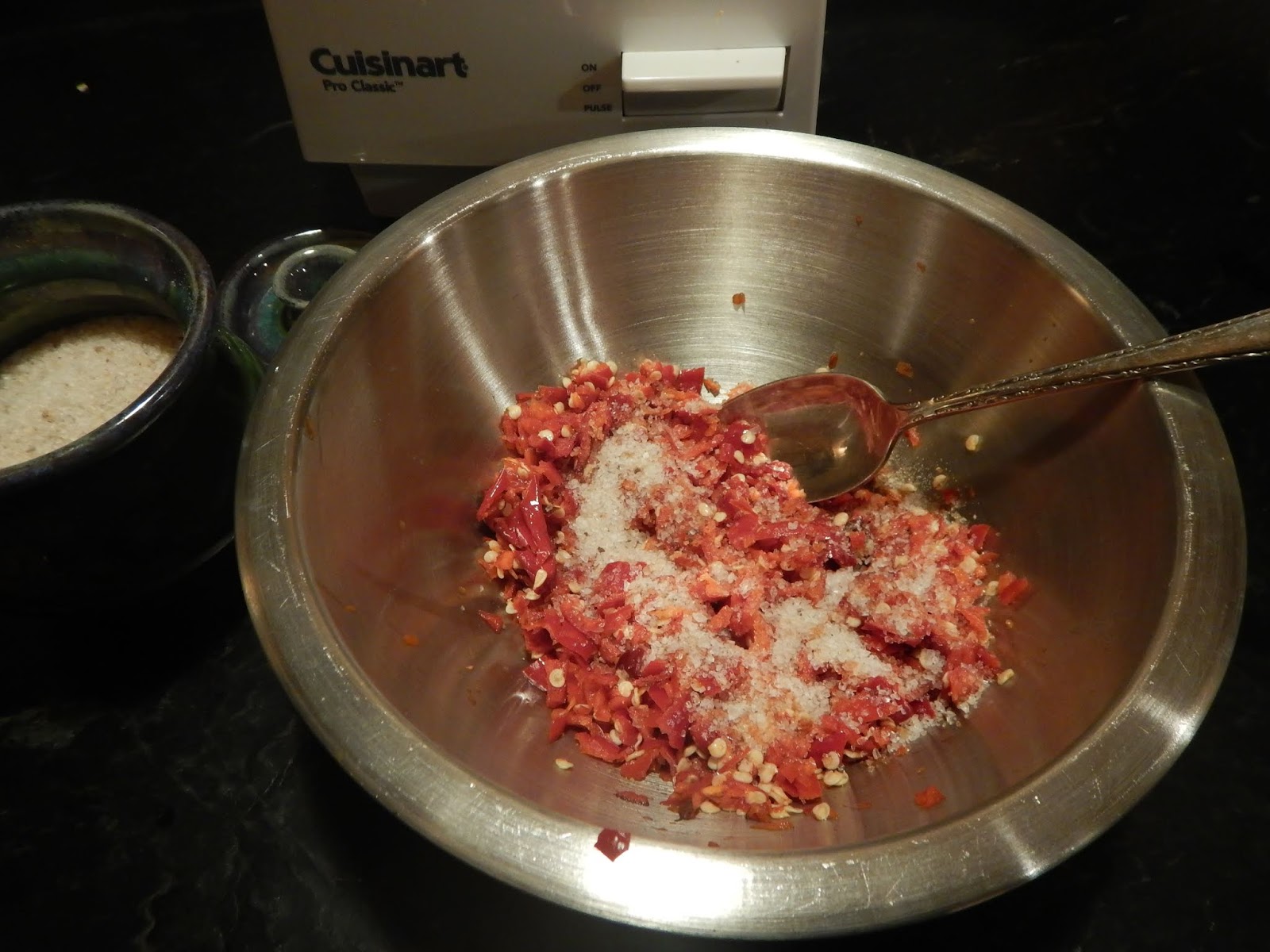
  1. Thinly slice peppers with a knife or roughly chop them and then use a food processor to chop the peppers into smaller pieces.  If you use a food processor, process just enough to coarsely chop the peppers.  You do not want to make pepper paste or puree. 
  2. Put the peppers in a small bowl and add the salt.  Mix very well with a spoon.  Cover the bowl with a plate or a clean kitchen towel and leave out at room temperature for 24 hours. 
  3. After 24 hours, move the bowl to the refrigerator and mix the peppers once a day for 5 days, or until the salt has dissolved and the now softened chiles are completely covered in liquid. 
  4. Transfer to a glass jar with a lid, tamping the chiles down so that they remain well  below the level of the liquid.  These will keep for several months in the refrigerator.
This recipe was adapted from Andrea Reusing’s book, Cooking in the Moment, although she credit’s Fuchsia Dunlop (author of Land of Plenty) with this simple method for preserving chiles for use long into the winter months.  Reusing suggests pureeing some of the salted chiles along with cider vinegar, garlic, and a little sugar to make your own hot sauce.  Of course you can use these chiles anywhere you need a little heat. Add them to soups, stews, marinades, stir-fry, dipping sauces, vinaigrettes, etc.

HVF Fresh Korean Chili-Garlic Sauce

Yield: 1 cup

4 oz fresh Korean peppers
4 cloves garlic
⅓ cup miso
¼ cup maple syrup
¼ cup tamari or soy sauce
  1. Remove the stem and roughly chop Korean peppers into one inch pieces.  Put the peppers in a food processor or blender along with the garlic cloves and roughly chop them until they are a fine, yet chunky paste. 
  2. Add the miso, maple syrup, and tamari.  Blend together until smooth.
  3. Taste and adjust the flavor as needed to your liking.  Add tamari for more depth of flavor, maple syrup for more sweetness, garlic to get more “zing” or salt if it just needs a little enhancement to wake up all the other flavors.
  4. Put the sauce in a glass jar and store in the refrigerator for up to 2 weeks.  Alternatively, you can freeze it in smaller portions as a means of preserving it for later use. 
Note:  You may use this in place of the Korean fermented chili paste called gochujang.  It’s pretty hot, so a little bit will go a long way!

Recipe adapted from minimalistbaker.com

Chile & Leek Stir-Fry with Ginger


Yield:  4 servings


8 oz firm tofu (drained)*

3 Tbsp soy sauce

2 Tbsp sherry or dry vermouth
2 tsp honey
⅔ cup vegetable stock
2 tsp cornstarch
3 Tbsp sunflower oil
3-4 leeks, thinly sliced
1 red Korean pepper, sliced thinly
1-inch piece fresh ginger, peeled and shredded
Salt and freshly ground black pepper, to taste
  1. Cut tofu into cubes.  Combine the soy sauce and sherry or vermouth in a medium bowl.  Add the tofu and stir to make sure the tofu is well coated.  Leave to marinate for about 30 minutes. 
  2. Strain the tofu from the marinade and reserve the marinade and juices in a measuring cup.  Mix the marinade with the honey, stock, and cornstarch to make a paste. 
  3. Heat the oil in a wok or large frying pan and when hot, stir-fry the tofu until crispy.  Remove from the pan and set aside.
  4. Reheat the oil and add the chili, ginger and leeks.  Stir-fry over high heat for about 2 minutes, moving the vegetables frequently to keep them from burning.  Stir-fry just until the leeks have softened. 
  5. Return the tofu to the pan together with the marinade and stir well.  Continue to simmer the mixture, while stirring frequently, until the liquid is thick and glossy.  Serve hot over rice or egg noodles.
*Note:  You may also substitute chicken breast meat for tofu.

This recipe was adapted from Christine Ingram’s book, Vegetarian and Vegetable Cooking:  The definitive encyclopedia of healthy vegetarian food.