Showing posts with label Green Beans. Show all posts

Wednesday, July 3, 2024

July 04, 2024 - This Week's Box Contents Featuring Green & Yellow Beans


What's In The Box

Garlic Scapes or Fresh Italian Garlic: We are finishing off the last of our garlic scapes and just getting started on Fresh Garlic! Fresh garlic is delicate, so handle it carefully so you don’t bruise the cloves. You’ll find the skin surrounding the cloves is very fresh and may be a little difficult to peel off—be patient, it’s worth the effort as the garlic cloves are juicy and full flavored!

Purple or White Scallions: We are finishing off the last of our scallions this week and transitioning into fresh white onions. Use the entire onion, greens as well as the onion base. You could even toss the root base that you trim off into a vegetable or meat stock!

Broccoli: Sulforaphane is an important plant compound that is found in broccoli, as well as other vegetables in the same family. This compound functions as an antioxidant as well as being antimicrobial and anti-inflammatory. It is important for supporting brain and heart health as well as our overall well-being. So, eat your broccoli, all of it including the stems! Just peel away the outer layer which can be a bit tough on the stem. Inside you’ll find a juicy, crisp, green core that is delicious!

White Cauliflower: Honestly, this cauliflower is delicious when simply steamed and served with a pat of butter or toss it with oil and roast it until it’s tender and golden. If you want to go a little over the top, you could finish it with a squeeze of lemon or add some spices to the mix.

Silver and/or Green Slicer Cucumbers: Cucumber production is directly correlated to heat and sunshine and when there is no heat or sunshine, the cucumbers don’t produce as much…which is the case this week! Cucumbers are one of nature’s fast foods. Just cut one into slices and enjoy it as a snack with salt, hummus, or your favorite dip.

Zucchini and/or Scallopini Squash: Scallopini squash is a bright yellow, saucer shaped vegetable with fluted edges. You can use it in any way you would use zucchini or yellow squash. They are interchangeable. You can also cut them in half and use them as a kind of bowl to hold a filling.

Green Top Gold Beets: If you are not a beet lover, or if you are still learning to like beets, this may be the beet for you. Gold beets have less of the distinct earthy flavor of a red beet and are sweet. They are delicious boiled or roasted, added to salads and slaws, etc. Be sure to find a use for the greens too!

Sweetheart Salad Cabbage: This variety of cabbage is characterized by its pointy shape. The leaves of this cabbage are more tender and are a great option for a raw salad. Store any unused portion loosely wrapped in plastic in the refrigerator.

Green Top Orange Carrots: Enjoy these tender, sweet carrots raw or lightly cooked. Use the feathery green tops to make pesto or chimichurri or add them to soup or bone broth.
 
Green & Yellow Beans: This week’s beans are our early season varieties known to germinate well in the cool spring soil. Enjoy these beans steamed, boiled, or stir-fried.

Snow Peas: Snow peas are characterized by a wide, flat pod that is edible. Just remove the little stem and the string that is attached to it that runs along the top of the pea pod. Enjoy them in stir-fry, lightly steamed, added to salads, or eat them right out of the bag!


Vegetable Feature: Green Beans

Fresh beans, also known as green beans, wax beans, snap beans or string beans, are actually the unripe fruit and pods of a variety of different cultivars of the common bean.  Aside from color, there are two main types of fresh beans: bush (or dwarf) and pole bean.  Bush beans plants generally do not grow more than two feet tall and do not require support, like the pole beans do.  Pole beans grow on twisting vines that like to climb, thus require a trellis.  Since bush beans are easier to harvest, they are the predominate fresh bean type to be farmed commercially.  We grow two types of fresh beans: the traditional “green bean,” and yellow or wax bean.

Green Beans: The varieties of green beans we grow vary in length between 5 and 6 inches.  The one exception is French beans, which are only about 4.5 inches long.  This is more of a specialty bean that we grow every now and then.  These green beans vary on the green spectrum, from light to dark, depending on variety.

Yellow Beans: The variety of yellow bean we grow is called Roc d’Or.  It is a deep yellow color, as to be expected from a name like “Gold Rock!”  These beans are more slender than our green beans, but also a little longer, normally about 6.5 inches long.

Preparation & Usage
All of our fresh beans can be eaten raw, steamed, boiled, stir-fried, or baked. 

Storage Tips
Fresh beans should be stored unwashed in the crisper drawer of your refrigerator either in a plastic bag or other reusable container. They will keep about a week. For longer storage, you can freeze fresh beans. To do this, rinse the beans in cool water and thoroughly drain. Cut the ends off before cutting them into the length you desire before placing them in a freezer safe container.

Additional Fun Facts 
Beans are native to the Americas, but once they made the trip across the sea to Europe, they became popular in the cuisine of many counties, particularly Italy and France


Palestinian Green Beans with Olive Oil - Fasolia Bi Zait

“Fasolia” is the Arabic word for beans, or green beans. “Zait” is the Arabic word referring to olive oil. This recipe is Yasmin Kahn’s version of a simple, staple dish commonly prepared in Palestinian homes. This dish may be served warm or at room temperature. It is often served with rice or flat bread and/or as a side dish to accompany other dishes in a meal. Despite the simplicity of this dish, it is full of flavor and just might surprise you as to how delicious and satisfying it is!

As with many traditional recipes, every home cook has their own version of this dish. In my research, I found versions of this recipe that are more like a stew with a thick tomato sauce. Some cook lamb or beef in the stew along with the vegetables. Some cooks keep the seasonings simple while others spice it up as Yasmin does in her recipe. Another source (famiebananiebread.com) describes this recipe as “…a dish that showcases the delicious simplicity of fresh green beans.  Fasolia is a staple in Palestinian cuisine, celebrated for its vibrant flavors and the sense of togetherness it brings to the dining table.”

Yield:  4 servings as a side dish

2 Tbsp olive oil or other neutral oil
2 onions, finely chopped
4 garlic cloves, finely sliced
¾ tsp ground cumin
½ tsp ground allspice
14 oz can of plum tomatoes 
1 tsp sugar
Sea salt and freshly ground black pepper, to taste
12 oz green beans, trimmed
Extra virgin olive oil, for serving
  1. Pour the 2 Tbsp of olive oil into a frying pan and gently fry the onions over medium heat for 15 minutes, until they are soft and translucent. Add the garlic and spices and cook for another few minutes.
  2. Add the tomatoes, sugar, ¾ tsp salt and a generous grind of pepper. Cover and leave to simmer for 10 minutes, adding a little hot water if the pan starts to look dry.
  3. Meanwhile, boil the green beans in a saucepan of water until they are just cooked through, but still have some bite. Drain and add them to the tomato sauce.
  4. Taste and adjust the seasoning, then drizzle with a couple of tablespoons of extra virgin olive oil just before serving.
Recipe borrowed from Yasmin Kahn’s book, Zaitoun:  Recipes from the Palestinian Kitchen.

Note from Andrea:  When I made this recipe, I used one bunch of scallions (greens and onion base) in place of the 2 onions called for in the recipe.  If you receive garlic scapes instead of fresh garlic this week, you can substitute 3-5 scapes, finely chopped, for the cloves of garlic called for in the recipe. In other similar recipes, the beans are cooked in a tomato mixture instead of being par cooked on the side and then finished in the tomato sauce.  I decided to try a shortcut and cook the beans in the same pan instead of boiling them on the side. They required a little longer cooking time in the tomato sauce to become tender and I had to add a little additional liquid to the pan. When they were about al dente and almost cooked through, I removed the cover from the pan and reduced the liquid down until the tomato sauce portion was a little thicker.  Did this shortcut save any time? Well, it saved me the time for having to wash one additional pan, but overall time was probably the same!  

Wednesday, July 15, 2020

July Farm Update

By Farmer Richard

Tomatillo fruit hanging heavy on the vines
and filling out their husks!
Despite the fact that we just did a farm and field update last month, a lot has changed and happened since then and we want to let you know what’s happening at the farm! We are at the apex of the season, halfway through the calendar year and one-third of the way through our CSA delivery season. The spring crops and weather were quite moderate and we were able to pack quite nice boxes for the early part of the season. But we know you can only eat so many radishes and lettuce and many of us look forward to all the delicious vegetables of summer! We’ve been delivering cucumbers and zucchini for several weeks and we’re in our second week of beans, but there are more summer favorites coming up very soon! If you don’t have time to read all the details of this week’s update, at least take a look at the pictures! Our hope is that we can connect you with our farm virtually so you know where your food is coming from and can have those images in your mind when you unpack your box each week!

The start of this year's garlic harvest, drying in the greenhouse.
Summer did not enter gently this year. The past two weeks have been a new challenge of very hot and humid days. We had a stretch of days reaching 88-90°F every day with high humidity that left us all with beads of sweat running down our brows early in the day. We started off the summer in a bit of a dry spell, but that has quickly changed as we’ve had frequent rains totaling about 9 inches in the past two weeks. If our more normal spring was a result of the extreme cutback in emissions related to COVID-19 changes in travel, etc, then it leaves us wondering if the sudden and recent switch to extreme weather is connected to “opening up.” Hmm….maybe we don’t want to “go back to normal!” Well, normal or not, we are looking forward to the second half of the season and we have a job to do. So here’s a glimpse of what is yet to come.

Rows of tomatoes in our 1st planting--staked,
tied and setting on fruit!
Spring days are highlighted by lots of planting and weed control. While we’re trying to get everything in the ground and keep up with flame weeding, mechanical cultivation and hand weeding spring crops, we are also planting and caring for the summer crops that will follow. Our efforts to control weeds are directly related to the hand of weather conditions we are dealt. While our crew members have done a good job keeping up with timely cultivations, rainy, wet conditions limit what we can do mechanically. Unfortunately, the weeds thrive in these hot, wet conditions which adds salt to our wound and leaves us with some big hand weeding jobs! We’re doing the best we can, but hand weeding requires a lot of crew time that we just don’t have many days. We’ve had a dedicated crew of four people who were hired specifically for focusing on hand weeding missions, but the weeds are growing faster than they can pull them! While the majority of our experienced H2A crew members arrived back in April, we did have several who received “administrative hold” and were not issued visas. Due to pandemic-related changes with the consulate’s office in Mexico, these members had to return home and wait for the call to return for further evaluation. They were also restricting visas to only those who had had a visa previously and were not considering any new applicants. Finally, the
A hillside sweet corn field....look carefully and
you'll see the deer fence surrounding the
field to help deter the critters.
first week in July we received notice letting us know the consulate’s office was ready to look at their cases. We are happy to report that four more crew members received their visas and made the long journey to Viroqua arriving last Thursday! We have only seen them from a distance as they will remain quarantined for 14 days, separate from the rest of our crew and with no contact with others in the community. They arrived healthy and well, going directly to the house we prepared for them complete with a fully stocked kitchen! They’ll reside in this location until the end of their quarantine and will stay busy during the day tackling their own weeding missions in fields we’ve assigned to them safely distanced from any other people. Thankfully, that is the beauty of being in the country where there are wide open spaces! We look forward to integrating Alvaro, Silvestre, Samuel and Joel into our crew in the near future. They all have special skills and contribute greatly to our farm. We’ve really missed them and are thankful to have them here!

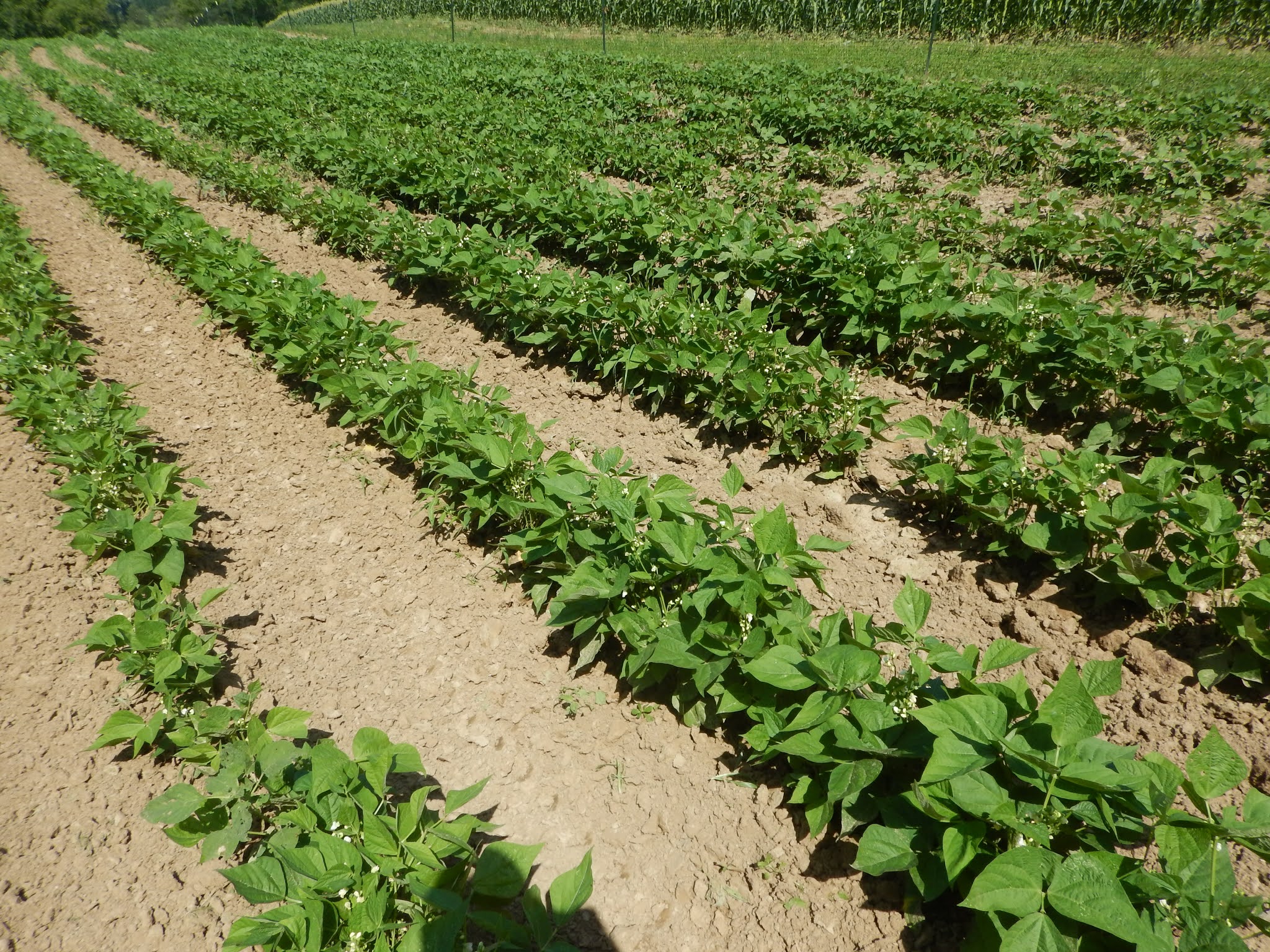
An upcoming crop of green beans,
nicely cultivated and setting on blossoms!
That’s enough about weeds though, lets look at some crops! Our first two crops of beans have yielded very nicely and after this week we still have three more crops coming up. They are all looking good and we’re hopeful we’ll be able to keep the bags of beans coming your way! We also have three crops of edamame coming up. The deer population in our area is fully informed that we grow edamame, so we have to be proactive and make sure we keep these crops surrounded by a tall deer fence to keep them from eating the plants! So far, so good and we hope to deliver the sweet, tasty fresh edamame in the near future.

An early crop of sweet corn, notice the small ears of corn.
Summer isn’t summer without sweet corn! While sweet corn isn’t a big money maker for our farm, I’ve always said it’s a crop worth growing because it earns us friends! Every year we have the goal of growing “the best sweet corn ever!” We’ve had many successful years doing so and hope we can pull it off again this year! We have planted five crops and they’re looking pretty good! The first crop suffered some loss from red-winged blackbirds that dug up about 50% of the seed. The remaining crops fared much better, but we still need to be diligent about keeping the critters out of the field! If the raccoons, deer and birds get a taste of the sweet ears of corn, they can really do some damage. These fields are also fenced and we’ll be monitoring them very closely as the corn matures and reaches the point of harvest. We’re also monitoring for the corn earworm moth which migrates from the south. With the reduced bat populations we have a larger challenge to produce sweet corn without these worms. The researchers and experts say it can’t be done organically, but with careful monitoring and a high level of management we have pulled it off many times before! So, we know it can be done and we’re going to do our best. Please know this is quite challenging to achieve, so if you do find a worm, please be forgiving.

The beloved SunOrange tomatoes--so sweet they're like candy!


The cutest little watermelon!
Tomatoes are another beloved summer crop we know you are all looking forward to. We actually had our first sweet taste of SunOrange tomatoes this week! I only found enough to pick a small handful and between Andrea and Amy, they didn’t last long. We have two crops of tomatoes planted, mulched, staked and tied and looking great! The first crop has a lot of fruit set on and we’re hoping we can start picking some of the early varieties within the next few weeks. The eggplant field is also looking quite nice. The plants have blossoms and the start of some small fruit setting on. Things could happen fast at this point, so we anticipate we’ll start harvesting eggplant within the next few weeks.

Our melons and watermelons are not far from the eggplant field, so it seems fitting to report their status now as well! After a few low yielding, disappointing years, this year’s melon and watermelon fields are looking good and setting fruit.  We’re keeping our fingers crossed that this continues and we’ll all be eating some of those “juice dripping down my chin” melons very soon! Lastly, I want to mention the peppers. We’re finally starting to see some fruit set on. The ½-inch jalapenos are quite cute and we’re hoping some of the other varieties will be ready to pick very soon.

While we’re in the midst of summer, we’re already looking to fall crops! The sweet potato vines are spreading nicely and the winter squash fields look great! On our field tour last Sunday we even spotted a nice-sized festival squash! It will be awhile before it’s mature and ready to harvest, but seeing that fruit made us realize how quickly this year is going! We’ve also started planting our fall root crops and within the next couple of weeks we need to plant beauty heart radishes, black Spanish radishes, daikon, turnips, etc.

A view of the sweet potato (left) and winter squash (right)
fields with blue skies overhead!
We also have to look ahead to the next growing season. We are already selecting and reserving fields for a new crop of strawberries knowing we need to plant a new field in 2021. We are also in the midst of garlic harvest which means we’re selecting and saving garlic for next year’s crop. We have had an unexpected increase in CSA members this year, more than double from last year. We welcome this increase and are hope you will all join us again next year as well! CSA is our preferred market to grow for and benefits our farm in many ways. We’ll see what the next year holds. Later in the fall we will be asking you to commit to the 2021 growing season so we may better plan for next year. We hope you will end this season with an increased appreciation for local and high quality organic produce along with a desire to make a commitment for next year. But for now, enjoy the rest of the season!

Wednesday, March 26, 2014

Second Match-up Complete, Third Match Competitors

In a much closer match in the Spring division, the Sugar Snap Peas edged out the Kohlrabi to move on to a match later against the overpowering Ramps.  I am just looking forward to eating all of these soon! Here is how we are currently standing in the bracket.


Remember Capt Jack picked all the vegetables and he is eagerly awaiting the results. You can see he is contemplating his bracket picks below.  Can you guess which vegetable he wants to win?


Now for the next round of contestants - both hailing from the Summer division of the Vegetable Bracket. Our first vegetable is the mouth-watering, sweet and adorable Mini Sweet Peppers. These little peppers are not only cute and colorful, but are terribly sweet when eaten raw or cooked.  What is my favorite way to eat them you ask (when they make it into my house)? I would have to say raw with a little garlic and herbed Brebis cheese stuffed in them. Yum!! This vegetable is a true team player, you just can't eat one!! We plant ½ acre of these little sweethearts and with all the colors, the rows look like little Christmas trees when they are loaded with ripe peppers.


The second vegetable contestant is not quite as flashy as the mini-sweet pepper, but equally beautiful and plentiful in its own way.  As the green beans come to the playing field, they recruited their yellow bean counterpart to join them on center-stage to add a little color to the competition against the mini-sweets.  Who doesn't love a fresh green or yellow bean?!  Green & yellow beans are usually considered to be more of the “old favorite” vegetable that has stood the test of time and comes back as a customer favorite year after year. One planting is never enough, so we plan to plant as many as 6 different crops each year!  If the weather cooperates, that means everyone will eat beans until they are coming out your ears!  Quickly sautéed with garlic, roasted until golden brown, or simply tossed with a light vinaigrette…..the crisp, fresh, mild flavor of green & yellow beans will always find their place on the summer dinner plate.


 So the real questions is.....  Who will the winner be!