Showing posts with label Rafael Morales Peralta. Show all posts

Wednesday, June 14, 2023

June 2023: Late Spring Farm Update

By Richard de Wilde & Andrea Yoder      


Onion field with cover crops planted 
in the aisles between the beds
Our world of farming, and all the decisions that face us on a daily basis, are often sculpted around the weather forecast.  As we look back on the past few months, we have to admit it has been a bit of a wild ride!  We had some nice, warm, sunny days back in March and early April, making it look like a promising start to the season. Overwintered parsnips and sunchokes were ready to be harvested, the mulch on the garlic needed to be loosened, and the greenhouses were filling up with plants that needed to go to the field. The only problem was we didn’t have our field crew!  Our H2A visa crew members were delayed by about two weeks this year. Delays with visa processing are commonplace this year and we’re just thankful they made it here without further delay! 

While we waited for our guys to arrive, we continued to do the best we could with our small winter crew and there were a few days when we were all in the field (Andrea and Richard included) harvesting parsnips! Rafael did some of our first direct seeded plantings as conditions were looking good.  Then, on March 31st a storm passed through and nailed us with hail! We have never seen hail as big as we saw that day and by the time it stopped falling from the sky, there was a solid layer of hailstones accumulated on the ground. Unfortunately, the hail was big enough that it punctured holes in all four of our greenhouses which have sheets of plastic for covering. While we usually don’t see too much wind in our valley, the month of April was unseasonably windy.  With holes perforating the greenhouse plastic, it was hard to keep the houses inflated and the plastic was whipping in the wind. We did the best we could to patch the holes, but there were limits to what we could do. Thankfully, we were able to secure all the houses and keep them intact while we waited for more crew members to help us change the plastic!

June 13, 2023:  Frost on frozen strawberry leaves!

Shortly after our field crew arrived from Mexico, we were blessed with about 10 inches of heavy, wet snow!  It was time to harvest ramps, so there were a few days when we had to wait for the sun to come out and melt the snow before we could go harvest! Once we got past that snow event, we were able to carry on with our field operations.  We started putting transplants out in the fields, continued with some early spring harvests, did our direct seedings, and hoped everything was moving in the right direction. We had some warm days, but no rain. No rain, no problem (well, less of a problem), we’ll get set up to irrigate when and where we can.  But then on May 25 there was a threat of overnight temperatures dipping below freezing! What happened to our standard of the last frost happening by the 15th of May?!  We scrambled to put covers on vulnerable crops for frost protection. Thankfully, our efforts paid off and we saved the tomatoes, peppers, eggplant, and basil. After the frost, the temperatures shot back into the 90’s and then we were scrambling to get the covers off, so we didn’t cook the crops!  We made it through that fiasco, but it was a little too close to disaster for our comfort level!  We thought we were past the point of frost, but earlier this week we woke up to another frosty morning!  This one took us by surprise and thankfully, no crops were damaged.  The strawberry leaves did have frost on them though!

Overhead irrigation using sprinklers to water 
a new planting of rutabagas so they'll germinate!

We are now in a state of dryness, as in one of the driest springs ever. Everything we have planted needs water, but we only have irrigation capabilities for some properties. We’re also limited by hours in the day and equipment.  So we’re doing our best to keep all of the crops in the game and we’re thankful for any bit of rain that may fall from the sky!

Despite the wild weather wave we’ve been riding, most of our crops look quite nice!  This has been a pretty good strawberry season with great tasting berries, one of the benefits of a dry year.  Our onion crop is also looking quite nice as is this year’s garlic crop! Garlic harvest will likely be happening within the next month, which seems unbelievable!  As you can see by the contents of your box this week, we’re at that point in the season where we’re starting to shift to more of the summer greens (kale, chard, etc.) as well as some brassicas (e.g., kohlrabi) and soon we’ll have some root crops coming in.  Beets and carrots are right around the corner! Despite the fact that it is technically not yet summer, some of our summer crops are starting to make their way into our harvest schedule.  For example, the zucchini in this week’s box and the cucumbers that just might make it into next week’s box! As for other summer crops, we have three plantings of corn in the ground, with two more planned. We have some nice crops of green beans and edamame, and our first tomato field looks great!  The melon and watermelon field look quite nice. Sweet potatoes are in the ground and have taken root, so cross your fingers that we have a bountiful harvest in 3-4 months!

June 2023:  First tomato planting!

In the midst of farming, we’ve also found some time to continue rehabilitation work on a new piece of property we are leasing.  We’re also doing some experimentation with planting a variety of vegetable crops into no-till soil.  We planted our fall pumpkin crop as part of this experiment, so be certain to come to the fall party and see how it turned out!

Yes, it’s been a wild, whirlwind of a ride this spring, but there’s one thing we can always say with 100% confidence—Mother Nature will always take care of us and keep food on our table!

Wednesday, June 29, 2022

Dealing with Weeds, A Fact of Life In Farming

by Andrea Yoder

Cultivating Strawberry Plants using
the Kult cultivator

Weeds are a central theme to our year round conversations on the farm.  During the growing season Richard and Rafael have daily conversations and plans for eliminating and preventing weeds in our fields.  During the winter months they still think about how they can eliminate weeds as they research new implements and machinery to help with mechanical cultivation as well as brainstorming other techniques for decreasing weed pressure, etc.  If all the weed control they both do in their sleep at night could actually take place in our fields, we wouldn’t have a single weed to worry about!  I hope you get the point that weed control is a big deal to the overall success of our crops and we invest a considerable amount of energy, time and resources towards weed control.  In conventional agriculture, chemical herbicides are often the main form of weed control, but in organic farming systems chemicals are a very limited option.  The only herbicide we use on our farm is 30% vinegar that we spray on weeds that may grow in places where we are limited in options for eradicating them, such as around our irrigation headers that stay in place at the end of a field for the duration of the season.  Our use of this type of herbicide is very limited, and over the years we have developed many other ways of battling weeds.  But first, what is a weed?

A thick stand of a diverse cover crop blend
including mammoth clover, vetch & rye grass

I asked Richard how he defines what a weed is and he said “A weed is a plant that interferes with an intentionally planted crop.”  This is an important distinction because in some cases we may consider a plant to be the intentional crop while at other times we may consider that same type of plant to be a weed that needs to be removed.  An example of this is burdock.  We plant whole fields to burdock intentionally because we want to harvest the roots.  We also send our crew members out to dig wild burdock out of the areas surrounding our fields, in pastures, etc. to prevent it from making seed and spreading!  While we often don’t think of them in this way, weeds are actually Mother Nature’s gift to the soil because we know Mother Nature likes to keep the ground covered at all times!  Weed seeds can actually remain viable in the soil for 20-30 years.  They remain dormant until the conditions are right and then they germinate.  This is part of nature’s design to protect the soil and deal with extremes such as droughts or excess moisture.  This collection of seeds in the soil is called the “Seed Bank.”  Our goal in weed control is to deplete the Seed Bank by germinating weeds and then eliminating those plants, but we also want to make sure we are not depositing into the Seed Bank either by letting weeds mature to the point where they produce seeds.

So why do we work so hard to eliminate weeds from our fields?  Well obviously it’s because a weed-free field is much more beautiful than one filled with weeds!  Ok, while that’s a true statement, aesthetics are not the main objective in weed control.  Plants that we consider weeds are competition for the crop for sunlight, nutrients and water.  Many times weeds grow faster than the crop and diminish the crop’s access to sunlight.  Plants that we consider weeds also extract fertility and moisture, thereby depriving the crop of vital nutrients.  The result of this competition is that the crop is not able to achieve its maximum potential, yields may be decreased, efficiency in harvest is diminished, and if nutrients are lacking there may be impact on fruiting, growth and the ability of the plant to defend itself against pests and disease.  

Sunchokes, an excellent weed competitor!

Some crops we grow are pretty aggressive and we don’t worry so much about weed pressure.  A good example of this is sunchokes which can quickly grow a sizeable plant that creates a canopy which shades the ground under them and prevents weeds from growing.  Even though sunchokes have a very long growing season, we seldom ever have to weed them because we’re able to deal with any weeds early on using mechanical cultivation and then once the plant is big enough weeds just aren’t much of an issue.  There are other crops, however, that are very poor weed competitors.  Onions, carrots, beets and parsnips are good examples of crops that can be a challenge.  In many cases, weeds grow faster than these crops which gives the weeds the advantage.  The other reason is that these crops do not produce as much leaf or plant material above ground to overshadow the weeds, or do not produce the leaves fast enough.  One thing a farmer needs to consider is the weed history of a field.  We have a lot of fields, but Richard and Rafael are very familiar with the weeds that are present in the different locations and take this information into consideration when planning where a crop will be planted.  

Utilizing an old-fashioned method of weed
control....hand weeding 

We have many methods of controlling weeds and are always considering what is going to be both most effective as well as cost effective.  The first objective we set is to prevent weeds from going to seed.  This is an underlying goal in all of our efforts because we do not want to contribute to that Seed Bank or we’ll pay for it for the next 20-30 years!  This is why timely weed control is so very important and must be a priority.  In wet years this can be a challenge as many of our weed control efforts are not possible when the field is too wet to take equipment into without getting stuck.  In these cases we can sometimes do hand weeding, however that can be counterproductive at times unless you actually carry the weeds out of the field.  If you just pull the weed and put it on the ground between the beds, it will often have enough moisture to take root and keep growing.  We do a lot of hand weeding, but weeding by hand is not easy work!  It’s hard on the body, very time consuming and consequently very expensive.  So, we try as much to use machinery and other methods which are more cost effective and faster.

Wet, but dry enough to not get stuck!
I consider Richard and Rafael to be masters of mechanical weed control and together they have developed quite an arsenal of machinery and implements to combat weeds on our farm.  If a piece of machinery doesn’t exist on the market, they design it and we build it!  There are many factors they consider when choosing which mechanical cultivation technique they are going to employ.  How big is the crop?  Are the weeds in the row, in between the rows or in the wheel tracks?  How aggressive can we be with a plant?  Is the plant well established and tough enough to take a little impact or is it delicate and cannot be disturbed?  How big are the weeds?  They also do weed control at all stages of the crop.  Before a crop is planted, the ground is prepared and, ideally, we wait at least two weeks to plant the crop.  During this two weeks we can germinate the weed seeds in the top layer of soil and get a nice flush of weeds.  Just before we plant the crop, they can “clean up” the bed using the basket cultivator that passes over the bed and flicks the little weeds out with shallow tillage.  This technique is called “stale bedding” and it’s a noticeable difference when we are able to accomplish this versus planting into freshly prepared soil.  We will do another article to explore the topic of tillage versus no-till farming methods, but I want to make a comment about tillage as it relates to weed control.  We do use tillage in our crop systems, but only when deemed necessary and we try to limit it to shallow tillage because deep tillage stirs up weed seeds and brings them to the surface where they are more likely to germinate.  We have enough weed issues on the surface already, so it behooves us to not create more issues we have to then deal with!  

Rafael operating the flame weeder

We also utilize pre-emergent flame weeding.  With this technique we use a machine called “The Flamer” which is basically a big propane tank set on a frame with burners that passes over the width of the bed very close to the surface of the soil.  The flames from the burners will kill any plant on the bed.  For this method to be effective, it has to be timed properly.  We want to kill the maximum amount of weeds, but we don’t want to kill our crop.  Thus, we have to time the flaming just ahead of when the crop emerges.  We utilize pre-emergent flame weeding for parsnips, carrots, cilantro and dill.  Luis has been doing most of the flame weeding this year and has been doing an excellent job of tracking the crops that need to be flamed and checking them regularly.  A crop can emerge from the soil literally overnight, so he has to be very timely in his efforts or he’ll miss a critical opportunity and the resultant weed pressure in the crop is noticeable.

Freshly mulched field in preparation
for planting peppers

I mentioned earlier that Mother Nature does not like to have the surface of the soil barren.  With this in mind, we have a few other tactics we can use to stay ahead of the weeds.  One tactic we use for some crops is mulch.  We mostly use rye straw for mulching crops such as strawberries, garlic, peppers and tomatoes.  Having straw mulch in place functions as a cover for the soil to discourage weed growth or smother any weeds that try to emerge.  We also use cover crops extensively, especially in the fall.  As soon as we take the last crop off a field for the year, we plant a diverse mix of cover crop seeds so we can establish a nice blanket of green to cover the soil.  There are some types of weeds that actually germinate and become established in the fall and then become a problem for us the following spring.  If we can get a cover crop growing quickly and shade the ground, we can discourage the growth of these weeds and reap the benefits of our efforts in the spring!

Freshly cultivated, weed-free 
field of potatoes

This is just a very little glimpse into the topic of weed control on a vegetable farm, but if we were to cover all there is to share we would have a book!  I hope you can appreciate the level of mastery of your farmers and have confidence that, while the battle against weeds is never ending, your team of farmers is doing their very best to continue to innovate and learn in an effort to manage weeds on our farm.  The result as it relates to you is that you will continue to receive wholesome, nutrient dense, flavorful and beautiful vegetables!


Tuesday, May 3, 2022

Get To Know Your Farmers: Insights from Richard & Rafael!


Rafael Morales Peralta (L) &
Richard de Wilde (R)

By Andrea Yoder

We want to welcome each of you to the 2022 CSA season!  It’s been a challenging start to the season as we’ve had an extraordinarily late spring, possibly record setting!  Despite very few dry days, we have been able to get quite a bit planted, but we need some heat so things will germinate and grow.  It looks like we may see some temperatures in the mid to high 60’s by the end of the first week of May, but that’s still unseasonably cool for this time of year.   Right now, crops are behind.  We planted a crop of baby arugula with your May boxes in mind, and while it’s up, it still needs several weeks before it will be big enough to harvest.  We will have to see how this month goes, but strawberries may start ripening later as well.  We’re thankful to have overwintered spinach for this first box, and hopefully the second as well, but it’s been a weird crop.  It started last fall.  We planted it at the scheduled time, but it was about 10 degrees above normal and the spinach grew much larger in size than it normally is going into winter.  Then the first new growth this spring was damaged by a hard frost.  Now we’re in a situation where the plants want to bolt which means the crop will end sooner than we had hoped.  Nonetheless, Mother Nature always takes care of us and we’re doing everything we can to pack some nice spring boxes for you.  The silver lining to having a late spring is that we have ramps for at least the first two CSA boxes, which doesn’t happen every year. 

Richard in his "office"

As we kick off another year, we realize we have a mix of familiar faces joining us for another year along with many new members who are joining us for their first, second or third year.  Thus, we thought it would be appropriate for you to get to know your farmers!  Several years ago we shared the stories of Richard deWilde, our farm founder, and his right hand man, Rafael Morales Peralta.  If you didn’t have a chance to read these articles, we hope you’ll take a moment to do so.  You may not realize it yet, but you are very lucky to have these two very extraordinary men as your farmers!   Connection is a very important part of CSA and we want you to know who is responsible for growing your food!  Thus, as we continue to get to know each other I thought it might be fun to interview Richard and Rafael about their perspectives on each other!  So I sat down with each of them individually and asked them each similar questions.  As you read their answers, thoughts and perspectives about each other, I think you’ll gain some insight that just might make you proud to call them your farmers.

Why did you choose to be a farmer, or did farming choose you?

Rafael checking the status 
of crops

RAFAEL:  “As soon as I came to Harmony Valley Farm, I liked it.  As I got more involved, I liked it more and more and that is why I continue to want to learn more.  We’re never done learning!  When you like what you are doing, you want more.  I like to learn and discover more things about organic farming.”  Is Organic important to you?  “Now, yes.  Before, no.  I didn’t know about organic before.  Now I know how important it is to eat organic vegetables.”

RICHARD:  “I grew up farming, went away to college and never wanted to see another rock or bale of hay in my life!  But then after the ins and outs of professional life, I was looking for more meaning in my life and work.  I remembered how,as a kid, I enjoyed seeing healthy crops and fields of flax in bloom and I decided I really liked farming.  And I still like it!”

Why do you like working with Richard / Rafael?

RAFAEL:  “Besides the work, I like to work with Richard.  He is more to me than my boss.  He’s like my second father.  The reason I like to work with him is because he is a genius of organic farming.  I want to  learn from him and discover more things.  I research things on the computer and then when I tell Richard about it, I realize Richard has it in his head already!  Every single question I ask Richard, he answers.  I feel very comfortable asking him questions and even though he’s very busy, he always answers me.  I feel that connection with Richard, like a father.”

RICHARD:  “Rafael’s smart, but more than that he’s really driven to do a good job, to learn new things, be better than last year.  For example, right now he’s studying growing degree days so we can anticipate the predicted emergence of pests we deal with.  Specifically we’re concerned about staying ahead of the cabbage maggot that eats a lot more than just cabbage!”

What have you learned from Richard/Rafael?

RAFAEL:  “First, I’m learning how to be a good person.  Right now I’m patient.  Not in the past.  I didn’t stop for anything!  In my first year or two here I made some big mistakes, like spraying the wrong field that wasn’t on my list.  I had to tell him what I did and he didn’t get angry at me.  He said ‘Well, lets see what happens with this crop.’  He always stays calm and shows kindness.  That’s what I want to do for others.  I was different in the past.  Working with Richard every day, I’ve learned how to be a good person, helping others, thinking about others.” 

Richard & Rafael evaluating a crop of tomatoes.

“I’m learning the way he teaches the crew.  No matter what’s going on, he’s there to help us, like actually in the field!  In the beginning I didn’t want the job cultivating with small tractors because Richard was always in the field!  It made me nervous and we had a language barrier.  Little by little he taught me and he kept telling me ‘You can do it.’  I believed him!  I remember one of my first cultivating missions.  He sent me to field 62 to cultivate carrots.  I got there and started cultivating.  Richard got to the field and said ‘Rafael, what are you doing?  I said wait for me.’  Richard jumped on the tractor and he made it look really easy!  But when I got on the tractor the steering wheel was difficult for me to control and Richard said ‘Don’t kill any plants!’  I started slow, but I practiced until I could do it more quickly.  Now I’m teaching other crew members in the same way Richard taught me.  We have more implements now to use for cultivating and we understand the concept of cultivation so we can create and invent new techniques.”

RICHARD:  “Rafael constantly reminds me of things we know and principles about running the farm.  He brings them up and puts them into action.  For example, things like how we have to plan for efficiency so we are ready for the crews, you know with instructions, wagons prepped, etc.  In particular he really pays attention to taking care of our machines and making sure they are ready when we need them.  It’s all about management, you know.  I don’t know, did he learn that from me?  Doesn’t matter, he’s doing it!  He's also really good about giving people credit where credit is due.  Specifically, in regard to taking care of things, paying attention to our machinery and noticing when something is wrong before it becomes a big problem.” 

What qualities do you appreciate/admire in Richard?

RAFAEL:  “He has too many good qualities!  One quality is the ease with which he makes decisions.  For me, it’s not so easy and when he’s not here I think ‘How am I going to do this?’  For example, I worry about having to order expensive parts, but he’s not worried.  I guess it’s because he has a lot of years of experience in the business, but it’s hard for me just to think about it!”

“I like his ways, in general just the way he is.  One day I told Richard ‘I’m going to try to be like you.’  He told me ‘You can do better.’  I looked at him and said ‘No way!’  I try my best every day.  Sometimes he shows up with new ideas and it takes me a long time to understand the new concepts.  I try to keep learning new things.  He already has the knowledge, but he needs to share it with us!  He’s super smart!” 

“Richard told me one time that when he wanted to go into organic agriculture his Mom & Dad said ‘You can’t do it.’  Nobody believed in him, but he worked really hard and now we have Harmony Valley Farm.  So when someone says ‘You can’t,’ work hard and show them you can!”

RICHARD:  “Rafael is very fair minded and really wants everyone to be treated fairly and respectfully.  He cares about our standing in the community and goes out of his way to communicate with our landlords and help them out when he can.  For example, one of our landlords told him he was concerned that his honeybees didn’t have enough pollen sources in the fall.  So we worked up a little patch of ground and planted some late blooming wildflowers for his bees!”

Rafael, what is your Vision for Harmony Valley Farm?

Rafael Morales Peralta, a visionary

RAFAEL:  “My vision is to keep working together to keep building Harmony Valley Farm in the best way to keep it going for a long time and to fulfill Richard’s dream.  To keep growing vegetables in the best way for many many years.  I understand the farm now because I have a bigger perspective.  Before, he would give me my mission for the day, I did it and was done.  Not now!  Some days I get tired and have to go to bed early, but the next day when I get up I have the energy to keep going!  It makes me feel good to grow organic food for humans.  That makes me feel really good.  But I couldn’t do this without Richard’s support.”

Richard, how Does Rafael fit into your vision for Harmony Valley Farm?

RICHARD:  “Rafael showed an interest in learning and I decided he was the best candidate to take over my field job, which is why I initiated the process to get permanent resident status for him.  Now, here we are 5-6 years later.  Rafael is a permanent resident and we’re at the final hurdle of getting his family visa’s too so they may join him!  We’ve worked together now for 10-12 years and it just keeps getting better and better!”

Friday, January 21, 2022

Reflections on Value As We Celebrate the 30th Year of CSA at Harmony Valley Farm!

By Andrea Yoder

Strawberry Day 2011:  Farmer Richard in the field
discussing the details of farming with CSA kids

2022 will be our 30th year of CSA deliveries.  Folks, that is a reason to celebrate!  Over the course of the past 29 years we’ve watched young families join our CSA, raise their children on CSA vegetables and farm visits, send those kiddos off into the world with a value (and palate) for “real” food with connection to the place from which it came.  We’ve received reports from these families about how appalled these kids are when they get their first exposure to dorm food at college, “Can you believe they served me asparagus in September and didn’t even know where it came from!?”  Many of those kids have now grown into lovely adults with their own families, careers, contributions to society and their own CSA memberships.  

CSA Vegetable Shares
at a Pick Up Site

While times may have changed, the basic concept of CSA has not.  It continues to be a model that feeds and enriches communities, builds relationships and connection, and serves both farmers and eaters at a time when support and nutritious food is paramount.  There really is something to connecting members of a community to the agriculture that produces their food.  It was important 30 years ago and it’s important now.  In fact, it may be one of the most important contributors to our business that has allowed us to even reach this milestone!  Perhaps CSA could also stand for “Community Sustained Agriculture!”  So before we go any further, we want to say “Thank You” for coming along with us on this journey, whether you’ve been with us for 30 years, 3 years or you are looking forward to your first year with our farm in 2022.  This is not our accomplishment alone, it is a reflection of the strength of the CSA model and its ability to remain sustainable over time.  It’s evidence that changing “Me” to “We” makes a difference and is a key component to a sustainable, resilient food system that can withstand the test of time.

Packing CSA boxes in 2018

It’s no secret that the world around us is shifting and changing.  These changes are catalyzed by a variety of factors but the largest one being the global pandemic we’ve all been living with for nearly two years now.  I think for many people it’s been a time to pause and really think things through, to figure out the “whys” behind actions and decisions, to consider the pieces of life that one is grateful for and to imagine a better future.  When all the noise around us is tuned out, what really matters?  What are our core values?  What do we want to invest our time, money and energy in?  

The past two years have brought a lot of uncertainty for our society, and we too have faced that uncertainty at the beginning of the past two growing seasons.  With the onset of the pandemic, we didn’t know what was going to happen.  All of our plans for crops and markets were in place, but when the world shut down we didn’t know if we’d be able to grow, have employees, or even who we were growing for or if we’d even have any customers to feed!  We kept on going and, thankfully, there were many mouths to feed!  As our industrial food system began to fracture, the need for local producers rose to the forefront and our phone was literally ringing off the hook.  We kept moving forward, doing what we do best, growing food for our community.  Our mission didn’t change even if our policies and appearances did.  The basic human need to have access to food hasn’t changed, despite the changes in the world over the past 30 years.  


2021 Harmony Valley Farm Crew

But two years later, we still enter this year with a bit of uncertainty.  Our CSA membership more than doubled back in the Spring of 2020.  We were thankful to have a very high retention rate for 2021, allowing us to attain higher levels of efficiency, defer the costs of the overhead to operate a CSA program over more shares, and most importantly to have the opportunity to grow healthy food for the members of our community.  What will this year hold?  Will our members value their CSA shares as much this year as they did two years ago when the pandemic first started?  Are people tiring of cooking at home and ready to return to the convenience of prepared foods, eating out, etc?  Of course, we want every member to believe in CSA as much as we do!  We want CSA to impact every person and family in positive ways and for each person to realize CSA is so much more than just a box of food.     

CSA Box Contents, September 2018

My job is not to convince anyone of anything.  I’m simply here to lay it all out and bring attention to it.  I’ll leave it up to you to decide if and how CSA fits your personal values for this new year.  So on that note, there are two ways to approach the word “Value.”  As a verb, we can say, “The value of a Weekly CSA share is $1,110.”  In terms of dollars, that is what it will cost you to purchase 30 CSA boxes for 2022.  Is it really worth the expenditure?  Well, let me tell you what last year’s boxes looked like.   In 2021, the cost of a Weekly Vegetable share was $1,050.  Each year we have a CSA member who gathers price comparison data each week from a food coop as well as a natural foods grocer.  Last year’s price comparison data demonstrated that if the contents of the CSA share were purchased at either of these retail stores, an individual would have paid 27-43% more than our actual cost of the share.  That translates to $280-$450 more dollars of produce delivered than was actually paid for.  How is this possible or sustainable?  This is where it pays to go direct, which reduces the costs associated with distribution.  As a CSA member you also share in both the risks and the bounty of each and every growing season.  When we have a productive year, you benefit!  Even in a challenging year where we may have crop losses, members typically still receive a value of produce greater than what they paid for because we have flexibility with what we pack in the box.  We are able to cover the loss of one vegetable by packing something different that is available.  

CSA Box Contents, August 2021

But the conversation about value doesn’t just stop with the dollars conversation.  As a noun, the word “value” means “a person’s principles or standards of behavior;  one’s judgment of what is important in life.”  We always encourage CSA members to look beyond just the dollar value of the produce received, but this is where you have to reflect on what is important to you personally.  Here are a few points to consider.  First of all, based on last year’s boxes, a CSA member who received our weekly vegetable share received over 85 different vegetables!  That doesn’t even account for the fact that within some general selections, such as winter squash or head lettuce, we sent more than one variety.  We have heard from members over the years that they value the wide diversity of foods they eat simply because they show up in their CSA box, including things they would never have selected for themselves or thought they didn’t like. When it’s in their kitchen they are more likely to try it and sometimes even find they really like things they didn’t think they liked!  We also know that consuming a diet with a wide variety of plant foods is beneficial for your health and we’ve had members tell us they eat far more vegetables when they are participating in a CSA than they do when they make their own selections at a grocery store or farmers’ market.  

Wild Rice & Butternut Squash Salad 
with Tat Soi (November 2021)

Having a refrigerator full of vegetables doesn’t do you any good unless you eat them, which is why we also feel it’s important to provide support and resources for you with each week’s deliveries.  In 2021 we provided more than 54 recipes in our weekly newsletters over the course of the delivery season.  But we didn’t stop there!  Each week we provided additional links to even more recipe ideas on our blog with the weekly “Cooking With the Box” article.  On top of these resources, I also received calls and emails from members from time to time who had specific cooking or preparation questions and utilized the option to tap into my culinary expertise.  That’s right, you can pick up the phone and call me.  Ask me any question and I’ll do my best to answer you.  I have been cooking seasonally now for over 15 years and am a professionally trained chef.  I do my best to combine my culinary skills and insights with day-to-day practicality in the recipes and resources I provide.  Of course, you can also reach out to other CSA members too if you choose to be a member of our private Facebook Group created and facilitated solely for the purpose of sharing recipe ideas, asking questions and engaging in communication with other members!

While these are tangible resources that come along with each CSA share at no additional cost, there are some other less tangible benefits that add value to your experience with eating out of a CSA box.  Some of these values may not be as obvious to you until you spend a little time reflecting on your own experiences.  As you consider the value you get from your CSA experience, here are a few reflective questions you may ask yourself:

How has my health or the health of my family members changed since I/we started participating in a CSA?

How have my eating practices changed since starting to participate in a CSA?  Do I prepare more of my own meals and buy less prepared foods, take out, etc?  Have I incorporated more vegetables into my day, including even breakfast?  Do I enjoy eating my own food more than the prepared foods or restaurant meals I previously purchased?

Has participating in a CSA changed the way my family members interact?  Do we spend more time together preparing meals and/or eating together?  What benefits have my children received as a result of CSA?  Do they simply eat more vegetables now?  Are they more likely to try new foods and experience new flavors?  Have we been able to use CSA as a way to teach our children and each other about different cultures, different things in nature, seasonality, etc?

Do I appreciate the transparency of knowing where my food came from and who worked to grow it?

Lorenzo & Ascencion
Working in the Tomato Field

Is it important to me that the dollars I spend on food support a local economy?  

Is it important to me that the farm that produces my food also has extensive food safety practices to ensure my food is safe and wholesome to eat?

Do I value knowing that my farm invests in caring for the health of the soil and plants so the food I am eating is nutrient dense?

Do I want my food dollars to support a growing system that is safe and regenerative for the environment, promotes biodiversity and supports pollinating creatures?

How do I feel about the people who work to produce my food?  Do I care if they are treated fairly, paid fairly, have a safe working environment and are respected?

If CSA has been a valuable part of your life, we would love to hear your thoughts and experiences.  Your stories are our connection to you and they fuel our work on days that may be less than ideal and are what will keep us going for another 30 years!

If you’ve already signed up for your 2022 CSA share, thank you for your commitment!  We are grateful for the opportunity to grow for you this year and hope you’ll share your experiences with others in your circles who may be interested in participating in a CSA.  Every year we have some members who do not return, for a variety of reasons, but also welcome new members.  For our CSA program to continue into the future for another 30 years, we need to continue to maintain our membership.  Honestly, the most effective "advertising" we've observed over the years is simply when members share their experiences with others!

HVF Co-Owners:  Rafael, Richard & Andrea
If you are still considering whether or not you want to participate in our CSA this year, we hope you’ll weigh your options with a broad view and perhaps a bit of reflection about the value CSA can offer you beyond just the box of vegetables.  But rest assured, we have learned a few things over the past 29 years and we are pretty good at what we do!  With our experience to back us and the humility to know we'll never stop learning and improving, we'll do everything we can to make sure that box of vegetables will not disappoint! 


Monday, May 3, 2021

Welcome to the 2021 CSA Season and Your Spring Planting Report!

By:  Andrea Yoder

The first asparagus poking through
just in time for the first CSA box!
We may be the only ones to think this, but my goodness winter seemed to be very short!  Here we are at the start of another CSA season and we are so grateful to be packing over 1,000 boxes this week!  Many of you are longtime members, but we also have quite a few first and second year individuals joining us.  Regardless of how many times you’ve journeyed through a year of CSA at Harmony Valley Farm, each year’s adventure is filled with both familiarity along with the uniqueness of every growing season.  Hold on tight, we’re ready to start sending you some of the best vegetables we can manage to grow!

Before we go any further, I’d like to introduce myself.  My name is Andrea and I started here in 2007 as the summer farm chef.  I spent my first summer cooking for our crew of about 30 at that time.  I have since moved on into other roles and have assumed many other responsibilities.  I do still hold onto my role as a Farm Chef, however I now use my culinary training and expertise to develop, research and test recipes to share with all of you through our newsletters and blog articles each week!  If you are interested in my full story, you can read more about my journey on our blog.  I also want to introduce you to Richard de Wilde, the visionary behind everything that Harmony Valley Farm has become.  He is our founding farmer and has been farming since the mid 70’s.  In his early years of farming he played an instrumental role in the development of organic standards and certification.  In fact, he has been described as a “Pioneer in Organic Farming!”  He has led a very interesting life and has many achievements to celebrate, but Harmony Valley Farm is his greatest joy and the result of many hours of labor and devotion.  You can read Richard’s full bio in an article we published on our blog several years ago.  Richard’s desire is for the farm to continue indefinitely into the future, which is why he has been cultivating the next generation of farmers to continue the work that he started.    And that leads me to today’s final introduction, Rafael Morales Peralta.  Rafael has been working with Richard for over 10 years, originally coming to Harmony Valley Farm on a H2A work visa.  He demonstrated such potential, skill and passion for vegetable farming that Richard invited him to become an owner.  He has been tasked with downloading all of the farming knowledge from Richard’s brain, a task that he is quite good at!  Rafael is enthusiastic, optimistic and energetic while also being very innovative.  Rafael has had an interesting journey as well, which we shared on our blog last year.  There are many other individuals who work at Harmony Valley Farm, each with important roles and responsibilities that contribute to our collective success.  Throughout this CSA season we hope to share some of their stories with you as well!

Dark Green Overwintered Spinach!
Now that you know who we are, we want to tell you what we have been up to since our last farm update several weeks ago.  Spring is always an exciting time of the year, but it is also a super busy time!  Early in April it looked like we were on track to have an early spring.  The weather was beautiful with sunshine and warmer temperatures.  We were able to dig overwintered sunchokes and parsnips as the ground dried out quickly.  We also started harvesting our overwintered spinach crop in early April, ahead of when we typically see this crop start to mature.  While we were thrilled to have green food coming out of the fields again, we also panicked a bit as we really wanted to preserve that crop to harvest for our first two CSA boxes in May!  Well, Mother Nature decides the timing and there really is not much we can do aside from responding to her cues and seeing how she’ll show up for us each year.  We have had several very strong weeks of spinach harvest and really thought it would be finished before our first week of CSA.  However, we got lucky and preserved one portion of the field that we could still harvest late last week and this week! So, we are at the tale end of the season, but there will be one delivery of overwintered spinach!

Ramps as far as the eye can see!
The season for ramps, another spring favorite, started in mid-April as well.  When we first started to harvest, it looked like it may be a short season that would end in April.  If there is one thing we’ve learned, and sometimes still forget, it’s that you should never underestimate the power of Mother Nature to show up for us.  Over the past few weeks, weather conditions shifted and what looked to be a warm, early spring turned into dry, cool conditions that slowed things down and moved us back to more of a “normal” time schedule for spring.  As such, the conditions have been favorable for continuing to harvest ramps and we are excited to send you at least one week of this special spring vegetable.  We are crossing our fingers to be able to deliver them in the second week too, but that verdict is up to Mother Nature.

Transplanting Strawberries
While we have been staying busy with harvests, we have also been working very hard to do the necessary field work to move forward with our spring plantings.  We started planting early in April and have had a very productive month leading up to the first week of May!  This year in particular we carried a heavier load for spring plantings as we needed to plant some perennial crops along with all the other standard crops we plant every year.  Last week we finished planting a nice field of strawberry plants for next year’s harvest.  We also planted a new field of asparagus along with rhubarb and a few horseradish plants.  It will be 1-3 years before we harvest some of these perennial crops, but we have to plan ahead to ensure we have these crops ready for your tables in future years!

While our seeding plan starts the first week of April, we seldom actually plant that week.  This year however, we were able to do our first “5/15 row plantings.”  This is a group of crops we plant every week, some crops for the entire season and others just for spring and fall.  That first planting is still small, but it looks like we may be harvesting our first baby arugula next week!  

Tiny little red radishes!
Red Radishes also look promising and we estimate they’ll be ready to harvest within the next 1-2 weeks! Spring planted spinach and cilantro will follow very closely behind .  We anticipate we’ll be harvesting spring spinach in about three weeks and cilantro in 3-4 weeks!

We have actually been hoping for rain over the past few weeks.  Unfortunately we had not received more than a little sprinkle here and there.  The irrigation crew has been working very hard to try to get water to some of our newly transplanted crops as well as some of the new plantings we had seeded.  Without adequate water the seeds just set there and do nothing or try to sprout and then die.  We all breathed a
huge sigh of relief Sunday evening when the clouds rolled in, we started to hear rumbles in the distance and it started to rain!  It rained throughout the night and we were happy to dump an inch of rain out of the rain gauge this morning!  Everything looks bright green and fresh today and we are anxious to see some of our direct seeded crops like peas, beets, carrots, parsnips and burdock take off now that they have some moisture!

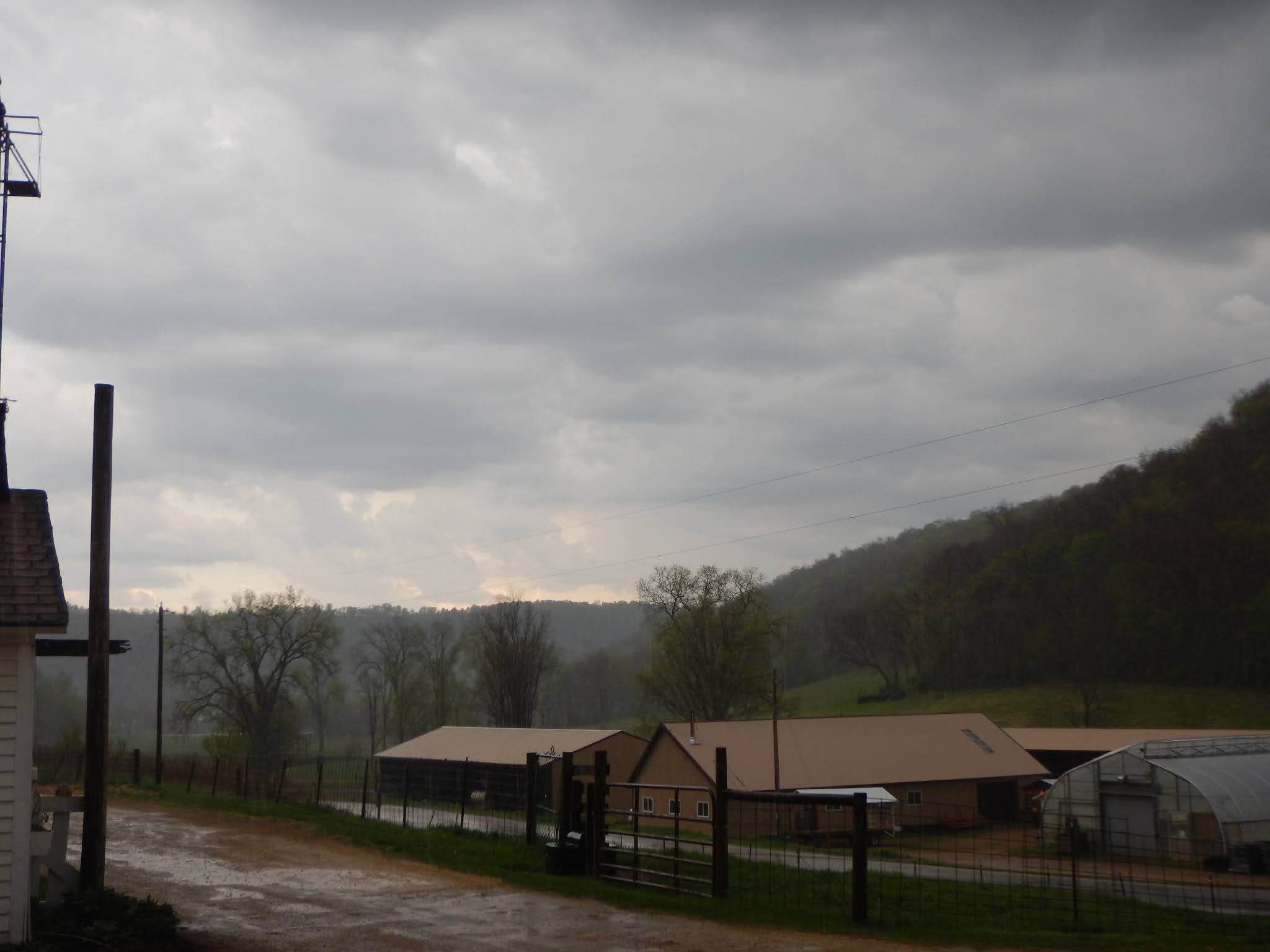
Storm clouds over our farm Sunday night
bringing us the rain we needed!

I almost forgot to mention that all of our potatoes have been planted and the plastic mulch is ready for transplanting the first basil and zucchini crops.  We have a nice crop of mini red romaine head lettuce growing nicely in one of our greenhouse tunnels and hope to harvest it within the next few weeks.  Until some of our spring planted vegetables are ready, we will continue to rely on our overwintered crops, foraged vegetables and spring perennials.  For those of you who are new to our CSA, your boxes for the first few weeks may contain some vegetables you are less familiar with.  Hang in there and rely on your resources to guide you.  We have a lot of recipes to choose from on our blog and website.  We also encourage you to join in the conversations in our private Facebook group where it is totally safe to ask questions like “Help, what do I do with nettles?!”  I say this every year, but my motto has always been “Never be intimidated by a vegetable!”

Our cows grazing on the hillside 
The animals are also happy and content as they are back to grazing and rooting around our hillsides.  Our little pigs, which came to our farm several weeks ago, made acquaintance with our beef cattle when the cattle were rotated to a pasture close to the pigs last week.  The pigs acclimated very quickly to their new environment and can be found running around the woods, playing in the creek, or munching on some of the spinach and parsnip scraps from the packing shed!  While the beef cattle are large creatures, they move quietly and calmly through the pasture.  It is a pleasure to see them so peaceful on the hillsides.  In the goat pasture, there is quite a lot of activity!  Last week we welcomed nine more kids into the herd and throughout the day we now see little goats darting around the pastures, climbing all over their mamas, playing in the feeders and exploring their world.

As spring continues to unfold around us, we welcome the bounty our fields will afford us this year.  We hope you enjoy this year’s adventure alongside us as you discover new favorite foods, new favorite recipes, and benefit from being part of our CSA community!