Showing posts with label Know Your Farmer. Show all posts

Wednesday, October 20, 2021

Farm: A Convergence of Nature and Humanity, a Living Organism


Richard & Andrea checking out the roots in a field
planted with a cover crop

By Andrea Yoder

Back in early August our friend John Peterson posted an article on the blog for his farm, Angelic Organics.  The title of his article was “Farmer John Writes:  Do You Eat Data?  If you have a minute, I’d encourage you to read his article.  If you receive/ed a CSA box on October 7/8/9, October 14/15/16 or October 21/22/23, you may have made the connection between this Farmer John I’m citing now and the Farmer John who grew the carrots in your box these weeks.  We share many parallel thoughts and perspectives on farming with John and want to take a moment to share some of his thoughts with you, after all its his energy and that of Angelic Organics that comes with those carrots to your table!

Fall Garlic Planting
In his article, John challenges us to consider the difference between viewing a farm as a living organism as opposed to a collection of data points.  His definition of a farm is a little different from the dictionary definition.  The dictionary defines a farm as “a tract of land devoted to agricultural purposes.”  John defines a farm as “a convergence of nature and humanity.”  I have to say, John’s definition resonates with us much more closely than the textbook definition of a farm.  You see, a farm is more than just “a tract of land.”  It truly is a living organism that needs to be nurtured, cared for, guided, protected.  It needs someone to commit to caring for it, a steward or rather stewards.  This is where the concept of a farm as a living organism comes to life.  It’s where humans commit to connecting to nature in a way that is bilaterally supportive and beneficial.  It’s where the perspective of a farm supersedes the data and our eyes are opened to the dynamic, complex nature of a farm.  It’s where food becomes more than just a product and becomes a way of connecting to nature, to community, to something much greater and more meaningful.

Silvestre counting the number of seeds per foot
the planter is putting out to make sure the
planting rate is correct.


Lets pause for a moment and revisit the concept of viewing the farm as a collection of data points.  We do use data every single day.  Our farm is a collection of every subject in school.  Most of us carry calculators in our back pocket.  We have all kinds of forms and documents where we record data—every single day.  We look at harvest yields and efficiency.  We consider bed feet and the quantity of seed needed to plant a specific plot of land.  We titrate mixes of nutrients to feed plants through drip irrigation, utilize metric tools to do repairs on machinery, apply concepts of pressure changes and temperatures to managing refrigeration, and of course we have to look at the bottom line on a Profit & Loss report to make decisions that help us keep the farm profitable, self-sustaining and ensure it has a future.  But with as many data points as we utilize every day, there are just as many considerations and aspects to viewing a farm as a living organism that are less tangible and more difficult to measure as a data point. 

What about the people?  As we look at our farm, we’re not just talking about ourselves who have been labeled “The Farmers.”  We alone are not the only caretakers of this land, and thank goodness as it’s a job that far exceeds our capabilities alone!  As we consider the convergence of nature and humans at Harmony Valley Farm, it’s vital to broaden our perspective to include you, our CSA members, as well as our employees and those within the community who support the innerworkings of our farm. This ranges from the guy who delivers parts from Auto Value to the truck drivers who pick up produce from our farm each week and everyone in between.  Yes, our relationships are laced with transactions.  We issue paychecks biweekly to our employees.  We pay invoices for services we receive.  We process payments from you when you submit money to purchase your CSA shares.  It can stop there if you want it to, but we hope you look a little further. 

We all need the food that comes off this farm.  This is the food that sustains our bodies, keeps us healthy, supports the growth and development of children, strengthens our immune systems and helps us function in our highest capacities.  People who eat well, feel well and, we hope, go on to do good things in this world.  This is where the meaning and connection, the convergence of humans and nature, becomes a beautiful, dynamic, living organism with a reach and impact that goes beyond what we even realize.

The Nash family enjoying our 
Fall Harvest Party in 2019

Over the years we’ve heard many stories about how participating in CSA has impacted people’s lives in positive ways.  CSA kids who grow into beautiful, healthy adults, families who have built memories around the meals they’ve shared and the moments they’ve spent at the farm.  Members who have become our close friends and loyal supporters.  You see, there’s an energy that comes with that food and we hope you understand the food we produce comes with a big dose of commitment, dedication and desire to truly nurture and care for this organism.  But we also hope you understand that we feel the energy you send back to us!  Your gratitude, whether spoken or unspoken, the ways you go on to do good things in this world, the ways you use these vegetables and connections to enhance your own lives.  It all matters. 

What about the many hands that work here, our employees?  Farmworkers are often overlooked and underrepresented.  One of our longtime buyers made a comment one time that every time a consumer takes advantage of cheap food, someone along the supply chain is exploited.  I don’t have a data point to demonstrate this point, but I can tell you that in the industry of fresh market vegetables, labor is the greatest cost of producing food.  Thus, it’s also the line item on a Profit & Loss statement that often stands out the most and is subject to being cut.  This farm would not run without the efforts of our employees.  

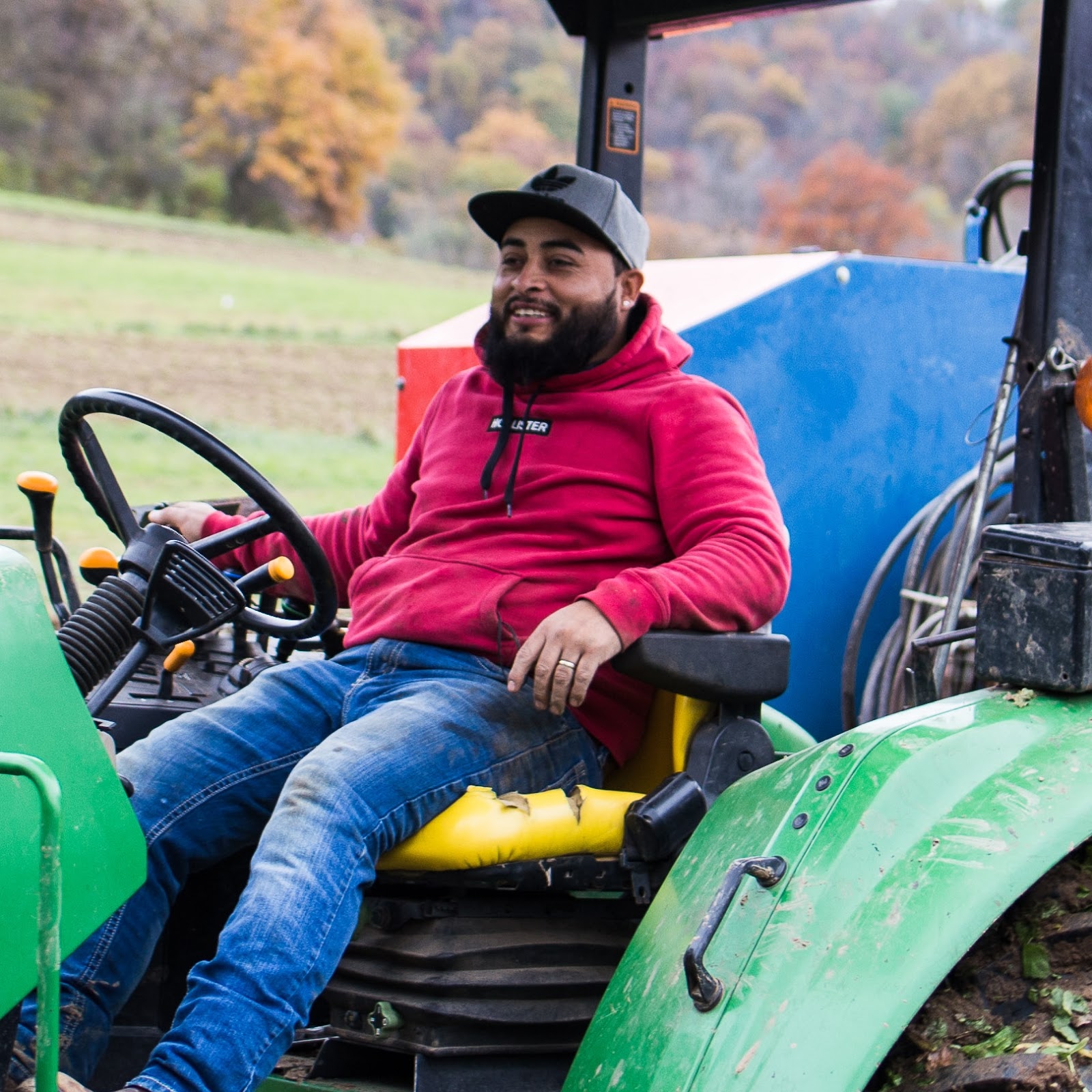
Luis is happiest when he's operating a tractor!

Their physical strength as well as their positive, “can-do” attitudes, problem-solving abilities, refined skills and even their jokes and laughter are what fuel our days.  Your dollars and continued support of our farm in turn supports these workers and their families.  The majority of our employees come from Mexico and many of them have worked with us for many years.  We care for each other and while as employers it’s not our responsibility to be concerned for the families of our employees, we can’t deny the fact that their families are just as much a part of this farm as we are, as you are.  So yes, we do think about them, their needs, their well-being and send them gratitude at the end of every season.  Gratitude for sharing their loved one with our farm, to care for the land and contribute to producing food for our community.  Last week we had all of our chimneys professionally cleaned. We’ve had the same person clean them for several years now and he caught me off guard as we were closing up the deal when he was finished.  As I handed him the check for his services, he told me he loves coming to our farm every year.  He said “everyone is so nice and you can just tell they are happy and want to be here.”  Needless to say, my heart melted and his words confirmed just how much our employees contribute to the spirit of this farm.

Nitrogen nodules forming on the roots of cover
crop plants, plus millions of bacteria you 
cannot even see!

I could write volumes about the opportunities we all have to connect to the natural side of Harmony Valley Farm, but I’m going to condense my thoughts today and just highlight one of the many amazing natural aspects of our farm that exemplifies the convergence of nature and humans.  We are surrounded by a vast and complex community of microorganisms, fungus and beneficial bacteria.  This network of organisms extends from our forest land to our fields and everywhere in between.  We can’t see it with our naked eye, but we know it exists in the soil beneath our feet.  This network functions on our behalf, keeping our soils alive, helping to make nutrients available to the plants and continually contributing to the regeneration of our farm.  The benefits we reap from this vast underground system of microbes far exceeds the understanding of our humble minds, and yet it’s a part of what makes this farm a complex living organism.

Get a copy of Farmer John's
Cookbook packed with 
farm stories and seasonal 
recipes!

Thank you Farmer John for challenging us to “think outside the box.”  Yes, there are many in the world that view a farm as a data point, a tract of land, a factory in a sense that produces food.  But lets not lose sight of the bigger, broader view of a farm as a living organism.  One that generates food, yes, but also represents the convergence of nature and humanity.  One that we care for and support and in turn it supports and cares for us.  It’s a pretty meaningful bite to swallow.  On behalf of all of us on this side of the partnership, thank you for choosing to be part of this farm.  We appreciate and value you, we think of you and hope your lives are enhanced through this connection.

Monday, May 3, 2021

Welcome to the 2021 CSA Season and Your Spring Planting Report!

By:  Andrea Yoder

The first asparagus poking through
just in time for the first CSA box!
We may be the only ones to think this, but my goodness winter seemed to be very short!  Here we are at the start of another CSA season and we are so grateful to be packing over 1,000 boxes this week!  Many of you are longtime members, but we also have quite a few first and second year individuals joining us.  Regardless of how many times you’ve journeyed through a year of CSA at Harmony Valley Farm, each year’s adventure is filled with both familiarity along with the uniqueness of every growing season.  Hold on tight, we’re ready to start sending you some of the best vegetables we can manage to grow!

Before we go any further, I’d like to introduce myself.  My name is Andrea and I started here in 2007 as the summer farm chef.  I spent my first summer cooking for our crew of about 30 at that time.  I have since moved on into other roles and have assumed many other responsibilities.  I do still hold onto my role as a Farm Chef, however I now use my culinary training and expertise to develop, research and test recipes to share with all of you through our newsletters and blog articles each week!  If you are interested in my full story, you can read more about my journey on our blog.  I also want to introduce you to Richard de Wilde, the visionary behind everything that Harmony Valley Farm has become.  He is our founding farmer and has been farming since the mid 70’s.  In his early years of farming he played an instrumental role in the development of organic standards and certification.  In fact, he has been described as a “Pioneer in Organic Farming!”  He has led a very interesting life and has many achievements to celebrate, but Harmony Valley Farm is his greatest joy and the result of many hours of labor and devotion.  You can read Richard’s full bio in an article we published on our blog several years ago.  Richard’s desire is for the farm to continue indefinitely into the future, which is why he has been cultivating the next generation of farmers to continue the work that he started.    And that leads me to today’s final introduction, Rafael Morales Peralta.  Rafael has been working with Richard for over 10 years, originally coming to Harmony Valley Farm on a H2A work visa.  He demonstrated such potential, skill and passion for vegetable farming that Richard invited him to become an owner.  He has been tasked with downloading all of the farming knowledge from Richard’s brain, a task that he is quite good at!  Rafael is enthusiastic, optimistic and energetic while also being very innovative.  Rafael has had an interesting journey as well, which we shared on our blog last year.  There are many other individuals who work at Harmony Valley Farm, each with important roles and responsibilities that contribute to our collective success.  Throughout this CSA season we hope to share some of their stories with you as well!

Dark Green Overwintered Spinach!
Now that you know who we are, we want to tell you what we have been up to since our last farm update several weeks ago.  Spring is always an exciting time of the year, but it is also a super busy time!  Early in April it looked like we were on track to have an early spring.  The weather was beautiful with sunshine and warmer temperatures.  We were able to dig overwintered sunchokes and parsnips as the ground dried out quickly.  We also started harvesting our overwintered spinach crop in early April, ahead of when we typically see this crop start to mature.  While we were thrilled to have green food coming out of the fields again, we also panicked a bit as we really wanted to preserve that crop to harvest for our first two CSA boxes in May!  Well, Mother Nature decides the timing and there really is not much we can do aside from responding to her cues and seeing how she’ll show up for us each year.  We have had several very strong weeks of spinach harvest and really thought it would be finished before our first week of CSA.  However, we got lucky and preserved one portion of the field that we could still harvest late last week and this week! So, we are at the tale end of the season, but there will be one delivery of overwintered spinach!

Ramps as far as the eye can see!
The season for ramps, another spring favorite, started in mid-April as well.  When we first started to harvest, it looked like it may be a short season that would end in April.  If there is one thing we’ve learned, and sometimes still forget, it’s that you should never underestimate the power of Mother Nature to show up for us.  Over the past few weeks, weather conditions shifted and what looked to be a warm, early spring turned into dry, cool conditions that slowed things down and moved us back to more of a “normal” time schedule for spring.  As such, the conditions have been favorable for continuing to harvest ramps and we are excited to send you at least one week of this special spring vegetable.  We are crossing our fingers to be able to deliver them in the second week too, but that verdict is up to Mother Nature.

Transplanting Strawberries
While we have been staying busy with harvests, we have also been working very hard to do the necessary field work to move forward with our spring plantings.  We started planting early in April and have had a very productive month leading up to the first week of May!  This year in particular we carried a heavier load for spring plantings as we needed to plant some perennial crops along with all the other standard crops we plant every year.  Last week we finished planting a nice field of strawberry plants for next year’s harvest.  We also planted a new field of asparagus along with rhubarb and a few horseradish plants.  It will be 1-3 years before we harvest some of these perennial crops, but we have to plan ahead to ensure we have these crops ready for your tables in future years!

While our seeding plan starts the first week of April, we seldom actually plant that week.  This year however, we were able to do our first “5/15 row plantings.”  This is a group of crops we plant every week, some crops for the entire season and others just for spring and fall.  That first planting is still small, but it looks like we may be harvesting our first baby arugula next week!  

Tiny little red radishes!
Red Radishes also look promising and we estimate they’ll be ready to harvest within the next 1-2 weeks! Spring planted spinach and cilantro will follow very closely behind .  We anticipate we’ll be harvesting spring spinach in about three weeks and cilantro in 3-4 weeks!

We have actually been hoping for rain over the past few weeks.  Unfortunately we had not received more than a little sprinkle here and there.  The irrigation crew has been working very hard to try to get water to some of our newly transplanted crops as well as some of the new plantings we had seeded.  Without adequate water the seeds just set there and do nothing or try to sprout and then die.  We all breathed a
huge sigh of relief Sunday evening when the clouds rolled in, we started to hear rumbles in the distance and it started to rain!  It rained throughout the night and we were happy to dump an inch of rain out of the rain gauge this morning!  Everything looks bright green and fresh today and we are anxious to see some of our direct seeded crops like peas, beets, carrots, parsnips and burdock take off now that they have some moisture!

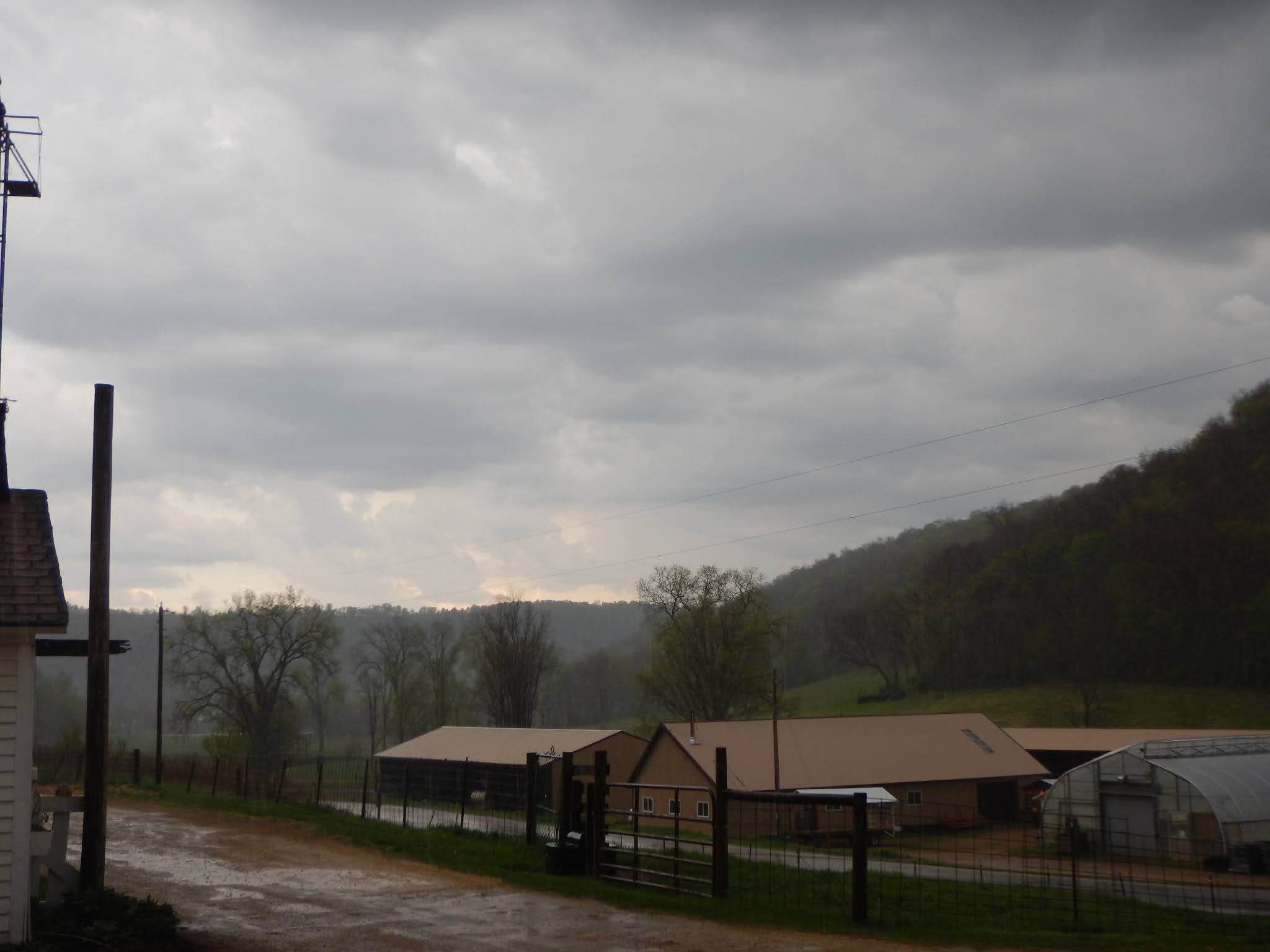
Storm clouds over our farm Sunday night
bringing us the rain we needed!

I almost forgot to mention that all of our potatoes have been planted and the plastic mulch is ready for transplanting the first basil and zucchini crops.  We have a nice crop of mini red romaine head lettuce growing nicely in one of our greenhouse tunnels and hope to harvest it within the next few weeks.  Until some of our spring planted vegetables are ready, we will continue to rely on our overwintered crops, foraged vegetables and spring perennials.  For those of you who are new to our CSA, your boxes for the first few weeks may contain some vegetables you are less familiar with.  Hang in there and rely on your resources to guide you.  We have a lot of recipes to choose from on our blog and website.  We also encourage you to join in the conversations in our private Facebook group where it is totally safe to ask questions like “Help, what do I do with nettles?!”  I say this every year, but my motto has always been “Never be intimidated by a vegetable!”

Our cows grazing on the hillside 
The animals are also happy and content as they are back to grazing and rooting around our hillsides.  Our little pigs, which came to our farm several weeks ago, made acquaintance with our beef cattle when the cattle were rotated to a pasture close to the pigs last week.  The pigs acclimated very quickly to their new environment and can be found running around the woods, playing in the creek, or munching on some of the spinach and parsnip scraps from the packing shed!  While the beef cattle are large creatures, they move quietly and calmly through the pasture.  It is a pleasure to see them so peaceful on the hillsides.  In the goat pasture, there is quite a lot of activity!  Last week we welcomed nine more kids into the herd and throughout the day we now see little goats darting around the pastures, climbing all over their mamas, playing in the feeders and exploring their world.

As spring continues to unfold around us, we welcome the bounty our fields will afford us this year.  We hope you enjoy this year’s adventure alongside us as you discover new favorite foods, new favorite recipes, and benefit from being part of our CSA community!

Thursday, February 18, 2021

Efficiency Versus Resilience

By Andrea Yoder

Beautiful produce displayed by one of our
Twin Cities Food Co-Op retail partners
If you have ever doubted the impact your personal purchasing and lifestyle choices may have on the environment, society, economics, the supply chain or our food system, stop and consider the impact the COVID-19 pandemic has had.  As we come up on nearly a year since COVID-19 fully infiltrated our reality, we now have the ability to reflect on what has happened and glean valuable insights that can more carefully steer our individual and collective ships into the future.  The Washington Post published an article earlier this month entitled “The Efficiency Curse” written by Michael Pollan who opened with this statement:  “The first teachable moment of the pandemic, for me, was the supply chain.”  When shelter at home orders went into effect, the market place changed, literally overnight.  Consumers made immediate and drastic changes to their behaviors.  No more eating at restaurants, no more going to work or school, less frequent shopping trips, nearly all meals at home and more food preparation happening in home kitchens.  Shelves became barren with shortages of food, cleaning supplies, and of course…toilet paper.  While hoarding may have been happening in some cases, it didn’t account for the entirety of the shortages.  And while one segment of the market couldn’t keep product on the shelves, another segment of the market now had surplus.  What was happening to our supply chain?

Tomatoes & Tomatillos, just two of over 80 
different crops grown on our farm!
Pollan’s observation was this:  “In times of crisis, resilience counts for more than efficiency.”  Suppliers to the industrialized, institutional food chain were dumping food, while the other side of the food chain saw shortages.  It was hard to watch the news stories of farmers dumping milk and burying vegetables in the field when their markets literally dropped out from under them.  Perishable foods that normally would’ve been funneled into the industrial, institutional food system to be turned into products such as onion rings and French fries to be served in restaurants, schools, event venues, etc no longer had a home and a quick pivot to handle this large excess wasn’t available or possible for many farmers and producers within the context of the “hyperspecialized system” that was created for these products.  The system is efficient when it’s working—production of larger quantities of one item with larger quantities per delivery to larger accounts means lower prices and greater efficiency.  However, Pollan’s observation was the overriding reality, “When the coronavirus came, we realized the system was fragile, rigid and therefore vulnerable.”

Rafael changing the plates on the vacuum seeder
to adjust to different sizes of vegetable seeds

It is one thing to go without a cleaning supply or your favorite brand of toilet paper, but when a basic human necessity for survival, food, disappears from the shelves it can be more than unnerving.  In the midst of a fracturing and collapsing industrial food system, the demand for local food increased across the country.  Consumers stopped looking to the system that was failing and they started finding ways to source their food that were more direct and closer to home.  All of those sayings that have been adorning bumper stickers started to have true meaning.  “Know your farmer, Know your food…..”  The strength of a local food system is not always efficiency, but as Pollan identifies—it’s resilience.

Manuel & Juan Pablo planting salad mix,
baby spinach & arugula in early April 

There may be many farmers in the world who would look at our field plans, shake their heads and call us simply crazy for growing more than 80 different crops!  But there’s a reason we do this and that reason is diversity.  First of all, we value CSA and in order to feed the same group of people for 30 weeks out of the year, we need more than 5-10 crops!  But beyond that, diversity within our business has always allowed us to have some flexibility and a bit of built in resilience.  Even in the most successful growing season, we are going to experience crop losses.  If we play our cards right, we can absorb the losses with the success of other crops, or at the very least have enough wins over the course of the entire season to stay in the game.  Pollan’s insight into diversity is spot on.  “There is a price to diversity, but it creates a cushion that can be very important in times of crisis.”

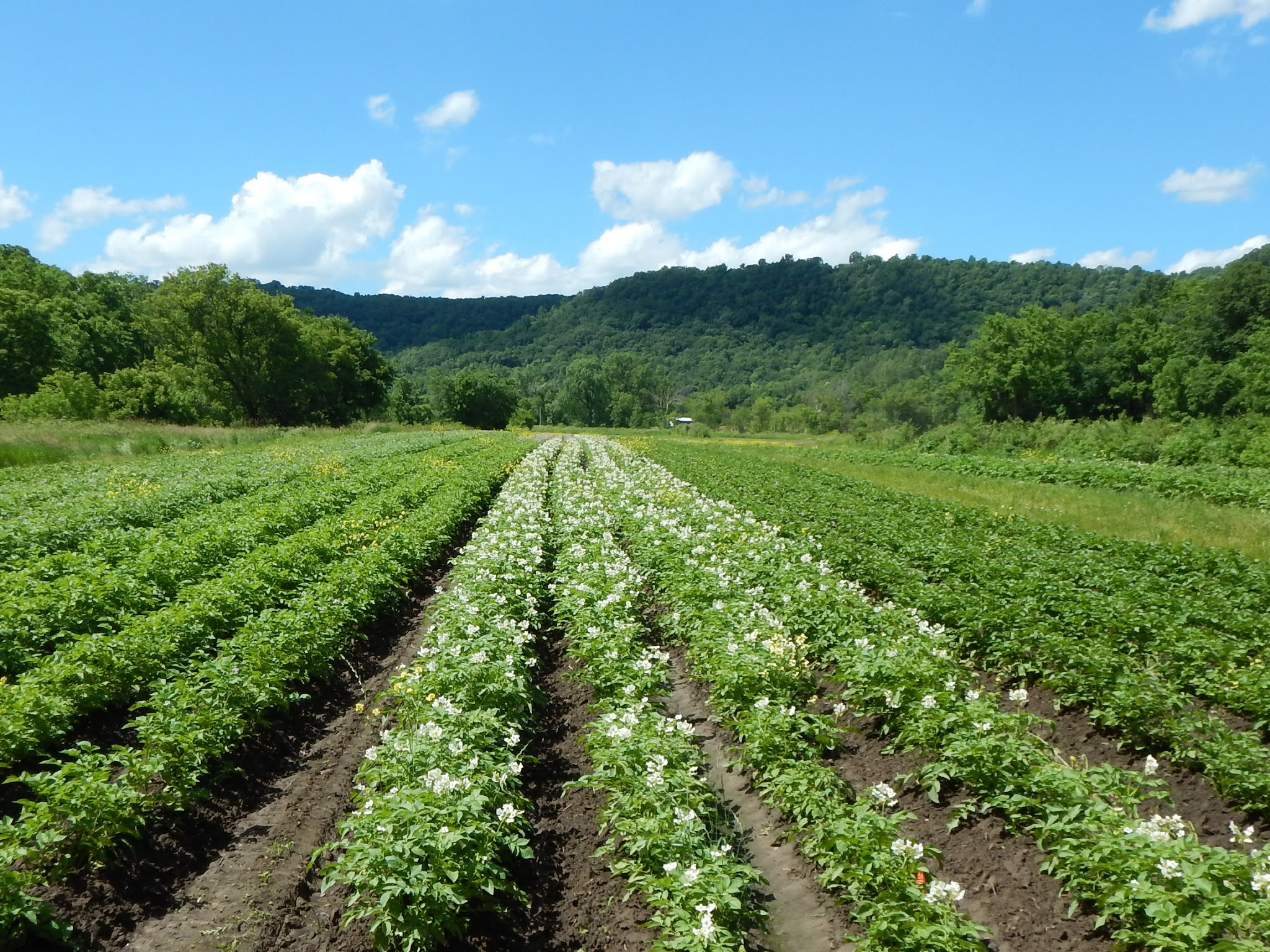
1.5 acre potato field with 9 different varieties!
We too strive for efficiency and work hard to find it anywhere we can.  We do need to remain profitable and so we need to be cognizant of our resources and find ways to use them efficiently.  We mechanize where we can, find more efficient ways to manage weeds, maximize nutrient inputs to produce healthier crops that will yield better, and review our processes frequently to make our day to day work as efficient as possible making the most of every hour of our days.  But when you grow over 80 different crops, everything isn’t going to always be efficient.  We have to get the potato planter out, grease it, set it up and maintain it so we can use it one time every year to plant about 1.5 acres of potatoes.  This is like one loop around the sandbox for the big boys who are planting hundreds or maybe even thousands of acres of potatoes!

Green bean harvest....use both hands!
What about green beans?  Wouldn’t it be easier to pick those with a machine?  Maybe, but green beans only represent about 2% at most of our overall acreage and we know that we’ll break a lot of beans if we pick by machine.  We’ll also lose some that will fall on the ground and get missed.  If we were sending them to a cannery or processing facility, we really wouldn’t worry too much about a few broken beans.  In fact, we’d grow a tougher variety that could take a little rougher handling.  But that’s not our end market and so we pick them by hand.  Efficient?  We try to be, but we know beans aren’t one of our most profitable crops due to the high labor cost.  We do however make a few friends in our CSA membership with those who appreciate having a flavorful, tender bean and we’ll consider that our payment for the sacrifice of efficiency because we know that these are the people who will stick with us when we face challenges and crises.  Monocultures invite vulnerability, whether that is a monoculture in a field, a feedlot, or a business.

Irrigation sprinklers watering a field to
germinate freshly planted seeds in a drought year
Over the years we’ve had to learn to pivot and be resilient in many different circumstances.  This pandemic is not the first challenge or crisis we’ve had to deal with.  We’ve had to adapt and respond to weather, shifts in the marketplace, changes in the economy, and fluctuations in our membership, etc.  We have been trying to find ways to be more resilient in our business long before the pandemic set in.  Most of our pre-pandemic thoughts around this issue have been related to climate change and our increasingly more erratic weather patterns.  We have tried to find ways to mitigate our risks and losses through strategies such as succession planting, planting a variety of crops, planting in different locations, and devising creative strategies for farming that will help us be more resilient when faced with challenges that impact our crops.  This is also why we have diversified our business and grow for both CSA as well as to supply wholesale and retail accounts.  Over the years we’ve been able to flex up on sales to one area when sales are lacking in another.  So when the phone started ringing and the CSA orders started rolling in last March and April, we didn’t have to turn anyone away until very late in the season. We simply changed our planting plans, redirected our resources and shifted to match the demand so we could maximize our capacity to feed people through our CSA program.  In the end, our ability to be resilient because of the diversity within our operation actually did help us realize greater efficiency!  The overhead to facilitate a CSA program was now spread out over more shares.  Our trucks were full, our time invested in harvesting, preparing and packing CSA vegetables was more efficient as well.

Gratitude for our front-line crew members!
In many ways the pandemic has forced us as a society to be more conscious and mindful about where our food is coming from and what it takes to get it to our plates.  It has also shed light on those individuals who previously have been overlooked in the shadows of our food system, “…the essential and front-line workers many of us never noticed before but whose well-being can no longer be separated from our own.  It turns out we’re all in this leaky boat together, so, like it or not, we’d better start building systems and supply chains resilient enough to withstand the shocks to come.”

Please don’t ever underestimate the power you as an individual have to impact society, the economy, the environment, your community, and our food system simply with the day to day choices you make.  You can, and do, make a difference.

Wednesday, May 20, 2020

The Future of Harmony Valley Farm: Introducing Rafael Morales Peralta!


Interviewed by:  Andrea Yoder

Rafael Morales Peralta
This week we’d like to introduce you to Rafael Morales Peralta, the most recent addition to the Harmony Valley Farm, LLC partnership along with me and Richard.  Rafael set out to write this article himself, and while his English is quite good, we knew he had more to share with all of you than his knowledge of English words would allow.  So, Rafael and I sat down and had a long chat about who he is and what he’d like to share with you about his life’s journey.  I’ll do my best to convey his thoughts and hope that one day in the future you will have the opportunity to talk with Rafael yourself!  Before we go any further, Richard has a few introductory thoughts he’d like to share.

Rafael operating the ASA lift root crop harvestor, October 2019
“Harmony Valley Farm is my life’s work and it is my desire to see it continue indefinitely into the future.  My own biological son, Ari, was raised on the farm and understands the challenges, but is pursuing a career as an environmental lawyer and does not wish to be “stuck with having to manage the farm” when I retire.  Thus, I’ve sought out individuals to bring into the business as co-owners and partners to carry Harmony Valley Farm into the future.  Andrea has definitely proven her mastery of organization, food safety, sales, greenhouse and packing shed management, and so much more.  With help from Simon, Kelly, Gwen and Amy, they are a team that is managing the details well through very challenging times.  But then there is the additional challenge of field planning, machine maintenance, planting crops, managing irrigation, weed control, coordinating the harvests, cover crops, fertility, and so much more.  It is too much for Andrea or any one person to manage it all.  Thus, for the last 15 years, I have been looking for an individual who has the potential to fill this role.  There have been a few promising people, but for a variety of reasons it was clear that our need was not in alignment with their path in life.  

When Rafael started working here, it was clear he had an intense interest and desire to learn.  He was always there to help whenever there was a need.  He rose in the rank of possibility as he mastered every task presented to him and continued to look for more responsibilities and thrived on learning new skills.  He also started to contribute in greater ways by starting to suggest improvements to the way we do things.  So that led me to make the decision to sponsor Rafael for a permanent visa to facilitate the opportunity for him to become an owner in the business.  After a long process spanning nearly four years, Rafael finally received his permanent residency status last year and is in the process of getting visas for his family so they may join him.  We are hopeful that we’ll see them before school starts this fall.  

Despite Rafael’s limited formal education, he has demonstrated a desire to continue to learn and he is a very intelligent individual.  He has mastered the internet and uses it to research new cultivating methods on You Tube, locates parts diagrams for old and specialty equipment and orders parts that are difficult to find.  He has been well-received by our local suppliers and is earning their respect.  I continue to help out with the difficult agronomy, fertility, pest scouting, setting priorities, etc, but Rafael now handles the majority of the daily questions, problems and needs that come up.  The crew now calls Rafael and Andrea first because they don’t want to risk waking me from my mid-day nap!  I’m grateful for the opportunity to work with Rafael and feel confident he’ll carry the farm into the future.”—Richard de Wilde, Harmony Valley Farm’s Founding Farmer

August 2012, Rafael Harvesting Sweet Corn
Rafael comes to us from a small community in Mexico called San Miguel de Allende which is located in the state of Guanajato.  He was born and raised in this community, and this is where his family still lives.   He comes from a very loving, tightly-knit family.  There are 8 children, four boys and four girls.  Rafael is the youngest of the boys.  His brothers, Manuel, Alvaro and Alejandro also work at HVF and it is clear that they were raised by very good parents!  I asked Rafael if he respects his parents and he answered immediately with a very strong “Yes, absolutely.”  His parents struggled to overcome during very challenging economic times while he was growing up.  While they may not have had an abundance of financial resources to buy them “things,” they always pushed their children to do the right thing and continue to strive to be good people and have a better future.  From his humble beginnings, Rafael was taught the value of working hard from an early age.  He shared with me that his grandfather had 1 hectare (2.2 acres) of land that he grew corn, beans and squash on.  Rafael and his brothers remember helping his grandfather work the land and care for the crops.  Most of the food they grew went to their large extended family, but the squash was a cash crop.  Actually, he didn’t sell the squash but rather the seeds.  Rafael remembers having to scrape the squash seeds out of the squash.  He also remembers how sore his fingers were after doing this all day!  Once the seeds were extracted his grandfather would lay them out to dry before putting them in big bags to take to town and sell.  On the days Rafael and his brothers helped him he would send a little extra food home with them.  Even before they could bring home a paycheck, this was their way of contributing to their family’s needs. 

Rafael doing precision cultivating of 5-row cilantro crop
Rafael and his brothers went to school, but Alvaro and Alejandro were the only ones who completed high school.  Manuel, the oldest son, left school after the third grade so he could work with his father to provide for the family.  His father was a hard worker, but the problem was that things were not good in Mexico at that time and people worked hard but received very little pay in return.  With eight mouths to feed, it was hard to make ends meet.  As Rafael got older and began to understand his family’s situation more clearly, he really wanted to help his parents.  He made the decision to quit school after his second year of high school so he could work.  While Rafael doesn’t regret leaving school to help his family, he always had a desire to continue learning.  He worked for awhile on a large broccoli farm and later had the opportunity to come to the United States on a H2A visa to work with race horses in Kentucky.  He did this work for about three years and then the opportunity fell through due to some unfortunate circumstances.  While the pay was better, working with horses was not something he really enjoyed, especially after one bit him on the arm!

Spending time with guests in the sweet potato
field, Harvest Party 2019
In 2004 Rafael married his beautiful wife, Adriana.  It is very clear that Rafael and Adriana have a very strong relationship.  Rafael describes his wife as “a great woman.”  I asked him to tell me what makes her “great.”  She is a strong woman who has always stood by his side as they have created goals and dreams together for their family.  They function as a team and she has committed to working just as hard as Rafael to create a better future for their family.  They both understand this means making sacrifices sometimes.  While they would like for their family to be together, they realize the opportunities for working in the United States afford their family more resources to build their future.  So, while Rafael is working here, Adriana has done her part to manage their household, raise their children, take care of her parents and continue to help others in their community who are in need.  She also started a small business selling kitchen supplies in order to earn some extra money.  Rafael has a tremendous amount of respect for his wife and further describes her as a very caring individual who is willing to help anyone.  Together they have three children.  Jimena, is 14 years old.  She does very well in school and wants to study medicine and become a doctor.  She is a tremendous help to her mother.  His oldest son, Adrian, is 13 years old.  He’s a quiet child and is interested in becoming a mechanic.  Their baby is Mateo.  He is 4 years old and is totally different from their two older children!  He is very outgoing and isn’t afraid to talk to anyone.  He keeps everyone entertained and laughing!
Rafael is happiest on a tractor!
 October, 2010
Rafael’s brother, Manuel, came to work at HVF in 2009.  After his first year, Rafael asked him if there might be an opportunity for him to work here as well.  Manuel asked us and we said “yes!”  At that time, Rafael and Adriana were looking for an opportunity that would move them closer towards their dreams for a better life.  They were working very hard seven days a week.  Rafael was working construction Monday through Friday and on Saturday and Sunday he would work with Adriana at their own little business.  They rented a grill and sold taquitos from their own little food cart.  Rafael describes the opportunity to come and work at HVF as the first step on his journey to achieving his dreams.  He didn’t know it at the time, but the opportunities would continue to stack up over time and the fact that he was present and willing to take risks and step outside of his comfort zone put him in a good position for a better life.  Rafael remembers calling Richard on the radio on only his second day of work!  He didn’t even know how to speak English, but he heard how others were talking on the radio.  He was working with Manuel doing irrigation and they had a problem with a hose and needed Richard’s help.  He called to Richard using the limited words he had, and the end result?  “It worked!  He understood me and showed up in the field to help us!”  Little by little over time, Rafael’s confidence was built.

One time he was clearing brush with Vicente. Vicente, an experienced equipment operator, was running the skidsteer with the brush puller on it.  Rafael asked him if he could try.  Vicente wasn’t so sure it was a good idea because Richard hadn’t given him permission, but he let Rafael have a chance at it.  No more than three minutes after Rafael got in the skidsteer, Richard pulled up in his truck.  “Oh man, I’m in trouble” was the thought that rolled through Rafael’s mind.
Making guajillo salsa to serve with goat
carnitas at our crew harvest party!
He stopped the machine and started to get out.  Richard motioned for him to get back in the skidsteer and continue.  He wanted to see what Rafael could do!  There was another similar incident where Rafael, Vicente and Manuel were clearing a wooded area with the bulldozer.  Rafael did not have any experience operating the bulldozer, but he had been carefully watching Vicente, Manuel and Richard.  They had a tricky situation where they were trying to move a large stump to a pile to be burned.  Vicente, Manuel and Richard all gave it their best shot, but none of them could make it happen.  Richard left and Vicente and Manuel resigned themselves to the fact that it couldn’t be done.  Rafael on the other hand had been watching all the tactics that were not working and devised a different plan for how to move the stump.  After Richard left he asked Vicente if he could try.  While very hesitant, Vicente agreed to let him try after saying “Come on Man, you’ve watched all of us try and it can’t be done.”  Rafael tried his plan and within five minutes he was able to move the stump to the desired location.  When Richard returned and saw what had been done he asked “Who moved that stump to the pile?”  Rafael was very nervous.  He knew they had to tell him, but he also knew he might get in trouble since Richard had not given him direct permission to operate the bulldozer.  They told Richard Rafael did it and to Rafael’s surprise, Richard looked at him and gave him a big “Thumbs Up” and a smile.  Yes, this was certainly another huge boost in confidence for Rafael!

Rafael preparing to kill weeds with the Flame Weeder
Over time Rafael continued to seek out more “missions” and willingly accepted more responsibilities.  He continued to align himself with opportunities to learn more from Richard and other experienced crew members.  He reached out to Vicente who spoke very good English.  Vicente became his teacher helping him learn more English so he could better communicate with us independently.  Now, Rafael recognizes how his hard work and perseverance are paying off.  He loves his job and wants to continue to work here into the future.  He also loves his family and wants them to be together.  Going back and forth to Mexico year after year is hard.  It’s hard having to leave his family every year.  They all want to be together and hopefully, they are close to realizing that part of the dream.  As Rafael continues to build his career here, he realizes how much his work has become a big part of his life.  He knew very little about organic agriculture when he first came here, but over time he’s come to value this method of farming and the benefits it has to the people growing and eating the food as well as the environment.

Always optimistic, Strawberry Day, 2019

We continue to learn from each other.  Farming is not easy and we get a lot of curveballs thrown at us every year, but the three of us continue to push forward.  While we all come from slightly different backgrounds, Richard, Rafael and I all come from humble beginnings.  We all understand the value of working hard and have a desire and passion to carry this farm into the future.  Richard and I appreciate Rafael’s energy, enthusiasm, positive outlook and drive.  We are happy to have him as our partner and want you to know we are doing the best job we can to grow vegetables for you and your family.  We also look forward to meeting Rafael’s family.  Even though they are in Mexico, they too have greatly contributed to the future of Harmony Valley Farm with through their love and support.

Wednesday, May 22, 2019

Know Your Farmer, Know Your Food….Meet Farmer Richard de Wilde

By Gwen Anderson

I’ve worked with Richard for over a year, and seen him nearly every day.  I’ve always found it fascinating to talk with him; his enthusiasm and passion are contagious, he is a wealth of knowledge, and has a patience in teaching that I admire.  When Andrea asked me to write this article, I was more than happy to do so.  It was a chance to hear more interesting stories about the man straight from the source.  Many of our long time members may know Richard already, but there may be many of you who don’t know him so well.  After all, I see him all the time and I still found out a lot during our “interview” that I can share with you! 

Richard's Senior Photo
Richard grew up making hay and milking cows on a farm on the plains of South Dakota.  His father had a herd of 100 Black Angus beef, and for a few years they had some pigs and sheep as well.  Before his feet could reach the pedals on the one ton Chevy truck they used to haul oats, Richard was helping his father farm.  He would also help his grandparents’ garden, and loved to spend time in the kitchen with his mother making banana bread.

When he went off to college at the South Dakota School of Mines and Technology, Richard thought “I want to work with my head, not my hands.”  He had an advisor who suggested he go into hard rock mining due to his love of nature.  The advisor told Richard he could have a “good, professional, high paying job and still be out in nature.”  After graduation, he got a job at Fort Snelling with the Corps of Mining Engineers, but not even a year had gone by before his thoughts began to wander. He would sit at his desk, his mind drawn to memories of beautiful fields of blue flax blossoms swaying in the wind.  It didn’t take long for the thought “I want to farm” to form in Richard’s mind, so he left the mining engineers, rented half an acre of land south of the Twin Cities and got back to doing what he loved.

Blue Gentian Farm, where Richard farmed with in the early years.
Once the farm was rented, Richard took the time to get to know his neighbors, one of which was a school for special needs children.  Richard has a soft spot for well-behaved children, so when he wasn’t farming, he would volunteer at the school. As he got to know the children better, he realized he had found a second calling.  Richard began studying and earned a master’s degree in Special Education with a focus on autism from Mankato State.  Upon graduation, he worked in special education in the St Paul public school system.  Later, he found meaningful work in being a foster parent for teenage boys who needed extra care and attention by running a specially licensed therapeutic foster home on the farm.

Being an organic farmer was never a question for Richard.  His Grandpa Nick was a dedicated organic farmer and had helped shape Richard’s opinions on the matter.  When agro chemicals came out after World War II, Grandpa Nick refused to use them, and suffered being called old fashioned and unwilling to change with the times because of it.  Richard always had a love for nature and all things wild, and Grandpa Nick’s success without using chemicals as well as Rachel Carlson’s book A Silent Spring cemented Richard’s desire to not use them himself.  “When I read about agro chemicals, I decided I didn’t want anything to do with them.”

Richard cultivating broccoli with his horses,
King and Prince.
Richard was one of the pioneers of organic farming.  He was a trail blazer for integrating cover crops, making compost, and attracting beneficial insects, birds and bats well before there were any large scale conversations happening about such things.  There was no such thing as organic certification when he started his farm, he just wanted to do what was right for the soil and nature.  So he experimented, learned what worked and what didn’t, and taught what he had learned to other farmers.  Richard sold his vegetables to the new co-ops in the Twin Cities where people went to buy healthy, organic vegetables.

In his early days, Richard had a chance to meet the Dakota County extension agent who told him “You can have an organic garden, but if you are talking about making a living farming, you can’t do it organically.”  The conversation spurred Richard to prove him wrong; he was going to do the right thing and he was going to make a living doing it.  (Fast-forward 20 years, that same County extension agent had changed his tune and met up with Richard again at a MOSES conference to say “You’ve been right all along: it turns out you can make a living farming organically!”)

By the mid-1980’s, suburbia was encroaching on Richard’s farm south of the Twin Cities to the point where it was time to move on.  When he left the fields he’d been farming for 12 years, he knew where he wanted to go: the Driftless Region.  Richard had been there several times before, and he loved the rolling hills and valleys, the waterways, and overall natural beauty the area had to offer.  The soil was rich and healthy, and the hills made a beautiful backdrop for the fields he worked.  After all, seeing a well-cared for field thriving in a natural surround is one of Richard’s favorite things about being a farmer.

Adrian (left) and Ari (right), The Melon Boys
Richard spent the first few years at Harmony Valley Farm building up soil health, structures, and business relationships.  He was still selling his produce in the Twin Cities and found a new market in Madison at the Dane County Farmers’ Market.  In 1989, Richard’s son, Ari, was born and soon became part of the daily farming operation.  Ari and his step-brother, Adrian, grew melons and sold them at the Farmers’ Market, becoming known as the “Melon Boys.”  As business grew, Richard began expanding the farm by leasing more nearby land and converting it to organic status.

When Richard and then partner Linda Halley added Community Supported Agriculture (CSA) to their farming model in 1993, they did so out of a desire to have a direct connection with more people than they could reach at the Farmers’ Market.  CSA birthed on farm events like Strawberry Day, which allowed Richard to meet the families he was growing food for face to face.  Being able to watch the children from those first CSA families grow into smart, healthy adults makes farming worthwhile for him.  Many of those children are now graduating from college, starting their own families and joining CSA’s of their own!

Nowadays, Richard sees himself as a support for the great crew he has to help with the farm.  He gives information and direction when needed to a crew who want to do the best job they can.  Harmony Valley Farm is a mature farm, with all the systems and infrastructure in place, no longer looking to expand.  With growth a thing of the past, Richard is now focused on making the farm better.  “I believe if you aren’t making improvements, you are going downhill,” Richard said.  “We aren’t looking for more, but better; always better.”  He is also selecting and training the next generation of Harmony Valley Farm farmers

Richard helping the crew harvest winter squash
“There is a great deal of joy in seeing things work, when things go smoothly,” Richard said about his farm and crew.  He gets great satisfaction out of a job well done.  “How many people, for their life’s work, get to have a job where you are outside in nature, watching things grow, you grow a lot of healthy food for a huge amount of appreciative people, and everything works?  Yes—I’ve worked too hard for most of my life, but I feel fortunate to be where we are today.”

So who is Richard de Wilde?  He is a man of perseverance and innovation.  He is a visionary who is not afraid to take on challenges to bring his dreams to fruition.  In his own words, he is a hippie rebel with an “I’ll show you” attitude.  In my opinion, he’s a darn good boss and a great storyteller.  I encourage you not to take my word for it though; come to the farm and talk to him yourself.  You’ll be richer for the experience.