Showing posts with label Farmer Andrea. Show all posts

Wednesday, July 29, 2020

Culture of Cleanliness….Developing Our Food Safety Eyes

By:  Andrea Yoder
Why do we do food safety training every year?

Why is attention to food safety an important element on our farm?

Who is responsible for following food safety practices on our farm?

These are a few of the introductory questions I ask our crew members every year when we do our annual food safety training, both for new employees and for those who have worked here for many years.  We’ve had a food safety program for our farm for well over twenty years, even before our wholesale buyers started requesting it and before the Food Safety Modernization Act (FSMA) was passed making it a legal requirement for farms.  Every year we make improvements to our food safety program, so obviously we have to communicate any changes to protocols, expectations, etc with our crew members, but we also still go back and review the basics…every year.  This week we wanted to give you a little insight into just what it means to have a food safety program as well as some of the protocols we practice and implement on a daily basis.

Moises cleaning a wash tank in
preparation for sanitizing harvest totes
Lets go back to those three introductory questions.  We do food safety training every year because we want to ensure the food we are producing is wholesome and safe for you, our customers!  It’s also our legal responsibility and it’s a requirement in order to do business with many of our wholesale buyers.  “Why is attention to food safety an important element on our farm?”  First and foremost, we do not want anyone to ever fall ill from eating our food.  We also want our customers to be able to trust us and we want to maintain a good reputation in our community! And lastly, “Who is responsible for following food safety practices on our farm?”  EVERYONE!  This includes all crew members, regardless of work responsibilities, but also any contractors or visitors to our farm. 

This is the point in our training where we talk about a “Culture of Cleanliness.”  This is a term we learned from our food safety inspector many years ago and since then we’ve worked very hard to establish and improve upon the “Culture of Cleanliness” we’ve created on our farm.  What is a “Culture of Cleanliness” and why is it important?  Have you ever seen one of those children’s books or picture games where you have to look at the picture and identify what doesn’t fit or what is wrong?  That’s kind of the way we operate every day.  The reason we have food safety rules and best practices is to reduce and minimize the risk of our food becoming contaminated or someone getting sick.  We don’t live in a sterile world and things are going to happen.  The reason we have a food safety program, rules, procedures and talk about these things every year is because we want to be able to identify situations that may cause a problem with food safety so we can intervene proactively in an effort to prevent problems. 
Cleaning the salad cutter before it goes to the field to harvest
Salad Mix!
We learn to see our work environment and our farm with a new set of eyes—our food safety eyes.  There are a lot of details, a lot of space and a lot of moving parts to our farm.  It’s more than Richard, Rafael and I can keep our eyes on by ourselves!  We need everyone who’s working with us to develop their special set of food safety eyes so they can see potential problems or identify when something is not right with a scenario.  We also need them to develop their food safety eyes so they see the food safety practices as the “normal,” expected way things are done.  Then, when someone isn’t doing the right thing or something is askew, it stands out as that thing that is not right with the picture! 
Red bucket labeled for cleaning only

So what are some of those practices we employ?  Well, for starters, we clean…A Lot!  We don’t just wash vegetables, we also clean equipment, trucks, facilities, harvest containers and more.  Part of our annual training is reviewing the difference between cleaning and sanitizing, as they are two different steps and need to be done in the correct order to be effective!  We clean a surface using soap to remove dirt and debris, then follow that with a fresh water rinse.  Once the surface is clean, we come back and spray on a sanitizer solution to take care of any microscopic pathogen.  This concept is applied in many scenarios throughout the farm.  Whether we’re setting up an area in the packing shed to wash and pack vegetables or we are preparing to use a harvest belt to pick zucchini and cucumbers, we always clean and sanitize!  We have even devised a system and set of tools so we can take the appropriate brushes, sanitizing agent, buckets of soapy water and clean water to the field --everything the crew needs to properly clean and sanitize the belt in the field prior to every use. 

Color-coded brushes and bilingual signs in our
packing shed
We have a colorful farm, if for no other reason than our color-coded tools!  One way we prevent potential cross-contamination is by designating specific colors of tools for specific uses.  When cleaning packing shed equipment, we use red brushes.  If we need to clean a harvest container, we use a green brush.  “What if I need to scrub a wall or a floor?”  Please use the white brush hanging in the packing shed.  We also have yellow tools that we use for cleaning bathrooms.  Despite their bright, cheery color, they never leave the bathrooms for any other use.  And there’s one last brush color we see about one time a year.  We need orange brushes for washing the pumpkins and winter squash when we harvest them!

Cheery yellow cleaning supplies,
for bathroom use only!
We also have color-coded buckets, because buckets are a great tool for many different uses.  White buckets are for use in harvesting many different vegetables, except for baby greens.  When we need to hand cut baby greens we use special green buckets that are only used for these products.  Red buckets are used for cleaning projects, white buckets with red paint on them are used for non-food uses such as carrying tools to the field or carrying rocks out of the field!  Blue buckets are used to feed and water animals and orange buckets are located on the harvest wagons and in field vehicles for collecting trash.  Whew…that’s a lot to remember!  Don’t worry, we have lots of signs in both Spanish & English to help us remember what to do and we review this information every year so we don’t forget!

Many tools we use have many different potential applications.  For example, knives are good for cutting vegetables, but they are also a good tool to use if you need to clean mud off of your shoes or a cultivator shank!  “STOP!  Please tell me you weren’t thinking about using the same knife for all of these uses?”  Don’t worry, we have separate knives!  Field crew members have wooden handled knives that are stored in leather sheaths.  These knives may be used for anything they want to use them for except for two things.  They may not be used to harvest vegetables and they may not be used as a weapon.  Aside from that they can use them to cut weeds, cut row cover, clean their shoes, etc.  When it comes time for harvest, they use their yellow handled harvest knife that is stored in a black plastic sheath that has a small hole in the bottom.  This knife and sheath are much easier to clean and sanitize in between uses than the knife that gets stored in the dirty leather holder.  Where do they clean and sanitize their knife?  We’ve got that covered too!  There are two knife cleaning stations set up every morning.  Leonardo comes early to set up fresh containers for the stations which consist of three trays to facilitate a three-step process.  The first tray contains soap and water to clean the knife, the second tray contains water only for a rinse step and the third tray contains water with sanitizer to sanitize the knife.  Done!
Freshly cleaned and sanitized barrel washer
set up.  We're ready to wash vegetables!

Pathogens such as bacteria, viruses and parasites are not the only things that may potentially contaminate food.  We’re also careful to make sure we’re removing excess grease from bearings on equipment and check all connections for implements, hydraulic hoses, etc. to make sure we catch and repair any leaks.  We’ve even implemented a system for outfitting our tractors that are used by harvest crews with “tractor diapers!”  To my knowledge this is not an industry standard, but it’s a practice Richard devised and it’s become standard protocol on our farm.  We secure a heavy duty tarp under the belly of a tractor and place absorbent pads in the tarp.  If there should be any kind of a fluid or oil leak, we can easily see it, catch it and repair it thereby removing the potential for product to be contaminated in production areas or around a field!  Of course, tractor diapers don’t replace the need for observation, so all crew members are trained to be very attentive at all times, whether they are operating a piece of machinery or just working in the area.  If they see anything that doesn’t look right, it’s their responsibility to speak up and say “Wait, we need to check this out!”  Ok, so what do we do if there is a problem?  First, STOP!  Notify those in the area that there may be a problem and contact a supervisor/owner.  Fully assess the situation and then devise a plan to prevent any further issues and clean up anything that needs to be cleaned, etc.  One important point here is that we are a team.  We all may see things differently and we all may play a slightly different role in resolving the situation and being part of the solution.  Remember, food safety is everyone’s responsibility!

Ascencion harvesting black radishes, note his
yellow handled harvest knife!
Of course there is one tool we all use every day and we consider this our most important tool.  Can you guess what it might be?  Here’s a hint—it’s likely the tool you use the most every day as well regardless of your job!  Hands!!  Our hands are the tool we use the most every single day, which is why one of the most fundamental food safety training topics is “When do you need to wash your hands” and “What is the proper procedure for effective handwashing.”  COVID-19 messaging has brought handwashing to the forefront as a public health issue this year, but we’ve been preaching and practicing proper handwashing for many, many years! 

Every year we continue to make improvements to our practices and every year we undergo at least one third party inspection.  Typically we have a voluntary third-party inspection, as we’ve elected to do for many years.  This inspection looks at our farm both Pre-Farm Gate (Field operations) and Post-Farm Gate (Packing shed operations) and evaluates us according to the Harmonized Standards.  Last year we also had our first food safety inspection by the Wisconsin Department of Agriculture (DATCP), the agency enforcing FSMA requirements in Wisconsin.
Crew training session with Richard, Andrea and our Spanish
interpreter, Michelle. Andrea is modeling the proper
attire to wear when working in animal areas--the only
place on the farm where you'll find bright yellow boots!

Whew---this is a lot of information, and we’ve only just touched the surface of the practices we employ on our farm.  We haven’t even discussed clutter control, first-in/first-out procedures, wearing yellow boots when working in animal areas, or what to do if it rains so much and river water washes through crop land!  Food safety is a part of our lives every single day and we hope you can see how integral it is to our farm and how we operate.  Of course we like having a neat, clean and organized farm.  It makes our work spaces more pleasant to work in and allows us to work more efficiently.  We do a lot of record keeping related to food safety as well, but that’s ok because it also helps us be better managers of our time and resources.  Is it worth it to invest this much thought, time and energy into a food safety program?  Absolutely!  Regardless of the law or requirements imposed on us by our buyers, we go back to our top priority which is always to ensure you and your family have safe, wholesome food to eat.  Thank you for your support of our farm.

Wednesday, June 3, 2020

Gratitude


The topic for this week’s newsletter started brewing in my mind last week when yet another CSA member took the time to send us a note of thanks.  Here are just a few excerpts from notes we’ve received:
The beautiful Diana Radishes 

“I am so excited to have the herbs, in addition to the GORGEOUS vegetables of today!!... Your produce gives me so much JOY and ESPECIALLY in such a dark time. I THANK YOU for the work you do.”

“I am so excited with our first share. Thank you so much for all the fresh vegetables.  I already had some greens with my eggs this morning.  Just letting you know you made my day.”

“We are sure thankful to be connected with HVF again this year, especially at a time when local, sustainable food practices are more important than ever.  May your crew have good health and fruitful harvests all season long,”

“I wanted to thank you for all you have done to make our CSA experience safe.  I picked up my first box on Saturday and was so happy to see the outside tent set up with clear directions on how to keep us all protected!  I left with my beautiful bag of vegetables and a huge smile on my face J”

Storm Clouds in the Valley, June 2, 2020
Gratitude, it’s a powerful medicine for the souls of those who both give and receive it.  It’s a trying time for our region, our country and the world.  This year is unfolding in unexpected ways and some days it’s hard to make sense of everything happening around us.  It would be wonderful if we could hunker down in our quiet little valley and remain immune to the hurt, anger, injustice, fear and inconvenience the events of this year have placed upon us all.  But, that’s not an option when you choose to be part of a community.  As I write this newsletter, the wind is whipping violently outside the office and as Richard just communicated to Rafael over the radio “We’re going to get slammed.”  Dust is swirling, trees are whipping around, and Alejandro, Manuel, Nestor and Jose Antonio are trying to wrangle the field covers that are being ripped off the crops they are meant to protect.  We know how to deal with the weather, or rather, we know we can’t control the weather, only our ability to respond to whatever hand Mother Nature chooses to deal us.  Sometimes we get a really good hand, and when we do, you reap the benefits too!  Ramps in May because of a late, cool spring?!  Yes, we’ll take it!  A stretch of nice, sunny, warm days that spurs the asparagus to push through and allows us to complete critical cultivating, transplant crops and plant more seeds?  That’s a good hand to be dealt and we’ll take it! 
Cultivating Celeriac with "The Kult"
We’ve had our fair share of experience managing the extremes of weather.  While we can’t control it, we are very adept at working with and around the weather.  We have a grasp on the realities of this type of storm.  But this year, the weather is not the only “storm” raging around us.  Restrictions and procedural changes related to COVID-19 that leave us wondering if our crew from Mexico will be able to join us.  Inconvenient changes to how we operate that slow us down, cost money, take away our markets and break down many of the plans we had for the year.  These pieces of the pandemic storm are things we could live without, but that’s not a choice right now.

Our crew packing CSA boxes in September, 2009
So we move forward and look for the good things in life.  For us, this year, it’s CSA—our community.  Think about what it stands for, “Community Supported Agriculture.”  We’ve always believed CSA can have a powerful impact on people’s lives, and this year may just be the reminder of that truth.  Simply put, we’ve always needed each other, but I think we may all realize this a little more intimately this year.  We’ve been trying to build our CSA membership back to where we were before the recession hit in 2009, after which our CSA membership dropped to an all-time low.  What’s it going to take to build our membership to a sustainable level so we can continue to do this?  We never thought the answer would be a pandemic that caused our corporate, industrial food system to fracture under the weight of its own weaknesses.  Or the fact that the pandemic forced us to spend more time at home, planning ahead for less frequent trips to the grocery store, and cooking our own meals!  The result of an inconvenient pandemic for our farm has meant a two-fold increase in CSA memberships that has actually pushed us past our record high number of boxes packed in a week from the height of our CSA glory days back around 2009!

Stack of referrals awaiting postage to be sent out.
We've received so many referrals, we went through a whole roll
of stamps and still didn't have enough to send out the first batch!
So even though this has all been very hard and this was not the plan we had in mind, we remain grateful for you, our community of eaters who have chosen to partner with us to grow food to nourish your families and enrich your lives.  This is our privilege and we want you to know we are grateful for your support.  We sense your support in so many ways.  Of course when you take the time to send us an email or write a little note to enclose with your payment, we experience your expressions of support in your own words.  Yes, we do read those notes, hang them on the wall, share them with each other and our crew members.  Your words of gratitude and support are our fuel and reminder to keep pushing on through the hard times.  With every referral you make, every conversation about CSA that you have with people in your circles, or every time you purchase our products at your local food co-op, we feel it.  Sometimes it’s subtle, anonymous, or delayed, but we feel it, and we are grateful.

Habitat for native plants and animals near our fields
We have devoted our life’s work to feeding the most people possible with healthy, nutrient rich foods through every season of the year and every season of their lives.  But farming is not just about growing food.  We also have a responsibility to restore and care for our land, protect our native plants and animals, and do our best to be a positive force in our community.  We have a responsibility to nourish body and soul.  Can vegetables change lives?  We absolutely believe they can and we hope right now you may be experiencing the little ways they do so by infiltrating our daily, sometimes mundane and sometimes tumultuous lives with vitality, beauty, nourishment and connection.  So in all the ways you support us, we hope you too feel supported right now.


Learning about celtuce from a member's mother
visiting from China!
Our hearts break when we see what’s happening in Minneapolis as well as many other cities in our region and across the country as the storms of injustice are raging.  Injustice is hard to watch, hard to experience, and hard to understand why it keeps happening.  It just doesn’t make sense.  Human lives are precious, all human lives.  When you sign up with our farm, we don’t care what color your skin is or where you come from.  We’re grateful to have you as part of our community.  Well, let me correct that last statement a bit.  We do care where you come from, because everyone has a story and a journey to share and we celebrate the diversity within our membership!  We have opportunities to learn from people from all over the world right here within our own community!  I learned more about the vegetable celtuce from a member's mother who was visiting from China when he brought her to a farm party than I ever learned from researching on the internet!  I recently learned we have a published author in our membership who was kind enough to share his memoir which I look forward to reading so I can know the journey he’s walked in this life.  We feed community leaders, teachers, healthcare workers, scientists, artists, students, and the list goes on.  We are blessed by you and the diversity each of you adds to our community.

Our hardworking crew harvesting winter radishes
 in late October
No conversation about gratitude related to farming would be complete without mentioning our crew members.  We do our best to offer respect to the hardworking crew members that work alongside us, no matter how challenging the task or situation.  They trudge through mud, shield their necks from the hot sun, bend over to harvest vegetables growing from the ground, and that’s only those who work in the field!  Others do tedious work of sorting salad greens in the packing shed to make those pretty little bags of baby arugula and salad mix we pack in your boxes.  They trim thousands of pounds of onions, and wash probably thousands of pounds of dirt off your vegetables so they are glistening and beautiful when you receive them.  Lets not forget about the office work, which is another piece to making this all possible.  Answering phone calls, responding to emails, processing orders, and keeping this whole beast organized and running smoothly…..that’s no small task!  We are so very blessed and grateful for all the people working on this farm, and when we’re all covered in mud, our skin is all the same color!

Sometimes storms lead to rainbows,
reminding us there is beauty after the storm
I’ve almost reached the end of this article, and the storm continues to rage outside.  The sky is full of dark clouds, the rain is pouring down, and I continue to hear intermittent rumbles in the distance.  Just like this storm, the storms of life will pass through.  When we’re in the midst of the storm, it may be hard to see what’s on the other side, but we still have a choice as to what we want to be when the storm is over.  Sometimes you need a little breather, a bit of a break to catch your breath, but once you have….it’s time to get back up, push forward and keep going.  When I’m tempted to quit, I see your faces, I hear your voices, I know you’re depending on us.  And I get up. We have a responsibility to show up for each other.  Not just when it’s easy, but especially when it’s hard.  So in closing, I thank all of you for the acts and words of gratitude you’ve shared with us simply based on your experiences of choosing to be part of our CSA.  But I also want to encourage you to continue sharing gratitude with those around you.  I stumbled across this quote from Melody Beattie where she says, “Gratitude turns what we have into enough, and more.  It turns denial into acceptance, chaos into order, confusion into clarity…it makes sense of our past, brings peace for today, and creates a vision for tomorrow.”

As the storms of life continue to rage around us, I certainly don’t have the answers to make them fade away.  But I can offer you encouragement to use gratitude as one of the many tools available in our toolbox of change.  Come on, just a simple “Thank you” to someone around you is all it takes to start the transformations.  I hope the week ahead of you is filled with Harmony, both on your table and in your heart.

Farmer/Chef Andrea along with Richard and Rafael

Wednesday, May 6, 2020

Welcome to the 2020 Harmony Valley Farm CSA Season!


By Andrea Yoder

Welcome to the 2020 CSA Season!  We are happy to be kicking off another year of seasonal eating and are grateful for the opportunity to grow food for you and your family this year.  We have a lot of new members joining our farm for the first time this year. We also have many members who are completely new to CSA.  So before we go any further we want to introduce ourselves to you along with some of the things you can expect, places to go for resources, etc.

Richard de Wilde, HVF Founding Farmer
I am Andrea Yoder.  I have been at Harmony Valley Farm (HVF) since 2007 and am one of the co-owners.  I am both a professional chef and a farmer and fill a variety of roles on the farm.  You can read more about me in this article published on our blog in 2019.  Richard de Wilde is our farm founder and has been growing organic vegetables since the early 70’s.  He’s considered by many to be a pioneer of organic farming in the Midwest.  You can read more about Richard in this article we published on our blog last year.  Richard’s vision is that Harmony Valley Farm will continue to be a leader in organic farming in the Midwest well into the future.  In order to fulfill that vision, Richard restructured the farm into an LLC over ten years ago to create a structure for farm succession and to provide opportunity for longtime employees to become farm owners.  Last year he invited Rafael Morales Peralta to become an owner as well.  Rafael will be sharing his story in a few weeks so you can get to know more about him and his role on our farm.

Cover photo of our 2020-21 CSA Calendar
Vegetable farming is very labor intensive and we could not do what we do without our hardworking crew members.  During the peak of our season we employ about 50 people.  While we may not meet the common definition of a family farm, we believe that in many ways we are a “Family Farm.”  When you work closely with the same individuals day after day, year after year, you really have an opportunity to get to know them quite well!  Many of our crew members have been working with us 10-15 years or more!  They are a great group of people with a wide range of skills, talents and unique personalities.  Every year we create a “CSA Calendar & Resource Guide” for our members.  The theme of this year’s calendar is “The Faces of Harmony Valley Farm.”  This week everyone will receive a calendar in your box and we’ll have them at our pickup sites in the weeks to come.  Please take a little time to review this calendar as it will help you get to know our farm a little better AND it’s packed full of useful information that will help to guide you through the season.

The Nash Family on their annual visit to the farm!
When you signed up for CSA, you may not have fully realized what you were signing up for because CSA is more than just a box of vegetables.  For those who are joining our farm for the first time this year, we want to let you know you are in for an adventure!  You may have signed up for our CSA because you were looking for a safe way to get food in the midst of the pandemic.  You will definitely get a box of food with each delivery.  What you may not have realized is that you just embarked on an experience that has the potential to change your life and positively impact your future in ways you may never have imagined.  Many of our longtime CSA members are a testament to the positive impact participating in our CSA has had on their lives.  CSA has helped them achieve health and longevity and it’s contributed to raising many healthy, intelligent, beautiful children.  CSA is connection, both with the people and the place your food is grown.  With this connection comes transparency.  We are real people and you can actually talk to us, ask us questions, have dialog so you can learn more about how your food is being grown.  Of course our primary goal is to provide you with the highest quality, most nutritious vegetables we can grow.  Our health is our greatest asset and so we take this job very seriously.  Of course in order to reap the benefits of nutrition, you have to eat the vegetables!  So, we also feel it is very important that we provide you with resources and support to help you make the most out of your purchase!  Every week we share information including recipes, storage information and farm updates with you in our weekly emails, blog posts, newsletters and on social media.  We’re here to help you have the best experience possible!

Picture of box contents from September 2019
We try to balance the contents of our boxes over the course of the season, providing a strong base of “staple” vegetables along with some more unusual vegetable to push you outside your comfort zone where you can be exposed to items you may not be familiar with.  Seasonal eating also means yielding to Mother Nature.  The season and weather patterns directly impact what is available throughout the season.  This means we have to adjust our eating, meal planning and recipes to match what’s available.  Sometimes this means we need to make substitutions in recipes or wait to make a recipe until the ingredients are in season.  We encourage you to use your resources each week to learn more about the vegetables in your box as well as how to use and prepare them.  Don’t get overwhelmed.  Yes, you may have a learning curve and a period of adjustment.  Many members tell us it takes three full years of CSA to fully make the transition to “Eating out of the box.”  Yes, from time to time something may get pushed to the back of the refrigerator and go to waste.  Compost it, return it to the earth and move on with the goal of making improvements each week so you can fully utilize your box contents.  Along the way I’ll try to give you quick and easy tips for streamlining food prep.  If you invest a little time each week washing and prepping your vegetables, meal prep can be quick and easy and eventually you’ll switch into autopilot.

HVF co-owner Rafael Morales Peralta
helping children dig carrots at our 2019 Harvest Party
At some point once this pandemic has moved on, we will once again open our farm to you as well!  We invite you to come and visit so we can show you our farm and you can spend some time in nature!  You see, this is part of the whole CSA experience.  CSA is not just food for your body, but also food for your soul.  Connections to people and places will help expand the meaning of sourcing vegetables beyond a purchasing transaction and this is where your food will take on a greater level of meaning.

We’ve always believed the CSA model has some inherent qualities that have allowed it to stand the test of time and, in a time of uncertainty in our world where other parts of the food system are struggling, CSA is something we can all turn back to.  We focus a lot on the agriculture, or food, aspect of CSA, but I think it’s important we don’t forget how important the “C” for community is as well.  So, welcome to our community.  We’re happy you’re here and we hope you enjoy your experience with us this year!

Thursday, April 30, 2020

April Farm Update


By Richard de Wilde & Andrea Yoder

Strawberry plants poking through the straw mulch.
Before the month of April slips away, we want to fill you in on what’s been happening in our quiet valley!  The past month has been a bit of a whirlwind with CSA orders coming in by the piles, more crew members joining us, the start of field work, and in the midst of it all we continue to navigate the pandemic.  So here’s a little insight into our world.

In the first few days of April we uncovered a nice field of overwintered spinach, which had been under a big field cover for the winter.  We also removed the cover on the garlic field and just recently, the strawberries as well.  After the covers came off we had to walk the garlic and strawberry fields with pitchforks to tease and loosen the straw mulch where it was compacted in some places.  This made it easier for the plants to push through.  We’re happy to report that it looks like we had a very good survival rate over the winter!  In fact, we’ll likely start harvesting green garlic as early as next week!

Transplanting onions!
Our first actual day doing field work was April 8.  With only our small winter crew, we prepared 2 acres of plastic covered raised beds to plant onions and shallots into.  We like to lay the reflective silver plastic mulch about two weeks in advance of planting so opportunistic weeds that might sprout will be smothered by the plastic before we poke holes in it for the plants.  Despite a bit of inexperience, they did a very nice job!  The field looks great with straight beds covered tightly on the sides and on the ends.  A critical detail that keeps the plastic anchored when we have high winds.

While we continued to do greenhouse plantings, accept CSA orders, and do the initial field work to prepare for the season, we also waited with uncertainty to find out if our experienced, skillful seasonal field crew would be granted visas and be allowed to travel from Mexico.  Thankfully, in the evening of April 8 we got the good news that 31 healthy individuals were en route to Wisconsin!  We all breathed a huge sigh of relief knowing they’d be joining us soon, for without them farming this season would have been an even bigger challenge.  We were so happy to see them, although we haven’t actually seen most of their faces as they arrived with face masks and have them on nearly all the time they are at work!  We have learned that you can tell a person is smiling by looking at their eyes, and we’ve also noticed the familial resemblance many of our crew members have to their uncles, nephews, etc.  If you put a mask on Antonio Cervantes he can easily be mistaken for his nephew, Jose Manuel.  They have the exact same eye features!

Planting a new field of asparagus!
While we were thrilled to greet these guys, we also knew we had to be prepared for a higher level of management in order to navigate the necessary precautions related to the pandemic.  The last few weeks have been filled with new procedures and practices on the farm along with extensive training (with a professional Spanish interpreter) in an effort to maintain a safe working environment.  We now have three groups of crew members that each have their own lunch area, designated bathrooms, and guidelines for which buildings on the farm they are permitted to enter.  We all continue to limit our movement in the community and are doing our best to do what we can remotely, electronically and with as little contact with the outside world as possible!  We actually started communications with our crew members several weeks before they ever left their homes in Mexico.  We let them know what was happening in the USA and advised them to self-isolate as much as possible, practice social distancing, and do everything they could to keep themselves in good health.  They did a great job and took preventative measures all along the way.  They all arrived totally healthy, not even a single cold!  Now our goal is to continue to be diligent about maintaining preventative practices so we can all remain in good health!

Now that our crew is back in action we’ve been making great strides in getting things done in the fields.  We did the first planting of radishes, salad mix, cilantro, arugula, etc on April 18.  Some of these plants were emerging, so we went ahead and did a second planting last Saturday.  We need to get more direct seeded crops planted, but it takes time to prepare the fields with applications of compost, minerals, trace elements, etc.  Today we're planting peas and parsnips.  Before the week is finished we hope to complete plantings of beets, carrots, burdock, chard and then, shortly after, sweet corn and green beans.

Field of freshly transplanted dandelion plants
enclosed by a deer fence.
The greenhouses, which just 2 short weeks ago were nearing capacity, are gradually looking more empty.  Onions were the first crop to go to the field and after three days of transplanting they were finally all in the ground.  The transplanting crew immediately moved on to broccoli, cauliflower, kohlrabi and cabbage followed by dandelion which is one of our major wholesale crops.  The deer seem to enjoy a nice field of tender dandelion plants, so we immediately put up a fence to keep them out.  Our first parsley field is planted and all 30,000 celeriac are standing up like rows of soldiers in the field.  We started off this week by loading fennel plants.  Despite some breakthrough rain showers in the morning, the crew was able to continue planting and when the sun came out in the afternoon they moved on to our first planting of kale and collards!

We have already started some of our warmer weather crops in the greenhouse.  The pepper seedlings look beautiful.  The zucchini and first planting of tomatoes pushed through the soil over the weekend and we planted watermelons earlier this week!  We’ll keep these plants snug and warm in the greenhouse for a few more weeks until we make sure the threat of frost has past us.

Nettles, Sorrel, and Chives happily growing in the field.
In between field and greenhouse work, we continue to wash and pack vegetables.  Overwintered parsnips and sunchokes along with spinach, ramps and burdock root are part of our weekly line-up.  We’re in week two of ramp harvest and crossing our fingers that Mother Nature will bless us with at least two more weeks if not three!  It all depends on the weather, but we must admit the weather has been more cooperative thus far than in some recent springs.  The jet stream seems to have moved north, so cooler air with less moisture.  Maybe this is the bright side of the pandemic?  Reduced economic activity has greatly reduced pollution and carbon emissions.  Maybe nature will give us an immediate reward of nice weather.  We can hope!

Our CSA sign-ups are up about 20% over last year and we have a lot of new members joining us for this season!  We are at about 70% capacity for the season and we are still accepting orders.  Kelly, Gwen and Amy are doing their best to get orders processed and welcome packets distributed before the start of deliveries next week!  We normally spread our order processing work out over several months, but with the state of the world orders have been compressed into just a few weeks!  We’re doing our best to get them processed as quickly as possible, but appreciate your patience.  We started sending Welcome Packets out last week and will continue to send them as we process your order.  Please, Please, Please take the time to read the important information contained in these packets.  The “C” in CSA (Community Supported Agriculture) is very important this year in order for everyone to have a positive, safe pick-up experience.  We’re looking forward to the start of a new CSA season and we’re grateful for every member who has committed to join us on this journey this year!

Friday, January 24, 2020

The 2020 CSA Season is Unfolding!


By Richard & Andrea

Harvesting curly willow earlier this week
When winter sets in we always feel like we have “all this time” to tackle our projects, brainstorm, lay out plans, etc.  Here we are, approaching the end of January and believe it or not we’ll be packing our first CSA boxes of the 2020 season in less than 100 days!  We’re thankful to see the days getting longer—it’s still light outside at 5 pm when the crew is heading home!  Sign-ups are rolling in as are shipments of seeds.  This week our winter crew was in the field trimming curly willow as we take advantage of appropriate conditions to get the willow out of the field while it’s above zero degrees and the snow is not too deep.  We’ll spend the next few weeks trimming and bundling it in the greenhouse before we need to prepare that house for growing transplants.  Yes, we’ll be setting up our first greenhouse to start planting onions and celeriac next month!  It’s exciting to see another CSA season starting to unfold!

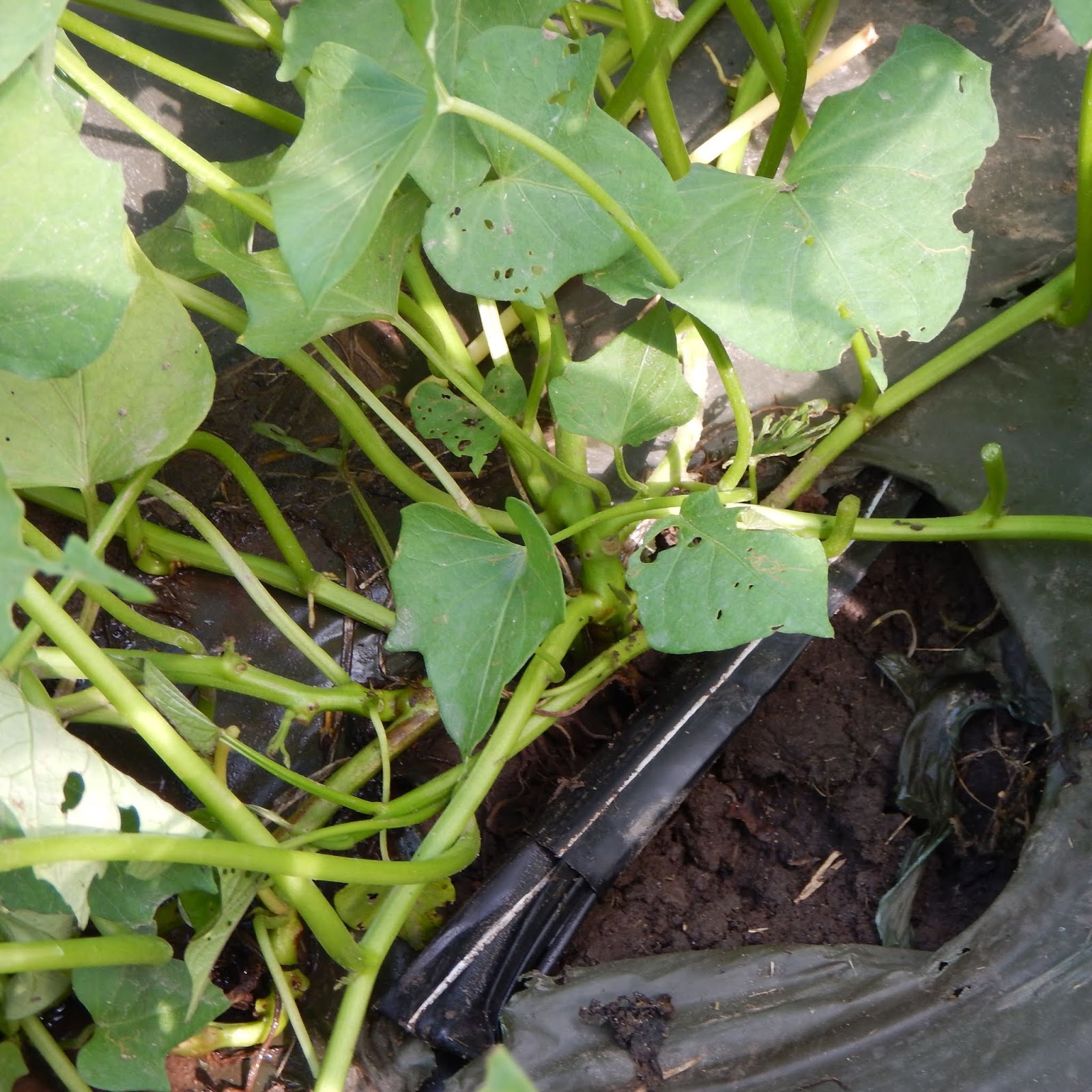
Drip tape line used to deliver nutrients to sweet potato plants.
As farmers, weather is always on our minds, so we might as well tackle this topic and get it out of the way!  There is some evidence that El Niño is finally turning to La Niña, which typically means less moisture and maybe even a bit of drought.  Since you just never know what you may get, we thought it prudent to update our irrigation permits and make sure our equipment is prepared and working well.  Whether we need irrigation as a means of delivering water to a crop or not, we use buried drip irrigation lines to deliver nutrients, microorganisms and trace minerals to our crops.  This year we are excited to expand our use of “sap analysis” to determine the specific nutrient needs of individual crops.  Sap analysis is kind of like a blood test for plants that allows us to better understand the plants’ nutritional needs at different points in growth.  Last year we saw some dramatic results when we used sap analysis to help us determine what support some of our crops needed in order to thrive.  We are planning to use sap analysis more proactively this year so we can be more aware of deficiencies and do what we can to correct them before they become a big problem.

As for crop planning, we’re laying out the plan and getting all the parts and pieces in place.  Sweet potato plants have been ordered, all 18,000!  We’ll be growing our two favorite orange varieties, Burgundy and Covington, and are also going to try a new variety called Bayou Belle.  We had better luck growing the white-fleshed Japanese sweet potatoes last year, so we’re going to expand that part of the planting a little bit.

Diana radishes, freshly washed!
We continue to appreciate the color and nutrition we get from our line-up of purple vegetables.  The color purple represents anthocyanins, plant compounds that play an important role in our physical health.  We’ll be doing one planting of the beautiful Amethyst beans and are considering growing the sweet and tasty purple tomatillos again this year.  Last year we also tried Diana radishes for the first time.  This is a spring radish that is shaped like a traditional red radish, but it has purple on the top and white on the root end.  We received positive feedback about this variety and we liked the way it looked in the field with regards to disease resistance, etc.  We have secured seed for our new favorite purple cauliflower, Purple Moon, and have our fingers crossed that we’ll get the Purple Majesty potato seed we have on order.  Lastly, we have to try a new bright magenta napa cabbage named “Scarrossa.”  We don’t typically grow napa in the fall, but that’s the recommendation for this variety so watch for this around October.

Fresh baby ginger with greens
We have been reviewing the results of our end of season survey that closed the fourth of January. We asked members for their input on which specialty produce items we should grow this year.  It’s clear that ginger is high on the list along with lemongrass!  We can’t make any promises at this point, but know we are trying to get some ginger “seed”.  Our supplier has closed ordering for now, but we’re on the list for an opportunity to purchase seed when they open ordering again sometime in February.  Wish us luck!  The other crop that had a lot of support was Egyptian Spinach.  This is a unique vegetable that grows in the heat of the summer when other greens struggle.  It is packed with nutrients and you just feel really good when you eat it!  It is a little challenging to grow, but we’re willing to give it a try!

Summer 2019:  Richard sampling and selecting
French Orange melon seeds
We continue to look for a personal-sized, yellow seedless watermelon, but there just isn’t anything available.  What about the French Orange Melons?  Good question.  For those of you who know the sweet, delicious, aromatic, one-of-a-kind French Orange melon, you may remember the sad story about how the producer has decided to drop the seed.  Richard has been working on saving seed for this melon for several years now.  This is not a quick or easy process.  The original seed was a hybrid.  When we plant the seed from melons produced from the original seed, we get a variety of results.  The sizing, color and characteristics of the melon are not always a direct reflection of the original seed.  As such, it takes several years of selecting the seed from the melons that most resemble the original set of characteristics and eliminate the off-types.  We feel like we are at a pretty good place with the quality of the seed we produced in 2019 and we finally have enough volume of seed that we can put in two nice sized plantings for actual production and harvest.  Richard will continue to carefully select seed and plant a separate seed production plot each year in an effort to refine our seed stock for this variety.  Wish us luck—we’re really hoping for a much better melon season than in 2019.  One of the problems we experienced last year was fewer pollinators.  We think the cold, late spring may have caused a decreased population of pollinator creatures.  It’s easy to take these little creatures for granted, but when something affects their population and they don’t show up, the results can be very dramatic!

Our crew happily putting together our first pollinator packs in 2016.
Speaking of pollinators, we are going to be planting pollinator packs again this year!  This is a project we started back in 2016.  In 2015 we published a series of newsletter articles we entitled “The Silent Spring Series.”  If you’re interested in reading these information-packed articles, you can find them all on our blog.  Basically the series took a look at the impact the use of agro-chemicals is having on our environment, ecosystem and our bodies.  The topic is pretty heavy and as we worked our way through the series we felt like we needed to create some light at the end of this very long tunnel.  We needed something positive to move the needle back to a point of hope.  We decided to plant pollinator packs, a garden pack with 9 different plants.  We started the seeds, transplanted them into the trays and delivered them to CSA members in the spring so everyone could use them to plant pollinator gardens in their own yard, on a patio space, in a community space or anywhere else they could think of where they would flourish, grow and serve to attract and support pollinator creatures (bees, butterflies, birds, wasps, etc).  We only intended to do it once, but it was so well-received, we get requests for them every year!  So, for those of you who already have an established pollinator garden, perhaps you’d like to add a few new plants to your space.  If you are just starting out, no worries!  We’ve included some plants in the pack that are easy to establish and will bloom in the first year!  Our order is nearly finalized and here is the list of seeds we ordered for this year’s packs.  Please note, the packs only hold 9 plants, but we’re ordering more than 9 different things just in case something doesn’t germinate very well and we can’t include it in all packs.  Here’s what we’re looking forward to:

Anise Hyssop, photo from Prairie Moon Nursery
Wild Bergamot, photo from Prairie Moon Nursery
Lance-Leaf Coreopsis, photo from Prairie Moon Nursery
New England Aster, photo from Prairie Moon Nursery
Brown-Eyed Susan, photo from Prairie Moon Nursery
Prairie Sage, photo from Prairie Moon Nursery
Lead Plant, photo from Prairie Moon Nursery
Little Bluestem Grass, photo from Prairie Moon Nursery
Blue Wild Indigo, photo from Prairie Moon Nursery
Leafy Prairie Clover, photo from Prairie Moon Nursery
Purple Coneflower, photo from Prairie Moon Nursery
Butterfly Weed, photo from Prairie Moon Nursery

We are looking forward to a great season and packing boxes for you and your families.  Once again we hope to strike a balance between supplying the staple items (onions, garlic, carrots, broccoli) and longtime favorites (sweet corn, tomatoes, green beans, strawberries) with some interesting and unusual selections to bring a little extra variety to your meals and challenge you, just a bit, to step out of your vegetable comfort zone and experience something new.  You never know, you just might discover a new flavor or vegetable you didn’t even know you liked!

In closing, we would like to share an excerpt from a note we received from a CSA family when they signed up for their second year with our farm.  Here’s what they shared:  “This past year was our first year getting a CSA share and it is not an understatement to say that it has changed our lives.  Thank you for doing what you do!  We love you guys!”  Thank you so much to all of you who send us notes like these.  We hope you understand how meaningful it is for us to read these and we also hope you understand that we think of you as we make our plans, select the varieties and pack your boxes each week.  Cheers to an awesome 2020 CSA season!