Showing posts with label garlic. Show all posts

Thursday, July 28, 2022

Garlic Harvest 2022: The Full Farmer Report

2022 Porcelain Garlic Drying in the Greenhouse

by Richard de Wilde

We finished our garlic harvest with 48,000 bulbs of medium to large size garlic.  The harvest actually went quite smoothly this year with only one interruption due to rain.  We initiated harvest a little bit ahead of schedule knowing there were chances of rain in the forecast, so we had a little buffer and could pause harvest for a few days without it causing a setback.  In most years we have to hurry and hustle to get it all harvested before a rain, in between rains, after a rain for fear that the longer we leave it the greater the chance of rot.  But this year we just paced ourselves over several days without a crazy rush!  Our harvest is drying in the greenhouses right now and before the end of this week we’ll start the process of topping the garlic and then sorting and crating to put it into storage.  The smallest bulbs, including some that were extra from our green garlic planting, will be used for next year’s green garlic, planted 1-2 inches apart.  Most of the largest premium bulbs, about 15,000 total, will be set aside and saved to plant next year’s main garlic crop.  We’ll tuck it away in the cooler to keep it safe and dry until mid-October when we pull out these beautiful bulbs and “crack” them to separate the cloves for planting.  

Garlic sprouts poking through the 
thick straw mulch in March

Once planted, we’ll cover the beds with a layer of rye straw mulch to insulate the garlic over the winter and will hold the mulch in place by covering the entire field with a huge row cover secured with sand bags to keep it from blowing away over the winter.  We’ll also put up a deer fence to deter our deer friends from tromping and digging in the field over the winter.    

Many people think farmers are crazy to take the best garlic they can produce, forfeit a sale to receive a premium payment and instead break it up and stick it in the ground with fingers crossed that it will actually survive and produce something of value the following year.  Well, let me offer a little perspective.  You can buy certified organic seed garlic at very high prices, as much as $20/pound, but it comes with only a “promise” that it is “disease free.”  So after many years of buying seed, we decided it behooves us to save our own and for the last 25 years we have maintained our own seed stock of two basic varieties.   By doing this, we decrease the chances of introducing disease onto our farm and maybe we save some money on the cost of seed in the end, or at least break even!

Our main two varieties of garlic are Red Italian and Porcelain.  Both of these varieties are classified as hardneck garlic, which means the plant will produce a garlic scape.  There is also a classification of garlic called softneck.  This type does not produce a garlic scape and is the variety required for making garlic braids.  While softneck garlic looks quite beautiful woven into a braid, from a practical culinary standpoint it is a bit more cumbersome to use.  It produces many small cloves that are a challenge to peel at times.  Some of you who have been with our farm for many years may remember the beautiful garlic braids we made with red chili peppers, dried sage and oregano flowers.  After many years of maintaining seed stock for this softneck garlic, we decided to stop growing it when the quality of the garlic started to diminish.  Now we focus our efforts on the hard neck garlic as it is what really feeds us!  

Red Italian garlic, freshly washed right out 
of the field!

The Red Italian is our most dependable garlic and is characterized by a reddish tint to the skin and an average of 7-8 large cloves per bulb.  Our other variety, Porcelain, is also known as continental and has only 3-5 larger cloves on a bulb that is mostly white in color.   For most garlic lovers, the Porcelain types with only 3-5 large cloves to peel is preferred.  From a grower perspective, Porcelain is a huge investment in “seed stock” to produce at best a one to four increase from seed to harvested bulb given there are fewer cloves on each bulb.  In contrast, the Red Italian produces 7-8 cloves per bulb which will then produce as much as 8 bulbs from 1 seed bulb!  

Planting the 2022 crop in October 2021

Growing garlic in Wisconsin is not a way to “pay off the farm,” but rather is one of our “making friends” crops.  It is fraught with weather-related challenges and seed stock problems!  As an example, for this year’s crop we had very nice seed stock that was selected from a very good 2021 harvest.  It was carefully planted right on time on October 15, mulched and covered with beautiful, clean rye straw harvested from our rye cover crop.  Before the snow started to fly it was covered and fenced from deer.  We did everything we could to give it the greatest potential, but then we had a record setting warm fall.  The above normal temperatures caused the garlic (especially the porcelain varieties) to produce more than the expected roots.  The sprouts actually grew up and pushed through the straw late last fall only to be frozen off over the winter.  When spring came late this year, the plants failed to produce new growth and they were officially deemed “duds.”  The survival rate for the Red Italian was better, but our overall harvest was down 40% from a “good” harvest!  

Our 2021 Garlic piled high and filling the 
greenhouse.  Possibly our best crop ever!

While 48,000 bulbs is a lot, we had a much higher potential last fall.  This is why we always plan for abundance and plant more than we estimate we’ll need.  When factors out of our control affect a crop, we still have enough usable product so that on the receiving end a reduced crop is not a noticeable failure.  Well, there you have it.  I just let the cat out of the bag and now you know that while we’re very pleased with the quality of this year’s crop, I’m also a little disappointed with the losses.  On the bright side, we have enough large, disease free stock to save for our 2023 crop and have enough for the remaining CSA boxes as well.  Once it’s all clean and tucked away in the cooler, we’ll be able to assess whether or not we have enough garlic to also offer it as a “Produce Plus” option later this year as we know there are some of you who would like to head into winter with a hearty supply to keep you well until spring rolls around again!  

Richard & Rafael discussing farming while
surrounded by this year's garlic crop
There you have it, another garlic harvest on the books!  Andrea asked me how many garlic harvests I’ve done or managed over the course of my farming career.  Wow, I have no idea the exact number, but I think it’s over 40!  Despite my years of experience, I continue to learn more with each year’s crop and look forward to doing it all again for 2023!  I hope you enjoy the garlic we’ve grown for you this year and appreciate and enjoy it in your meals with an occasional thought of gratitude for our hardworking farm crew that worked diligently to make it happen for you!


Thursday, June 16, 2022

Alliums – Good for Us and Always in Season!

Garlic Scapes growing from the center
of Hardneck garlic plants
By Richard de Wilde

Alliums encompass a wide variety of species including garlic, green garlic, garlic scapes, fresh garlic, as well as dried garlic for winter use.  This class of vegetables also includes onions and the relatives thereof!  Many years ago we set the lofty goal of including at least one vegetable from the allium family in every CSA box throughout the season!  This year you have already received ramps – which had a typically short season – chives, green garlic, and this week, garlic scapes.  

In what we classify as “onions” we have gone through the ‘potato’ onion and are moving into the green and purple scallions, which are grown from seed in the greenhouse starting in February, then transplanted in the spring as early as possible, this year being transplanted later than usual. We did not harvest and delver our overwintered Egyptian Walking Onions this year because we are trying to find a better way to propagate them.  Heretofore we have been trying to propagate them from the bulbils, which are the tops the plant forms, rather than from the set it produces. The bulbil tops that we harvested and replanted in fall – when we plant garlic and potato onions – have failed to produce a consistent crop for several years. So, in wanting to keep this onion in our seasonal line-up, we dug up all we had from last year’s planting and replanted the bulbs for a harvest next spring.  This is a propagation technique we previously used but tried to replace because of the hassle factor of replanting at a very busy time of year. But we like them so much as an early scallion-type onion that we managed the transplant this week! This gives us all something to look forward to for next year!   We’re always thinking ahead, with your interest in mind, and our own desire to produce seasonal onions throughout the year!
Yellow Onions Drying 
in the Greenhouse

Many of our long-term members understand the very high degree of management of detail that is involved in a long season, local diet. Yes, as farmers, we live and plan around the weather, but as managers of a detailed enterprise you would be challenged to suggest that there is any business that requires more detailed management than our diversified, focused business of feeding people locally, and in season as much as possible. While of course doing it in a manner that builds soil, captures carbon, and protects and enhances wildlife and pollinators. A win-win for our local economy, seasonal eating, and food security!

Sorry, I digress, back to alliums. I am thankful for the advice given by many people about allium production. When we experienced disease problems many years ago, we consulted with experts, and they recommended raised beds to prevent water damage to small plants. We responded, and now almost all our crops are on raised beds to minimize being damaged with flowing or standing water. Onions can experience damage to only one layer of a developing seedling, which does not show up until the onion is mature and develops ‘soft rot’ or neck rock when cured. Considering this, we have taken raised beds to a higher level in covering them with plastic and a thin sheet of aluminum foil that deters the ‘onion thrip,’ an insect that causes most of the onion disease and storage problems. Also, based on a tip from a former Seedway rep, we harvest the mature storage onions with some green in the top, and dry them in our greenhouse with 80% shade coverage to prevent sun scald and excess temperatures. This has resulted in a consistent supply of onions in even the worst weather conditions.

Onions coming in from the field where they 
are laid out on tables to dry, one crate at a time!
With the use of plastic bed covers, if we prepare them two weeks in advance of poking the hole that our transplant goes into then in those two weeks most of the weeds will germinate and die before we plant. However, onions are the exception in that we do not have two weeks of warm weather to germinate weeds as we plant them very early in the spring.  We have tried making the beds in the fall, but there were problems with that, so now we continue to plant into freshly laid plastic in spring and know that we will need to weed the holes which the onions are transplanted into. This year, as most, we have already hand weeded twice!

This whole system, developed over 20+ years and adapted yearly, has produced the most consistent onions and long-term storage onions for many years!

2022 Onion Field with Erosion Proof Aisles of 
Cover Crop In Between Raised Beds of Onions
Plastic disposal is still a process. We have had promises of plastic recycling, but the most recent company has suspended pick-up since the pandemic started. We do make extensive use of rye straw that we bale from winter cover crops. However, mulch cools the soil – which is great for garlic and strawberries – but for onions, the reflective mulch with onions planted directly into a black strip has proved far superior to any other system. For onions we plant low growing White Dutch Clover with Red Fescue to provide an erosion-proof aisle between the raised plastic beds. We manage any weeds that come through the Clover and Fescue with a weed trimmer. See photo of a recently trimmed aisle which transports excess water away without causing any soil erosion, while in fact contributing to soil improvement.

Juan Pablo & Alfredo hand weeding onions
With our allium crops, as with all our crops, we employ technology, experience, and observation, while also artfully managing the many hands which do the hard work. This allows us to grow a nutritionally superior crop without the use of any synthetic chemicals which would destroy our health and which would have wreaked unimagined destruction on our bird, bat, and pollinators. Our use of organic methods ensures that the local ecosystem will remain healthy and in balance, and that we will be able to provide delicious produce long into the future.

Friday, April 16, 2021

April Farm Update…..Ramps, Overwintered Spinach and the start of a new CSA Season!

By Andrea Yoder & Richard de Wilde

Rows of gorgeous Green Garlic!
Spring is here and we’re just 3 weeks away from the first CSA deliveries of the 2021 season!  Every day we see a little more green filling our valley as our wooded hillsides come out of winter hibernation.  Despite the fact that we’ve had a quite chilly week with temperatures in the low thirties overnight, we would still describe this as an early spring.  Things are changing quickly and the growing season is starting to take shape.  Here’s a little glimpse of what’s happening on the farm.

Remember those gorgeous sunny, warm days back in March?  Those were the days that jump started the garlic crop and we had to strip back the cover and loosen the mulch to make sure the sprouts could push through!  The green garlic looks quite nice and we are planning to start harvesting some next week.  Richard can’t remember ever putting green garlic in the first CSA box of the season, but it will be in the first boxes this year!

Unloading our first ramp harvest this week!
You cannot talk about spring happenings at Harmony Valley Farm without talking about ramps and overwintered spinach.  These are two crops many people, ourselves included, look forward to every spring.  We started harvesting overwintered spinach last week and yesterday we did our first ramp harvest!  We know everyone would like to receive these two items in the first few CSA boxes in May, and we hope we’ll be able to include them.  Unfortunately, we’re at the mercy of Mother Nature and the season for both of these crops is starting a little early this year.  So if you are one of those people who needs to get your fill of ramps and overwintered spinach before their short season is over, we encourage you to head to your local food co-op and stock up on these items now!  If we are still able to harvest ramps in May, they will certainly be in your box.  And that overwintered spinach?  We are doing our best to manage the crop and hope to be able to time it just right so we can do a second harvest off these plants for the first few CSA deliveries.

Antonio hand-harvesting
Overwintered Spinach
We are also happy to report we had a very good harvest of overwintered parsnips and sunchokes.  The parsnips are so sweet and delicious, they need nothing more than to be tossed with oil, salt and pepper before roasting them.  Our spring sunchoke harvest was very plentiful and we’ve been staying busy washing and packing them for our wholesale partners.  Not only are they an important part of our spring diet, they also help us financially while we’re getting the season underway.

Last week we did our first plantings of salad mix, baby spinach, arugula, cilantro, radishes, baby bok choi, dill, hon tsai tai and baby white turnips.  While we plan to plant these crops in the first week of April, we seldom have the opportunity to actually do so!  The radishes are already up and we’re crossing our fingers that they will be ready for the first week of deliveries!

While we are anxious to plant more crops, it takes awhile to get fields ready in the spring.  Over the past two weeks the guys have been working hard to spread compost and minerals, subsoil, rototill and shape beds for planting.  This year we partnered with a new supplier for our compost and we’re very pleased with the product.  We had to pay a little more for it, but it is well-made, easy to spread and for the first time in many years we have had favorable conditions to be able to spread compost on all of our fields in the spring!  We also invested heavily in mineral applications, including trace minerals.  Adequate fertility in the soil is a key to producing delicious vegetables, but it’s also important for producing healthy plants that pass their nutrients on to us!  We were also able to put minerals on our pastures where we graze our animals as well as the fields where we grow hay to feed them in the winter.  Just like humans, animals can taste the difference and always favor the mineral rich parts of the pastures.  I guess you could say they are grass connoisseurs and definitely have discerning palates!

Germ testing beet seed in the
greenhouse to test seed quality
As we finish preparing fields, we’ll move on to planting.  We hope to see warmer temperatures next week which will be more favorable for direct seeding beets, carrots, parsnips, chard and possibly even the first peas.  We did start transplanting onions a week ago.  It takes quite awhile to plant all of our onions and we hope to finish them today.  We are anxious to transplant more crops including the first broccoli and cauliflower, kohlrabi, cabbage and leeks.  We are also anticipating a shipment of strawberry and asparagus plants today, purchased from Nourse Farm in Massachusetts.  It’s already time to plant next year’s strawberry field!

While we’ve completed about three-fourths of the plantings on our greenhouse plan for this year, we still have plenty of greenhouse work to complete over the next few weeks.  Next week we’re scheduled to plant our first tomato seeds in the greenhouse and we hope to plant zucchini before this week is finished.  It’s also time to transplant the herb packs we’ll deliver for you in mid May!

Leonardo, Antonio and Isidro
transplanting peppers 
So who is doing all this work?  Good question!  We welcomed back 24 of our field crew who comes from Mexico on agricultural guest worker visas.   We were happy to see them on March 29, but from a distance as they had to quarantine due to their recent travel.  Thankfully they had an uneventful quarantine period and everyone remained healthy and well without so much as even a cold!  While we all wish the pandemic would move into the past, we also acknowledge it is still very much a concern at present.  Our crew members understand the importance of how our individual choices impact the work we’re able to do at the farm and they did their part to minimize their risks of exposure both before they departed their homes as well as during their travels.  Their efforts were clearly effective and we are thankful they are all in good health, ready and eager to work!  We are looking forward to welcoming another group of workers the last week in April and have our fingers crossed that they will arrive without any delays.  We are also grateful for the opportunity to work with Family Health La Clinica, an organization that offers mobile health services to migrant workers.  They have been an invaluable resource for our farm as they have helped us navigate managing our workspace throughout the pandemic to keep our workers safe.  They will be coming to the farm to administer vaccinations to any crew members who would like to receive it.  In the meantime, we continue all of our precautionary practices to do the best we can to remain healthy so we can all keep farming!

We’ve received several emails from CSA members inquiring about the use of plastic liner bags in the CSA boxes this year.  Just as we are continuing our precautionary practices on the farm, we will also continue to take a precautionary approach to CSA deliveries as well as with CSA pick up procedures.  While we hope that we’re collectively making forward progress in moving past the pandemic with vaccinations, etc, we also feel that we need to continue to be precautionary and would like to continue to offer a safe pick-up option for all our members knowing some of you are high-risk individuals or live with high-risk individuals.  We realize the concerns for transmission of the virus on touch surfaces may be less than we thought one year ago, however using the plastic liner bag in the CSA boxes serves other purposes as well.  We want to limit the time each member is in the site and continue to ask that only one member enters the site at a time.  The use of the bag also helps achieve a quick in and out pick up.  Thus, we will continue to use the plastic liner bags for now.  We’ll certainly reassess as the year goes on and if at some point we feel it is appropriate to discontinue using them we will do so.

Repurpose CSA bags as covers for
storing artwork!
In the meantime, we do ask all CSA members to continue to follow the pandemic procedures we laid out last year to facilitate a quick, safe CSA pick-up.  This includes wearing a mask when you go to pick up your share, physically distancing at the site and only one person enters the site at a time.  As for the bags, we encourage you to find ways to repurpose them in your own homes or communities.  Last year we compiled a list of ways you, our members, were creatively repurposing them in your homes.  You can view that list HERE, and we ask that you continue to send us your creative ideas as you find more ways to repurpose them.  If your collection goes beyond what you can use in your own home, you may also consider checking with other organizations in your community such as your local food pantry, schools, community centers, etc.  They may be able to use them for projects, etc. in their organizations and might appreciate the donation!  At the very least, the bags are recyclable.

Transplanting onions one week ago....
just before it started to rain!
This certainly is not everything we are doing on the farm, but at least it gives you a snapshot.  We are looking forward to growing food for you and your family this year and hope you are ready to start cooking and eating some tasty meals!  We do still have room to accept more sign-ups for all of our delivery areas, so if you haven’t signed up yet we encourage you to do so!  If you have a friend, neighbor, or know of someone who is interested in joining, please refer them to us.  We will keep adding members until we’re officially sold out!

Enjoy the rest of April and we’ll see you in May!

Thursday, March 18, 2021

March Farm Update: Farm Happenings, New Vegetables for 2021, and Survey Report!

By Andrea Yoder & Richard de Wilde

The greenhouses are filling up!
We’re less than seven weeks away from our first CSA delivery and this weekend will mark the official first day of spring!  For those of you who have already signed up for your 2021 shares, we want to give you a huge “THANK YOU!”  We are happy to report that we are 75% of the way towards our maximum capacity for this year and we are still accepting sign-ups for all types of vegetable shares at all sites right now.  We do anticipate we’ll sell out earlier this year, so we encourage you to get your order in soon if you have not already signed up!

We want to update you on a few farm “happenings.”  Our greenhouses are filling up quickly and our small winter crew is doing their best to keep us on schedule with plantings.  This week we saw the first celeriac sprouts poke through along with head lettuce and broccoli!  We also planted the savory and oregano for the beloved herb packs we’ll be delivering with your shares in May.  Next week we’re scheduled to plant more head lettuce along with fennel and our first planting of kale and collards.  We’ll also likely run out of space and have to move into our third and final greenhouse.  Once that’s full, the only option we’ll have is to move plants to the field!  We’re looking forward to welcoming more of our field crew back, hopefully the last week of March!   Cross your fingers that we get some nice, mild spring weather so we can start preparing fields for planting as soon as they arrive!

Richard's sample harvest of overwintered parsnips
Before the four inches of heavy, wet snow we received earlier this week, it was actually starting to look like it might be an early spring!  Rafael, Isidro and Moises spent a little time trimming pussy willow and curly willow hedgerows.  They also pulled the cover off the garlic field and started loosening the straw mulch so the garlic sprouts can push through.  Richard dug a few overwintered parsnips just to see how they looked.  The ground was still a little frozen and after the snow, it’s very wet.  We’re happy to report that they do look like they’ve fared well over the winter and the few we cooked up tasted like candy!  Many of you are wondering about ramps, asparagus, and overwintered spinach.  We haven’t seen any signs of ramps yet and it’s still too early for asparagus.  Richard did sneak a peek at the overwintered spinach which is under a cover.  It looks rough right now, but that’s always how it looks this time of year.  There is new growth coming from the plants, so we’re hopeful for a good crop this spring!

Pie-Pita Pumpkins
(photo from HighMowingSeeds.com)
It’s crazy to think we could be doing our first field plantings in 2-3 weeks, but it is possible!  We’ve received the majority of our seeds, but are still waiting on some backorders.  Every year we trial some new vegetables, so we thought we’d give you a little glimpse at some of the things we’re trying this year.  Pie-Pita is a new pumpkin with this description that caught our attention:  “…A brilliant development in pie pumpkins……delicious, high Brix pie pumpkin flesh with the added bonus of hulless seeds inside.”  They say you get an average of ¼ pound of seeds from each pumpkin.  When I called this order in, the customer service rep taking my order got giddy with excitement and then confessed it is one of her favorite new vegetables being offered by High Mowing Seeds this year.  With her endorsement, we’re excited to see it for ourselves!

GinFiz Tomatoes
(photo from OsborneSeed.com)
We also have a few new tomato varieties on the list.  Our friends at Osborne Seeds had a couple new ones including Darkstar, GinFiz, MaiTai and CubaLibre.  We’re looking forward to Darkstar because it has a “rich purple color with brown hues and incredible flavor……with the look of an heirloom tomato and the added bonus of Late Blight resistance.”  Some years can be very challenging for growing tomatoes in our valley and leaf diseases can mark the early end of a tomato crop.  We always try to select varieties that taste good and are attractive, but also have disease resistance so we can actually keep the plant alive long enough to produce good fruit!  CubaLibre is a black tomato with “heirloom appeal,” but we also selected it for its “excellent disease package.”  GinFiz and MaiTai are eye-catching varieties with hues of orange & yellow mixed with splashes of red….. “like a sunset!”  We know you appreciate variety, so we’re hoping these varieties will add a little fun to your summer tomato salads and BLT sandwiches!

We received favorable feedback last year from our trials of purple napa cabbage, so we’re trialing a few more varieties in this class this year.  The Amy melon from last year’s trials also received high marks from the members who had the chance to try this melon.  Amy is a canary type melon with a bright yellow rind and creamy, sweet, smooth white flesh.  We are looking forward to growing more of these so everyone can try it this year!

Garlic sprouts poking through the mulch.
We do value your feedback and use it to help us refine our plans, make changes, etc.  We had an excellent response to our "2020 End of Season Survey" with 999 participants!  Thank you for taking the time to do the survey and offer your feedback.  We wanted to share a few highlights from the results.  Overall, we received a very positive response with high ratings for satisfaction with the overall CSA experience as well as customer service, product quality and communications.   We selected a list of 30 crops and asked for your feedback about how much you received.  We try to strike a balance, yet offer variety and keep things interesting.  Thus, we wanted to know how close we were to the bullseye.  Of the 30 crops, 21 crops received a "Just Right" rating from 60-70% of respondents who felt they received a good amount of the item over the course of the season.  We had 8 crops that received a "Just Right" rating from 70-75% of respondents.  In some cases, the remainder of responses were nearly evenly split between "Not Enough" and "Too Much."  When the pandemic is past and we can go back to having a Swap Box at the sites, those who feel there is too much of something can leave it for those who may want more!  In the meantime, consider striking up a trade with a neighbor or friend after you take your vegetables home.  There were some crops though where the remaining responses were more strongly weighted in one direction.  20-30% of respondents indicated they would like more green beans, garlic, sweet peppers, sweet corn and tomatoes along with Brussels sprouts, spinach, salad mix and kale.  The takeaways from this feedback for us are that overall we're doing a pretty good job, but we have some room to tweek the quantities of some things.  Some items, like sweet corn, are difficult.  There's a limit to how much we can put in the box and still have room for other items!

Broccoli sprouts just pushing through the dirt.
We also asked you to choose your top 3 favorite selections from your CSA Box in 2020.  Here are the top 10 vegetables that received the highest number of responses:  Brussels Sprouts, Garlic, Greens, Ramps, Salad Mix, Winter Squash, Strawberries, Sweet Corn, Sweet Potatoes & Tomatoes.  

We asked the same question but asked the children in the household to answer the question.  Here are the top 10 responses from the children:  Green Beans, Broccoli, Carrots, Brussels Sprouts, Cucumbers, Melons, Potatoes, Strawberries, Sweet Corn and Tomatoes.  We’d have to agree with both the adults and the children--these are some of our favorites too! 

Farmer Rafael scouting out ramps (2020)
Most of the top 10 favorites are fairly short season, with some coming on in the peak of the summer and a few in late fall.  While we all enjoy eating these in  the peak of their season, we have to be realistic  that we need more vegetables in our diet over the course of the year than just these top 10 favorites!  This is one of the reasons we’ve worked hard to extend our season early in the year with some unique spring specialties like asparagus, ramps and rhubarb.  At the end of the season we rely on a wide variety of storage vegetables to sustain us when fresh vegetables from the field are not an option.  If you were to ask either of us what our top three favorite vegetables are, the answer would probably be different depending on what season we are in!  That’s the beauty of seasonal eating.  You can have many favorites throughout the year which means you always have something to look forward too!
Colorful Mini Sweet Peppers!

Last year we had a phenomenal response to our “Produce Plus” offers, both during the year as well as with our “End of Season Special Offers.”  This is another great way to “stretch” the season so you can continue to eat local the entire year.  Last night we enjoyed our final bag of green beans we had frozen back in August and we’re still using frozen mini sweet peppers in everything from scrambled eggs to soups, stir fry and pizzas.  They taste just as delicious now as they did in the summer!  Some of you may still be enjoying jars of salsa or tomatoes you canned last summer and there are at least a few of you who have some pickled jalapenos on your shelf too!  Just this week I spoke with two members who still have sweet potatoes and winter squash they got at the end of the season.  They are storing well and they have found many ways to continue to enjoy them.  We’ve received a few emails from members who ran out of carrots and other winter roots earlier than they anticipated and have made some notes for themselves that read something like this “Order more vegetables at the end of the season so you don’t run out before spring!”   

There are many ways to extend the local Midwestern growing season and your CSA season.  Whether it’s canning, freezing, fermenting or drying vegetables; stocking up on storage vegetables; or simply making large batches of recipes you can freeze and tuck away in the freezer, they all help bridge the gap between growing seasons while keeping your body well-nourished and healthy.  So, this year we’ve tried to build in a little extra to our planting plans so we can better provide for those who would like to take advantage of stocking up beyond their weekly vegetable shares.  If there are specific items you are interested in purchasing in bulk, please let us know.  If we are able to do so we’ll add it to the list!

That’s a wrap for now.  It’s time to go water the plants in the greenhouse, finish the fertilizer order, work on the spring training plan, and do the final edits to the 2021 CSA calendar so we can send it to the printer!  Enjoy the rest of this month and we’ll catch up again in April!

Wednesday, July 15, 2020

July Farm Update

By Farmer Richard

Tomatillo fruit hanging heavy on the vines
and filling out their husks!
Despite the fact that we just did a farm and field update last month, a lot has changed and happened since then and we want to let you know what’s happening at the farm! We are at the apex of the season, halfway through the calendar year and one-third of the way through our CSA delivery season. The spring crops and weather were quite moderate and we were able to pack quite nice boxes for the early part of the season. But we know you can only eat so many radishes and lettuce and many of us look forward to all the delicious vegetables of summer! We’ve been delivering cucumbers and zucchini for several weeks and we’re in our second week of beans, but there are more summer favorites coming up very soon! If you don’t have time to read all the details of this week’s update, at least take a look at the pictures! Our hope is that we can connect you with our farm virtually so you know where your food is coming from and can have those images in your mind when you unpack your box each week!

The start of this year's garlic harvest, drying in the greenhouse.
Summer did not enter gently this year. The past two weeks have been a new challenge of very hot and humid days. We had a stretch of days reaching 88-90°F every day with high humidity that left us all with beads of sweat running down our brows early in the day. We started off the summer in a bit of a dry spell, but that has quickly changed as we’ve had frequent rains totaling about 9 inches in the past two weeks. If our more normal spring was a result of the extreme cutback in emissions related to COVID-19 changes in travel, etc, then it leaves us wondering if the sudden and recent switch to extreme weather is connected to “opening up.” Hmm….maybe we don’t want to “go back to normal!” Well, normal or not, we are looking forward to the second half of the season and we have a job to do. So here’s a glimpse of what is yet to come.

Rows of tomatoes in our 1st planting--staked,
tied and setting on fruit!
Spring days are highlighted by lots of planting and weed control. While we’re trying to get everything in the ground and keep up with flame weeding, mechanical cultivation and hand weeding spring crops, we are also planting and caring for the summer crops that will follow. Our efforts to control weeds are directly related to the hand of weather conditions we are dealt. While our crew members have done a good job keeping up with timely cultivations, rainy, wet conditions limit what we can do mechanically. Unfortunately, the weeds thrive in these hot, wet conditions which adds salt to our wound and leaves us with some big hand weeding jobs! We’re doing the best we can, but hand weeding requires a lot of crew time that we just don’t have many days. We’ve had a dedicated crew of four people who were hired specifically for focusing on hand weeding missions, but the weeds are growing faster than they can pull them! While the majority of our experienced H2A crew members arrived back in April, we did have several who received “administrative hold” and were not issued visas. Due to pandemic-related changes with the consulate’s office in Mexico, these members had to return home and wait for the call to return for further evaluation. They were also restricting visas to only those who had had a visa previously and were not considering any new applicants. Finally, the
A hillside sweet corn field....look carefully and
you'll see the deer fence surrounding the
field to help deter the critters.
first week in July we received notice letting us know the consulate’s office was ready to look at their cases. We are happy to report that four more crew members received their visas and made the long journey to Viroqua arriving last Thursday! We have only seen them from a distance as they will remain quarantined for 14 days, separate from the rest of our crew and with no contact with others in the community. They arrived healthy and well, going directly to the house we prepared for them complete with a fully stocked kitchen! They’ll reside in this location until the end of their quarantine and will stay busy during the day tackling their own weeding missions in fields we’ve assigned to them safely distanced from any other people. Thankfully, that is the beauty of being in the country where there are wide open spaces! We look forward to integrating Alvaro, Silvestre, Samuel and Joel into our crew in the near future. They all have special skills and contribute greatly to our farm. We’ve really missed them and are thankful to have them here!

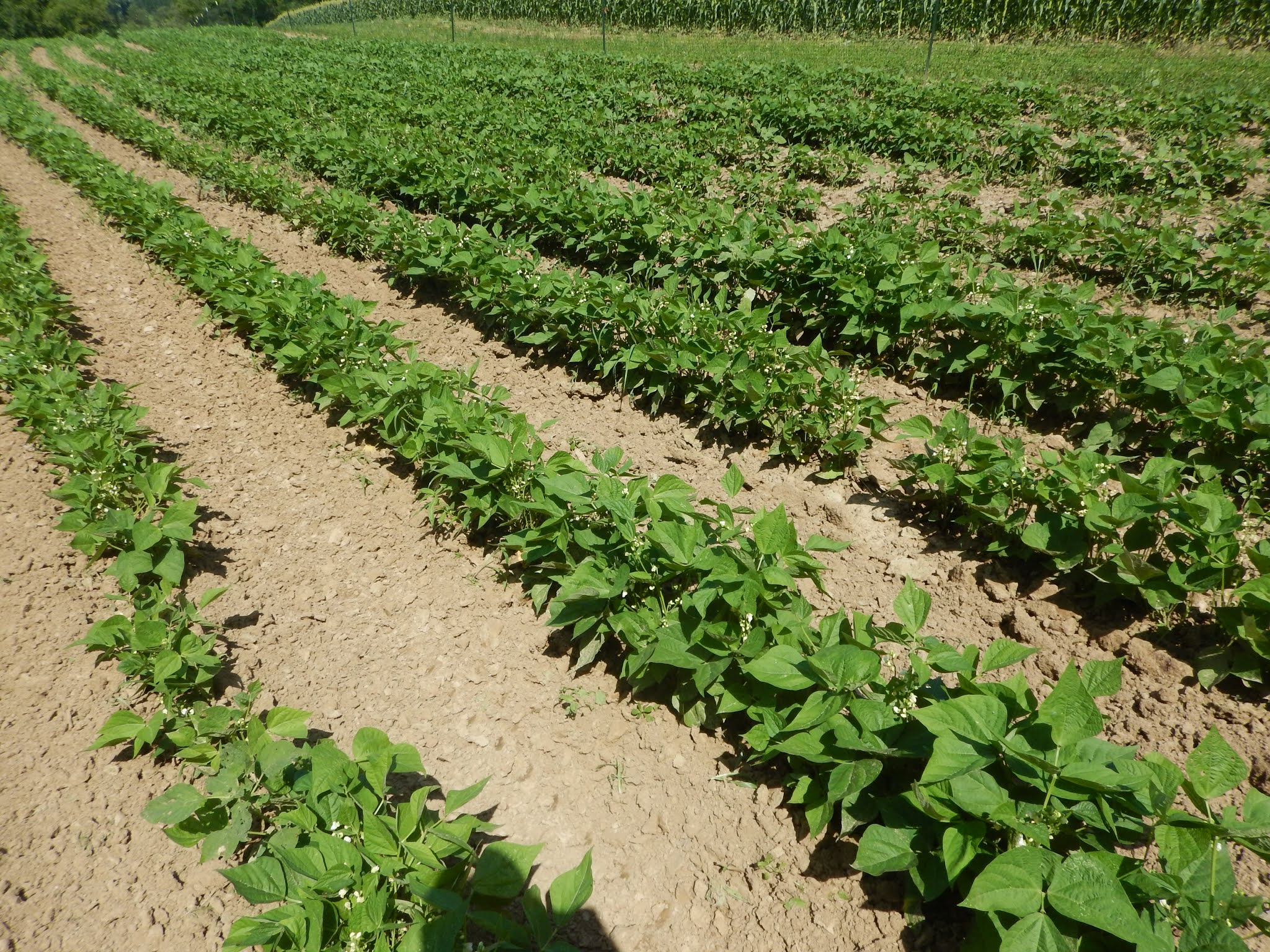
An upcoming crop of green beans,
nicely cultivated and setting on blossoms!
That’s enough about weeds though, lets look at some crops! Our first two crops of beans have yielded very nicely and after this week we still have three more crops coming up. They are all looking good and we’re hopeful we’ll be able to keep the bags of beans coming your way! We also have three crops of edamame coming up. The deer population in our area is fully informed that we grow edamame, so we have to be proactive and make sure we keep these crops surrounded by a tall deer fence to keep them from eating the plants! So far, so good and we hope to deliver the sweet, tasty fresh edamame in the near future.

An early crop of sweet corn, notice the small ears of corn.
Summer isn’t summer without sweet corn! While sweet corn isn’t a big money maker for our farm, I’ve always said it’s a crop worth growing because it earns us friends! Every year we have the goal of growing “the best sweet corn ever!” We’ve had many successful years doing so and hope we can pull it off again this year! We have planted five crops and they’re looking pretty good! The first crop suffered some loss from red-winged blackbirds that dug up about 50% of the seed. The remaining crops fared much better, but we still need to be diligent about keeping the critters out of the field! If the raccoons, deer and birds get a taste of the sweet ears of corn, they can really do some damage. These fields are also fenced and we’ll be monitoring them very closely as the corn matures and reaches the point of harvest. We’re also monitoring for the corn earworm moth which migrates from the south. With the reduced bat populations we have a larger challenge to produce sweet corn without these worms. The researchers and experts say it can’t be done organically, but with careful monitoring and a high level of management we have pulled it off many times before! So, we know it can be done and we’re going to do our best. Please know this is quite challenging to achieve, so if you do find a worm, please be forgiving.

The beloved SunOrange tomatoes--so sweet they're like candy!


The cutest little watermelon!
Tomatoes are another beloved summer crop we know you are all looking forward to. We actually had our first sweet taste of SunOrange tomatoes this week! I only found enough to pick a small handful and between Andrea and Amy, they didn’t last long. We have two crops of tomatoes planted, mulched, staked and tied and looking great! The first crop has a lot of fruit set on and we’re hoping we can start picking some of the early varieties within the next few weeks. The eggplant field is also looking quite nice. The plants have blossoms and the start of some small fruit setting on. Things could happen fast at this point, so we anticipate we’ll start harvesting eggplant within the next few weeks.

Our melons and watermelons are not far from the eggplant field, so it seems fitting to report their status now as well! After a few low yielding, disappointing years, this year’s melon and watermelon fields are looking good and setting fruit.  We’re keeping our fingers crossed that this continues and we’ll all be eating some of those “juice dripping down my chin” melons very soon! Lastly, I want to mention the peppers. We’re finally starting to see some fruit set on. The ½-inch jalapenos are quite cute and we’re hoping some of the other varieties will be ready to pick very soon.

While we’re in the midst of summer, we’re already looking to fall crops! The sweet potato vines are spreading nicely and the winter squash fields look great! On our field tour last Sunday we even spotted a nice-sized festival squash! It will be awhile before it’s mature and ready to harvest, but seeing that fruit made us realize how quickly this year is going! We’ve also started planting our fall root crops and within the next couple of weeks we need to plant beauty heart radishes, black Spanish radishes, daikon, turnips, etc.

A view of the sweet potato (left) and winter squash (right)
fields with blue skies overhead!
We also have to look ahead to the next growing season. We are already selecting and reserving fields for a new crop of strawberries knowing we need to plant a new field in 2021. We are also in the midst of garlic harvest which means we’re selecting and saving garlic for next year’s crop. We have had an unexpected increase in CSA members this year, more than double from last year. We welcome this increase and are hope you will all join us again next year as well! CSA is our preferred market to grow for and benefits our farm in many ways. We’ll see what the next year holds. Later in the fall we will be asking you to commit to the 2021 growing season so we may better plan for next year. We hope you will end this season with an increased appreciation for local and high quality organic produce along with a desire to make a commitment for next year. But for now, enjoy the rest of the season!

Wednesday, July 31, 2019

August 1, 2019 - This Week's Box Contents, Featuring Garlic!

Cooking With This Week's Box


White Spanish Onions: Cheeseburger Onion Rings


Fresh Porcelain and/or Italian Garlic: Triple Garlic Linguine (see below); Portuguese Bread and Garlic Soup with Cilantro (see below); Skillet Zucchini Pesto Pizza; Pasta with Smashed Zucchini Cream; Garlic Broccoli Stir-Fry


Green or Purple Beans: Fresh Green Bean Salad

Red Norland or Golden Carola Potatoes: Crispy Potato Tacos

Green Bell Peppers: Portuguese Bread and Garlic Soup with Cilantro (see below); Crispy Potato Tacos

Jalapeno Pepper: Portuguese Bread and Garlic Soup with Cilantro (see below)

Sunorange, Chocolate Sprinkles, or Red Grape Tomatoes: Fresh Green Bean Salad; Crispy Potato Tacos

Cilantro: Portuguese Bread and Garlic Soup with Cilantro (see below); Crispy Potato Tacos


We’re flipping another page on the calendar this week as we welcome in the month of August!  Summer is whizzing by, but August is also an exciting month filled with sweet corn, tomatoes and peppers so who can complain!  This week we’re going to start topping our garlic, sorting out our seed stock and getting it all tucked away safely in the cooler.  So needless to say, garlic is at the forefront of our thoughts which is why I chose it as our featured vegetable!  This week we have two garlic-centric recipes.  The first is for Portuguese Bread and Garlic Soup with Cilantro (see below).  As with many traditional recipes that stand the test of time, this recipe has its roots in peasant food.  This is a very fitting for this week’s box though as it utilizes not only garlic, but also jalapeno and bell peppers as well as cilantro.  It comes together pretty quickly as well, so it’s a good option for a healthy, quick dinner.  The second recipe is Triple Garlic Linguine (see below).  It’s a simple garlic-forward pasta dish, but you could add other things to it such as some diced chicken and/or chard.

Skillet Zucchini Pesto Pizza
photo from runningtothekitchen.com
I’ve been having fun finding and trying new recipes using zucchini this summer.  You know I love a good, simple pizza, so this recipe for Skillet Zucchini Pesto Pizza caught my eye.  I also came across this recipe for Pasta with Smashed Zucchini Cream.   Aside from some Parmesan cheese, this pasta dish actually doesn’t have any cream in it.  The creaminess comes from smashing the zucchini and letting all the juices come together to create the sauce.

If you didn’t have a chance to see last week’s featured vegetable article about cucumbers, I’d encourage you to check it out.  If you go to the bottom of the article you’ll find a list of 30 recipes/recipe ideas all featuring cucumbers!  So if you are running out of ways to enjoy cucumbers, let me suggest a few things you may not have tried.  Perhaps these refreshing Cucumber Mint Green Tea Popsicles or this Mojito Cucumber Mint Sorbet will hit the spot!

This week we’re picking both green and purple beans.  Both varieties are more tender than our earlier varieties and thus, better for eating raw.  Growing up, we only ate green beans cooked…rather overcooked, thus I despised green beans.  It wasn’t until my adult years I realized you can eat them raw.  Now that is my preferred way to eat them, which is why this Fresh Green Bean Salad is on the list for this week!  Raw green beans are crunchy and fresh tasting and can become a tasty simple salad with a light vinaigrette mixed with some other summer vegetables like the cucumbers and tomatoes in this recipe!

Smashed White Bean KAle Quesadillas
Photo from runningtothekitchen.com
One of our awesome CSA members posted this recipe for Smashed White Bean Kale Quesadillas in our Facebook Group.  It’s a simple recipe, but a good one for a quick, easy, yet filling dinner option.  Really you can use any green in this recipe, one member suggested she was going to use last week’s amaranth greens which made me think of making these with this week’s chard!

I hope you’ve been enjoying the fresh potatoes, I know we have been!  This week I want to try this recipe for Crispy Potato Tacos.  This recipe calls for Russet potatoes, but I think a waxier potato such as the Red Norland or Gold Carola potatoes we’re sending this week would be a better option.  I would also suggest adding some sautéed green bell peppers to the tacos and top it off with quartered grape tomatoes and cilantro from this week’s box.

Looking for something different to do with carrots this week?  How about turning them into this refreshing Tropical Carrot Smoothie!  Many carrot drink recipes call for carrot juice which means you lose the fiber—no good!  This one blends the whole carrots with strawberries, mangos and other frozen fruit.  Perfect!  Or, if you prefer a creamier drink, try this Carrot Cake Smoothie.

Garlic Broccoli Stir-Fry
photo from omnivorescookbook.com
Looking for a simple side dish?  Try this recipe for Garlic Broccoli Stir-Fry.  It would actually go well with these Cheeseburger Onion Rings.  I know I always tell you to slice the onions thinly, especially when serving them raw.  This recipe, however, is an exception to that rule.  You make thick slices of onion and then pull the rings apart.  Press ground beef and a piece of cheese inside the onion ring, bread the whole thing and fry it.  You end up with a crispy coated burger wrapped in a slice of onion with gooey melted cheese oozing out the middle!  Ok, it might be a little messy but it sounds kind of fun and these white onions are the perfect onion for this application!

That concludes this week’s cooking chat.  Have a great week and I’ll see you back next week, hopefully with recipes for using edamame and more tomatoes!—Chef Andrea

Vegetable Feature: Garlic 


By Andrea Yoder


“In all of its many forms and in kitchens around the globe, the lusty and pungent allium garlic is the flavor of comfort.”  This is the opening line in an article entitled “The Glories of Garlic” published in Saveur magazine October 9, 2014.  Garlic is one of the oldest cultivated crops and has made its way around the globe to permeate and enhance the cuisine of cultures all around the world.  In Spain it’s used to make Ajo Blanco, a chilled garlic and almond soup.  In Argentina it’s a key ingredient for making chimichurri, a fresh sauce or condiment consisting of parsley, oregano, garlic and red wine vinegar that is commonly served with grilled meat.  In Chinese cuisine, garlic is an integral part of the base of many dishes along with ginger and scallions.  In France, garlic is used to make aioli, or rather a fancy name for homemade garlic mayonnaise.  These are just a few examples of how important garlic is to our diets, no matter where we come from in this world.  So this week we are featuring this staple ingredient that we strive to include in every CSA box throughout the season, in one form or another!

Garlic is a big deal crop for us, partly because we like the challenge of growing it, but also because we value having it available and we use it in meals throughout the entire year.  We start off the season with green garlic, then move on to garlic scapes, then fresh bulb garlic and finally, dried garlic that can be stored throughout the fall and winter.  We value garlic for its flavor, but also for its health and medicinal value.  It’s antimicrobial, antifungal, antibacterial…..basically, it’s good medicine.  Richard swears by a good raw garlic sandwich to ward off something as simple as the common cold.  Perhaps including garlic in your diet daily is a good dose of prevention and gives your immune system the daily boost it needs to keep you healthy!

Italian Garlic
While we have several different varieties of garlic, we have two main types that are our “workhorse” varieties.  These two varieties are Italian and Porcelain.  At the farmers’ market we are frequently asked “What’s the difference between the two?”  I don’t think the flavor of these two garlic varieties are much different, but perhaps you’ll detect some subtle differences.  The thing that sets these apart in my kitchen is the size of the cloves.  Garlic forms a bulb or head of garlic that contains individual pieces of garlic called cloves.  Italian garlic forms more cloves per head than porcelain, but the cloves are smaller.  Porcelain garlic, on the other hand, has fewer cloves per head but the individual cloves are bigger.  We use a lot of garlic in our household, so I tend to gravitate towards porcelain garlic simply because it means less peeling!  You can tell the difference between the two not only by the size of the cloves, but also by the color of the skin.  Porcelain garlic has pure white skin with just an occasional streak of purple while Italian garlic has more reddish purple coloring.

Porcelain Garlic
Properly dried garlic typically has a long shelf life if stored in the right environment.  We store garlic in a cold, dry cooler at about 34-36°F.  Home refrigerators are usually too humid to properly store garlic, so if you are looking to store garlic for awhile or over the winter in your home, we recommend you store it in a cool, dry place out of direct sunlight and a location with good ventilation.  If you ever purchase garlic from us as a produce plus item, we’ll pack it in a mesh bag that can be hung up.  The mesh contains the garlic but allows it to breathe and have better airflow.

In its raw form, the flavor of garlic can be very strong, spicy and even might burn a bit if you eat a big piece!  Some people really like this bold, strong garlic flavor.  Others may find raw garlic too pungent for their palate, so for those individuals I recommend enjoying garlic either sautéed, fried or roasted.  Cooking releases some of the pungent sulfur compounds, mellows the intensity and even sweetens it up a bit.  You can roast a whole head of garlic in the oven until the cloves are soft and golden, then pull the cloves off the head and squeeze the soft, roasted garlic out of the skins.  You can also peel garlic in advance, toss it with oil and roast it in the oven or cover it with oil and slow roast it to make garlic confit.  The benefit of the latter is that you end up with a flavorful garlic oil as well as roasted garlic cloves!

This year’s garlic has been drying in the greenhouse for almost three weeks now and it’s finally ready to start removing the tops and sorting.  We have a big job ahead of us over the next two weeks as we sort out our seed and get everything moved from the greenhouse to the cooler for storage until late December.  This week we encourage you to try some more garlic-forward recipes as we embrace this beautiful vegetable, celebrate its recent harvest and look forward to enjoying garlic throughout the remainder of the season!

Triple Garlic Linguine


Yield: 4-6 servings


photo from saveur.com
1 head garlic, plus 10 cloves (7 thinly sliced, 3 minced)
1 cup olive oil
½ tsp crushed red chile flakes
12 oz linguine
4 ½ cups chicken stock
½ cup grated parmesan
2 Tbsp fresh lemon juice
2 Tbsp roughly chopped parsley, for garnish
Kosher salt, to taste

  1. Heat oven to 350°F. Slice garlic head in half crosswise and set cut side up on a piece of aluminum foil. Drizzle with 2 Tbsp oil and 2 Tbsp cold water; wrap into a tight package. Bake until tender, 1–1 ½ hours.
  2. Heat remaining oil and the sliced garlic in a 1-qt. saucepan over medium; cook until garlic is golden, 4–6 minutes. Using a slotted spoon, transfer garlic chips to paper towels to drain; set ⅓ cup oil aside. Reserve remaining oil for another use, if you like.
  3. Heat reserved ⅓ cup oil, the minced garlic, and chile flakes in a 14” high-sided skillet over medium. Cook until garlic is soft but not golden, 2–3 minutes. Add pasta and stock; bring to a boil. Cook, using tongs to stir pasta occasionally, until liquid is almost evaporated and pasta is al dente, about 12 minutes. Unwrap roasted garlic and squeeze cloves into pasta. Add parmesan, lemon juice, parsley, and salt; toss to combine. Garnish with reserved garlic chips.
Recipe borrowed from saveur.com.

Portuguese Bread and Garlic Soup with Cilantro (Açorda à Aletejana)


Yield: 6-8 servings


photo from saveur.com
4 cups roughly chopped cilantro leaves and stems
7 cloves garlic, peeled
1 large green bell pepper, stemmed, seeded, and roughly chopped
1 serrano or jalapeño pepper, stemmed, seeded, and roughly chopped
Kosher salt, to taste
Freshly ground black pepper, to taste
½ cup olive oil
½ lb crusty bread (such as a baguette or French bread)
8 cups chicken stock
4 eggs, lightly beaten

  1. Pulse cilantro, garlic, bell pepper, serrano/jalapeño, salt, and pepper in a food processor until roughly chopped. Add oil; purée to a smooth paste. Place ½ cup of paste in a bowl. Add bread and toss to coat; set aside.
  2. Heat remaining paste in a 6-qt. saucepan over medium heat; cook until fragrant, 2–3 minutes. Add stock and bring to a boil. While stirring constantly, slowly drizzle in eggs; cook until eggs are just set, about 1 minute. Remove from heat and stir in bread mixture; serve hot.
Recipe borrowed from saveur.com.