Showing posts with label Sweet Potato Recipes. Show all posts

Wednesday, October 23, 2019

Sweet Potatoes 2019

By Chef/Farmer Andrea


This year's sweet potato vines in July.

We’re excited to be delivering the first of several weeks of sweet potatoes!  Sweet potatoes are an important crop for us, not so much because they are a big money maker, but more so because they are an important part of our diet and we love to eat them!  Richard may or may not admit this, but I think he also likes the challenge of growing a tropical plant in the upper Midwest!  As with every crop, you just never know what kind of a year you will get.  Up until 2016, we had always had a sweet potato crop to harvest.  Some of you may remember fall 2016 when we had a devastating 100 year flood at the end of September.  Sadly, our sweet potatoes were planted in field #65, right next to the river.  The rain started to fall, the river started to rise and quickly became a raging, angry beast that came out of its banks and flooded our beautiful sweet potato field.  It was heartbreaking as we were only one week away from harvest.  Even now it’s hard to write about that year when we lost the entire sweet potato crop.  We all survived with plenty to eat, but a winter without sweet potatoes just isn’t right!  We came back in 2017 and had a pretty good year.  The crop wasn’t perfect, but we were just thankful to have something to harvest!  In 2018, Richard and the crew were determined to have a knock-out sweet potato year.  Their determination paid off and we had the best sweet potato crop in the history of Harmony Valley Farm!  We harvested over 30,000 pounds of sweet potatoes and they were gorgeous!  It’s hard to match a crop like that, but we set out to do so again this year.

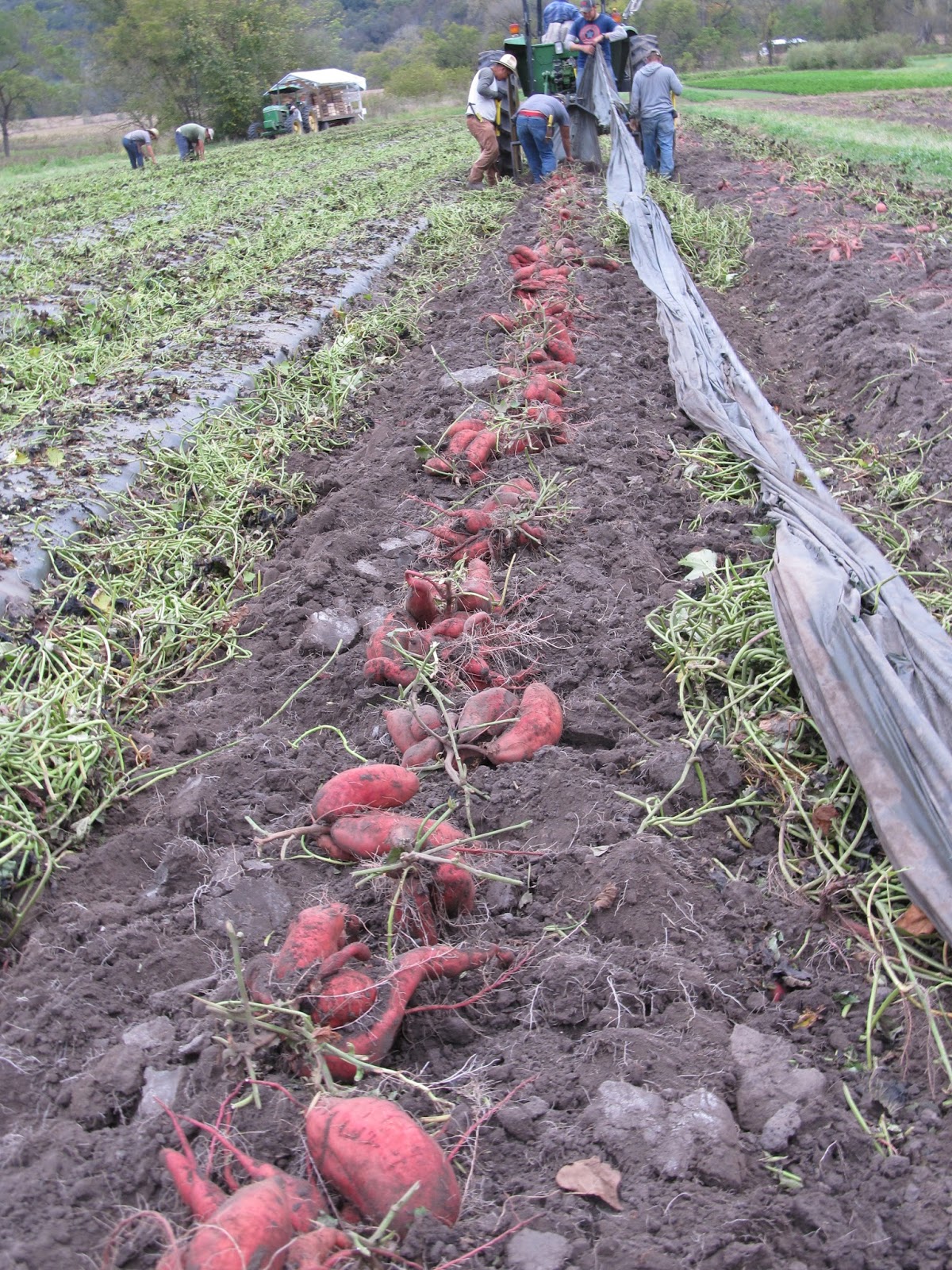
Digging sweet potatoes.
We planted this year’s crop on June 1.  We get our sweet potato plants from two organic producers in North Carolina.  Due to a cold, wet start to their season, they shipped our plants about 10 days later than we had planned.  Nonetheless, the field was ready before we received them so we were ready to start planting them the same day they arrived!  Most of the plants survived the transplanting process and took off.  Overall, the crop looked to have a good start.  We fertilized and delivered nutrients as needed, but there were periods of time when the soil was wet and saturated, despite the fact that we grow on beds covered with plastic mulch for heat gain.  I mentioned earlier that sweet potatoes are tropical plants.  They thrive in hot, dry climates.  In wet conditions, you often end up with scraggly roots and the plants don’t set potatoes as they should.  This year’s yields came in at about 50% of last year with an estimated 17,000 pounds.  The potatoes are nice and tasty, we just didn’t find as many potatoes per plant as in previous years.  Our two main varieties this year are Covington and Burgundy.  Both are orange fleshed sweet potatoes known to be sweet and flavorful.  We also grew Murasaki sweet potatoes, a white fleshed Japanese variety.  We haven’t had much luck with these potatoes in past attempts.  They have never yielded very well and the potatoes are always very small and skinny.  I can’t help myself though, it’s a delicious potato with sweet, moist white flesh.  Somehow I managed to convince Richard we needed to try them yet again this year.  Surprisingly, the yield was significantly improved and we harvested the largest potatoes we’ve ever seen on this variety!  Evidently this variety actually thrives with a little more moisture.  Despite a disappointing yield, we did make some important observations that will help us raise future crops and we’re always happy to have something instead of nothing.  We do plan to deliver sweet potatoes in most, if not all, of the remaining CSA boxes and we’ve allocated some to offer as a Produce Plus offering before Thanksgiving as well as part of our End of Season special offering.  We also partner with the Lakewinds Food Co-Ops in Minneapolis and they’ve done an outstanding job selling and promoting our sweet potatoes in their stores in previous years.  This year we’ll send a few their way, but not nearly what we or they had hoped for.  Because we knew our yields would be low this year, we saved every little potato when we were harvesting.  Typically when the potatoes are more abundant we would leave some of the little guys in the field. But this year, every potato is precious to us.  So we have some potatoes we’re sorting out as “Baby Bakers.”   Evidently we’re not the only ones in the country who have small, fat potatoes.  Within the last year other companies have started selling these baby sweet potatoes as well. They are completely usable potatoes, just much smaller than the historical industry standard.  You’ll likely receive some in your box before the end of the year.  They are the cutest little things and are actually easier in many ways to work with compared to some of the bigger potatoes.

Freshly washed sweet potatoes.
After we harvest the sweet potatoes, we bring them into our nursey greenhouse in wooden crates.  We stack them up and once they are all harvested, we start the curing process.  When sweet potatoes first come out of the field they are not very sweet and flavorful.  The skins are also very tender and delicate, so we have to handle them very careful with gloved hands to minimize any surface damage to the skin.  We hold them at a temperature of 85-95°F with humidity of 90-95% for 7-10 days.  During this time the greenhouse feels like a sauna!  This process helps to set the skins so they’ll last longer in storage. It also develops the starches into sugars, making them a truly sweet potato!

Sweet potatoes are best stored at a temperature of 55-65°F.  Do not store them in your refrigerator or at temperatures less than 50°F or they’ll get chill injury.  Store them in a cool, dry location or on your countertop until you’re ready to use them.

There are so many things you can make with sweet potatoes ranging from sweet potato casserole to sandwiches, fries, soup, cakes, pies, donuts, salad and more!  Of course, one of the simplest things you can do is just bake them and eat them right out of their skin with a touch of butter!


Sweet Potato Kimchi Pancakes

photo by John Kernick for epicurious.com

Serves 8 

1 pound sweet potatoes 
1 cup packed kimchi (approximately 7 ounces), chopped finely 
1 ½ tsp finely chopped garlic 
1 to 2 Tbsp chopped fresh Serrano chiles (The amount of chile pepper you use may be adjusted to your liking and will also be dependent upon the heat of the kimchi. If you do not have fresh chiles available, you may also substitute pickled jalapeƱo or a pinch of dried red pepper flakes.) 
1 cup thinly sliced onions 
1 large egg, lightly beaten 
1 tsp kosher salt 
¾ cup all-purpose flour 
About ½ cup vegetable oil
  1. Peel sweet potatoes and julienne (very small strips) using a mandolin or the shredding attachment on a food processor. You should have about 6 cups of sweet potatoes once they are cut. 
  2. Stir the potato together with the remaining ingredients except for the oil. Let the mixture stand at room temperature until wilted and moist, about 5 minutes, then stir again. 
  3. Heat 2 Tbsp of the oil in a 12-inch heavy skillet over medium-high heat until it shimmers. Using 2 serving spoons, scoop up some of the sweet potato mixture in one spoon and use the other one to compress the mixture and form a rough patty. Care- fully slide the patty off the spoon and into the hot pan. Repeat the process to add another 4 or 5 pancakes to the pan. You will need to do several batches to cook all the pancakes. 
  4. Cook until golden brown, 1 ½ to 2 minutes, then flip the pancake. Add a little more oil if necessary. Cook until golden brown, 1 to 2 minutes more. Transfer to a plate lined with paper towels or to a baking rack on a sheet pan. Hold the pancakes in a warm oven     (set at 150-200°F) until you are finished frying the pancakes and are ready to serve them. Add oil to skillet between batches as needed. 
  5. Serve warm with a dipping sauce of your choice. The original recipe was accompanied by a soy-vinegar dipping sauce, but I prefer to serve them with a dollop of sour cream or sour cream mixed with lime juice and cilantro. 
  6. If you have extra pancakes leftover, they can easily be cooled and frozen. When you are ready to use them, reheat the unthawed pancakes in a 375°F oven.
This recipe is a long time favorite!  It was originally published in Gourmet magazine and can be found at www.epicurious.com.

Wednesday, October 10, 2018

October 11, 2018 - This Week's Box Contents, Featuring Sweet Potatoes


Cooking With This Week's Box


Yellow & Red Onions: Sweet Potato and Red Lentil Coconut Curry Soup (see below); Roasted Autumn Sweet Potato Salad (see below); Acorn Squash Quesadillas with Tomatillo SalsaSheet Pan Chicken & Broccoli; Mizuna Quinoa Salad with Lemon Scallion Vinaigrette

Garlic: Sweet Potato and Red Lentil Coconut Curry Soup (see below)

Broccoli or Broccoli Romanesco: Sheet Pan Chicken &Broccoli  

White or Yellow Cauliflower: Cauliflower Tots

Sugar Dumpling Squash: Acorn Squash Quesadillas with Tomatillo Salsa
   
Honeynut Butternut Squash: Chai Spiced Bread

Baby Spinach: Roasted Autumn Sweet Potato Salad (see below)  

Salad Mix: Roasted Autumn Sweet Potato Salad (see below)
Burgundy Sweet Potatoes: Sweet Potato and Red Lentil Coconut Curry Soup (see below); Roasted Autumn Sweet Potato Salad (see below)

The moment we’ve all been waiting for…SWEET POTATOES!  After we lost our entire crop two years ago, we all hold our breath until we know for sure the sweet potatoes are harvested and stored away safely in our greenhouse.  If you haven’t already, please take a moment to read Farmer Richard’s article this week.  We have a great crop this year and we’re excited to start sharing them with you this week.  Our featured recipes this week give you two options to start your sweet potato cooking season.  The first is a delicious, and simple, recipe for Sweet Potato and Red Lentil Coconut Curry Soup (see below).  In this recipe you roast the sweet potatoes before adding them to the soup which adds a little extra layer of sweetness and flavor.  The other recipe is for Roasted Autumn Sweet Potato Salad (see below).  I think this is a great recipe for this week with our fall spinach or salad mix.  You could even add a little crumbled bacon if you like. 


Acorn Squash Quesadillas with Tomatillo Salsa
photo from Smitten Kitchen
I continue to collect winter squash recipes and appreciate this recipe for Acorn Squash Quesadillas with Tomatillo Salsa that was shared by a member in our Facebook Group.  Of course we don’t grow acorn squash, but you can use the sweet and delicious sugar dumpling squash in this week’s box in place of it.  This is a perfect recipe this week to wrap up our season with peppers and tomatillos.  You can use both in this recipe along with a jalapeno or the Korean chili peppers. 

The other winter squash selection in this week’s box is the beloved little honeynut butternut squash.  This is another one of our sweet specialty squash varieties that is really quite good just baked and enjoyed with a little salt and a pat of butter.  Of course, you could bake it and use the flesh to make this delicious Chai Spiced Bread, a recipe that a member shared with us several years ago.  I’m warning you…it’s delicious!
I’ve really been enjoying the carrots this summer and fall and I think the thing I appreciate the most about them is how easy it is to prepare a delicious, simple dish because the carrots themselves are so good!  This week I am into roasting and want to try this recipe for Honey-Maple Roasted Carrots.  Enjoy these as a simple side dish to make a meal as simple as a seared pork chop, the carrots and a salad made with this week’s salad mix.

Sheet Pan Chicken & Broccoli
photo from Overtime Cook
I’ve seen recipes for Cauliflower “tater” tots before, but they always seem complicated. This recipe for Cauliflower Tots actually seems pretty manageable, so I’m going to give them a try this week!  Serve these with a burger or grilled cheese sandwich for an All-American meal!  As for this week’s broccoli or broccoli Romanesco, these will be used to make a simple dinner of Sheet Pan Chicken & Broccoli.  Serve this with steamed rice for an easy dinner.

This is the time of year when some of our Asian greens that are a little spicy taste the best.  This week’s boxes include mizuna, either green or red.  Check out Early Morning Farm’s list of 7 Ways to Use Mizuna including this recipe for Mizuna Quinoa Salad with Lemon Scallion Vinaigrette.  Of course we don’t have scallions now, but red onions would work as well. 


What should we do with the last of the sweet peppers?  Check out The Food Network’s “10 Ways to Use Sweet Mini Peppers”
and you’ll find tasty recipes including one for Sweet Pepper Poppers!

We did it!  Another week of delicious, nutritious and tasty meals.  Do you ever just stop to consider how many different vegetables you’ve consumed over the course of the season?  This is our 24th week of deliveries.  If anyone goes back and counts how many different things we’ve had to cook with, please let me know what number you come up with!  We still have more delicious vegetable tricks up our sleeves as we finish out the season.  Have a great week!—Chef Andrea

Vegetable Feature: Sweet Potatoes

This week we’re excited to be packing sweet potatoes in your boxes!  Sweet potatoes, which are actually a tropical vegetable, are an important part of our fall and winter diets.  If stored properly you can eat sweet potatoes all winter! The ideal storage temperature for sweet potatoes is 55-65°F.  They can get chill injury if stored at temperatures below 55°F, so if you don’t have the perfect location to store them at their ideal temperature, it’s better to store them on your countertop in your kitchen instead of putting them in the refrigerator.

Straight out of the field, our sweet potatoes tasted pretty good, but not good enough to eat.  That’s right, we have a rule around here that you don’t really eat sweet potatoes for at least two weeks after they are harvested.  When they are first harvested the potatoes are starchy, not very sweet or tasty, and the skins are very tender requiring careful handling.  Sweet potatoes aren’t truly sweet potatoes until we “cure them.”  Curing is a process by which we hold the sweet potatoes at high heat and high humidity for 7-10 days, basically it’s kind of like a sauna for sweet potatoes!  During this time the starches in the potatoes are converted to sugars and the skins become more stable for long term storage. 

Sweet potatoes are less starchy and more sweet and moist than a regular potato and have a wide variety of uses.  You can simply bake them whole until fork tender and eat the flesh right out of the skin.  They are also delicious cut into bite-sized pieces and roasted or cut them into wedges or thin slices and make roasted fries or chips.  If you’re going to do this, it’s best to put the wedges or slices of sweet potatoes on a rack in a pan.  If you do this, the air and heat from the oven can better circulate on all sides of the sweet potato making it more crispy and less soggy.  Sweet potatoes also make delicious, hearty soups and stews, may be added to chili, shredded and fried like hash browns, or just simply cook and mash or puree them. 

Sweet potatoes can also be incorporated into baking.  Sweet potato pie is a decadent way to eat a vegetable.  If you’re going to make pie, consider this Sweet Potato Pie with Pecan Topping featured at MarthaStewart.com.  It’s delicious served with Bourbon Whipped Cream.  You can also use sweet potatoes to make biscuits, rolls, quick breads, cookies, bars, cheesecake and more! 

Sweet potatoes pair well with a wide variety of ingredients, which makes them so versatile in their use.  They pair very well with apples and pears as well as other root vegetables, bitter fall greens, dried beans and greens such as kales.  They also go very well with coconut, ginger, chiles, butter, cream, citrus and nuts of any kind.

If you haven’t read Farmer Richard’s main article for this week, please take a minute to do so as it will help you understand more about what it takes to actually grow this tropical vegetable in a northern climate! 

Roasted Autumn Sweet Potato Salad

Yield: 6 side salads

Roasted Vegetables:
2 cups ½ inch cubed sweet potato
2 cups ½ inch cubed red onion
3 Tbsp olive oil
4 sprigs of fresh thyme
2 sprigs of fresh sage
1 tsp kosher salt
A couple cracks of black pepper

Crushed Croutons:
1 Tbsp salted butter
½ cup panko

Dressing:
1 ½ Tbsp white wine vinegar
1 Tbsp Dijon mustard
1 tsp pure maple syrup
Pinch of kosher salt
A couple cracks of black pepper
3 Tbsp olive oil

Greens:
5 oz spinach (or substitute salad mix)
½ cup pepitas (pumpkin seeds)
¼ cup dried cranberries or tart cherries
¼ cup goat cheese or crumbled feta
Fresh thyme leaves (optional)
  1. Prepare the roasted vegetables.  Preheat the oven to 450° F.  Line a baking sheet with parchment paper.  Place the prepared potatoes and onion on the baking sheet.  Add all the remaining roasted vegetable ingredients to the pan; toss to coat.   Bake for 25 to 30 minutes or until lightly charred, stirring halfway through.
  2. Make the crushed croutons.  In a 10-inch cast-iron skillet melt the butter over medium heat.  Add the panko and toast until golden, about 3 minutes.  Set aside.
  3. Make the dressing.  In a serving bowl, whisk together all of the dressing ingredients until emulsified (until the oil and vinegar become one).  This can be made 3 weeks in advance and stored at room temperature.
  4. Assemble the salad.  Add all the greens ingredients into the salad bowl along with the roasted vegetables (including the crispy herbs) and crushed croutons.  Toss to combine.  Serve immediately.


Recipe borrowed from Melissa Coleman’s book, The Minimalist Kitchen.

Sweet Potato Red Lentil Coconut Curry Soup


Yield:  4 servings


2 pounds sweet potatoes, peeled and diced into small pieces (about 5 cups)

2 ½ Tbsp olive oil

1 Tbsp fresh grated ginger
1 onion, diced
1 clove garlic, minced
4 cups vegetable stock or water
1 (15-oz) can coconut milk
1 ½ Tbsp red curry paste
1 (15-oz) can crushed tomatoes
1 cup red or yellow lentils
Salt, to taste
Lime juice, to taste
Cilantro, chopped, for serving
  1. Preheat oven to 425°F.  Toss sweet potatoes with 1 ½ Tbsp of olive oil and roast for 25-35 minutes or until golden brown and tender. 
  2. Meanwhile, in a medium pot, heat the remaining tablespoon of oil over medium heat.  SautĆ© the ginger, onion, and garlic in oil until softened.  Add the coconut milk, red curry paste, tomatoes and red lentils.  Cover and simmer for 25 minutes.  Add roasted sweet potatoes and continue to simmer for 10-15 minutes. 
  3. Use an immersion blender or regular blender to blend until smooth or to desired consistency.  Thin with additional water if needed.  Season with salt and the juice of one lime.  Stir to combine.  Adjust seasoning to your liking with more salt and/or lime juice as needed.
  4. Serve hot, garnished with chopped cilantro.

Recipe adapted from Elizabeth Stein’s book, Eating Purely.

Wednesday, October 18, 2017

October 19, 2017 - This Week's Box Contents, Featuring Sweet Potatoes


Cooking With This Week's Box

After a year without sweet potatoes, we’re super excited to be sending sweet potatoes in your box this week!  Where do we start with cooking?  There are so many things we could make with sweet potatoes!  Don’t worry, we’ll be sending them for most of the remaining boxes, so you’ll have plenty of time to make all your favorite recipes and maybe try a few new ones!  This week we’re pretty busy with harvest so I’m keeping things a bit more on the simple side.  The Moroccan Sweet Potato Salad (See below) is pretty easy to make.  You just toss roasted sweet potatoes with a simple, but flavorful vinaigrette and eat it at room temperature.  I think I’ll roast a chicken and serve the Moroccan Sweet Potato Salad with the chicken and this simple recipe for Moroccan Couscous.   The currants and pine nuts in the couscous will go nicely with the sweet potatoes. 

We are finishing off our last crop of broccoli raab which will give me a chance to make Alice Water’s  Pizza with Broccoli Raab and Roasted Onions and Olives.  I think this would be good with a few little sautĆ©ed shrimp on top.  We need something to go along with the pizza, but we already have our greens on the pizza.  I think I’ll go with this simple French Grated Carrot Salad with Lemon Dijon Vinaigrette.  I like simple carrot salads for several reasons.  First, when the carrots are flavorful and sweet on their own, you don’t need to do much to them so keeping it simple is better. The other thing I like about carrot salads is that you can put the dressing on and it doesn’t get soggy like a greens salad does.  You know I’m a fan of taking leftovers for lunch the next day, and this type of salad works great for that purpose. 

Ok, we’ve done Moroccan and we’ve had a taste of France, now lets move into Indian cuisine!  I have pretty limited experience with Indian food, but am intrigued by the different styles of Indian cooking and the spices they use.  The food is much different than what I grew up with in the Midwest!  When I was in college, one of my neighbors in the dorm was from India and invited me to attend one of their traditional celebrations.  It was wonderful to experience their culture and I was overwhelmed by the delicious food they served.  In my feeble attempt to learn more about this cuisine and culture, I try to dabble a little with some of the easy adaptations as I build my comfort level and slowly learn more about this part of the world.  So that whole explanation leads me to this recipe for Indian Creamed Spinach.  Richard really likes creamed spinach, so I thought I’d try this variation.  The recipe calls for 16 oz of spinach, but the bag of spinach in this week’s box is only 8 oz.  You can either cut the recipe in half or use the green tops from the beet greens to make up the difference.   This recipe has a little heat in it, which can come from using either the jalapeno or guajillo in your box.  I’ll probably serve this with the leftover roasted chicken and some steamed basmati rice.

Recipe courtesy of foodiecrush.com
I think this is the week to make homemade Beet Chips! Any color of beet will work for beet chips, but the Chioggia beets are especially fun to prepare this way.  Most recipes just tell you to put the sliced beets on a sheet try, but I often put them on a rack on top of the sheet tray.  If you have a baking rack and can do this, it helps keep them get crispy.  These will be our Sunday evening snack that we’ll probably just eat with a simple sandwich as we’re making our plans for the crew.

What are we going to do with the squash this week?!  Well the honeynut butternut squash is an easy one.  These are so sweet and flavorful, you really don’t need to do anything more than to just cut them in half and bake them.  After they’re baked I usually just top them with a pat of butter, salt, pepper and occasionally a little bit of cinnamon or nutmeg.  This actually makes a very delicious breakfast item! 

This recipe for Spaghetti Squash Pad Thai with Cashew Ginger Sauce caught my eye, so I think I’ll give it a try this week.  I already used shrimp on my pizza, so I’ll probably substitute thinly sliced sirloin steak in place of the seafood.  This is a meal on its own!
I’ve had Fish Chowder on my mind lately.  The waxy gold-fleshed potatoes in this week’s box are perfect for this type of chowder. Serve a bowl of hot chowder alongside a fresh arugula salad with bread or crackers and you’re set. 

The last item in our box to use is the broccoli/cauliflower.  I love roasted broccoli and cauliflower, so I’m going to jazz up this concept this week with this Balsamic and Honey Roasted Broccoli and Cauliflower. This will make a nice accompaniment to a seared steak or pork chop.

And that’s a wrap for this week!  What’s the next exciting vegetable coming up in the box?  Well, it may not be in next week’s box, but we’ll be harvesting Brussels sprouts before long!  That should give most of you something to look forward to this week.  I hope you have a good week and create some delicious meals!

—Chef Andrea


Featured Vegetable:  Sweet Potatoes

This week we’re excited to be packing sweet potatoes in your boxes!  Sweet potatoes are an important part of our fall and winter diets.  If stored properly you can eat sweet potatoes all winter! The ideal storage temperature for sweet potatoes is 55-65°F.  They can get chill injury if stored at temperatures below 55°F, so if you don’t have the perfect location to store them at their ideal temperature, it’s better to store them on your countertop in the kitchen instead of putting them in the refrigerator. 


Peanut & Sweet Potato Soup

Sweet potatoes are less starchy and more sweet and moist than a regular potato and have a wide variety of uses.  You can simply bake them whole until fork tender and eat the flesh right out of the skin.  They are also delicious cut into bite-sized pieces and roasted or cut them into wedges or thin slices and make roasted fries or chips.  If you’re going to do this, it’s best to put the wedges or slices of sweet potatoes on a rack in a pan.  If you do this, the air and heat from the oven can better circulate on all sides of the sweet potato making it more crispy and less soggy.  Sweet potatoes also make delicious, hearty soups and stews.  One of my favorite sweet potato recipes is for a Peanut & Sweet Potato Soup that we featured in a previous newsletter.  Another favorite sweet potato recipe is for Sweet Potato and Kim Chi Pancakes.  This is a recipe that was shared with me by a CSA member and I look forward to making it every year.  If you haven’t tried it yet, you really should.  Don’t be afraid to eat sweet potatoes at room temperature or even cold in salads such as the Moroccan Sweet Potato Salad (See below)recipe featured in this week’s newsletter.

Sweet potatoes can also be incorporated into baking.  Sweet potato pie is a decadent way to eat a vegetable.  If you’re going to make pie, consider this Sweet Potato Pie with Pecan Topping featured at MarthaStewart.com.   It’s delicious served with Bourbon Whipped Cream.  You can also use sweet potatoes to make biscuits, rolls, quick breads, cookies, bars, cheesecake and more! 

Sweet potatoes pair well with a wide variety of ingredients, which makes them so versatile in their use.  They pair very well with apples and pears as well as other root vegetables, bitter fall greens, dried beans and greens such as kales.  They also go very well with coconut, ginger, chiles, butter, cream, citrus and nuts of any kind.

This year we have several different trial varieties.  If you haven’t read Farmer Richard’s main article for this week, please take a minute to do so.  In his newsletter he discusses the different varieties we’ve grown.  We’ll identify the variety in each week’s newsletter.  We’re looking for member feedback about the different varieties so we can decide what to plant next year!  As we go through the remainder of the season, pay attention to the different varieties and let us know what you think! 


Moroccan Sweet Potato Salad

Yield:  6 servings

2 ½ pounds sweet potatoes, peeled and cut into 1-inch cubes
⅓ cup plus 2 Tbsp extra-virgin olive oil
¾ tsp kosher or fine sea salt
2 garlic cloves, finely minced
1 tsp ground cumin
1 tsp sweet paprika
⅛ tsp cayenne pepper
3 Tbsp fresh lemon juice
⅓ cup chopped fresh Italian parsley
⅓ cup chopped fresh cilantro
⅓ cup sliced almonds, toasted
  1. Position a rack in the center of the oven and preheat to 425°F.  
  2. In a large bowl, toss the sweet potatoes with the 2 Tbsp oil and ¼ tsp of the salt.  Transfer the sweet potatoes to a large rimmed baking sheet and spread them out in an even layer. (Set the bowl aside to use for tossing the cooked potatoes).  Roast the potatoes, stirring once at the midpoint of roasting, until they are tender when pierced with a fork but still hold their shape, 15 to 20 minutes.
  3. Meanwhile, in a small bowl, mix together the garlic, cumin, paprika, cayenne, lemon juice, and the remaining ½ tsp salt.  Whisk in the remaining ⅓ cup oil.   Add the parsley and cilantro and stir to combine.
  4. When the potatoes are ready, return them to the large bowl.  Add the vinaigrette and toss gently.  Add the almonds if you are planning to serve the salad within a few hours;  otherwise, toss them in just before serving so they stay crisp.  Serve at room temperature.  The salad can be made up to 2 days in advance, covered, and refrigerated.  Remove from the refrigerator 2 hours before serving.
This recipe was borrowed from Roots by Diane Morgan.

Coconut Pan-Roasted Sweet Potatoes

Yield:  4 to 6 servings

2 pounds of sweet potatoes
2 Tbsp coconut oil
Sea Salt, to taste
Maldon sea salt, for finishing
  1. Scrub the sweet potatoes, then peel and chop them into cubes a scant inch across.
  2. Warm the oil in an 8-inch or 10-inch sautĆ© pan.  Add the sweet potatoes, turn them about to coat, and season with a few pinches salt.  Put a lid on the pan, turn the heat to medium-low, and cook for about 20 minutes in all, giving the pan a shake every now and then to turn the potatoes.  Taste a piece and if they’re not yet soft, continue to cook a few minutes longer or until they are tender and browned.  Serve with flaky sea salt.  
This simple recipe was borrowed from Deborah Madison’s cookbook, The New Vegetarian Cooking for Everyone.  

Thursday, November 19, 2015

Vegetable Feature: Sweet Potatoes

by Lisa Garvalia
Sweet Potato Harvest
Sweet potatoes, the sweet vegetable that you don’t have to feel guilty eating! Sweet potatoes are a great source for our daily nutritional needs. They are packed full of beta-carotene, calcium, potassium, iron, Vitamin A and Vitamin C. They are cholesterol free, have no saturated fats and are full of antioxidants. Oh, and did I mention they are sweet and delicious as well?


So, how does the sweet potato get that delicious sweet flavor?  Choosing the right variety of sweet potato, good soil, adequate watering and close monitoring during the growing season are all necessary to get the best tasting sweet potato. After the sweet potatoes are dug and brought in from the field, they are immediately put in the greenhouse and left to cure. The curing process is what changes the starch in the sweet potato to sugar and also ‘toughens’ up the skin so they can be easily handled and have a longer storage potential. The greenhouse is kept at a constant temperature of 85-90 degrees with the humidity level being the same and the process takes up to 7-10 days.


Sweet Potatoes Curing in the Greenhouse
Sweet potatoes do store well and they get better with age. The ideal storage for sweet potatoes, because of the high sugar content, is 55-60 degrees. Keep them in a dry, dark, well ventilated area. Sweet potatoes are sensitive to colder temperatures so keeping them at or above the suggested temperatures is best. If you do find spots on your sweet potatoes during storage it is a good idea to cook and freeze them if you are unable to eat them right away.

Sweet potatoes are very versatile when choosing how to cook them. They pair well with a variety of ingredients including apples, oranges, coconut, cranberries and limes. Common spices used with sweet potatoes include cumin, coriander, chilies, thyme, rosemary, chili powder, curry powder and more. If you want to keep it basic you can simply place a sweet potato in the oven and bake until tender. Cut it open and add butter, salt and pepper, or keep it in the fridge for a simple left-over, just warm and serve.

Best Whipped Sweet Potatoes with Caramelized Apples

Yield:  6 servings
3 pounds sweet potatoes
3 Tbsp unsalted butter, divided
2 Tbsp heavy cream
½ cup applesauce
2 tsp grated fresh ginger
Coarse salt and freshly ground pepper
2 apples, peeled & cored
3 Tbsp sugar
  1. Preheat oven to 375°F.  Place sweet potatoes on a parchment-lined baking sheet;  pierce each several times with a fork.  Bake until very tender when pierced with a knife, about 50 minutes.  Remove from oven;  let cool slightly.
  2. Cut open potatoes;  scoop flesh into the bowl of an electric mixer fitted with the paddle attachment (may also use a food processor).  Add 2 Tbsp butter and the cream, and beat until smooth.  Add applesauce and ginger;  beat to combine.  Season with salt and pepper.
  3. Transfer sweet potato mixture to an ovenproof serving dish.  Place in oven until heated through, 10 minutes.
  4. Meanwhile, cut the apples into 1-inch pieces.  Melt remaining butter in a nonstick skillet over medium-high heat.  Add apples and sugar;  saute until golden and nicely caramelized, about 8 minutes.  Remove from the heat.  
  5. Remove serving dish from oven and top with caramelized apples.  Serve immediately.

Recipe sourced from Martha Stewart Living Annual Recipes 2003.

Sweet Potato Rolls

Yield:  20 rolls
¼ cup warm water
1 envelope active dry yeast (1 scant Tbsp)
1 cup milk
⅓ cup unsalted butter
½ cup sugar
1 ½ Tbsp coarse salt
1 tsp ground cardamom
2 cups cooked sweet potatoes (about 2 medium)
1 tsp freshly squeezed lemon juice
1 large egg, lightly beaten
7 cups sifted all-purpose flour
Vegetable oil, for bowl
Melted butter, for brushing
  1. Place the warm water in a small bowl and sprinkle with yeast. Let stand until yeast is dissolved and mixture is foamy.
  2. In a small saucepan, heat milk over medium heat just until it begins to steam and bubble around the sides. Remove from heat; add the butter, and stir until melted and combined. Stir in sugar, salt and cardamom. Let cool slightly.
  3. Combine sweet potatoes and lemon juice in the bowl of an electric mixer fitted with the paddle attachment; beat until smooth, 2 to 3 minutes. Beat in egg, and the milk and yeast mixtures until smooth.
  4. Switch to the dough-hook attachment. Add flour, 1 cup at a time, beating until dough forms. Continue kneading dough on medium speed until smooth, about 8 minutes. The dough will be slightly sticky.
  5. Transfer dough to large oiled bowl. Cover with a clean kitchen towel, and let rise in a warm place until doubled in bulk, about 1 hour.
  6. Preheat oven to 400 degrees. Line a baking sheet with parchment paper; set aside. Punch down dough and turn onto a clean work surface. Knead again with your hands, just until smooth. Using a bench scraper or sharp knife, cut dough into 20 equal pieces, and shape into round rolls.
  7. Place rolls on prepared baking sheet, about 2 inches apart; cover with a clean kitchen towel, and let rise again in a warm place until double in bulk, about 40 minutes.
  8. Using kitchen scissors or a sharp paring knife, snip an X in the top of each roll. Brush tops with melted butter. Bake until tops of rolls are golden, about 20 minutes, rotating pan halfway through. Transfer to a wire rack to cool slightly.
Note:  Excellent served with the Cranberry Maple Butter recipe featured in our fruit newsletter on November 22, 2014.

Recipe sourced from Martha Stewart Living Annual Recipes 2003.

Friday, March 20, 2015

Book Review

Deborah Madison’s The New Vegetarian Cooking for Everyone
Reviewed by Andrea Yoder

Deborah Madison has been one of my favorite chef-authors for many years.  She has written over 10 cookbooks including Vegetable Literacy and her most recent cookbook, The New Vegetarian Cooking for Everyone.  I have a weakness for her cookbooks, so when I saw a copy of her most recent book on the shelf at the bookstore I couldn’t resist.  Deborah has focused her career on preparing simple, seasonal, vegetable-based cooking.  In her early days she worked at Alice Water’s well-known San Francisco restaurant, Chez Panisse.  She later opened her own restaurant, Greens, which focused on vegetarian cuisine.
   The New Vegetarian Cooking for Everyone was preceeded by an earlier cookbook Deborah published in 1997 entitled Vegetarian Cooking for Everyone.  Her original work is considered a classic cookbook in the realm of vegetarian cuisine and has won several awards.  Her new cookbook is “for everyone interested in learning how to cook vegetables creatively, healthfully, and passionately.” The recipes are simple & written with the intent that they will be prepared at home, as opposed to being chef-y restaurant recipes. Since Deborah is cooking in a different region of the United States, there are a few times when you might need to make a minor substitution for an ingredient that we may not have available in a given season in Wisconsin.
   Deborah takes the time throughout the book to include her own personal commentary on most of her recipes.  She offers suggestions for making substitutions or slight alterations to recipes to give the cook more options to choose from.  She also makes suggestions for other recipes in the book that might pair well together so you can easily put together a full meal.  I also appreciate that she takes time in the beginning of the book to include some basic information about how to go about cooking in an approachable way.  She also includes a section on basic cooking fundamentals that enable any cook, no matter how much experience you may have, to become more savvy in the kitchen.
   While the list price for this book is $40, it is a value when you consider the book includes over 1600 recipes featuring many of the vegetables we grow on our farm over the course of the season.  If you’re looking for a good vegetable-centric cookbook to guide you through a CSA season, I’d encourage you to consider Deborah Madison’s The New Vegetarian Cooking for Everyone.  Her simple recipes & vegetable storage information will be helpful to those who may be new to CSA and are learning to cook new vegetables.  Her book also may be appealing to cooks with more experience who are looking for simple recipes that highlight the delicious vegetables they’ve grown to love.
   I selected 3 simple recipes from her book to feature this month.  If you have some of these vegetables remaining from the late season 2014 shares, perhaps you can find a use for them with some of Deborah Madison’s ideas.

Roasted Beets, Apples, and Onions with Cider Vinegar
“This is a bold dish, far greater than the sum of its parts. Any leftovers make a great little
salad or item on a composed salad plate. Use any color beet or a mixture.”
Recipe borrowed from Deborah Madison’s cookbook, The New Vegetarian Cooking for Everyone.

Yield: 4 servings
4 medium beets, steamed, peeled and cut into ½ –inch dice
2 cups diced apples, skin on
½ onion, diced
¾ tsp sea salt
2 Tbsp apple cider vinegar
⅛ tsp freshly grated nutmeg
1 Tbsp brown sugar, optional
1 ½ Tbsp butter or sunflower seed oil
Freshly milled pepper
Apple cider vinegar or horseradish, for serving

1. Heat the oven to 350°F. Lightly butter or oil a 4-cup casserole or
gratin dish.
2. Toss the beets with the apples and onions, season with the salt,
vinegar, and nutmeg. If you favor extra sweetness, add the sugar as
well.
3. Slide the vegetables into the baking dish and dot with the butter or
drizzle with oil. Cover and bake for 1 hour.
4. Serve warm or even chilled. Season with pepper and have extra
vinegar or horseradish on the table, if you like their extra bite

Roasted Onions with Vinegar & Rosemary
“Serve these easily prepared onions as a side dish, or add them, chopped, to arugula or
spinach salad or spoon them over bruschetta with slivered Manchego cheese.”
Recipe borrowed from Deborah Madison’s cookbook, The New Vegetarian Cooking for Everyone.

Yield: 4 to 6 servings
4 to 5 onions, sliced into ½-inch rounds
2 Tbsp olive oil
2 Tbsp balsamic or aged sherry vinegar
1 Tbsp finely chopped rosemary
Sea salt and freshly milled pepper

1. Preheat the oven to 400°F.
2. Toss the onions with the oil, vinegar, and rosemary. Season with salt and
pepper. Put them in a baking dish with a few tablespoons water.
3. Cover and bake for 30 minutes, then uncover and continue baking until the
onions are browned around the edges and tender, about 30 minutes more.
Give them a stir every 10 minutes or so toward the end.

Sweet Potato Muffins with Candied Ginger
“Chunks of candied ginger make these particularly good. If you don’t have ginger readily
at hand, replace it with chopped dates, raisins or fresh pineapple. Serve these with Brie or
other mild cheese, butter, or cream cheese.”
Recipe borrowed from Deborah Madison’s cookbook,The New Vegetarian Cooking for Everyone.

Yield: 10 to 12 muffins
⅓ cup chopped candied ginger
¼ cup butter, melted
⅓ cup unsulfured molasses
1 cup mashed cooked sweet potato
or winter squash
2 eggs, at room temperature
½ cup buttermilk
½ cup packed light brown sugar
1 ¾ cups flour
1 tsp baking powder
1 tsp baking soda
¼ tsp sea salt
1 tsp ground cinnamon

1. Preheat the oven to 375°F. Oil muffin tins.
2. Mix the ginger and wet ingredients in a bowl until smooth; mix the dry
ingredients in a second bowl. Combine the two, mixing gently until well
blended.
3. Spoon the batter into the muffin tins and bake on the middle rack until
lightly browned, 25 minutes