Showing posts with label cultivator. Show all posts

Wednesday, June 6, 2018

June Farm Update


By:  Farmer Richard

It’s been 7 weeks since the last farm update we shared with you on April 19, written with a foot of snow on the ground!  In that update we reported that this year sets the record for the coldest and wettest spring in the forty plus years since I started farming!  Despite that crazy, wet, snowfall in late April, we were able to do our first spring planting on April 24 which is one full week later than any other year I’ve had farming.  The late start to the season would suggest that all of the crops would be later and heat loving crops like tomatoes, sweet corn and peppers would be equally late and have a short season, barely making it before the first fall frost!  Well folks, keep reading as I have some good news!!

Onions in the greenhouse
We had to plan our greenhouse transplants for a “normal” year.  We started planting in late February and actually had some really nice, sunny days in March.  We have new plastic on all the houses, so our early seeded crops took off nicely and even when the days became more cloudy, the crops continued to grow and were ready pretty much on schedule.  As soon as the skies cleared (and the snow melted away), we seized the few dry days we had to prepare ground, lay plastic (for some of our transplants like onions and tomatoes) and tried to keep our field plantings on schedule.  When greenhouse transplants are ready, they really need to get to the field!  However, just because you get a plant to the field it doesn’t mean it’s going to take off and grow, especially when it’s cold as it has been this spring.  


Antonio, Jose Luis & Carlos laying out hoops to cover zucchini
We decided to invest the time and energy into covering some crops with row covers to help trap heat and accelerate plant growth.  We cover some crops every year, but this year we had so many fields to cover that we had to fill an extra 1,000 sandbags and cut 1,000 new wire hoops to put over the beds to keep the covers from damaging the transplants under them.  Without the hoops we risk giving the plants cover abrasion and we need the sandbags to hold all the covers in place!  We couldn’t have covered all of these crops without our amazing crew!  When we had only a few dry days to plant and cover, they were asking “can we work late to finish?”  They repeatedly tell me, “if we don’t plant it and take care of it, we don’t have a crop to harvest!”  It’s important to get the big picture! 

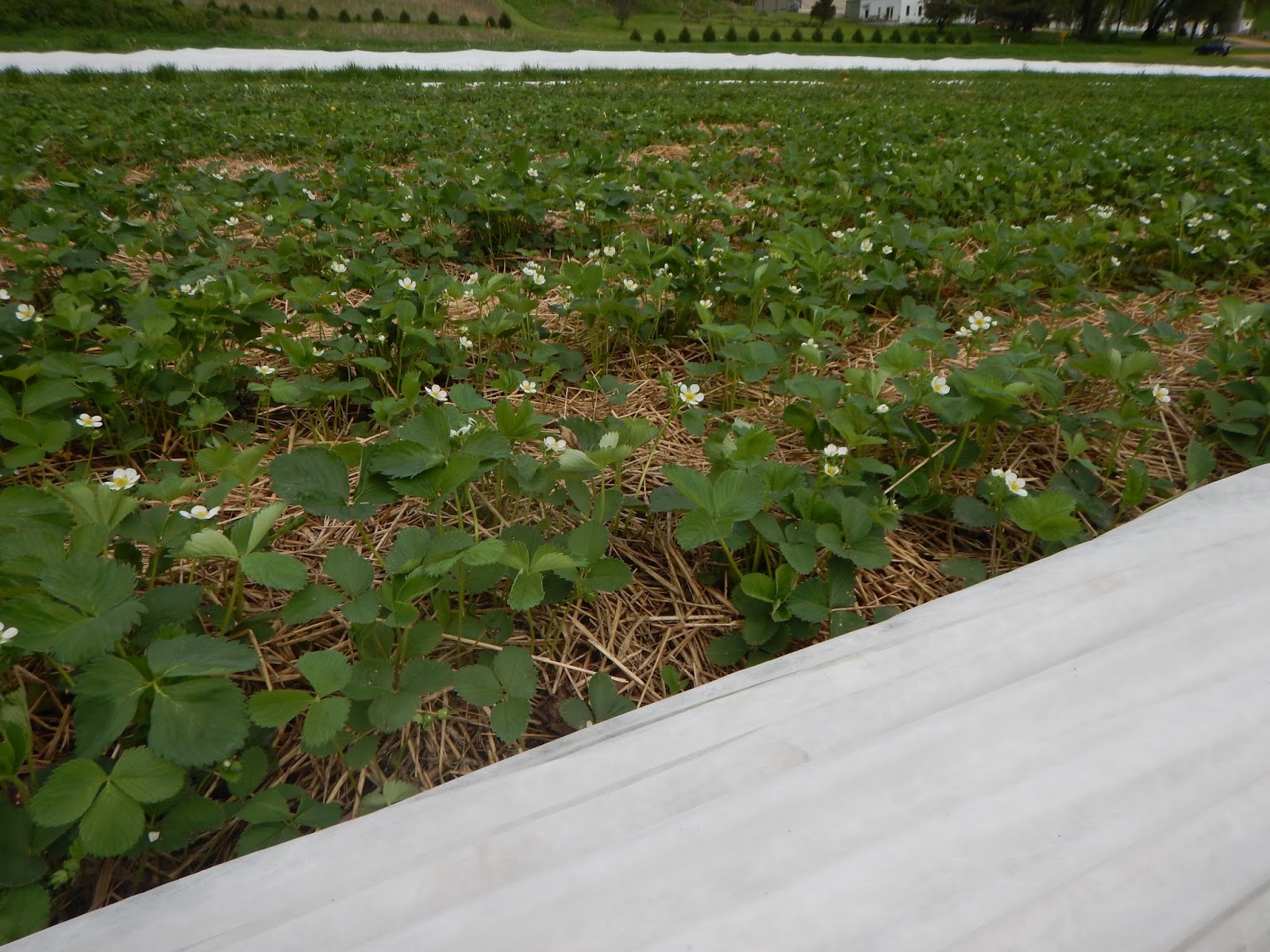
Strawberries right after the covers were taken off.
We are well aware that it is our crew’s dedication to getting the crops planted on time, covered for protection from cold and storms and willingness to work late some nights that has changed the picture from coldest/latest spring to bring us pretty much back on schedule!  Does anyone remember that heat wave we had at the end of May?  We went from cool growing weather to blazing hot!  Those covers we had on everything…..most of them had to come off because now we ran the risk of the crop getting too hot!  We had to uncover the zucchini, cucumbers, tomatoes, peppers and eggplant.  When we did, we were really happy to see beautiful plants that now appear to be growing at a normal rate!

Zucchini plants thriving after being uncovered!
Vicente and the irrigation crew members receive some acknowledgement here as well.  They have worked diligently to set up all the drip irrigation making it possible to give many of our new transplants a small drink of water mixed with fish and kelp fertilizer shortly after they were planted.  The combination of water and nutrients followed by a week of unseasonable, warm temperatures and we really saw some growth under those covers!  We are now ahead of schedule for zucchini, cucumber, melons, tomatoes, eggplants and peppers!! 

We have two crops of sweet corn and beans up and growing and one planting of edamame.  We lost about 25% of the first planting of corn to the Red Wing Black Birds.  Unfortunately they found that they could dig up the corn seed that was planted shallow because the soil was cold and we wanted the seeds closer to the surface so they would receive heat from the sun.  These were pretty determined birds that didn’t seem to mind the “scare eye” balloons and shiny streamers we put in the field to try to deter them.  They ignored our tactics and continued to dig up the seeds.  So our solution was to feed them organic corn on the edge of the field.  That actually did work as a decoy and and we still have 75% of the crop!  It’s hard to get upset with these birds, after all they have babies to feed and we’re always encouraging parents to feed their young ones more organic vegetables! 

Luis and Felix G mastering the new cultivator
If the weather cooperates we can still have a great year!  Right now we’re working really hard to battle the weeds.  Rafael has done a superb job of flaming crops to kill weeds just before a crop comes up.  Our local Cenex crew has been super cooperative in keeping our flamer filled and repaired.  A few gallons of propane used on the precise day saves hours and hours of weeding later!  The result of being diligent and staying on top of flaming is the main reason we have two beautiful crops of early carrots and five acres of parsnips, cilantro & dill!  Rafael has also done a lot of mechanical cultivating and has been instrumental in directing other cultivating crews.  Luis and Felix G have become masters at operating our new Kult/Cress German cultivator.  They’ve learned how to work together to use this machine to mechanically kill a lot of weeds! 

HVF crew hand weeding parsnips.
Andrea gets huge credit for keeping ahead of our frantic spring planting schedule.  Simon has also been a key player in helping us keep the greenhouse plantings on track and has helped with our “hot water” seed treatment for some seeds and biological seed treatments for others.  Andrea has also worked hard to maintain our seed inventory and provides planting plans for each crew every time they go out to plant.  Gwen is now learning the ropes of managing our records once a planting is done.  It’s super important that we have good, complete records both for our own use as well as for maintaining our ability to trace crops back. 

Our Strawberry Day event is coming up on June 17, and yes it looks like we’ll have strawberries!  We hope to see you at the party, or join us for the weekend and do some camping!  We have had a few CSA member visitors this spring and we welcome more.  If you’re interested in camping, we’d love to offer you a spot in one of our two campgrounds or reserve our cabins for your stay. 

Bee pollinating the strawberries
As I write this article on my back porch, I have marveled at the dozens of hummingbirds and the many bumblebees that I see coming to visit the columbine flowers in our yard.  Our strawberries are being pollinated by small bees I collectively call “sweat bees.” As the light dims and the day turns to night, I am in awe of the whippoorwills singing to me.  After a five year absence when we didn’t hear them in our valley, we’re very thankful that they’ve returned!  Every night we listen as they sing us to sleep and every morning they wake us up like an alarm clock, right outside our window.  Despite a challenging spring, life is good!

Thursday, July 9, 2015

Managing Weeds at Harmony Valley Farm

How do you manage weeds? That is a great question we’re often asked and it has a variety of answers depending on the crop, the stage of growth of the crop, the weather conditions, etc.  While conventional farmers often use chemical forces in their battle against weeds, we turn to non-chemical methods including mechanical cultivation and flaming. Richard and Rafael keep a close watch over our fields. Richard referred to Rafael as the “Weed Manager”. His observations have been extremely helpful in deciding when to cultivate and which implement to use on each crop. The goal is to reduce the weed seed, also known as the ‘seed bank’ in the soil. Weed seeds can live for 10 – 30 years in the soil, just waiting for the perfect time and conditions to grow. Our job is to remove weeds and not let them produce any more seeds. Below I will summarize some of our equipment, crew and processes that take on the task of keeping the weeds at bay!


Rafael flaming the cilantro
field before the crop sprouted.
If you have ever been to our farm or seen field pictures, you have seen our raised bed fields. Our first line of defense is to reduce the weed seed in the top 2 inches of soil before planting a crop. We try, but do not always have the perfect weather conditions or enough time, to make the beds 2 weeks prior to planting, thus giving the weeds time to sprout. If that happens, we can use the ‘Flamer’ to burn off the weeds that have sprouted prior to planting. Juan or Rafael have been Richard’s go to guys when it comes to flaming our fields. The ‘Flamer’ is a piece of equipment that takes the propane from the large tank mounted on the implement and through the pipes to create, in essence a flame thrower.  Sounds pretty cool right!  No, there is no big ball of flames; it is really just enough heat/flames close to the ground to burn the weeds that are already growing, but can save a huge amount of time and manpower.  We can also use the ‘Flamer’ after the crop is                                                          planted but before the plants push through the ground to                                                                  burn the weeds that are already growing.


Rafael cultivating the cilantro field
with the 5 Row Basket Weeder


A closer look at Rafael basketing the
cilantro field!


Once the crop is out of the ground we lose the option to flame. Now we have to turn to a variety of different cultivating implements for help. This will depend on the crop and how big it is in the field. A good example is our cilantro. It is planted on raised beds in rows of 5 on top of each raised bed.  We use the 5 row ‘basket weeder’ to loosen the soil and pull out any small weeds that are already growing in the top inch of soil. Rafael has done an excellent job with perfecting his basketing procedures.  Rogelio, Ramon and Jose Manuel have also done a great job with the basket weeder.


Oscar (driving the tractor) and Luis operating 'The Kult'
to take care of those pesky weeds in our beautiful parsnip field.

A closer look at the fingers of 'The Kult' working!
Last year we purchased an awesome German made K.U.L.T. Kress Cultivator. We refer to this as ‘The Kult’. Rafael learned how to operate this implement and has now taught Oscar and Luis how to use it. Weeds growing in the row are a huge problem as they are hard to get to without damaging the crop. This implement, when conditions are good, will help to reduce those pesky weeds in the row. There is one person (Oscar) driving the tractor and another (Luis) steering the implement to make sure the crop does not get pulled out. The Kult has little fingers that come close to weaving together near the base of the crop loosening the soil and ‘stirring’ out the small weeds. We use this machine with our transplanted brassicas (broccoli, cauliflower, etc). We transplant our brassicas to give them a head start on the weeds, giving them the advantage of being larger than the sprouting weeds.  It is way easier to get rid of smaller weeds when our crop is larger and easier to see in the row and the Kult works very well with these crops.    


Vicente using the 2 row Lilliston
cultivator in the corn field.


Vicente using the disc Lilliston
to bury the weeds in the potato field.
For other larger crops, it makes more sense to bury the weeds with dirt. This is a great option for crops like potatoes or corn.
 Vicente has learned how to use the Lilliston cultivator with ease. The open steel fingers on this implement pull up the soil between each crop row and push the loose soil around the plant, essentially burying the weeds.


Corn row before (top) and
after (bottom) the Lilliston.
When all mechanical attempts have been applied,
we have one more tool: our hands to do hand weeding. This is very time consuming but also necessary in some cases.  With carrots or parsnips, both of which have longer germination rates, the weeds generally pop up before the crop. After the field is flamed with the flame weeder and the crop starts coming up, we need to make sure the hand weeding gets started soon.  This takes very good eye-hand coordination as well as knowing the difference between the crop and a weed.
I can’t stress this enough, but extreme precision while using any of these implements makes the difference between a well weeded crop and not having any crop at all because it was all pulled out or buried.   You have to watch the front of the tractor to see where you are going, but also the back to make sure you are not pulling up any plants.  Even the hand weeders need to be careful.


Picture of the tool room where we
store the hand weeding tools.


Here are some parting thoughts on weeds.  Richard estimates that we kill 90 -95% of the weeds in our fields with the mechanical weeding techniques, leaving only a smaller amount for the hand weeders. Did you know that 1 weed that has gone to seed can produce up to 20,000 seeds and that these seeds can and will be carried by birds, water and the wind? This means that even though we remove most of the weeds, we will always have some weeds to deal with on the farm. Did you also know that Mother Nature does not like bare ground? Turns out she doesn’t like to be naked!  We use cover crops to help with the weeds (and other reasons) since if we don’t cover it, she will use the weed seeds in her seed bank to cover herself up. I know we have only touched briefly on the weed subject and there is a lot of information out there we didn’t discuss.  Rest assured that Richard and Rafael are on top of the weed battle. Discussing when to cultivate, which crops, upcoming weather, which implements to use, should they use fingers, discs, knives or how deep to go when cultivating are just some of the conversions that they have on a daily basis. In the end, we are grateful to all of our cultivating crew for their attention to detail, which allows us to have healthy crops to harvest and eat!