Wednesday, May 11, 2022

May 12, 2022 - This Week's Box Contents Featuring Black Spanish Radishes


Cooking With This Week's Box

Nettles in the field
Nettles:  

Black Spanish Radishes:  
Black Radish & Apple Slaw with Honey Vinaigrette (See Below)
Barbecue Seasoned Roasted Roots & Tubers (See Below)

Wild Ramps:  
Photo of Creamy Garlic Butter Pasta
with Spinach from diethood.com
Ramped Up Mac & Cheese 

Overwintered Spinach:  


Overwintered Parsnips:  

Overwintered Sunchokes:  


Photo of Mushroom, Parmesan Watercress 
Omelet from marthastewart.com
Chives:  

Red Potatoes:  

Watercress:  

Welcome to week 2 of our CSA season!  It’s finally getting warm and the trees are finally starting to get their leaves.  Our valley is vibrantly colored in shades of green and it’s so nice to have green vegetables back on our plates as well!  This week we wild-harvested some peppery watercress for your box.  If you’re not sure what to do with this pungent green, you might find a recipe or some inspiration with this article 23 Watercress Recipes We’re Just Wild About.  

We also wild-harvested nettles for your box!  Yes, these are stinging nettles, but if you just follow the guidelines that we provided for you in a previous blog post,  you’ll be just fine and you can enjoy the nettles this week.  They are packed with nutrients and flavor, so don’t pass them by.  I’ve included some of my favorite past recipes in this week’s list of suggestions.

Now on to this week’s featured vegetable, which is not green but rather black!  Black Spanish Radishes are another nutrient-packed vegetable that we enjoy in the fall, winter and spring.  If you are not familiar with this vegetable, take a moment to read more about it in this week’s vegetable feature article.  I’ve also included two tasty recipes for you that are simple to make.

Looking ahead to next week, we’re really hoping we’ll have enough asparagus to include in your boxes.  Our first harvest this week only yielded 8# (you have to start somewhere!).  We also have a nice crop of mini romaine lettuces that we hope will be ready in the next 1-2 weeks.  Sorrel is sizing up nicely and before long we’ll have fresh radishes!

Have a great week of cooking and I’ll see you back here next week!

Chef Andrea 

Vegetable Feature: Black Spanish Radishes

Black Spanish Radishes are an intriguing root vegetable with some unique attributes.  For starters, they are one of the very few vegetables that are supposed to be black!  They have a charcoal black skin which is a stark contrast to the snow white flesh inside.  They are classified as a winter storage radish and may be stored for months.  We actually harvested these last fall and have been holding them in our cooler for nearly  seven months!  Because of their long storage potential, they are used more by people in colder climates such as northern Europe where they are an important winter food.  

Black Spanish Radishes are in the Brassicas family, a class of vegetables known to have a wealth of beneficial nutrients.  Black Spanish Radishes are unique in that they have the highest levels of a phytonutrient called glucosinolate.  This nutrient plays an important role in supporting the liver in its role in detoxifying the body of toxins.  If you are interested in more of the science about how this phytonutrient works in our bodies, there is an interesting article at www.wholisticmatters.com/Spanish-black-radish-whats-old-is-new-again.

Black Spanish Radishes may be eaten either raw or cooked.  When eaten raw, they have a stronger flavor with a peppery bite that is similar to horseradish.  They can be added to fresh vegetable or grain salads, sliced thinly and added to sandwiches, or eaten raw with creamy dips.  I find the flavor and eating experience to be more enjoyable if they are sliced thinly so the flavor is not too overwhelming in one bite.  These radishes are also delicious when fermented or made into kim chi.  If you do not care for a strong radish flavor, you may enjoy Black Spanish Radishes more when cooked, which helps to mellow out their flavor.  They may be roasted, added to soups & stews, stir-fried or sautéed.  There are a lot of beneficial nutrients in the skin, so I recommend leaving the skin on.

Store Black Spanish Radishes in the refrigerator in a plastic bag or wrapped in a towel to keep them firm until you are ready to use them.  They will store for quite awhile, but we encourage you to use these within the next 3-4 weeks for best results. 


Barbecue Seasoned Roasted Roots & Tubers

Yield:  4 servings

Barbecue Spice Blend
¼ cup chili powder
1 ½ Tbsp freshly ground black pepper
1 ½ Tbsp brown sugar
1 ½ Tbsp coarse salt
1 Tbsp paprika
½ tsp smoked chipotle powder or smoked paprika

Vegetables
2 cups diced Black Spanish Radish
1 cup diced sunchokes
3 cups diced potatoes
3 Tbsp vegetable oil
1 cup minced chives
Salt, to taste 

  1. Preheat the oven to 375°F.
  2. Prepare the spice mixture.  Combine all of the spices in a bowl and stir to combine.  You will have about ¾ of a cup of the mixture, which is more than you will use for this recipe.  Store extra spice mixture in a tightly closed jar.  Use it with other roasted vegetable blends or use it to season meat such as beef steaks, pork chops, pork roasts, etc.
  3. Dice the radishes, sunchokes and potatoes.  You may choose the size of the dice.  I like a medium dice that is a nice balance of a moderate cooking time along with the right amount of surface area to hold the seasonings.  The important thing is to cut all the vegetables in a similar size.  You may choose any ratio of vegetables as long as you have about 6 cups in total.
  4. Place the diced vegetables in a large mixing bowl and drizzle with 3 Tbsp of oil.  Toss to lightly coat all the vegetables.  Sprinkle with about 3-4 tsp of the spice mixture and toss to combine.
  5. Spread the vegetables in a single layer on a baking sheet and place in the oven.
  6. Roast for 35-45 minutes, or until the vegetables are tender and slightly crispy on the outside.  You will need to stir the vegetables about half way through the cooking time.
  7. Remove from the oven and taste one vegetable.  If desired, sprinkle with additional salt and the chives.  Stir to combine and allow the chives to wilt down a bit on the hot pan.  Serve immediately.

Recipe by Chef Andrea Yoder, Harmony Valley Farm


Black Spanish Radish & Apple Slaw with Honey Vinaigrette

Yield:  6 servings

1 large Black Spanish Radish (about ¾ lb.), finely julienned
2 Tbsp honey, plus more to taste
2 tsp Dijon mustard
¼ cup apple cider vinegar or white wine vinegar
½ cup olive or sunflower oil
1 medium apple, finely julienned
¾ cup minced chives
Salt, 1 tsp plus more to taste
Freshly ground black pepper, to taste 

  1. Scrub the exterior of the Black Spanish Radish first, then cut in half and cut each half into finely julienned pieces.  Place the radish in a medium mixing bowl and sprinkle with 1 tsp salt.  Stir to combine and set aside.
  2. Next, make the vinaigrette.  In a small bowl, combine the honey, Dijon mustard and vinegar.  Using a whisk, stir to combine.  While continuing to whisk the mixture, drizzle in the oil.  Once fully combined, add freshly ground black pepper, stir and set aside.
  3. Cut the apple and put it in a small bowl.  Drizzle some of the dressing over the apples, just enough to lightly cover all of the pieces when lightly stirred.  This will prevent the apple from browning.
  4. Add the apples and chives to the black radishes.  Drizzle with just enough of the vinaigrette to lightly coat the vegetables.  You will have extra vinaigrette, so do not put it all on the radish mixture!  (See Note Below)
  5. Allow the slaw to marinate for about 10 minutes before serving.  Taste and adjust the seasoning to your liking by adding additional salt, black pepper and/or a drizzle of additional honey.

Note:  This recipe was written to intentionally make more vinaigrette than you need.  The reason for this is that this honey vinaigrette is a nice, simple one to keep in your refrigerator.  Spring is a time of the year when we enjoy a lot of different salad greens, so having a simple vinaigrette on hand will allow you to make a quick salad when you may be short on time.  The other way you may choose to use the extra vinaigrette is to make a more substantial salad by tossing the vinaigrette with spinach and then topping it off with this Black Spanish Radish & Apple Slaw.

Recipe by Chef Andrea Yoder, Harmony Valley Farm


Wednesday, May 4, 2022

May 5, 2022 - This Week's Box Contents, Featuring Horseradish Whips and Sunchokes!


Cooking With This Week's Box

by Andrea Yoder

Ramp Pesto
Wild Ramps:   
Egg Noodles in Ramp Horseradish Cream 
(See Below)


Overwintered Sunchokes: 

Photo from: www.seasonedbysilvie.com
Sunchoke, Potato and Horseradish Soup (See Below)
Spiced Sunchokes with Masala 
25 Ways to Use Jerusalem Artichokes (Sunchokes) 

 Chives: 

Red Potatoes: 

Horseradish Root: 

Prepared Horseradish 
Sunchoke, Potato and Horseradish Soup (See Below)
Egg Noodles in Ramp Horseradish Cream (See Below)
Parsnip Latkes with Apple Chutney and Horseradish Yogurt

Welcome to the 2022 CSA Season!

This is our weekly Cooking With the Box portion of our blog.  Each week you can come here to find inspiration, recipes and ideas for ways to put every item in your box to use!  I try to include a mix of new suggestions as well as reminders of recipes we’ve published over the years in our newsletters.  Within our membership we have a mix of members who may be joining us for the first year or are relatively new along with seasoned members who have been with us for a decade….or more!  Hopefully there will be something for everyone along the way. 

Of course, I also want to remind you that we have a private Facebook Group for our CSA members.  This is a great place to share recipes you have tried with other members, ask questions, and interact with our community of like-minded eaters!

I hope you enjoy this journey through the seasons. Get ready, we’re going to have a lot of great meals this year!

 Chef Andrea 


Vegetable Feature: Horseradish Whips and Sunchokes

by Andrea Yoder

One of the exciting parts of participating in CSA is learning to eat with the seasons.  In our northern climate, spring can be a challenging time to grow vegetables.  Over the years Richard has learned how to work with Mother Nature to figure out how we can eat locally and seasonally during these sometimes challenging times of the year.  In the spring we turn to perennial crops like the chives in this week’s box along with asparagus, nettles and sorrel which we hope to include in the next few weeks.  We also employ strategies of overwintering vegetables in the field that are then available for harvest early in the spring.  This includes root vegetables such as the sunchokes and parsnips in this week’s box along with our crop of overwintered spinach.  The other way we work along with Mother Nature is by foraging wild vegetables.  Every spring we look forward to harvesting wild ramps from our wooded hillsides.  We also hope to harvest watercress which grows in our spring-fed creeks.  So while some of the vegetables in this week’s box may be unfamiliar to you, we hope you will embrace this opportunity to partner with Mother Nature in this season.

Every week throughout the season we’ll feature a vegetable in your box.  This is your opportunity to learn more about vegetables you may be less familiar with, but we also use these articles to share information specific to this year’s crop as well as offer suggestions for ways you might prepare them.  So, hopefully there will be helpful information for everyone from our newest members to our seasoned veterans! 

This week we’re going to focus on the Horseradish Whips and Sunchokes.  These crops are unique because they can both be stored for long periods of time in refrigerated storage, but they also can be overwintered in the field.  Here’s how this works.  We plant both of these crops from our own seed stock that we harvest in the fall.  As we do our fall harvest we carefully select pieces to replant for the next year’s crop.  Nearly one year later we harvest a portion of that crop to put into cold storage so we can wash and pack it for CSA boxes and wholesale orders throughout the winter.  We also leave a portion of the crop in the field and return the following spring to harvest in March or April.  This is one way we can work with Mother Nature to have food available throughout the winter, but also to have fresh things to harvest very early in the spring!

Horseradish whips are the thin pieces of roots that grow off the main root.  You will likely never see whips being sold in a grocery store, which is quite a shame as they are very usable product!  In fact, I prefer them because I can use a small portion at a time if I want to, but also because they don’t need to be peeled.  Horseradish is a bold, pungent vegetable, so you do need to take care when working with it.  The powerful plant compounds in horseradish that give it its peppery flavor have the ability to attack cancer cells and boost our immune systems, but they also can sting your eyes as you’re working with it!  Thus, the less you have to handle it, the better.  To get the most value out of horseradish, you do want to capture its pungency.  To do this you need to either incorporate it into recipes, dishes, etc. in its fresh form, or you can make what is called “prepared horseradish.”  To make prepared horseradish you simply need to grate or finely chop the horseradish.  You can do this by hand if you like, but when you are using the whips I think it is easiest to just chop them into 1-inch pieces and blend them in a blender or food processor.  Once the horseradish is finely chopped you can put it in a jar and fill the jar with vinegar to fully cover the horseradish.  The vinegar helps to stabilize the compounds which will otherwise volatilize into the air and your horseradish will lose its flavor.  You can store prepared horseradish in the refrigerator for quite awhile and just use it in small quantities as you need it.  Horseradish is a great accompaniment for roasted meat, especially beef.  It also goes well with a lot of vegetables including beets, potatoes and sunchokes.  We like to grate fresh horseradish into our soup bowls before we fill them with hot soup.  The flavor of the horseradish will infuse into the soup and the flavor is excellent as its at its peak.  This is a good technique to use when serving hearty beef or vegetable stews, split pea soup or other hearty bean soups.  In its raw form, it will store for quite awhile in the refrigerator, so don’t feel like you need to use it all within the next week or two.  It will store for a month or more.

Now on to sunchokes.  Sunchokes are an indigenous vegetable to North America and one that the native peoples that inhabited our lands before us included in their diets.  Sunchokes are also called Jerusalem artichokes, earth apples and sunroots.  They have a nutty flavor and may be eaten raw or cooked.  When people ask me what you do with a sunchoke my answer is always “You can do anything with a sunchoke that you can do with a potato, plus you can eat it raw!”  Sunchokes have a higher moisture content than most potatoes, which gives them a crunchy, juicy texture more similar to a water chestnut or jicama when eaten raw.  They are excellent when roasted as they get crispy on the outside and are fluffy on the inside.  They are also delicious incorporated into soups, stews and pan-fried.

Sunchoke Field

Now, we do need to discuss one important piece of information about sunchokes.  They contain a non-digestible fiber called inulin.  Inulin is found in other fruits and vegetables including asparagus, onions and bananas, however sunchokes have higher amounts than other foods.  Inulin is an important prebiotic nutrient.  It is an important food source for beneficial probiotic bacteria in our bodies, specifically in our large intestines.  There are many benefits that stem from the synergistic effects of consuming prebiotics including improved nutrient absorption, enhanced immunity, better digestion and overall improved health and well-being.  Unfortunately, the good bacteria produce gas as a byproduct when they feed on the inulin.  As the host in which this is taking place, this means you may develop symptoms of gas and bloating when you eat them.  So, my suggestion is to eat them in moderation as your symptoms will likely be dose-dependent, although some people don’t have any symptoms!  If this is your first time trying them, just have a small portion and see what happens.  I personally only eat about a ¼ cup serving at a time and feel just fine.  When choosing how to use sunchokes, I like to use them along with other vegetables or in preparations where I’ll be eating them more as a condiment than as a main ingredient.  For example, if you are making sunchoke soup, use a small portion of sunchokes along with potatoes.  Several years ago I developed a recipe for Chile & Lime Sunchoke Salsa which is used as a condiment and eaten in smaller quantities.


Egg Noodles in Ramp Horseradish Cream

Yield:  4 Servings
Photo from: www.diaryofamadhausfrau.com

1-12 oz package of egg noodles

3 Tbsp butter

6 ramps, cleaned, trimmed and cut into bite sized pieces

1 small onion (or additional ramp bulbs), diced

1 Tbsp all-purpose flour

1 cup vegetable broth

¾ cup heavy cream

3 Tbsp prepared horseradish, drained

1-2 tsp lemon juice

Pinch of sugar

Chives, minced for garnishing

  1. Cook the egg noodles according to the ingredients on the package.  Drain and place back in the pot, cover with a lid to keep warm.
  2. Melt the butter in a large skillet over medium-high heat.
  3. Add the ramps (bulbs and leaves) and onions and cook, stirring occasionally until the onions are transparent and the ramps have softened. 
  4. Sprinkle the flour evenly over the mixture and stir to combine. 
  5. Add the cream and the vegetable broth to the skillet.  Bring to a boil.  Turn down the heat to low and let the mixture simmer until it thickens.
  6. Stir in the horseradish a tablespoon at a time.  Add a teaspoon or 2 of the lemon juice and the pinch of sugar.  Season with salt and freshly ground pepper to taste.
  7. Place the noodles in a bowl and pour the sauce over them.  Toss to combine, then garnish with chopped chives and serve.

Recipe sourced from diaryofamadhausfrau.com.

Sunchoke, Potato and Horseradish Soup

Yield:  4 Servings
Photo from: www.neantog.com

1 pound sunchokes

4 Tbsp olive oil 

1 onion, finely chopped

1-2 cloves garlic, crushed

1 tsp sea salt and a pinch of black pepper

2 cups vegetable stock

1 medium potato, diced

1 Tbsp freshly grated horseradish

2 Tbsp chopped fresh chives

4 Tbsp cream

Spinach pesto, or any other pesto you have available, optional

  1. Heat the oven to 375°F.  Cut the sunchokes into large chunks and drizzle with about 2 Tbsp oil.  Toss to combine and spread them out on a baking sheet.  Bake for 30-40 minutes until tender.  Remove from the oven and set aside to cool.
  2. Meanwhile, add 1-2 Tbsp olive oil to a large saucepan over medium heat.  Add the onions and sauté for 4 minutes, then add the garlic and cook an additional minute.  Add the stock and potato, bring to a boil, then simmer for about 10 minutes or until the potatoes are tender.
  3. When the sunchokes are cooled slightly, transfer to a food processor or blender.  Add some of the cooked potatoes and a little of the vegetable stock and process until smooth.  If you want a perfectly smooth soup, blend all of the portion of soup that was cooked with the potatoes in the saucepan.  If you prefer a more coarse, rustic soup, just puree enough to blend the sunchokes.
  4. Return the processed mixture to the saucepan and heat gently.  Stir in the freshly grated horseradish and season with salt and black pepper.  Simmer for a few minutes before tasting and adjust the seasoning to your preference.
  5.  Ladle the soup into bowls and top each with a tablespoon of cream.  Drizzle each bowl with pesto if you are using it and garnish with fresh chives.

Recipe sourced from www.neantog.com.

Tuesday, May 3, 2022

Get To Know Your Farmers: Insights from Richard & Rafael!


Rafael Morales Peralta (L) &
Richard de Wilde (R)

By Andrea Yoder

We want to welcome each of you to the 2022 CSA season!  It’s been a challenging start to the season as we’ve had an extraordinarily late spring, possibly record setting!  Despite very few dry days, we have been able to get quite a bit planted, but we need some heat so things will germinate and grow.  It looks like we may see some temperatures in the mid to high 60’s by the end of the first week of May, but that’s still unseasonably cool for this time of year.   Right now, crops are behind.  We planted a crop of baby arugula with your May boxes in mind, and while it’s up, it still needs several weeks before it will be big enough to harvest.  We will have to see how this month goes, but strawberries may start ripening later as well.  We’re thankful to have overwintered spinach for this first box, and hopefully the second as well, but it’s been a weird crop.  It started last fall.  We planted it at the scheduled time, but it was about 10 degrees above normal and the spinach grew much larger in size than it normally is going into winter.  Then the first new growth this spring was damaged by a hard frost.  Now we’re in a situation where the plants want to bolt which means the crop will end sooner than we had hoped.  Nonetheless, Mother Nature always takes care of us and we’re doing everything we can to pack some nice spring boxes for you.  The silver lining to having a late spring is that we have ramps for at least the first two CSA boxes, which doesn’t happen every year. 

Richard in his "office"

As we kick off another year, we realize we have a mix of familiar faces joining us for another year along with many new members who are joining us for their first, second or third year.  Thus, we thought it would be appropriate for you to get to know your farmers!  Several years ago we shared the stories of Richard deWilde, our farm founder, and his right hand man, Rafael Morales Peralta.  If you didn’t have a chance to read these articles, we hope you’ll take a moment to do so.  You may not realize it yet, but you are very lucky to have these two very extraordinary men as your farmers!   Connection is a very important part of CSA and we want you to know who is responsible for growing your food!  Thus, as we continue to get to know each other I thought it might be fun to interview Richard and Rafael about their perspectives on each other!  So I sat down with each of them individually and asked them each similar questions.  As you read their answers, thoughts and perspectives about each other, I think you’ll gain some insight that just might make you proud to call them your farmers.

Why did you choose to be a farmer, or did farming choose you?

Rafael checking the status 
of crops

RAFAEL:  “As soon as I came to Harmony Valley Farm, I liked it.  As I got more involved, I liked it more and more and that is why I continue to want to learn more.  We’re never done learning!  When you like what you are doing, you want more.  I like to learn and discover more things about organic farming.”  Is Organic important to you?  “Now, yes.  Before, no.  I didn’t know about organic before.  Now I know how important it is to eat organic vegetables.”

RICHARD:  “I grew up farming, went away to college and never wanted to see another rock or bale of hay in my life!  But then after the ins and outs of professional life, I was looking for more meaning in my life and work.  I remembered how,as a kid, I enjoyed seeing healthy crops and fields of flax in bloom and I decided I really liked farming.  And I still like it!”

Why do you like working with Richard / Rafael?

RAFAEL:  “Besides the work, I like to work with Richard.  He is more to me than my boss.  He’s like my second father.  The reason I like to work with him is because he is a genius of organic farming.  I want to  learn from him and discover more things.  I research things on the computer and then when I tell Richard about it, I realize Richard has it in his head already!  Every single question I ask Richard, he answers.  I feel very comfortable asking him questions and even though he’s very busy, he always answers me.  I feel that connection with Richard, like a father.”

RICHARD:  “Rafael’s smart, but more than that he’s really driven to do a good job, to learn new things, be better than last year.  For example, right now he’s studying growing degree days so we can anticipate the predicted emergence of pests we deal with.  Specifically we’re concerned about staying ahead of the cabbage maggot that eats a lot more than just cabbage!”

What have you learned from Richard/Rafael?

RAFAEL:  “First, I’m learning how to be a good person.  Right now I’m patient.  Not in the past.  I didn’t stop for anything!  In my first year or two here I made some big mistakes, like spraying the wrong field that wasn’t on my list.  I had to tell him what I did and he didn’t get angry at me.  He said ‘Well, lets see what happens with this crop.’  He always stays calm and shows kindness.  That’s what I want to do for others.  I was different in the past.  Working with Richard every day, I’ve learned how to be a good person, helping others, thinking about others.” 

Richard & Rafael evaluating a crop of tomatoes.

“I’m learning the way he teaches the crew.  No matter what’s going on, he’s there to help us, like actually in the field!  In the beginning I didn’t want the job cultivating with small tractors because Richard was always in the field!  It made me nervous and we had a language barrier.  Little by little he taught me and he kept telling me ‘You can do it.’  I believed him!  I remember one of my first cultivating missions.  He sent me to field 62 to cultivate carrots.  I got there and started cultivating.  Richard got to the field and said ‘Rafael, what are you doing?  I said wait for me.’  Richard jumped on the tractor and he made it look really easy!  But when I got on the tractor the steering wheel was difficult for me to control and Richard said ‘Don’t kill any plants!’  I started slow, but I practiced until I could do it more quickly.  Now I’m teaching other crew members in the same way Richard taught me.  We have more implements now to use for cultivating and we understand the concept of cultivation so we can create and invent new techniques.”

RICHARD:  “Rafael constantly reminds me of things we know and principles about running the farm.  He brings them up and puts them into action.  For example, things like how we have to plan for efficiency so we are ready for the crews, you know with instructions, wagons prepped, etc.  In particular he really pays attention to taking care of our machines and making sure they are ready when we need them.  It’s all about management, you know.  I don’t know, did he learn that from me?  Doesn’t matter, he’s doing it!  He's also really good about giving people credit where credit is due.  Specifically, in regard to taking care of things, paying attention to our machinery and noticing when something is wrong before it becomes a big problem.” 

What qualities do you appreciate/admire in Richard?

RAFAEL:  “He has too many good qualities!  One quality is the ease with which he makes decisions.  For me, it’s not so easy and when he’s not here I think ‘How am I going to do this?’  For example, I worry about having to order expensive parts, but he’s not worried.  I guess it’s because he has a lot of years of experience in the business, but it’s hard for me just to think about it!”

“I like his ways, in general just the way he is.  One day I told Richard ‘I’m going to try to be like you.’  He told me ‘You can do better.’  I looked at him and said ‘No way!’  I try my best every day.  Sometimes he shows up with new ideas and it takes me a long time to understand the new concepts.  I try to keep learning new things.  He already has the knowledge, but he needs to share it with us!  He’s super smart!” 

“Richard told me one time that when he wanted to go into organic agriculture his Mom & Dad said ‘You can’t do it.’  Nobody believed in him, but he worked really hard and now we have Harmony Valley Farm.  So when someone says ‘You can’t,’ work hard and show them you can!”

RICHARD:  “Rafael is very fair minded and really wants everyone to be treated fairly and respectfully.  He cares about our standing in the community and goes out of his way to communicate with our landlords and help them out when he can.  For example, one of our landlords told him he was concerned that his honeybees didn’t have enough pollen sources in the fall.  So we worked up a little patch of ground and planted some late blooming wildflowers for his bees!”

Rafael, what is your Vision for Harmony Valley Farm?

Rafael Morales Peralta, a visionary

RAFAEL:  “My vision is to keep working together to keep building Harmony Valley Farm in the best way to keep it going for a long time and to fulfill Richard’s dream.  To keep growing vegetables in the best way for many many years.  I understand the farm now because I have a bigger perspective.  Before, he would give me my mission for the day, I did it and was done.  Not now!  Some days I get tired and have to go to bed early, but the next day when I get up I have the energy to keep going!  It makes me feel good to grow organic food for humans.  That makes me feel really good.  But I couldn’t do this without Richard’s support.”

Richard, how Does Rafael fit into your vision for Harmony Valley Farm?

RICHARD:  “Rafael showed an interest in learning and I decided he was the best candidate to take over my field job, which is why I initiated the process to get permanent resident status for him.  Now, here we are 5-6 years later.  Rafael is a permanent resident and we’re at the final hurdle of getting his family visa’s too so they may join him!  We’ve worked together now for 10-12 years and it just keeps getting better and better!”

Thursday, April 14, 2022

Will We Have Ramps & Overwintered Spinach for the First CSA Deliveries?

Ramps emerging in the woods!
By Andrea Yoder

Spring is officially here, but some recent days have felt more like winter has returned!  For those of you who have been part of our farm in previous years, you know every good farmer conversation either starts with or gravitates to a discussion about the weather.  So, the leading question for today is “Is it an early spring or a late spring?”  Well, it’s been both! In mid to late March all indications were that it just might be an early spring.  Temperatures started to warm up, the garlic was pushing through, pussywillow started to bloom and we had to move fast to cut the willow before it went too far past its prime.  We also had to take the covers off the garlic field and loosen the mulch so the new sprouts would be able to push through.  Those two tasks occurred in the same week, posing a challenge for our small winter crew.  However, as always, they pulled it off!  

Snow Drops dusted with snow, March 31, 2022
Towards the end of March, that picture of an early spring started to show signs and symptoms more congruent to a late spring.  We woke up to a snow-covered valley on several occasions and we’re finishing up this week with a fierce, cold wind and temperatures forecasted to dip down to 25 degrees for several days in a row.  Vegetables don’t grow when it’s that cold, so what originally looked like an early start to spring is now officially a late start.  What is a farmer to do?  Great question and one we’ve been asking ourselves every day as we set up work plans and priorities for our crew!

On April 4 we welcomed back 25 members of our field crew who come from Mexico on a H2A visa to work with us for the growing season.  After a few months of rest with their families, they return to us refreshed and ready to get back into the fields!  Unfortunately, weather conditions have not been conducive to doing field work, so up until Monday and Tuesday of this week most of our work has been indoors.  We’ve taken advantage of these days to bring our farm back to a sense of order after winter.  We picked up sticks and cleaned up our farmyard in addition to doing some clean up around our fields and in the woods.  We’re working on cleaning up fallen trees, branches that blew down over the winter, and have been grading field roads.  We have also been able to do some cleanup work on some new land we’ll be farming this year as well as clearing some of our woods of the invasive honeysuckle.  All the tractors and field vehicles are being serviced, which means a lot of oil and filter changes!  Our CSA delivery trucks went in for their annual inspections this week and will return to the farm with a clean bill of health and, in the case of the Twin Cities delivery truck, a new set of tires!  These are just a few of the repair and maintenance projects we’ve been working on.  We’ve also been whittling away at our list of spring projects including spring cleaning our packing shed areas, doing some work on our employee housing, maintenance checks on all our fire extinguishers (over 60 in total…. safety first!), cleaning out the chicken coop and goat houses, and cleaning & sharpening all of the hand tools.

Pepper Seedlings in the Greenhouse
In the meantime, the greenhouses are nearly at capacity!  We’ve spent the last two weeks transplanting little celeriac and pepper seedlings into larger flats.  This is slow, tedious work, but Leonardo, Erik, Felix, Nestor, Ana and Lupe, as well as a few others have done a great job and the plants look great!  We have two crops of broccoli and cauliflower planted with a third crop of broccoli transplants scheduled to be seeded next week.  We have three plantings of head lettuce transplants, the first of which we will plant in our tunnel greenhouse next week.  We hope to include these in CSA boxes with the second or third delivery.  The onions and leeks look great and we’re hoping to transplant them into the field next week.  Earlier this week we had a little window of opportunity to do some field work and one of the priorities was laying the plastic mulch and drip take for the onion field.  This week we seeded the last two herb components for the Herb Packs we will be preparing for you!  In mid to late May we’ll send garden herb packs to all the CSA sites, and you’ll have the opportunity to pick one up as an additional item to supplement your CSA box!  The last exciting greenhouse update is that the ginger has started to sprout!  We know this is a favorite fall item for many members, and it’s a fun crop we enjoy growing and using as well.  

Trays of culinary herbs on their way to 
becoming CSA Herb Packs!
So, with CSA deliveries starting in just three short weeks, what are we planning on putting in the box?  Will there be overwintered spinach and ramps?  The answer is the same nearly every year…. “It depends on the weather!”  We sent scouts out to some of the woods where we harvest ramps, and we were encouraged with what they found.  The ramp bulbs are a good size for this stage of their growth, but overall, they are still immature.  Richard thinks they need one good week of warm weather to support their growth to the stage where we would consider harvesting them.  Given our forecast for low temperatures through the weekend and into the first part of next week, we do not anticipate we’ll be able to start harvesting ramps until the last week of April.  In terms of CSA boxes, this is great news!  While there are no guarantees, we are hoping we’ll be able to include ramps in the first two CSA boxes this year.  

Overwintered spinach is the other spring favorite we are keeping our eye on.  We removed the field cover at the beginning of the week, partly because the temperatures were a little warmer and also because we wanted to get a good look at the field.  The spinach is fairly large already.  Last week we were predicting that we’d start harvesting spinach next week and that it would be too big to harvest for the first box.  However, Richard’s assessment is that it really hasn’t grown much over the past week.  With regards to CSA boxes, this is good news as it increases the likelihood, we’ll be able to include it in the first and possibly second CSA box!  Right now, the spinach is uncovered and we’re a little concerned about the cold temperatures and high winds forecasted over the next few days.  While we typically would put the field cover back over the spinach to protect it from the cold, freezing temperatures, the high winds we’re experiencing poses a problem with doing so.  First of all, it’s hard to put the cover back on with high winds…think giant parachute!  If we can get the cover back in place the next trick is keeping it in place, but we have lots of sandbags to help with that.  The other issue is that with the high winds, the cover is going to be moving a lot which can cause abrasion injury to the spinach leaves.  So, what’s the right answer?  Do we battle the wind and try to put the cover back on the spinach knowing it may protect it from cold injury but may cause abrasion injury?  Or do we cross our fingers and hope for the best if we leave it uncovered?  The nice thing about overwintered spinach is that it is high in natural sugars which function as a built-in antifreeze.  Perhaps Mother Nature knows what she’s doing, and we should trust her on this one.  Who knows, this could turn out to be the sweetest, most delicious, overwintered spinach ever!  

Chives waking up from a long winter!
As we head into the final few weeks of April, we look forward to welcoming our second group of workers on April 25.  As soon as the fields dry out a bit, we’ll be back out harvesting overwintered sunchokes and the remainder of our overwintered horseradish.  The chives are looking good, and the sorrel is small, but it’s up.  The next thing we’ll start looking for are buds on the trees and asparagus shoots!  If you signed up for your shares already, watch the mail for your Welcome Packet which will be arriving within the next 1-2 weeks.  If you still haven’t signed up, what are you waiting for?!  Come join us and I guarantee you’ll eat well and be well in 2022.

Friday, March 18, 2022

Pandemic Year Number Three! COVID Procedures for 2022

July 2020: 
Leonardo & Andrea....with Masks!

By Richard de Wilde

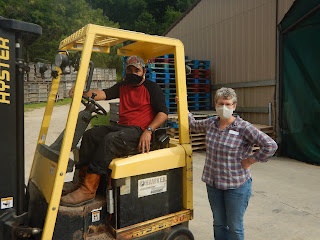
As we prepare for another CSA delivery season, it’s hard to believe we are in the third year of the pandemic.  We continue to navigate the pandemic, adapting as needed as we try to make the best decisions about COVID precautions for ourselves, our crew and you, our customers.  Personally, I have become comfortable wearing a mask indoors and in stores.  I anticipate having a mask handy the rest of my life!  We prefer to use the washable, reusable cloth masks and while they may not be the top-of-the-line disposable kind currently being recommended, they have worked well for us.  Thankfully they have prevented us from contracting COVID as well as avoiding colds and influenza!  We will forever continue good sanitation practices including frequent hand washing which we did before the pandemic!  

April 2021: 
Planting Strawberry plants...
with masks!
As with the last two years, we are starting another delivery season with a bit of uncertainty as to what the year will hold with respect to the pandemic.  Based on the CDC’s Community Risk Tool, the risk in all of our delivery areas is presently rated at “Low!”  While I hope the risk stays low, a new variant was recently discovered, and some are predicting another spike in COVID cases as it spreads across the country.  I guess only time will tell how this variant plays out.  Here on the farm, we have chosen to continue the COVID precautionary procedures we implemented at the start of the pandemic.  Keeping our workers safe and healthy has always been a priority.  At various times throughout the pandemic, we have also been required to follow guidelines set out in Emergency Orders specific to employers of migrant workers that have been issued by the Wisconsin Department of Workforce Development.  While we were required to follow these procedures by law, it wasn’t really a big deal as we had already implemented 80-90% of the requirements before they issued the order!  Another emergency order went into effect on March 1, 2022, and will expire on July 28, 2022.  So, here at the farm we will continue the majority of our pandemic-related practices including wearing masks in the workplace while indoors, in vehicles, and in outside situations where it is not possible to maintain a 6-foot distance.  We will also continue to clean frequently touched surfaces daily in the workplace as well as in the housing we provide for our workers.  This includes facilities as well as all of our trucks and vehicles!  Additionally, this will be the third year that our H2A crew will quarantine upon arrival from Mexico to make sure everyone is in good health.  

With the start of our CSA deliveries only seven weeks away, we realize we need to make plans for the Pandemic-Related Procedures for CSA pick ups this year.  Before we get into the details, I want to start by extending a “Thank You” to all our members who responded to the “end of the season” survey we sent out last December.  The main focus of the survey was to gather your thoughts about pandemic related procedures as it pertains to our CSA sites.   Since we closed the survey on January 15, 2022, the pandemic has continued to be a dynamic situation with ever-changing CDC guidelines and the evolution of new variants.  We knew this would be the case when we asked the survey questions, nonetheless this information has been helpful in guiding us as we make some important decisions for the 2022 season.   Before we go on, I want to share a summary of the survey results.

  • Total Responses:  664 
  • 50% of respondents support continuing to implement our 2021 precautionary pick-up procedures.  Additionally, 30% favored continuing these procedures, but with modifications.  
  • 74% of respondents support continuing to require masks be worn at the pick-up sites.
  • 77% of respondents think we should continue to implement physical distancing at the sites including asking that only one member enter the site at a time.
  • 60% of respondents support the continued use of the large plastic bags in the CSA boxes to facilitate a quick pick up at the sites.
  • 77% of respondents voted to bring back the Swap box for 2022.  
  • 84% of respondents would like to see more Choice items offered at sites in 2022.
  • 20% of respondents want to continue bringing their own pens for the checklist.
So, what pandemic-related procedures will we be implementing at our sites this season?  Well, based on our understanding, COVID is presently diminishing, but by no means gone! In fact, it will probably be with us in one form or another forever. So it behooves all of us to continue to minimize the risk of exposure.  We understand that many of you are tired of COVID restrictions, and some are resistant to vaccinations. We realize there is a spectrum of beliefs, and we respect everyone’s personal points of view.  We also ask that each of you come to the table with a willingness to be respectful of each other as a community and offer compassion and understanding to those who may hold a belief different from your own.  We believe CSA pick-up sites are already a low-risk way to source food, but we want to continue to offer an environment where all members can feel comfortable.  We also can’t forget that we do have some individuals in our membership who are high risk based on a variety of health situations.  Respect has always been an important part of building a strong CSA community and therefore we ask that everyone please respect the precautionary measures we are requesting you follow at our CSA pick up-sites.  In my mind, it’s not too different from taking your shoes off when you visit a friend’s house, and they ask you to leave your shoes at the door.  We also now know that the risk of contracting COVID on a touch surface is not as great as was thought originally.  Rather, there is a greater chance of spreading and contracting COVID by airborne transmission.  With all this in mind, here are our thoughts for Pandemic-Related Procedures for CSA Pick Up in 2022.  
2020 & 2021:  
Plastic Liner Bag in the CSA Box

The Plastic Liner Bag in the Vegetable CSA Box
:  While the use of the plastic bag in the CSA box has helped us facilitate a quick, in-and-out CSA pick up over the past two years, we have decided to discontinue using them for 2022.  We plan to return to our pre-pandemic method of packing the CSA vegetables directly into the CSA box.  Even without the use of the bag, we feel a quick CSA pick up is possible if each person makes a concerted effort to enter, transfer the contents of their box and exit the site.  We do ask that you do not take the entire box home with you!  We would like for each member to bring your own reusable bag, box or a cooler and transfer the contents of your box to that container to transport them home.  One of the benefits of using the plastic bag was that more of the boxes stayed at the CSA sites and were returned to the farm the following week in good condition so they could be reused.  We want to continue to minimize our waste by being able to reuse the waxed produce boxes, however we can only do that if they are clean and appropriate to hold food (i.e., no pet hair, footprints, etc.).  Additionally, we are committed to decreasing the use of plastics where we can this year and this seems like a good place to start.  

If you have a stack of the CSA box liner bags from the past two years and are looking for a way to reuse/recycle them, we do have an option we can share with you.  First, please do not return them to your CSA sites this spring as we are not able to accept them for reuse on the farm.  Rather, we suggest you donate them to Community Hunger Solutions (CHS).  This is an organization we work with locally.   (CHS) which helps us distribute excess or number 2 produce from our farm to food pantries in our area.   They have a need for those CSA bags and would love to reuse them.  If you are willing to contribute to the cost of shipping, you may send your bags directly to CHS for reuse.  Here’s how it works.  
  1. Only send them clean, dry bags that are still in good condition (no rips, tears, mold, etc.) and have not been used for non-food items.
  2. Fold them up neatly so they are flat and put them in a shipping box. 
  3. Send them directly to CHS at the following address:
Community Hunger Solutions (CHS)
c/o Vernon Economic Development Association
1201 N Main St, #5
Viroqua, WI  54665

Masks:  We are continuing to ask that all members please wear a face mask when you go to the site to pick up your box.  It is a small, simple act that helps minimize the risk of exposure to anyone in a shared space.  The peace of mind this provides other members is a small price to pay for wearing a mask for the 5-10 minutes (or less) it will be on while you pick up your CSA box!

Swap & Choice Boxes:  We had over 75% of respondents vote to bring back both the Swap Box this year and to offer more Choice items on the side (E.g., basil, eggplant, etc.).  This is a pretty high percentage, so we have chosen to take your advice and offer a swap box as well as more choice items this year.  For those of you who may not be familiar with these terms, here’s the deal.  The Swap box is a box at the site that members can use to share any produce items from their box that they may not care for or have a use for in a given week.   If another member wants the item and has a use for it, they can take the item out of the Swap box.   Choice items are those that may be packed on the side in a given week.  If it’s an item you like, you’re welcome to take a portion home with you.  

Whether you use the Swap box or take a Choice item is up to you. If you pass on both, you will still receive more in value than you pay for over the course of the season. 

Physical Distancing: We will also continue to implement physical distancing at the sites.  This means we ask that you give any other member picking up at the same time their own personal space.  This may mean you need to move off to the side to unpack your box or wait a moment for another member to finish and exit the site.  Please be patient and courteous.

Farm Events & Camping!

2018 Strawberry Day Field Tour
While we’re not quite ready to return to our usual pre-pandemic style of hosting farm events, we do feel we can offer a safe, low-risk, fun opportunity to visit the farm this year.  We’ll have more details coming later, but we are planning on offering U-Pick Strawberry Day on Saturday, June 18 and a Pick Your Own Pumpkin Day on Sunday, September 25.  We will not be hosting a potluck and likely will not be doing wagon tours to the fields, but we will have space for you to enjoy your own picnic and will provide the option of a self-guided walking field tour.  We will also continue to offer the opportunity to camp in our valley any time of the year!  We have two lovely meadow campground areas and simply ask that you RSVP in advance.

So, that’s it in a nutshell!  We will remind you of the pandemic related procedures which will be clearly outlined in the Welcome Packet you receive in late April prior to the start of deliveries.  We consider these to be small requests and hope everyone will follow them respectfully.   If you have feedback to share with us, we welcome you to do so.  If you have other thoughts or perspectives you would like to share, we welcome your feedback and we’re happy to engage in conversation.  Now, with that behind us lets move forward and have an awesome 2022 CSA Season!