Wednesday, November 17, 2021

Wrapping Up the Season….The Bounty & The Blessings

By Andrea Yoder
Aerial view looking down our valley

It is simply amazing just how much food can be produced off of our 110 acres of land tucked away in a valley.  In comparison to some of the large produce farms out west, 110 acres is just a little drop in a bucket, and yet we can produce tons (literally) of food!  It doesn’t matter how many seasons I go through, I think it will always amaze me to see how the seeds that we store in one small room can, over the course of the season, be turned into tons of produce that at times comes close to exceeding our storage facilities!  This week we wanted to give you a little glimpse of what’s been happening on the farm this fall.

The past seven weeks have been a bit of a whirlwind of activities.  Up until about the last week of October we continued to harvest some herbs, greens and other fresh vegetables.  Thankfully we had a pretty mild fall and some of our late planted gamble crops of cilantro, red radishes, baby bok choi and mustard had enough time to mature so we could harvest them.  While we continued those harvests, we also had to prioritize harvesting our crops to put into storage!  First it was a push to get all the sweet potatoes in, totaling around 30,000 pounds.  Next it was burdock root.  This is a high dollar value crop that is very important to our farm.  We can store it for almost an entire year and there are only a few growers in this country who produce burdock root so we have many customers who depend on us!  It also has very long roots so it’s best to dig it when conditions are dry.  We started harvesting some in mid-September, but really did a push to get it all out by the end of the first week of October.  Thankfully we managed to get it all dug before we had rain and our harvest came in at well over 60 bins or about 25,000-30,000 pounds!  That’s a lot of burdock root and to think it came from only about 8 pounds of seed!

Rows and rows of
Beauty Heart Radishes!
Beauty heart radishes were also a priority and with the warm fall we had, they were growing rapidly pushing them close to the edge of being too big.  But we know they are best after some cold weather so we tried to hold off until we got a few frosty nights.  Thankfully we did get that little bit of cold and we started the harvest.  The other tricky part of harvesting beauty heart radishes is they can be very brittle.  If we machine harvest them we often lose a lot that crack in the process.  So we made the decision to maximize our yields and harvest them all by hand this year.  Overall we harvested well over 20,000 pounds and we still have about 14,000 pounds remaining in the cooler that we’ll continue to wash for orders and CSA boxes we’ll be delivering through the end of the year.  

Brussels Sprouts on the stalk,
going into storage
As our main cooler started to fill up, I knew it was almost time to transition our warm temperature cooler to a cold storage area.  No problem, except at that time we were storing about 30 bins of potatoes in that cooler!  I held off as long as possible, but then Richard declared it time to harvest Brussels sprouts.  In late October we saw the first forecasts for temperatures dipping into the low 20’s.  While Brussels sprouts can withstand multiple frosty nights, dangerously low temperatures in the 20’s can cause damage.  In Richard’s 30 plus years of living in this valley, he also knows that a forecasted temperature of 25 degrees can mean an actual temperature of up to 10 degrees colder in the valley.  Brussels sprouts are too important of a crop to lose, so we started loading up wagon after wagon with bins to bring them in on the stalk.  It takes a lot more storage space, but it’s a much faster harvest and on frosty mornings we can snap them off the stalks.  Just before the first load came in, we emptied the potato storage cooler and moved all the potato bins to a refrigerated trailer that we use once a year in the fall.  I decreased the temperature in our previously warm cooler to 34 degrees and it was ready to store Brussels sprouts.  I lost track of how many bins we harvested overall, but it was around 40 or maybe a little more.  We still have about 20 bins in the cooler and overall we’ll yield about 5,000-6,000 pounds of sprouts!  

As we closed out the month of October, we’d fill up our already full coolers at the beginning of the week as we prepared to pack CSA boxes on Wednesday and ship wholesale orders for the first part of the week.  We had to get creative, we had to remain very organized.  Everything had to have a place and there were some days when there was one way into a cooler and one way out.  On a few occasions, we had 20-30 bins of root vegetables stacked outside at the end of a busy harvest day.  But after the crews unloaded we always managed to find more space to get everything into the appropriate storage environment.  At the end of the day on Wednesday after we had loaded all the trucks, we’d breathe a sigh of relief only to wake up the next morning and do it all again for the end of the week!  While our rutabaga crop was mostly a loss and this year’s carrot crop was a disappointment with very low production, we have still had a very bountiful fall harvest and year overall!  So facing the challenge of exceeding storage capacities is actually a good problem to have!   

The majority of our crops are in now.  We still have a little tat soi in the field along with our little planting of specialty crosnes.  Aside from that, our mission now is to trim, wash, pack and deliver all these vegetables!  This week we’ll be delivering about 52,000 pounds of vegetables total including all of our CSA deliveries as well as orders we’re sending to our wholesale and retail partners.  That’s a lot of vegetables!!   Our crew has been working very hard all season, but especially over the past few weeks to help us get everything harvested as well as working diligently so we can fill our orders, pack CSA boxes and meet all of our deadlines.  We’ve already said goodbye to 11 of our H2A crew members who returned to Mexico at the end of October.  This week we’ll be sending 14 crew members back to their families who are very anxious to welcome them home!  We’ll be taking a little break next week to celebrate Thanksgiving, but we’ll be back at it the next week washing and trimming more vegetables, finishing the last of our field work and some of the other outside missions still remaining on the list.  It’s been a busy, yet very rewarding fall.
2021 HVF Crew Photo (brief moment without masks)

Thus is the nature of our business, the push and the pull, the cycles and the seasons.  As we move into winter we look forward to a little bit of rest and rejuvenation.  We also pause to reflect on the many blessings we’ve received this year, the bountiful harvests we’ve brought in and the thousands of people who have received nourishment from the food that has come off our land.  As we celebrate Thanksgiving next week, it’s an understatement to say we have a lot to be thankful for this year.  

As we wrap up this growing season, we’re already working towards next year.  Our garlic, horseradish and sunchoke crops are planted as is our overwintered spinach.  Fields have been composted and planted to cover crops.  Irrigation equipment is tucked away in storage and we have a list of supplies that need to be ordered to be ready for next season.  Now we’re focusing on cutting and storing firewood, maintenance and repair projects and cleaning up some brush and field perimeters of overgrown trees, etc.  We’re also working on the 2022 CSA season and will be sharing more information about that with the next CSA delivery in December.  

We hope you have a wonderful Thanksgiving in whatever way you choose to celebrate.  We are grateful for your support of our farm and hope you have enjoyed the bounty of the 2021 season.  Take care and we’ll see you in December to officially wrap up our 2021 CSA Season!

Wednesday, November 3, 2021

November 4, 2021 - This Week's Box Contents, Featuring Radicchio!


Cooking With This Week's Box

Red & Yellow Onions:  

Italian Garlic:  

Burgundy Sweet Potatoes:  
Maple Gochuhang Roasted Brussels Sprouts
Photo from dishnthekitchen.com
Sweet Potato Kim Chi Pancakes 

Brussels Sprouts:  

Radicchio:
Radicchio and Caramelized Onion Quiche (See Below)

Peter Wilcox or Purple Viking or Gold Carola Potatoes:

Fresh Baby Ginger:
Gingery Sesame Noodles  (Substitute Kale for the spinach)
Maple-Sage Roasted Black Futsu Pumpkin

Lacinato Kale:

Black Futsu Pumpkin:

Parsnips:

Orange Carrots:

Green Savoy Cabbage:

Hello Everyone!

We’re rolling into the home stretch with only three more CSA vegetable boxes remaining after this week!  As I write these words it is frosty and cold outside, the coldest morning we’ve had this fall!  We’re nearly finished with our field work, but we do still have some vegetables out in the field that we hope will be ok after this frosty morning so we can harvest them over the next few weeks.  In two weeks when we deliver the next CSA Box, we hope to include a harvest report so you know what our fall has been like!  Until then, lets turn our attention to this week’s box which includes a couple exciting items!  First of all, lets talk about the gorgeous heads of radicchio!  So this week’s “green” is actually not green, but rather a gorgeous magenta/burgundy color.  If you are not familiar with this vegetable, take a moment to read this week’s vegetable feature article.  As for recipes, our featured recipe this week is a Radicchio and Caramelized Onion Quiche (See below).  It takes a little time to make a quiche, but none of the steps are complicated and leftovers are always a plus!  If you’re looking for some other ideas for how to use radicchio, check out this article entitled 36 Radicchio Recipes That are Ridiculously Good.

Gingery Sesame Noodles
Photo from halfbakedharvest.com
Another exciting item in this week’s box is Fresh Baby Ginger!  If you’ve never had our ginger, please take a moment to read a little more about it in our 2020 Baby Ginger Feature Article.  Last year we featured recipes for making Ginger Syrup and Homemade Pickled Ginger.  Of course you could also use it in your meals this week to make Gingery Sesame Noodles or this Ginger Garlic Soup!  Fresh baby ginger is different than ginger you typically buy in the store.  Because fresh ginger has a thin skin, it’s best to use it within one week while it’s at the peak of quality.  We recommend storing it at room temperature until you use it.   If you won’t be using it all within a week, you can also preserve it by freezing it.  I usually cut the ginger into small 1 inch pieces before freezing it.  This allows me to remove one or two smaller pieces when I need them without having to thaw the entire piece.  When you’re ready to use frozen ginger, just let it rest at room temperature for 5-10 minutes before you cut it for use.

Brussels sprouts are another frequently loved vegetable in this week’s box.  If you used some of your Korean chili peppers to make your own Gochujang (Korean chili-garlic sauce) and you still have some remaining, pull it out and make these Maple Gochujang Roasted Brussels Sprouts!  The other recipe I included this week is for Grilled Brussels Sprouts.  I’ve never even considered grilling Brussels sprouts, but I have to admit this sounds good!  Be sure to either thread them onto a skewer or put them in a grill basket while grilling them, especially if they are small.

Now that we’re into chilly weather, it’s time to pull out some of those classic, warm, nourishing comfort foods such as Coq au Vin Chicken Meatballs or Classic Homemade Beef Stew.  Both of these recipes make use of carrots as a “behind the scenes” ingredient to flavor the cooking liquid.

That’s a wrap for this week’s cooking recommendations.  Of course there are more delicious recipes in the list, so hopefully there is something that resonates with your preferences this week.  The next delivery will be November 18/19/20, just one week before the big Thanksgiving Day holiday!  Get ready as we’re going to start sifting through all the Thanksgiving recipes to find some gems we can use not only this month, but throughout the winter!

Have a good week, stay warm and eat well!

---Chef Andrea 


Vegetable Feature: Radicchio

By:  Andrea Yoder

Description:  We don’t grow radicchio every year, but it holds a special place in our seasonal lineup as a late “green” and we like a good challenge!  Radicchio is a bitter green that does best when grown in cool months, which is why it is one of the last crops we harvest late in the fall.  It is a popular winter vegetable in Italy and there are many different varieties and shapes.  Many varieties are named for the regions in Italy which they are thought to have originated or where they are grown.  Our winters are more extreme than the mild winters in most parts of Italy, thus not all varieties are conducive to our growing region.  The variety that is best suited for our growing conditions is Chioggia Radicchio, named for the city of Chioggia which is a coastal town located in northeastern Italy along the Adriatic Sea.  This variety is similar to Boston lettuce in the way it grows round, compact heads, although a head of Chioggia radicchio is usually more densely packed than Boston lettuce. 

Growing Information:  One of the reasons it is best to grow radicchio in cool weather is because the cold treatment helps to balance the bitterness with a touch of sweetness making the overall eating quality much better.  The challenge for us though is protecting it from critters and extreme cold temperatures.  Deer are particularly fond of this crop, so we put up a tall fence to deter them.  Some years we also have to cover the radicchio with a double layer field cover held up off the crop by wire supports for additional frost protection.  In Italy, many people harvest radicchio from their gardens all winter long.  We have a shorter window for growth and harvest and while radicchio can take some frost, very low temperatures in the teens and twenties can cause frost damage.  If you see a bit of browning on the edges of the outer leaves, that’s the cause.  The other challenging part of growing radicchio is that the rate of growth slows significantly with cool temperatures making it difficult to grow a sizeable head before our winter truly sets in.  This year, however, we were thrilled to be able to harvest pretty good sized heads that are densely packed!

Brussels Sprouts with Caramelized Onions & Radicchio 
Nutritional Benefits:  Radicchio is rich in minerals and vitamins.  The compounds which lend to its bitterness also help aid digestion and help support the liver in detoxifying the body.  One article found at lacucinaitaliana.it describes radicchio as “a precious ally for our health because it is a true mine of antioxidants, able to counteract free radicals and cellular aging….”  If you are not a fan of bitter vegetables, you may take one bite of raw radicchio and say “Andrea, why did you give me this vegetable?!”  To answer your question, “Because it is good for you AND can be very delicious!”  

Preparation & Use:  The key to preparing bitter vegetables is balance.  Bitter is balanced by sweetness, acidity and fat, so while you may not find a big bite of a leaf to be to your liking, you may find you really like this vegetable when it is incorporated in dishes with other ingredients that help to balance and complement the bitterness. I also prefer to thinly slice radicchio instead of eating it in big pieces.  Lastly, cooking can help to mellow out the bitterness and techniques such as grilling and roasting help to bring out some of the sweetness in this vegetable as well.  

Given radicchio’s popularity in Italy, many of the classic pairings and ways radicchio is used go back to Italian cuisine.  Radicchio may be eaten both raw and cooked.  In its raw form, radicchio is often paired with other greens as well as fruits such as apples, pears, figs, oranges and persimmons to make delicious fall salads.  It is also often incorporated into pasta dishes, risotto, savory pies, omelets, baked au gratin, or used as a topping for focaccia or pizza.  Many dishes will pair radicchio with other ingredients such as walnuts, hazelnuts, pistachios, chestnuts, fatty cheese such as Parmesan, Gorgonzola (blue cheese) or Taleggio.  It is also often paired with seafood as well as bacon or other pork products, eggs, olive oil, olives, Brussels sprouts, sweet potatoes, and caramelized onions.  

Storage:  While we encourage you to use the radicchio within a week or two, you’ll find it stores pretty well and you can likely keep it for several weeks.  Store it in a plastic bag in the refrigerator to keep it from wilting.  You can use the entire head, including the core.  Carefully peel back the layers, wash well and pat dry before using.

Radicchio and Caramelized Onion Quiche


Yield:  8 servings

1 recipe Perfect Piecrust (see below)
1 large egg white
3 Tbsp grated Gruyere cheese (about ¾ ounce)
3 Tbsp extra-virgin olive oil
1 large red onion, halved and thinly sliced 
1 ¼ tsp kosher salt
¼ tsp sugar
1 medium radicchio, halved and thinly sliced (about 8 ounces)
1 tsp balsamic vinegar
3 large eggs
1 ½ cups heavy cream
¼ tsp freshly grated nutmeg
½ tsp freshly ground black pepper
1 Tbsp unsalted butter, cubed
Pinch fleur de sel (Flaky sea salt)

  1. Preheat the oven to 375°F.  On a lightly floured surface, roll the dough to a ⅜-inch thickness and press into a 9-inch pie pan.  Line the dough with foil and fill with pie weights, rice, or dried beans.  Bake for 20 minutes, then remove the weights and foil and bake for additional 5 to 7 minutes, until lightly golden. 
  2. Take the crust out of the oven and brush the bottom of the crust with the egg white and sprinkle on the Gruyere cheese in an even layer.  Return the crust to the oven and bake for 10 to 13 minutes, until lightly browned.
  3. Meanwhile, in a large pan, heat 2 Tbsp of oil over medium heat.  Add the onion, ½ tsp salt, and sugar and cook, stirring occasionally, until the onion is soft and browned, about 15 minutes.
  4. Stir in the radicchio and the remaining tablespoon oil and ¼ tsp salt and cook, stirring constantly, until the radicchio is very wilted and jammy, about 10 minutes.  Stir in the balsamic vinegar and cook 1 minute more.
  5. In a medium bowl, whisk together the eggs, cream, nutmeg, the remaining ¾ tsp salt, and pepper.
  6. When the crust is lightly browned and the cheese is melted, sprinkle on ½ cup of the radicchio-onion mixture and carefully pour in the custard.  Dot the top with the butter pieces, sprinkle on the fleur de sel, and return to the oven.  Bake for 25 to 35 minutes, until the top of the quiche is puffed up and golden and the middle is almost set.  Allow the quiche to cool slightly, about 10 minutes, before serving with the remaining radicchio-onion-mixture sprinkled on top.

Recipe created by Melissa Clark as featured in her book, Cook This Now.


Perfect Piecrust
Yield:  1 (9-inch) single piecrust

1 ¼ cups all-purpose flour
¼ tsp kosher salt
10 Tbsp unsalted butter, chilled and cut into ½-inch pieces
2 to 5 Tbsp ice water

  1. In a food processor, briefly pulse together the flour and salt.  Add the butter and pulse until the mixture forms chickpea-size pieces (3 to 5 1-second pulses).  Add the ice water, 1 Tbsp at a time, and pulse until the mixture is just moist enough to hold together.
  2. Form the dough into a ball, wrap with plastic, and flatten into a disc.  Refrigerate at least 1 hour before rolling out and baking.

Wednesday, October 27, 2021

October 28, 2021 - This Week's Box Contents, Featuring Sweet Potatoes!


Cooking With This Week's Box

Escarole:  

Porcelain Garlic:  

Yellow Onions:  

Poblano Peppers:  

Guajillo Peppers:  

Russet Potatoes:  

Butternut Squash:  

Brussels Sprouts:  

Burgundy Sweet Potatoes:  
Sweet Potato Muffins with Pecan Streusel (See Below)
Gold Beets:  

Green Curly Kale:  

Purple Daikon: 

Hello Everyone! 

It’s finally time to send sweet potatoes your way!  This year’s Burgundy sweet potatoes are quite sweet and tasty, as well as unique in appearance.  These may be the most interestingly shaped sweet potatoes we’ve ever grown!  Nonetheless, I’m excited to share this recipe for Sweet Potato Muffins with Pecan Streusel (See Below).  I discovered this recipe last winter and I’ve made them countless times.  They never get old!  One thing I really like about this recipe is its versatility.   The original recipe is vegan, but it works well with dairy items (milk and butter) as well, so I often use whatever I have on hand.  You can also change up the nuts you use.  I often use almonds, but walnuts, hazelnuts, etc. would work too.  Now this week we’re focusing on sweet potatoes, so you really should make your first batch using them.  That being said, I’ve made this same recipe using winter squash puree in place of the sweet potatoes.  Butternut squash, Orange Kuri, Kabocha, or the Tetsukabuto squash we’ll send your way in December are all good varieties to cook, puree and use to make these muffins.  I’ve also made this recipe using bananas and applesauce as well---you guessed it, equally as delicious!  Ok, two more modifications I want to share.  I like to substitute ½ cup of almond flour for the spelt flour.  It makes a light, very tender muffin.  The last time I made this recipe I realized I didn’t have any muffin liner papers.  Yes, you can grease the muffin tins, but honestly I’d really recommend using the papers for this recipe as they are much easier to extract without falling apart.  Instead of making muffins, I used a small Bundt pan (6 cup capacity) and made a cake!  I poured the batter in the pan and then put the streusel topping on top.  After it was baked I turned it out onto a plate so the streusel was then on the bottom.  With this cake strategy, you can turn this recipe into a nice dessert or coffee cake!  If you haven’t picked up on it yet, I really like this recipe!
 Photo from Brussels Sprouts Hash and Eggs

Time to move on as there are a lot of other great recipes to try this week!  I know we’re going to be eating these Sheet Pan Sweet Potato, Poblano and Black Bean Quesadillas for lunch later this week.  Quesadillas are a quick and easy item to make and then reheat in a toaster oven.  Perfect for a quick lunch or keep them in the fridge for the kids to heat up after school!   The other fun recipe I came across this week was for these Garlic Pizza Sliders Dip.   They are ooey-gooey, cheesy delicious!  Great for the kids, great for game night, or movie night.

Brussels sprouts are another exciting crop this week!  I love vegetables for breakfast, so I’m going to make this Brussels Sprouts Hash and Eggs.  My other breakfast dish idea for this week is this Chickpea and Kale Shakshuka.

This week we’re sending Russet potatoes, one of the few drier, starchy potatoes we grow.  This is the variety traditionally used to make baked potatoes.  My favorite way to eat this is baked with a salt crust.  If this interests you, check out this article, How To Make Salty, Crispy Skinned Baked Potatoes.  

Ok, that’s all I’m going to comment on today.  Take a look at this week’s recipe suggestions and see for yourself if anything looks good!  Have a great week and I’ll see you next week to celebrate the first week of November and ginger harvest! –Chef Andrea


Vegetable Feature: Sweet Potatoes

By:  Richard deWilde

Most Midwest farmers would not even consider growing a tropical plant like sweet potatoes or ginger (spoiler alert…coming in next week’s box!).  But we’ve never fit the profile for a typical Midwest farm and we’ve attempted many unconventional challenges and new crops.  Learning how to grow sweet potatoes has been one of our more favorable attempts.  Still, every year presents a new set of challenges to overcome and we continue to learn from each experience.  

Sweet Potatoes starting out this spring
Of the many varieties of sweet potatoes from around the southern parts of the world, only a handful stand a chance of producing in Wisconsin.  We have tried them all and will continue to try any new ones available.  For now we have settled on two varieties that consistently produce a yield in our unconventional system.  We start our sweet potato crop from plants called “slips.”  We depend on slips grown in outdoor beds by two organic growers in North Carolina.  Time is of the essence for us as we need to maximize the growing season.  Thus, we want to plant as soon as possible after the last frost date in May.  When we order, we hedge our bets and divide our order between the two suppliers.  They are affected by weather too and in years past they’ve been hit by tropical storms, cold weather snaps, etc. which affects the timing and quality of the slips they are harvesting.  But, if all goes as planned, we get the slips by the end of May.  We transplant them into raised beds covered with dark green plastic which helps hold heat to make the plants think they’re in their preferred tropical environment!

Jose Luis & Oscar showing getting ready to 
start picking up the sweet potatoes
I mentioned we have two favorite varieties and those are Burgundy and Covington.  Covington is a dependable producer of nice banana-bunch like clusters of four to six potatoes.  They typically have nice shape and size, but generally fall slightly below in “brix,” which is a measure of sweetness.  Burgundy has moved to the top of the list with its deep orange color and sweetness for several years.  It tends to lag behind in yield, only producing two to three nice tubers in a cluster, but we love their rich taste and sweetness so are willing to compromise a bit on yield.  

Every year is different and this year defies these typical descriptions in many ways!  It was very dry and hot when we planted them, just what sweet potatoes like!  We have a water line under the plastic cover to deliver water and nutrients, but sweet potatoes do not require much fertility and we know that excess water produces thin, stringy potatoes and few tubers.  So we refrained from too much water based on the readings we took from our moisture sensors.  The vines were very prolific, vines on top of vines that were knee high!  In September when we cut them back to dig a test cluster, it was disappointing.  We only found one to three potatoes on each plant.  So in early October, we put a cover on them to trap in heat and prevent frost damage.  No frost came, but fearing wet and cold weather, we removed the cover, chopped the vines and dug them!  It took most of three days with a crew of ten to carefully lift and crate them.  Approximately 30,000 pounds went into the greenhouse where we “cured” them for about ten days.  This means we held them in an environment with temperatures around 85°F with very high humidity for 8-10 days which helps set the skins so they are more stable for storage and the starches in the tubers are converted to sugars enhancing their sweetness.  

Digging a few samples and digging the whole crop are pretty different.  The covers and waiting definitely produced more size to tubers, but it did not change the number of tubers in a cluster.  The Burgundy that is in this week’s box was a mystery to watch come out of the ground as I followed behind the digger.  The initial clusters remained at only 1 or 2 nice tubers, but below, very deep, about 18 inches was another crop of sweet potatoes that were long, skinny and beautifully twisted.  Needless to say, they are less than perfect in shape, but they still taste delicious! So while they may not look like the standard graded sweet potato you may see on a store shelf, we chose to include them in your boxes and hope you’ll embrace the unique individuality expressed in each one!  

This year the Covington and Burgundy both came out of the field with a Brix of 8-10 where we usually see 4-6.  After the curing process they both measured fairly equal at 11-12.  These two varieties do have different natural sugar profiles, so even if they measure similarly with a Brix reading, they can be two very different flavor and tasting experiences.  So, you be the judge!  Let us know what you think about the flavor of the Burgundy and compare it to the Covington variety we’ll be sending to you in several weeks.   

It’s best to store sweet potatoes at room temperature.  We do not recommend storing them in the refrigerator as they are susceptible to chill injury.  And that’s this year’s sweet potato story.  We hope you enjoy this year’s unique crop as you use them in soups, casseroles, tacos, desserts, baked goods and so much more over the next few weeks.  


Sweet Potato Muffins with Pecan Streusel


photo from thefirstmess.com
Yield:  10-12 muffins

Streusel Topping:
½ cup pecan halves, chopped
5 Tbsp coconut sugar or brown sugar
½ tsp ground cinnamon
Pinch fine sea salt
2 ½ Tbsp cold butter or vegan substitute

Muffins:
2 cups light spelt flour*
1 tsp ground cinnamon
1 tsp baking powder
1 tsp baking soda
¾ tsp fine sea salt
1 ½ cups mashed, cooked sweet potato flesh
½ cup maple syrup
⅓ cup melted coconut oil or butter, at room temperature
2 Tbsp milk or non-dairy alternative 
1 tsp vanilla extract
  1. Preheat the oven to 400°F.  Lightly grease 10 cups of a standard size muffin tin and set aside.  Alternatively, line the muffin tin with muffin papers.
  2. Make the streusel topping.  In a small bowl, mix together the chopped pecans, coconut sugar, salt and cinnamon.  Add the butter to the bowl and mix it in with your fingers, or use a pastry cutter.  Break up the bits of butter and cut them into the sugar and pecans.  Once you have a sandy, crumbly texture, and the streusel sticks together when you pinch it with your fingers, set aside in the refrigerator.
  3. In a large bowl, combine the spelt flour, cinnamon, baking powder, baking soda, and sea salt.  Stir with a spatula to evenly mix.
  4. In an upright blender, combine the mashed and cooked sweet potato, maple syrup, coconut oil, milk and vanilla.  Blend on high until totally smooth and creamy.  Alternatively, whisk these ingredients by hand in a medium mixing bowl.
  5. Pour the sweet potato mixture into the large bowl with the flour mixture.  Use your spatula to get all of the sweet potato mixture you can out of the blender.  Gently stir and fold everything together until JUST combined.  
  6. Divide the muffin batter evenly among the 10 prepared muffin cups.  Remove the pecan streusel from the fridge and divide it evenly amongst the tops of the muffins.  Press it in a bit with your fingers.  
  7. Bake the sweet potato muffins for 18-20 minutes, or until the tops are domed, slightly golden and a pairing knife or cake tester inserted into the middle of one comes out clean.  Let the muffins cool completely before enjoying!
*Note Regarding Spelt flour:  If you do not have this type of flour available, you may substitute standard all-purpose flour, whole wheat pastry flower or gluten free flour of your choosing.

Recipe adapted slightly from TheFirstMess.com.

Wednesday, October 20, 2021

Farm: A Convergence of Nature and Humanity, a Living Organism


Richard & Andrea checking out the roots in a field
planted with a cover crop

By Andrea Yoder

Back in early August our friend John Peterson posted an article on the blog for his farm, Angelic Organics.  The title of his article was “Farmer John Writes:  Do You Eat Data?”  If you have a minute, I’d encourage you to read his article.  If you receive/ed a CSA box on October 7/8/9, October 14/15/16 or October 21/22/23, you may have made the connection between this Farmer John I’m citing now and the Farmer John who grew the carrots in your box these weeks.  We share many parallel thoughts and perspectives on farming with John and want to take a moment to share some of his thoughts with you, after all its his energy and that of Angelic Organics that comes with those carrots to your table!

Fall Garlic Planting
In his article, John challenges us to consider the difference between viewing a farm as a living organism as opposed to a collection of data points.  His definition of a farm is a little different from the dictionary definition.  The dictionary defines a farm as “a tract of land devoted to agricultural purposes.”  John defines a farm as “a convergence of nature and humanity.”  I have to say, John’s definition resonates with us much more closely than the textbook definition of a farm.  You see, a farm is more than just “a tract of land.”  It truly is a living organism that needs to be nurtured, cared for, guided, protected.  It needs someone to commit to caring for it, a steward or rather stewards.  This is where the concept of a farm as a living organism comes to life.  It’s where humans commit to connecting to nature in a way that is bilaterally supportive and beneficial.  It’s where the perspective of a farm supersedes the data and our eyes are opened to the dynamic, complex nature of a farm.  It’s where food becomes more than just a product and becomes a way of connecting to nature, to community, to something much greater and more meaningful.

Silvestre counting the number of seeds per foot
the planter is putting out to make sure the
planting rate is correct.


Lets pause for a moment and revisit the concept of viewing the farm as a collection of data points.  We do use data every single day.  Our farm is a collection of every subject in school.  Most of us carry calculators in our back pocket.  We have all kinds of forms and documents where we record data—every single day.  We look at harvest yields and efficiency.  We consider bed feet and the quantity of seed needed to plant a specific plot of land.  We titrate mixes of nutrients to feed plants through drip irrigation, utilize metric tools to do repairs on machinery, apply concepts of pressure changes and temperatures to managing refrigeration, and of course we have to look at the bottom line on a Profit & Loss report to make decisions that help us keep the farm profitable, self-sustaining and ensure it has a future.  But with as many data points as we utilize every day, there are just as many considerations and aspects to viewing a farm as a living organism that are less tangible and more difficult to measure as a data point. 

What about the people?  As we look at our farm, we’re not just talking about ourselves who have been labeled “The Farmers.”  We alone are not the only caretakers of this land, and thank goodness as it’s a job that far exceeds our capabilities alone!  As we consider the convergence of nature and humans at Harmony Valley Farm, it’s vital to broaden our perspective to include you, our CSA members, as well as our employees and those within the community who support the innerworkings of our farm. This ranges from the guy who delivers parts from Auto Value to the truck drivers who pick up produce from our farm each week and everyone in between.  Yes, our relationships are laced with transactions.  We issue paychecks biweekly to our employees.  We pay invoices for services we receive.  We process payments from you when you submit money to purchase your CSA shares.  It can stop there if you want it to, but we hope you look a little further. 

We all need the food that comes off this farm.  This is the food that sustains our bodies, keeps us healthy, supports the growth and development of children, strengthens our immune systems and helps us function in our highest capacities.  People who eat well, feel well and, we hope, go on to do good things in this world.  This is where the meaning and connection, the convergence of humans and nature, becomes a beautiful, dynamic, living organism with a reach and impact that goes beyond what we even realize.

The Nash family enjoying our 
Fall Harvest Party in 2019

Over the years we’ve heard many stories about how participating in CSA has impacted people’s lives in positive ways.  CSA kids who grow into beautiful, healthy adults, families who have built memories around the meals they’ve shared and the moments they’ve spent at the farm.  Members who have become our close friends and loyal supporters.  You see, there’s an energy that comes with that food and we hope you understand the food we produce comes with a big dose of commitment, dedication and desire to truly nurture and care for this organism.  But we also hope you understand that we feel the energy you send back to us!  Your gratitude, whether spoken or unspoken, the ways you go on to do good things in this world, the ways you use these vegetables and connections to enhance your own lives.  It all matters. 

What about the many hands that work here, our employees?  Farmworkers are often overlooked and underrepresented.  One of our longtime buyers made a comment one time that every time a consumer takes advantage of cheap food, someone along the supply chain is exploited.  I don’t have a data point to demonstrate this point, but I can tell you that in the industry of fresh market vegetables, labor is the greatest cost of producing food.  Thus, it’s also the line item on a Profit & Loss statement that often stands out the most and is subject to being cut.  This farm would not run without the efforts of our employees.  

Luis is happiest when he's operating a tractor!

Their physical strength as well as their positive, “can-do” attitudes, problem-solving abilities, refined skills and even their jokes and laughter are what fuel our days.  Your dollars and continued support of our farm in turn supports these workers and their families.  The majority of our employees come from Mexico and many of them have worked with us for many years.  We care for each other and while as employers it’s not our responsibility to be concerned for the families of our employees, we can’t deny the fact that their families are just as much a part of this farm as we are, as you are.  So yes, we do think about them, their needs, their well-being and send them gratitude at the end of every season.  Gratitude for sharing their loved one with our farm, to care for the land and contribute to producing food for our community.  Last week we had all of our chimneys professionally cleaned. We’ve had the same person clean them for several years now and he caught me off guard as we were closing up the deal when he was finished.  As I handed him the check for his services, he told me he loves coming to our farm every year.  He said “everyone is so nice and you can just tell they are happy and want to be here.”  Needless to say, my heart melted and his words confirmed just how much our employees contribute to the spirit of this farm.

Nitrogen nodules forming on the roots of cover
crop plants, plus millions of bacteria you 
cannot even see!

I could write volumes about the opportunities we all have to connect to the natural side of Harmony Valley Farm, but I’m going to condense my thoughts today and just highlight one of the many amazing natural aspects of our farm that exemplifies the convergence of nature and humans.  We are surrounded by a vast and complex community of microorganisms, fungus and beneficial bacteria.  This network of organisms extends from our forest land to our fields and everywhere in between.  We can’t see it with our naked eye, but we know it exists in the soil beneath our feet.  This network functions on our behalf, keeping our soils alive, helping to make nutrients available to the plants and continually contributing to the regeneration of our farm.  The benefits we reap from this vast underground system of microbes far exceeds the understanding of our humble minds, and yet it’s a part of what makes this farm a complex living organism.

Get a copy of Farmer John's
Cookbook packed with 
farm stories and seasonal 
recipes!

Thank you Farmer John for challenging us to “think outside the box.”  Yes, there are many in the world that view a farm as a data point, a tract of land, a factory in a sense that produces food.  But lets not lose sight of the bigger, broader view of a farm as a living organism.  One that generates food, yes, but also represents the convergence of nature and humanity.  One that we care for and support and in turn it supports and cares for us.  It’s a pretty meaningful bite to swallow.  On behalf of all of us on this side of the partnership, thank you for choosing to be part of this farm.  We appreciate and value you, we think of you and hope your lives are enhanced through this connection.

October 21, 2021 - This Week's Box Contents, Featuring Escarole!


Cooking With This Week's Box

Baby Arugula:

Escarole:
Escarole, Bacon and Roasted Butternut Squash Salad with Dried Apricots and Pepitas (See Below)
Escarole with Lentils & Sausage (See Below)

Lacinato Kale:

Italian Garlic:

Red Onions:

Mini Sweet Peppers:

Hot Peppers:

Baby White Salad Turnips:

German Butterball Potatoes:

Orange Kuri Squash:

Jester Squash or Starry Night Acorn Squash:

Orange Carrots:

Spicy Blue Cheese Mini Sweet Peppers
photo from culinaryginger.com
We’re coming up on the end of our Peak Season shares as we near the end of October.  If you are not already signed up for the final four boxes of the season, you still have time to do so!  We have more tasty selections in store for our November and December boxes including sweet potatoes, tat soi, Brussels sprouts, radicchio and kohlrabi!  This week we’re featuring Escarole, one of our bitter greens that holds an important spot in our late season greens lineup.  If you’re not familiar with this green, I encourage you to read more about it in this week’s feature article.  It can be eaten raw or cooked, so I thought I’d include one recipe for each application this week.  This week’s recipes include Escarole, Bacon and Roasted Butternut Squash Salad with Dried Apricots and Pepitas (See Below) and Escarole with Lentils & Sausage (See Below).  While both recipes include meat, you could easily omit the meat for a vegetarian option or replace the meat with a meatless alternative.

Spiced Kuri Squash Pie, photo from coconutandlime.com
Next week we’re planning to start washing and packing sweet potatoes, so this week we took advantage of a little extra room in the box to send not one but two varieties of winter squash your way!  Orange Kuri squash is very similar to kabocha squash, so feel free to use it in any recipe calling for kabocha.  I’m really excited to use it to make this Roasted Red Kuri Squash and Coconut Soup and this Spiced Kuri Squash Pie.  Both of these recipes have some simple yet interesting flavor twists that made them stand out to me.

We are also including either Jester squash or Starry Night Acorn squash.  Jester is very similar to delicata squash and while the skin is technically edible, I find it is more thick than delicata squash and I don’t care to eat it.  This feature is also what helps it store better than delicata squash, a trade off I think is well worth it.  Starry Night Acorn squash is a trial variety for us this year.  Of course you can use it in any recipe calling for acorn squash, although I’ll caution you with the fact that typically acorn squash is a pretty bland squash which is why most recipes bathe it in butter and brown sugar!  This variety is supposed to be more sweet and flavorful, so before you add a lot of sweetener, taste it first.  These two varieties of squash are considered to have more lean flesh and are appropriate to substitute for each other in most recipes.

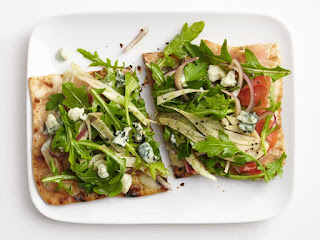
Arugula & Prosciutto Flat Bread Pizzas
photo from foodnetwork.com
While we’re not finished harvesting greens, we are coming to the end of our baby greens season.  Use this final bag of arugula to make these simple, yet tasty Arugula & Prosciutto Flat Bread Pizzas or Arugula Salad with Pears and Goat Cheese.  In both recipes the fatty ingredients (Prosciutto and goat cheese) are a fantastic complement to the spicy arugula.

As the nights get chilly and we bring another month to a close very soon, we’re reminded that winter will be here before we know it.  If you have more vegetables than you think you can eat this week, consider squirreling away a few things for the winter.  Peppers are easy to freeze, or turn the hot peppers into Salt-Cured Chiles or HVF Fresh Korean Garlic-Chili Sauce.  You’ll be happy to pull these little preserved gems of vegetable goodness out of the freezer this winter!

That’s a wrap for this week.  I hope you enjoy cooking with this week’s vegetable selections and encourage you to share your escarole creations with us in our Facebook Group!  Have a great week!---Chef Andrea

Vegetable Feature: Escarole

By:  Chef Andrea Yoder

Description & Growing Information: Escarole is in a family of vegetables called chicories which also includes radicchio. Escarole has a pretty long growing season and some years it’s hard to get them to full size.  It is a cold-hardy green that is best suited for growing in the fall and is sturdy enough to be able to take some frosty, cold nights.  In fact, we don’t even think about harvesting escarole until it’s had some chilly nights!  The flavor changes dramatically after they’ve had cold treatment.  This green does just fine uncovered when freezing temperatures are in the low 30’s and high 20’s, but it can sustain some damage when we get a hard freeze. So, some years we do cover this plant to protect it from freezing too hard on those really cold nights.  Due to a warm fall this year, our escarole and radicchio crops are coming in a few weeks ahead of schedule.  We’ve been hesitant to start harvesting them because they had not yet had that cold treatment.  Thankfully, we did have several chilly nights last week and when we tasted them earlier this week we were pleasantly surprised by how mild their flavor is with a slight sweetness.

Escarole resembles a head of green leaf lettuce, but it does have some distinct differences.  First of all the leaves are more broad and a bit more thick when compared to leaf lettuce.  The center of a head of escarole and the portion of the leaves near the base are generally blanched to a light yellow or white.  While all the leaves are edible, these light colored center leaves tend to be the most tender and mild flavored.  As such, this is the portion of the plant you may wish to prioritize for eating raw and save the darker outer leaves for cooking.

White Bean & Escarole Pizza
Preparation & Use: Escarole may be eaten raw or cooked.  When eaten raw, the bitterness is going to be more pronounced.  You’ll find that cooking mellows the bitterness and accentuates the sweet qualities.  It’s also important to note that different ingredients help to balance the flavor of escarole, both raw and cooked.  Fatty ingredients such as sausage, prosciutto, bacon, duck, hard cheese, olive oil, olives and nuts such as pine nuts and hazelnuts provide a nice counter balance to the bitterness of escarole.  Acidic ingredients also perform similarly, which is why you’ll often see recipes for escarole that include vinegar or fruit such as apples, citrus, pears, persimmons and pomegranate.  Of course it also makes sense to pair escarole with other fall vegetables such as garlic, onions, beets, potatoes and winter squash.  Escarole is popular in Italian cuisine where it is often used in soups or sautéed and/or braised along with white beans, lentils, pork and garnished with a variety of cheeses.

There’s a classic preparation for escarole that some Italian cooks call Scarola Affogata, which means “smothered escarole.”  In this dish, garlic is sautéed in olive oil until golden, then chopped escarole, salt and red pepper flakes and seasoning are added to the pan.  The greens are cooked until they are soft and tender.  This is then served as a side dish, or you can use the greens for another purpose, such as on top of a pizza or slathered on a piece of thick, crusty bread.

Storage: Store escarole in a plastic bag in the refrigerator until ready to use.  When you are ready to use it, separate the leaves from the base and wash well in a sink of cold water.  If you are using the escarole for a raw salad, shake or spin off excess water to dry the leaves.  If you are cooking it or adding it to soup or stew, it’s ok if there is still some water on the leaves.  

Escarole with Lentils and Italian Sausage 


Yield:  4 servings

1 cup dry lentils
3 cups chicken broth
1 Tbsp olive oil
1 pound Italian sausage
1 large onion, roughly chopped
3 cloves garlic, thinly sliced
1 head escarole, stems removed and roughly chopped
Salt and pepper, to taste
½ cup Parmesan cheese, finely grated
  1. Place the lentils in a medium-sized pot.  Pour in the chicken broth and season with a bit of salt and pepper.  Bring the lentils to a boil, cover the pot tightly, and reduce the heat.  Simmer until the lentils are tender, about 15-20 minutes.  Remove from the heat.  Drain most of the juices away and reserve the lentils.  Leave just enough juice so the lentils don’t dry out.
  2. Heat the oil in a large skillet or frying pan over medium heat.  Add the sausage and cook until browned and cooked through, about 10 minutes.  If using links of sausage, transfer the cooked sausage to a cutting board and let rest at least 5 minutes before slicing into disks.  If you are using bulk sausage, just crumble.
  3. Add the onions to the pan and cook over medium heat until they are soft and translucent.  Add the garlic and cook 1 more minute.  Add the cooked lentils, escarole, salt and pepper and cook until the escarole is wilted, about 3-5 minutes.  Add the sausage back to the pan and stir everything until fully incorporated.
  4. Remove from the heat, garnish with shredded Parmesan cheese.  Serve with crusty bread for sopping up the liquid.
Recipe created by Chef Jamie DeMents from Coon Rock Farm (www.coonrockfarm.com).

Escarole, Bacon and Roasted Butternut Squash Salad with Dried Apricots and Pepitas


photo from heatherchristo.com
Yield:  4 servings

2-3 cups butternut squash, peeled and chopped into bite-sized pieces
3 Tbsp olive oil
Kosher salt, to taste
1 head escarole, roughly chopped
2-3 slices bacon, cooked and chopped
½ cup dried apricots, thinly sliced
¼ cup roasted and salted pepitas

Vinaigrette:
1 shallot, minced
2 Tbsp fresh Italian parsley, minced
2 Tbsp whole-grain mustard
2 Tbsp honey
¼ cup red wine vinegar
¼ cup olive oil
Kosher salt, to taste
  1. Preheat the oven to 375⁰F.  Toss the squash with the olive oil and season with salt. Roast the squash for 15-18 minutes or until golden browned on the edges and fork tender.  Set aside to cool.
  2. In a small bowl, whisk together the ingredients for the vinaigrette and season to taste with salt.
  3. In a large bowl, combine the escarole, cooked bacon, apricots and pepitas with the butternut squash.  Just before serving, drizzle some of the vinaigrette over the top and gently toss to coat.  You want just enough vinaigrette to lightly coat all the ingredients.  Season to taste with salt and serve immediately.
Recipe created by Heather Christo and is featured at heatherchristo.com.