Showing posts with label Rutabaga. Show all posts

Wednesday, December 4, 2019

December 5, 2019 - This Week's Box Contents, Featuring Rutabagas!

Cooking With This Week's Box


Rutabaga: Finnish Rutabaga Casserole (see below); Rutabaga & Apple Salad (see below); Norwegian Mashed Rutabagas (see below)

Happy December!  As we roll into the home stretch of the 2019 CSA season, I am reminded that seasonal eating can be a lot of fun!  This week we’re featuring rutabagas—and if you just groaned or moaned, I want you to know I heard you!  Just kidding.  Over the past few weeks we’ve eaten quite a few rutabagas as I trialed some new recipes and this week I have three simple recipes to share with you.  The first is for Finnish Rutabaga Casserole (see below).  While I made this for Thanksgiving, my understanding is that this is actually a traditional Finnish dish often served at Christmas alongside ham.  You can make it with rutabaga only or you can do a mix of rutabaga and potato.  The next recipe is for Norwegian Mashed Rutabagas (see below).  In Norway they cook rutabagas with carrots to make a simple mash.  Really, you can make root mash with any combination of vegetables.  Rutabagas and carrots go really well together and make a pretty root mash, but also one that has a hint of sweetness.  If you wanted to add some potato or sweet potato to the mix, you might be veering from tradition but I guarantee it would still be delicious.  The last recipe, Rutabaga & Apple Salad (see below), comes from a blog written by an American now living in Norway.  I don’t know if this is a traditional recipe, but it is so delicious!  When Richard sat down to eat dinner his first comment was “What a beautiful salad!”  As we started eating it, we both commented “Wow, this really tastes good!”  I am going to add this to my lineup of winter vegetable salads.  It’s crispy, crunchy, slightly sweet and very simple.  While rutabagas won’t win the prize for being the most flashy vegetable, they have a lot of potential to create some tasty meals.  If none of these recipes appeal to you, you might want to check out Dishing Up the Dirt where you’ll find 11 more delicious recipes to utilize rutabagas.

Apple Turnip Quiche
Turnips are another underappreciated root vegetable, but how can you not appreciate this week’s gorgeous sweet scarlet turnips!  I’ve likely shared this recipe for Apple Turnip Quiche before, it’s one of my favorites and I make it quite frequently throughout the winter.  This recipe is credited to The Birchwood Café and I have to say, my homemade versions are just as good as the piece I ate at the café!  This quiche is delicious served for breakfast, brunch, lunch or dinner.  There are several other winter recipes that rotate through my kitchen from December through March.  Chicken Pot Pie with Biscuit Topping is one of them.  I use whatever root vegetables I have available, typically carrots, parsnips, celeriac and either turnips or rutabagas.  Sweet scarlet turnips are always my first choice because they look so pretty in this dish.  I had never heard of pasties until I moved to Wisconsin.  Last year I decided to give them a try and we featured this recipe for Cornish Pasties in our December newsletter.  They are very easy to make, leftovers reheat well and they are simple but tasty.  Again, use whatever root vegetables you have available.

Ok, there’s one more underappreciated root vegetable in this week’s top 3 lineup—Celeriac.  One of my favorite winter dishes to make with celeriac is Wild Rice and Celeriac Gratin.  I also like this recipe for Braised Chicken with Celeriac & Garlic.  In both of these recipes the flavor of the celeriac is present, but subtle.

Ethiopian Spiced Cabbage, Carrots & Potatoes
photo from thewanderlustkitchen.com
We’re nearing the end of green vegetables, but do still have a small amount of kohlrabi and some green savoy cabbage that we tucked away for this month’s deliveries.  I am looking forward to making Andrea Bemis’ recipe for Kohlrabi & Chickpea Salad.  This is a great salad to enjoy during the winter.  This creamy vegetable salad includes toasted sunflower seeds and raisins to add a bit of crunch and sweetness to accompany the kohlrabi and chickpeas that provide the base of this salad.  If you have green savoy cabbage piling up in your refrigerator, consider trying a dish from another country such as this Ethiopian Spiced Cabbage, Carrots & Potatoes.  Of the nine ingredients in this recipe, 5 of them are vegetables in this week’s box.  This recipe is super simple, vegetarian and can be the base of a nice weeknight dinner when served with lentils and Ethiopian flat bread.  The unique part of this recipe is that it uses Berbere spice.  Berbere is a unique Ethiopian spice blend that has a lot of spices including chiles, garlic, fenugreek, cinnamon, allspice and a variety of other components.  You can find this in the bulk spice section of most co-ops, so just get a little bit for this recipe—it’s what makes Ethiopian food Ethiopian food!

Bombay Carrot Salad with Cashews & Raisins
photo from feastingathome.com
Every week needs a pizza and this week’s seasonal combo is Carrot Pizza with Fontina & Red Onion.  This recipe uses carrots to make a creamy “sauce” to spread over the crust.  I’m not sure what this would look like with the purple carrots.  I might recommend using the orange ones for this recipe.  If anyone does try it with purple carrots, please post a picture in the Facebook Group!  I do think it would be fine to use the purple carrots, or a combo of both colors, in this Bombay Carrot Salad with Cashews & Raisins.  This salad, paired with Garlicky Lentil Soup, would make a tasty, nourishing winter meal.

One of the things I love about food is how it can take you to other parts of the world.  We started off this week’s discussion with recipes from Finland and Norway.  Our carrot salad took us to Bombay and we had a taste of Ethiopia just ahead of that.  While we’re in Africa we might as well explore this Peanut and Sweet Potato Soup.  This is a Deborah Madison recipe we featured back in 2014.   If you aren’t into African flavors, maybe you’d prefer this Thai Red Curry Soup with Sweet Potatoes & Squash.  This is one of the easiest Thai curry recipes—great for a quick weeknight dinner.

Sweet Potato and Molasses Muffins
with Maple Cashew Frosting
photo from dishingupthedirt.com
I’m sure we all enjoyed our fair share of Thanksgiving pies, cakes, desserts, etc, so no dessert recipes this week, but a little something sweet to wrap up this week’s article.  These Sweet Potato and Molasses Muffins with Maple Cashew Frosting are courtesy of Andrea Bemis from Dishing Up the Dirt.  They are a healthy version of decadent—no guilt.

Ok, one more thing to share and I have no idea how this recipe ties together with anything I’ve shared this week.  I just think this idea for Roasted Red Onion Flowers is super fun and I really want to try it.  Just look at how beautiful they are!  So if you have a stash of red onions on your counter, give these a try.  They’ll go great as a side dish with nearly anything.
And on that random final note….Have a great week!—Chef Andrea

Vegetable Feature: Rutabagas


by Andrea Yoder


Nature has a way of giving us what we need in its appropriate season.  As we move into the winter months, we no longer have the luxury of eating fresh veggies out of the field.  Instead, we turn to foods that store well and in preparation for the long, cold months we stock our root cellars full of vegetables that can survive the winter.  Not as many people these days have a root cellar, but you can use your crisper drawer for a similar purpose!  Rutabagas, along with turnips, are two of the best storing root crops and the stars of this week’s “Weed Em’ & Reap” newsletter article.  Take a moment to read more about these two underappreciated vegetables and you’ll quickly learn they have been an important part of winter diets in northern regions for a long time!

When you are ready to use your rutabagas, trim off the neck on the top.  Cut the vegetable lengthwise in halves or quarters so it is more manageable to handle.  Trim off the exterior skin using a paring knife,   You’ll find the flesh to be a beautiful golden color, firm and crisp.  When cooking rutabagas, less is often more.  Don’t try to make rutabagas fancy, that’s just not their style.  This week’s recipes reflect tradition and feature dishes from both Finnish and Norwegian culture.  Rutabagas can be eaten raw, boiled, stir-fried, roasted, baked and braised.  Elizabeth Schneider wrote, “There is really just one way not to cook it:  in lots of water for a long time….”  Perhaps this cooking method is responsible for turning up many noses over the years.  If you overcook rutabagas, they will quickly go from tender, sweet and delicious to mushy, strong flavored and stinky.  Rutabagas are also often used in soups, gratins, roasted root mixes, and root mashes, but can also make a really nice winter salad or stir-fry.  Rutabagas pair well with butter & cream (big surprise), ginger, lemon, nutmeg, parsley, sage, thyme, apples, pears, other root vegetables, bacon and other smoked and roasted meats.

Rutabagas should be stored in a cold environment with moisture to keep them from dehydrating.  If stored properly they can be preserved for months.  If you notice your roots starting to get floppy or soft, just soak them in a bowl of water in your refrigerator and they’ll spring back to life.  Don’t let them shrivel up in the crisper drawer this year, give them a try!  You just might find you like them and will miss them come spring!

Finnish Rutabaga Casserole (Lanttulaatikko)


Yield:  6 servings

6 cups peeled & diced rutabaga OR 3 cups rutabaga and 3 cups peeled & diced potatoes
¼ cup dry bread crumbs
¼ cup heavy cream
½ tsp ground nutmeg
1 tsp salt
2 eggs, beaten
3 Tbsp butter
  1. Preheat the oven to 350°F.  Butter a 2 ½-quart casserole and set aside.
  2. Cook the rutabagas and/or potatoes together in salted water to cover, just until soft and tender.
  3. Drain and mash with a potato masher.  Soak the bread crumbs in the cream and stir in the nutmeg, salt, and beaten eggs.
  4. Blend mixture with the mashed rutabagas and potatoes.  Turn into the casserole dish.  Dot the top with butter.  Bake for 1 hour or until the top is lightly browned.
This recipe was borrowed from Beatrice Ojankangas’ book, Homemade:  Finnish Rye, Feed Sack Fashion, and Other Simple Ingredients From My Life In Food.  Beatrice grew up in rural northern Minnesota, the oldest of ten children.  In addition to a lifetime of experience cooking for her family, she also has an extensive list of accomplishments as a food writer and recipe developer.  While she comes from Finnish descent, she also lived in Finland for a short while. During this time she researched and collected recipes that she compiled and published as, The Finnish Cookbook.

Mashed Rutabagas (Kålrabistappe)


Yield:  4-6 servings

1.5 pounds rutabaga (kålrabi)  
8 oz carrots (2-3 medium) 
1 qt water
1 Tbsp plus 1 tsp salt (or to taste) 
¼ cup whipping cream
2 Tbsp butter
¼ tsp black pepper
¼ tsp nutmeg
  1. Peel and cut rutabaga and carrots into pieces (large dice).  Place the vegetables into a pan and cover with a quart of water seasoned with 1 Tbsp salt.  Bring the water to a boil and cook the rutabagas and carrots just until tender and soft. Drain, reserving 1 cup of the cooking water.
  2. Mash the rutabagas and carrots by hand using a potato masher.  
  3. Stir in cream, butter, pepper, and nutmeg. If needed, add the additional teaspoon of salt and maybe a dash of the reserved liquid, to taste.
This recipe was adapted from one originally printed in the Oct. 21, 2016, issue of The Norwegian American.  It was submitted by Lillian Laila Owren of Kristiansand, Norway.

Rutabaga & Apple Salad (Kålrabi Salat med Epler)


Yield:  Makes a large bowl (7-8 cups)

1 medium or several small rutabaga (about 1 pound)
2 tart apples, cored
¼ red cabbage (about 2 cups, sliced thinly)
½ cup hazelnuts, whole
Salt and freshly ground black pepper, to taste
Vinaigrette:
⅓ cup oil (neutral vegetable oil or hazelnut oil)
¼ cup apple juice
2 tsp Dijon mustard
1 ½ tsp apple cider vinegar
1 Tbsp honey
  1. Peel and cut the rutabaga into matchsticks by hand or with a mandolin. Cut the apples into matchsticks as well. Thinly slice the red cabbage. Place rutabaga, apples and cabbage in a serving bowl.  Season with salt and freshly ground black pepper and toss to combine.
  2. Place the hazelnuts in a large frying pan over medium-high heat to toast. Shaking once and a while to prevent burning. When starting to turn a golden brown remove from the pan. (I like to add the skins and all, but you can remove the skins if you wish by rubbing the hazelnuts between your palms or in a tea towel.)  Roughly chop the nuts and add to the salad.
  3. Combine all the ingredients for the vinaigrette in a small bowl and whisk well. Pour over the salad and gently mix until everything is covered. Serve immediately.
This recipe was borrowed from northwildkitchen.com, a blog written by Nevada Berg.  Nevada grew up in Utah, but now lives in the beauty of Norway where she enjoys foraging, exploring, and cooking. The pictures and stories on her blog are beautiful!

Rutabagas & Turnips….Give Them A Chance!

By Andrea Yoder

Rutabagas
Winter can be a challenging time to eat seasonally and locally for many in the upper Midwest and sometimes we have to think “outside the box” as we get creative with preparing storage vegetables until spring returns.  Root vegetables such as celeriac, turnips and rutabagas often get a bad wrap, and honestly—most of the time it’s because someone is intimidated by them, doesn’t have a clue what to do with them, or has had a bad experience with them (….as in their mother or grandmother served them overcooked vegetables!!!!).  So this week, we’re going to bring two of these often underappreciated roots out of the shadows and give them a brief moment of fame.  Let me introduce you to the stars of this week’s show---Rutabagas and Turnips!

Gold Turnips, Sweet Scarlet Turnips, and Purple Top Turnips
I asked Richard how long he’s been growing rutabagas and turnips.  His reply, “Almost forever!”  His earliest memories of these vegetables goes back to his Grandpa Nick who grew them in his garden, both to feed his family as well as his animals through the winter.  Even though we grow these every year, we’ve tried to limit the number of storage turnips and rutabagas we’ve included in late season boxes.  In fact, many years we haven’t even put rutabagas in the box and still we have people tell us in end of the season surveys that they “got too many rutabagas!”  Perhaps they are confusing rutabagas and turnips or maybe they just haven’t been able to surmount that hurdle of “What the heck do I do with these roots?!”  Friends, I hope you’ll trust me on this and know that both of these humble vegetables have and deserve a place on our tables this winter, just as they’ve graced the tables of our ancestors for hundreds of years before us!  Both rutabagas and turnips have a long history in the culture of peoples from northern regions such as Norway, Sweden, Finland, Scotland, Ireland, and northern Asia.  This is because both of these vegetables grow well in regions with a colder climate where other crops can’t be produced.
Hand-harvesting rutabagas on a sunny fall day
Consider what it was like to live in a time where you had to eat what you could grow because transportation just wasn’t available.  It’s too cold to grow bananas, avocados, sweet potatoes and even some grains, but you can grow potatoes, carrots, cabbage, turnips, rutabagas.  Now it makes more sense why some of these root vegetables became such an integral part of these cultures!  In Norway the nickname for rutabagas is “Nordens Oransje” which means, “Orange of the North.”  This brings up another important point about these roots.  It’s not just that they are able to be grown in these areas, they also provide valuable energy, vitamins, minerals and other nutrients that our bodies need to stay healthy over the winter.  As the nickname indicates, rutabagas are actually a pretty good source of vitamin C.  Of course, I should mention that both rutabagas and turnips are members of the brassica family which is known to be a family of important foods that provide us with antioxidants and other phytochemicals that build up our immune systems, prevent cancer and protect our bodies in many other ways.  So it seems, nature does provide us with the foods we need.  Now it’s our job to embrace them!

Scarlet turnips as far as you can see!
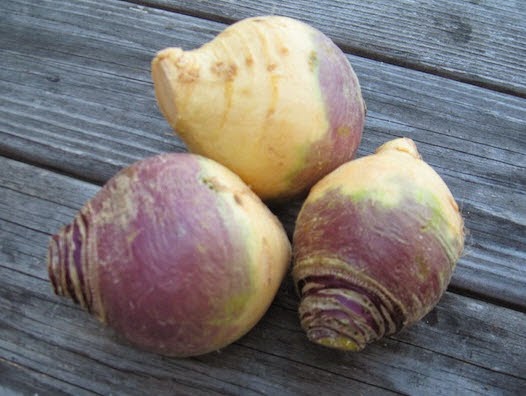
In Scotland rutabagas are called “neeps,” while in Ireland rutabagas are called “turnips” and the English seem to follow the lead from Sweden and call them “swedes.”  As you can see, turnips and rutabagas are often confused.  Rutabagas are a buttercream yellow with purple shoulders.  They are often on the larger size growing anywhere from 5-7 inches in diameter, or bigger!  The ones in your box this week are on the small side and, while not necessarily good for yields and profitability, you will find them more manageable to work with.  Rutabagas have more of a pointy bottom on the root end and often have a Dr. Seuss like stem, although we often trim away most of the stem so all you see is the stem stump on top.  Turnips on the other hand are more rounded, or more of a flattened round shape.  The traditional storage turnip is a purple top turnip that has a white bottom with purple shoulders.
Rutabaga leaves--seldom eaten by people,
but excellent forage for animals!
See why it’s easy to confuse them with rutabagas?  In addition to purple top turnips, we also grow golden and sweet scarlet turnips.  All three of these varieties store very well, but we think the flavor is different amongst these three and we tend to favor the golden and sweet scarlet varieties.  However, it’s important to note that, as with many other vegetables in the Brassica family, the flavor of the vegetable is significantly impacted by exposure to cold.  The turnips and rutabagas we harvest early in the fall before we’ve had frost are not as sweet and mild as those harvested after a few chilly nights.  The other factor that affects taste is how you cook them.  If I were allowed to have only one pet peeve in the world, it would be “Do Not Overcook Brassicas!”  Turnips and rutabagas need to breath, so when you’re cooking them either leave the lid off or at least open it up a bit.  If you don’t, all of those sulfur containing phytochemicals which make these vegetables so darn healthy for us will volatilize, build up in the steam and get trapped in the pot.  When you remove the lid, WHOOEEEE they do NOT smell good!  Many a grandmother and mother of the past have subjected their families to boiled turnips and rutabagas that simmered away in a big pot on the stove, covered, for hours filling the whole house with their stench.  No one wants to sit down to the table to eat overcooked vegetables.  Just don’t do it, ok?

Cornish Pasties, made with a variety of root vegetables
Turnips and rutabagas have also been known as “peasant food” or “animal fodder.”  Now, would you rather eat something with the reputation as being good enough to feed the peasants and animals or something fit for a king?  Well, actually I think it’s a testament to the vegetable that it’s versatile enough to feed both a human and an animal.  Furthermore, farmers often used these vegetables as feed as well as forage crops (letting the animals graze and eat the green tops) because they were a valuable source of nutrition in the days before hybrid grain varieties were available.  Prior to these hybrid varieties, corn and other grains couldn’t always be grown in some of these northern climates because the growing season wasn’t long enough.  Additionally, turnips and rutabagas could be stored and fed to the animals all winter!  In addition to his memories of Grandpa Nick, Richard also remembers seeing bunker silos full of root vegetables being stored as winter animal feed when he visited Europe.  Once we had cheap grain available, these crops fell out of favor for use with animals.  So it has nothing to do with the fact that the rutabaga or turnip is a crop of lesser value and thus was fed to the animals or lower rungs of society.

Turnip lanterns to celebrate Räbelichtli,
photo from mrs-twinkle.com
Ok, two fun facts before we wrap up.  Did you know there is a festival called Räbeliechtli that is celebrated in German speaking regions throughout Switzerland?  This word comes from “rabe” meaning turnip and “liecht” meaning light.  It’s celebrated in early November and includes a procession or parade at night in the dark in which children carry lanterns carved from turnips!  So if you really can’t find anything to make with a turnip or a rutabaga, at least turn it into a fun, creative project and carve it into a lantern.  Here’s how!

International Rutabaga Curling Championship
photo from visitithaca.com
The other fun fact I want to share with you is that there is actually a sporting event held in celebration of the rutabaga.  That’s right, there is an International Rutabaga Curling Championship held in Ithaca, New York every year towards the end of December at the Ithaca Farmers’ Market.  The event is open to both amateurs and professionals and, according to this website, ‘Preparation is crucial. “Athletes must prepare by sending positive vibes to the Gods of Rutabagas.  First-time spectators cannot possibly be prepared for this event.”’  I know we have some CSA members with ties to Ithaca as well as the sport of curling (Kathy P, I’m looking at you).  If anyone has ever attended or participated in this event, I want to know about it!

I really hope you’ll give these humble vegetables a chance this winter.  While they are seldom the focus of a dish, they can easily be incorporated into many tasty dishes that will nourish your body and keep you well throughout the winter.  I haven’t told you much about cooking them yet, but that information can be found in this week’s “What’s In the Box” newsletter which features rutabagas.  Congratulations Friend, you’ve made it to the end of the season!

Friday, December 19, 2014

Featured Vegetable: Rutabagas

By Sarah Janes Ugoretz


Rutabaga is derived from the Swedish rotabagge, which literally translates to “root bag.” Not terribly glamorous I suppose, but the rutabaga really is an underrated vegetable. As Deborah Madison—author of Vegetable Literacy and my go-to for most things veggie—says: “Treated lavishly and respectfully, rutabagas are a fine winter vegetable.” The result of a fortunate cross between the wild cabbage and the turnip, rutabagas are often mistaken for the latter—in some countries, the two are even treated interchangeably! While both are members of the Cruciferae family, rutabagas differ from turnips in a few key ways. Most notably, with a longer growing period—90 days compared to 40 or less for the turnip—rutabagas are denser roots. As such, they take longer to cook. It’s often best to first peel and then blanch them in boiling water for a few minutes before tossing them into a dish with other (still raw, at this point) vegetables.

Nutrition-wise, rutabagas are a good source of vitamins C and B6, as well as calcium, magnesium and potassium. Being that they are a winter root vegetable, rutabagas will keep well in your crisper drawer for a month or more. If you’re the homesteading sort, you can experiment with packing your extra roots in moist sand. Kept in a cool (but not freezing) location, you’ll be able to keep these roots around for several months.

The first written reference to rutabagas dates back to 1620, when they were observed growing wild in Sweden. Accounts vary as to the actual origin of this vegetable, though many believe rutabagas first appeared in Scandinavia or Russia.

Early on, rutabagas were commonly used as a vegetable in family meals, as fodder for livestock and, for a time in Britain, as cannonball substitutes! Among residents of the British Isles, it was tradition to carve rutabagas into lanterns and fill them with coal on Halloween night as a means of warding off evil spirits. Today, rutabagas’ uses are primarily culinary in scope. Honestly, a rutabaga is at its best when used simply. They are a prime candidate for roasting and pureeing, and they make an excellent addition to hearty soups, stews and casseroles. In addition to other root vegetables, nice companions for rutabagas’ crisp, slightly sweet flavor include butter, cream, parsley, bay leaf, smoked paprika, bacon, apples and pears.
Rutabaga harvest at Harmony Valley Farm

Rutabagas do not taste the same the world-around. The eating quality of a rutabaga is very closely connected to the weather conditions during its growing and harvest season. This year was a pretty mild, cool year and as a result you’ll find these rutabagas are quite mild and slightly sweet. In contrast, when the growing season is hot, the flavor of the rutabagas tends to be more sharp, bold and sometimes a little on the bitter side. In a good rutabaga year, Richard’s standby method for vegetable prep holds true for rutabagas—“just add butter, cream and cheese.” We’ve shared this in previous newsletters, but can’t help but repeat this very simple way to enjoy a rutabaga. If you’ve tried rutabagas previously and didn’t care for them, we’d encourage you to try them again. You may find these taste quite different from what you’ve experienced previously.

Mashed Rutabaga Potato Supreme
This recipe is borrowed from our friend, John Peterson at Angelic Organics Farm. It was featured in his cookbook entitled Farmer John’s Cookbook: The Real Dirt on Vegetables. 

Serves 4
Salt, few pinches 
1 pound rutabaga (approx., 1 medium or 2 small), peeled, cut into ½-inch chunks
½ pound potatoes, peeled, cut into ½-inch chunks
1 medium carrot, chopped
¼ cup milk
3 Tbsp unsalted butter, melted
¾ tsp salt
¼ tsp freshly grated nutmeg
Freshly ground black pepper, to taste

  1. Bring a large pot of water to a boil. Add a few pinches of salt and then drop in the rutabaga; boil for 10 minutes. Add the potato and carrot and continue to cook until all the vegetables are tender, 15 to 20 more minutes. Once tender, remove from the heat and carefully drain off the water.
  2. Heat the milk in a small saucepan, but do not boil.
  3. Mash the rutabaga, potato and carrot with the butter until smooth, adding a little of the warm milk at a time until the mixture reaches the consistency you like. Stir in the salt, nutmeg and pepper to taste. Serve hot.

Tuesday, April 8, 2014

Second Final Four Match-Up

Yesterday, as the Ramps were dicing up the Mini Sweet Peppers, Capt Jack was looking forward to the Sweet Potato and Rutabaga mash-up today. He is pretty sure he knows who will win, but only time will tell.


On the 'LIKE' side today we have Capt. Jack's favorite vegetable of all time - the Sweet Potato!  These sweet beauties have cured the competition thus far. First they roasted the Honeynut Butternut Squash, then they steamed the Broccoli Romanesco. Now we will see if they can mash up the Rutabaga team. To help the Sweet Potatoes go to the Championship round, 'LIKE' our status on Facebook today.


On the 'SHARE' side, we have the Rutabaga team. They buried the Celeriac in the ground during the first round and are still reeling over the Red Beet blow-out on Friday. These root veggies are looking to smash the Sweet Potatoes with a little butter, salt and pepper to help them go down. The Rutabaga team is looking to you for help to take down the competition, to help them move on - 'SHARE' our Facebook status today!


The winner of this round will move on to take on the Ramps for the Championship Title.  I am sure that Jack will be eagerly waiting to see the results tomorrow. Can you guess who he wants to win?


Friday, April 4, 2014

Winter Division Championship Round!

We are officially crowning the Sweet Potatoes the Fall Vegetable champion, and let me tell you that Jack is eager for their next battle.  We had to hold him back, as we need to crown a Winter division champion first. As we draw to an end next week, we have decided that we will allow the vegetables to rest and recuperate over the weekend.  After today's battle, we will start up the Final Four match ups on Monday with Ramps vs. Mini Sweet Peppers. Then on Tuesday the Sweet Potatoes are going to try to mash up the winner of today's match. Here are the current standings.


As you may remember, the Rutabaga shredded the Celeriac in the first winter round. After that dicing, we are eager to see who will win in this match-up. These root beauties are considered a solid vegetable that stores well for a long period of time.  To help with their sweetness, we leave them in the field until after the first light frost to make them even better than the waxy ones you'll find in the store.  If you would rather have a Shepard's pie with a mashed Rutabaga topping, 'LIKE' our Facebook post today to root for the Ruties team.


In the first Winter match-up, The Red Beets sliced up the Beauty Heart Radishes to take the win.  But can they do it again against the Rutabaga's or will the beets get beat? We have the beets, we have the beets, we have the beets, yaahhh, we have them! The beets have come to this match-up with a quick win in mind. They are so versatile and colorful, it seems an unfair advantage in the looks department.  But they are not just a pretty vegetable, they also have a wide variety of uses from salads to desserts and everything in between. To show your love for these red beauties, 'SHARE' our photo on Facebook today!


So, who will come out as the hottest vegetable in today's dish?  Only you can decide.


Sunday, March 30, 2014

Moving into the Winter Division Match-ups!

As the sweet sixteen are whittling down, we only have two more match-ups to complete the elite eight line-up.  Today we move into the Winter division with two of the farm favorites, Rutabaga versus Celeriac.

On the 'Like' side, we have the humble Rutabaga, known to many as “Grandma’s Favorite Vegetable.” Mmm, I can still smell Grandma’s Shepard’s pie with mashed rutabaga topping!  Farmer Richard is a fan of mashed rutabagas, simply cooked until tender and mashed with a little cream and butter.  We leave them in the field until they get a light frost to make them sweet and tasty.  They are a very solid vegetable and store well for a very long time to sustain us through a long Midwestern winter.


On the 'Share' side, we have the gnarly looking, but great tasting Celeriac (aka celery root).  Many people are intimidated by the outward appearance of celeriac with it’s bumpy peeling and knobby root base.  Don’t be intimated….celeriac is actually a very gentle vegetable and will serve you well in soups, stews, salads, and warm creamy gratins.  With its mild, sophisticated flavor and creamy white flesh, it seldom steals center stage.  Celeriac prefers to stay in the background offering subtlety to dishes and taking its role as a supporting actor very seriously.  Similar to the rutabaga, celeriac is known for its long storage potential to bridge the long gap between winter and spring.