Showing posts with label Irrigation. Show all posts

Wednesday, August 25, 2021

Late August Field & Farm Update

By Richard and Andrea

Can you believe we’re at the end of August already?!  We’re quickly approaching that transition point in the season where summer and fall vegetables overlap, the days are busy, the harvests are bountiful and the meals you get to prepare with all these vegetables are colorful and delicious!  The week’s have been flying by for us and there’s no shortage of tasks to keep us on our toes.  First it was garlic harvest, then a push to get the onions out of the field.  Last weekend we harvested about half of our potato crop and this week we’ve stayed busy harvesting thousands (literally) of watermelons!  The next big harvests coming up will be winter squash followed by sweet potatoes and that will bring us up to fall root crop harvest and our final big harvest push before we close out the season.  Ok, now that we’ve laid it all out, lets back up and talk through some of the details.

Farmer Richard inspecting a
pheromone trap in the sweet corn field.
While fall will officially be here before we know it, we still have a lot of summer to enjoy!  We hope you’ve been enjoying this year’s sweet corn, which has turned out better than we had anticipated.  Some of the sweet corn blew over in the storms we had back in July, but thankfully the crops have come through despite that and the corn has been very good!  After this week we’ll have one crop remaining to harvest.  This is the time of the year when we have to watch out for corn earworm, a pest that starts as a moth which lays its eggs on the silks of the corn.  When the egg hatches a little worm makes its way down the silks and into the ear.  It’s a harmless, but annoying little creature.  We’ve been monitoring its activity, first through reports from University extension who reported sightings in Coon Valley, which is not far from us.  Those reports coincided with the first moths we caught in our pheromone traps.  We’ve been using an organically approved spray to treat this pest and try to prevent the worms from being a problem.  So far it looks like our tactics have been effective, but you may still find a worm or two in this late season corn.  If you do, just trim the tip off the ear as the remainder of the corn is still wholesome and delicious!

Mini Sweet Pepper Field
As we move into the latter part of summer we are also reaping the benefits of sweet peppers, tomatoes, and watermelons!  This has been one of the most productive watermelon crops we’ve ever had!  Between watermelons, melons, tomatoes and corn, it’s been a challenge to get everything in the boxes!  We are just starting to pick tomatoes from our second planting, so there will hopefully be several more bountiful weeks of tomatoes.  The sweet peppers are just starting to change colors, so look forward to a variety of orange Ukraine, Orange and Red Italian Frying peppers and of course, mini sweet peppers!  If you’re finding the quantity of food you’re receiving is quite a lot for your household during this peak part of the season, consider how you can tuck away some of these vegetables through simple preservation methods so you can enjoy them throughout the winter and they don’t go to waste!  If you have extra tomatoes, chop them up and cook them down, then either freeze the coarse “sauce” or puree it.  If you don’t have time for the cooking part, just freeze your tomatoes.  If you have freezer space, all you have to do is wash them and cut out the core.  Put the whole tomatoes in a freezer bag and put them in the freezer.  When you take them out you can cook them down into a soup or sauce.  Peppers are also easy to freeze as you can freeze them raw.  I (Andrea) will include some of these preservation tips from week to week in the newsletter, so look to this resource for some guidance.

Looking ahead to some of our fall crops, we are happy to report that the sweet potatoes and winter squash crops both look very good at this point!  Richard dug some sweet potatoes just to see what was happening underground and they look great!  The butternut squash are so thick you can barely walk in between the rows in the field.  We’ll likely start harvesting them within the next few weeks, which means we need to get the rest of the onions and shallots trimmed, cleaned and into the cooler!

An established cover crop is
important to prevent erosion over the winter!

Last week we put out the last of our transplants with our fall lettuce crop and a crop of escarole and radicchio that we hope to harvest in November.  We’ve completed all of our main season plantings including our fall storage turnips and radishes.  We still have several weeks of plantings to complete for the crops we plant weekly including radishes, cilantro, bok choi and our fall spinach and salad mix.  Aside from this small lineup, we’re turning our attention to planting cover crops!  This past week we received over 7,000# of cover crop seed and we plan to plant it all!  Cover crops are an essential part of our system and we rely upon them to hold our soil in place over the winter as well as for the nutrients and organic matter they build in our soils.  Of course there’s also the benefit they offer to the planet as they sequester carbon.  It’s an investment in time and money, but one we feel more than pays for itself in returns!

Steam rolls off the compost pile
as it is turned with the compost turner

As we “put our fields to bed for the winter,” we’ll also be spreading minerals and compost to put fertility back into the soils for next year.  Silvestre has made some nice windrows of compost and it’s heating very nicely!  After the last turn it heated to 160°F overnight!  In order to be compliant with the NOP (National Organic Program), it needs to be maintained at 140°F for a minimum of 15 days and we will turn it to stir it up and incorporate more oxygen a minimum of 5 times during that period.  This process not only turns the raw materials into actual compost, but the time it’s held at these temperatures also kills weed seeds and any pathogens.  By the time it’s finished it will look like “black gold!”

Benchmark for the water level is in place
(lower left) & the permit is posted!
We usually start our conversations by somehow talking about the weather, so we’d better circle back and cover that topic!  Despite receiving rain over the past few weeks, we’re still pretty dry!   Our irrigation crew continues to work hard to keep up with the moisture losses we see simply based on evaporation and transpiration.  Now that the plants we’re watering are more mature, they lose more moisture every day as they “breathe,” but we also see greater moisture loss when it’s windy and hot.  On the topic of irrigation, we’re happy to report that we did receive our irrigation permit that was pending for one of the properties we lease.  We shared about this application process and our irrigation practices in an article we published last month.  We are grateful for the support of the DNR in issuing this permit, but also for the positive feedback we received from some of the community members who initially had expressed concern about this application.  We will continue to do the best we can to manage our irrigation practices responsibly.  Last week Richard and Luis put in the benchmark for the new permit, posted the permit and we’re hoping to start irrigating soon.

Cows grazing on green pastures
In the pastures, we’re happy to report both the cows and pigs are content, thriving and doing well.  The cows continue to enjoy their pasture grass and we have a good supply of hay put up for their winter feed.  The pigs have also been eating well and are starting to enjoy hickory nuts falling in their pasture.  Hopefully they’ll have a few acorns to snack on this fall too!  While we are sold out of pork for this fall’s deliveries, we do still have beef available.  If you are interested in stocking up for the winter, you might want to consider purchasing a custom half beef.  It’s our most economical offering and you get to choose how you want it processed!  Just email Andrea, our meat lady, if you are interested.

Well, there are many other crops and farm activities we haven’t even touched on, including the gorgeous purple and yellow cauliflower that we’re harvesting this week!  We still have a lot of work ahead of us to finish out the second half of our CSA season.  Pretty soon we’ll also start laying the groundwork for next year’s CSA program and start pre-booking seeds and supplies for next year.  The cycle keeps going and we continue to be grateful for your support of our farm.  Enjoy the final weeks of summer and we’ll meet you back here later this fall for another update!

Wednesday, July 28, 2021

Perspectives on Irrigation Practices At Harmony Valley Farm

By Richard de Wilde

Welcome to Harmony Valley Farm!
I am writing this article in hopes of communicating with a wide audience that includes our CSA members with whom we communicate on a regular basis.  While many of our CSA members are very familiar with who we are and have been with our farm for many years, we recognize we also have  newer members who are still getting to know us.  However, I also am writing this article for the purpose of sharing some information about our farm and our practices with members of our community who may not be familiar with who we are, specifically as it relates to the recent comments submitted by some in response to our pending irrigation permit application with the DNR.  Before I address some of the specific concerns raised, I’d like to provide a little background to bring us all together on the same page.

Uncovering our garlic field ahead of schedule
this past March due to an unseasonably warm spring! 
Nearly every conversation related to farming in some way also relates to weather, so lets start there!  This year we have seen a little bit of everything starting with a warm and dry spring followed by a late May frost.  After that cold snap, the weather pattern shifted and it got very hot!  The El Niño drought cycle that started last August and persisted most of the winter hit us hard!  We had planted our first carrots, beets and all of the parsnips on fields that we could not irrigate.  The moisture dissipated in an unusually hot April and seeds sat there for weeks before a light rain provided enough moisture to germinate some of them.  Thankfully, those carrots made it and we have been harvesting them this month!  We did not get a full stand of parsnips, but we will have some for harvest this fall.

A natural spring that
feeds the creek on
our land


This year has been a challenge for us as well as other farmers in the Midwest.  We have, thankfully, had some rain which has definitely helped and we are very grateful to have received it.  However, we have also gone for long stretches of time without rain, which makes it difficult to germinate seeds and establish crops.  Some crops also have higher water needs to keep them productive and thriving.  One of the challenges we face is that we are limited on land we have the ability to irrigate, which can often help bridge the gap until the next rain.  Access to irrigation can, in situations such as these, be the difference between having a crop or not.

Unlike some growing regions in the west, our area of southwest Wisconsin is typically blessed with an abundance of moisture from rains, natural springs and small to large creeks and rivers.  The Bad Axe River, which runs through our property as well as land we lease and farm, and our spring fed creeks are able to hold their water levels well, even in a drought.  We know this is true because we monitor water levels regularly when we are pumping water for irrigation.  Our last severe drought was in 2012, and we remember it well.  Our current El Niño drought event started last year and despite a couple of timely rains this spring and summer, overall still continues.

Sweet corn setting on ears
If you have driven through the countryside recently you may have seen corn and soybean fields that  look pretty good.  Our beans and edamame (edible soybeans) crops also look pretty good, despite the fact that we have not irrigated them.  These crops have large seeds that can be planted up to 2 inches deep to get enough moisture to germinate and send down a root as deep as needed to find moisture.  This is a good attribute to have in a drought year when you are trying to get seeds into enough moisture to germinate.   However, we raise a wide variety of vegetables and many have very small seeds that are shallow rooted (e.g. carrots, red radishes and rutabagas).  Seeds for crops such as these can only be planted ¼- ½ inch deep and if that top portion of the soil is dry, we need to either time the planting just before a rain or we have to add moisture to the soil to get the seed to germinate.

Irrigation has made a huge difference and, thankfully, our crops look quite good this year overall.  While we have manageable options to irrigate on most of the land we use to produce crops, irrigating from waterways requires a permit from the Department of Natural Resources (DNR) and we are not permitted to irrigate on some of the land we are currently farming.  Some may ask, “Why don’t you just drill a well?”  Well, we do have two low capacity wells on land that we own, but we farm many small fields spread out over six miles.  Many of our fields are on leased land where this is not an option due to the permanency of the structure, need for electrical access to run the pump, and the significant financial investment.  So, our more practical option is to pump surface water from a nearby waterway using equipment that can be moved and used only when necessary.

This is the time of year when we are planting some of our fall storage crops, but we are running out of land with access to irrigation and it is proving to be a challenge to get these crops to germinate, let alone take them to harvest should we continue to experience extended periods of dry conditions with only intermittent rain.  We currently have an irrigation permit application pending with the DNR for access to irrigation on a piece of land we lease on the North Fork of the Bad Axe River.  We actually started the process in March 2020 by asking for an amendment to our existing permits, but the process was held up due to the pandemic.   We tried again in March of this year, but we were told we cannot amend our current permit and needed to start the application process from the beginning.  The permit process is quite lengthy and involved.  We have had irrigation permits with the DNR since the drought of 1988.  These permits are very specific as to the pumping rate, dates and total season capacity.  We record each time we pump, including calculating the gallons per minute (GPM) that we are using.  Every year we are then required to report our annual totals pumped for each permit.  This information is then made available to the public.

Blanding's Turtle passing through one of our 
vegetable fields!
As part of the DNR permit process, they post a notice allowing the public to comment on the application for the permit before they make their final decision.  The public comment period for our application is now closed, however we had the opportunity to read the public comments that were submitted to the DNR, as well as some of the informal comments individuals made regarding our application through a variety of social media outlets.  We realize some individuals and conservation organizations are concerned about the environmental impact associated with withdrawing water for the purposes of irrigation.  Specifically we are aware of the concern for a negative impact on trout populations and endangered and rare species of wildlife including cricket frogs and Blanding’s turtles.  We have actually found both cricket frogs and Blanding’s turtles on our farm and fully understand and respect their fragile state.  Our entire application for this irrigation permit is accessible on the Wisconsin DNR website, so anyone who wishes to review the documents we were required to submit is welcome to do so.  There is some irrigation jargon that we use that may be difficult to put into context if you are not familiar with the terms and volumes we are representing.  Additionally, it is difficult within the application to fully represent “the big picture” of how we manage irrigation activities in the context of our entire farming operation along with our own values and conservation efforts.  Thus, I thought it may be helpful to provide the public and those who are not as familiar with Harmony Valley Farm with some basic background information.

An irrigation pump and sand filter
at an irrigation site
First of all, the proposed rate of water withdrawal for the property we are requesting a permit for is 150 gallons per minute (GPM) from the North Fork of the Bad Axe River.  On June 8, 2021, a team of ten DNR staff members came out to take a look at our operation and the land represented in our application.  Based on the volume of flow they measured on June 8, 2021, our withdrawal of 150 GPM represents 0.53% of the water volume.  This is clearly not enough to negatively impact any wildlife, including trout or other game fish. The DNR staff was very thorough in their assessment and they spent several hours examining the pumping site, the equipment we use, location of the pipes we would lay and the surrounding wetland areas.  They measured the river flow at our requested pumping site.  They looked at our pumps that are double screened to prevent any small fish or tadpoles from getting sucked into the system.  I would like to comment that the DNR staff deserves credit, not criticism, for the thorough job they do with reviewing irrigation applications.

Hooded Merganser mother duck and her babies
spotted swimming on the Bad Axe River!
While 150 GPM may seem like a lot of water, it is important to put this volume into context.  When we  look back at our overall water usage for irrigation, our annual withdrawal amounts always come in well under the maximum volume we are allowed to pump based on our existing permits for other land we farm.  In fact, I looked back to see what our overall annual water usage was for irrigation in 2012, our last official drought year.  We actually only used one-third of the allowable volume of water we were permitted to withdraw, and that was in a drought year!  Another point I’d like to make is that our current permit includes irrigation access for land we are no longer farming.  Over the past several years, and with repeated flood events, we have stopped farming some land that is too prone to flooding, have transitioned some to pasture, and have sought other options on land that is less vulnerable.  If our pending irrigation application is approved, we would not be increasing the overall water we are withdrawing from the Bad Axe River.  Rather, we are only requesting to withdraw in a different location.

A planting of native wildflowers in full bloom 
on our farm this summer
 
Some of the public comments expressed concern with maintaining the waterways and surrounding ecosystems.  These concerns are valid and ones we also share.  It is for this reason that we employ practices that allow us to do the best we can to deliver water efficiently and only as needed.  Based on my more than 40 years of organic farming experience, it is evident that soil that is cared for with annual applications of cover crops and compost is rich in organic matter which helps absorb rainwater and increases water-holding capacity.  This means the soil is more resilient and is able to more efficiently utilize water, thus requiring less irrigation volume.  We have been managing some parcels of land we farm for 15-30 years and continue to utilize these same farming practices, investing in nutritive inputs on land we own as well as land we lease with the intention of building soils that are resilient.  We also use moisture sensors, as well as observation, to help us make decisions about when to water and how much water a crop needs.  Excessive water use is not only unnecessary, but it is also not good for plants.  Additionally, over the past few years we have transitioned to more extensive use of underground drip irrigation which is a much more efficient way to deliver water than by using overhead irrigation (e.g. sprinklers) where more moisture is lost due to evaporation.  We do still use overhead irrigation in some situations, but only when that is our only option.  So yes, we do irrigate, but we do so in the most responsible manner and the nature of how we are utilizing irrigation is much different than in some areas such as a “Central Sands” pivot system where they are irrigating crops on sandy soil which is not able to hold moisture well.

Blanchard's Cricket Frog found 
hanging out in the pumpkin field!
(photo by Kyle Lindemer)
In the public comments, several individuals also questioned the validity of self-reporting.  We have had a “public interest benchmark” from the beginning when we received our first irrigation permit in 1988.  I personally have dropped a measuring tape off the bridge deck where this benchmark is measured many hundreds of times to check the depth of the water.  Even in the worst drought the water level has stayed well above the benchmark.  When measured on June 8, 2021 by DNR staff after 6 months of drought, we were still more than six inches above the benchmark and it has not dropped since then.  The DNR staff confirmed the same observation we have made over the years which is that the creeks and rivers in this area, being mostly spring fed, are very stable year round.  Is the public interest benchmark enforceable?  Yes, the DNR could come out and measure at any time.  If the water level drops below the benchmark we would not be able to irrigate.  Aside from a visit from the DNR, it is up to the permit holder to be honest and do the right thing.  As I mentioned before, our historical water usage, even in a drought year, is well below the maximum volumes we are permitted to withdraw.  We accurately report each and every hour that we pump and record these volumes both for the purpose of reporting to the DNR, but also because we need to have a record of this information to help us make decisions related to managing crops.  We have absolutely no reason to under report as our actual usage is well under what we are permitted to withdraw.

Creek bank erosion caused by the flood of 2007

I, along with my partners, am very clear about our intention which is to produce wholesome, nutrient dense, certified organic food for thousands of people in our region.  I chose to be an organic farmer in the early 70’s because I felt it was the responsible way to grow food, both for the impact on human health as well as for the environment.  There were very few who thought I would succeed, and in fact the extension agent in my area told me “it cannot be done.”  I have always had an appreciation for nature and the preservation of our land, waterways, pollinator populations, wildlife and ecosystem as a whole as these are all integral components to a healthy organic farming system and a healthy community.  We have been irrigating out of the Bad Axe River with a permit for more than thirty years.  We are still the only irrigator on the Bad Axe River and in those thirty years there has been no detriment to the fish populations as a result of our activities.  In fact, we have invested a lot of time, effort and resources into improving the waterways and try to be good stewards of the land we own and manage.  Every time we have heavy rainfall or a “100 Year Flood,” there is cleanup that has to be done in the aftermath.  We have spent literally hundreds of thousands of dollars riprapping eroded stream banks, cleaning up debris washed down the river that is blocking the flow of water as well as plugging up culverts and blocking bridges.  Yes, we benefit from these efforts, but so do others downstream as well as those who enjoy these areas for fishing every summer.  We value biodiversity on our own land as well as in the areas surrounding our fields.  We have planted acres of pollinator habitat, establishing beautiful stands of native wildflowers and grasses as well as fruit and nut trees which provide nesting habitat and food for our pollinating creatures and wildlife.  In some areas we have cleared nearby woods of invasive species.  We make significant contributions to the local economy in wages as well as through our support of other local businesses with our purchases.  Additionally, over the last five years we have donated on average 20,000 pounds of produce from our farm annually to Community Hunger Solutions for distribution to food pantries in our local area who serve community members in need.

Clover cover crop established in between rows
of kale late in the fall
As certified organic farmers, we do not utilize genetically modified (GMO) seeds or the chemicals, such as glyphosate and neonicotinoids, that are used in conjunction with these crops.  If you are interested in learning more about the impact GMOs and the aforementioned chemicals have on human and environmental health, I encourage you to read a series of six articles we published on our blog in May-August 2015. These articles were entitled “The Silent Spring” series and are complete with citations for sources referenced.  The use of these chemicals is directly related to human health concerns as well as the single biggest reason for the decline of bird, bat and pollinator populations.  Additionally, we do not apply raw manure to our fields for fertilizer, thus we never present the problem of raw manure runoff into waterways.  We also use grass filter strips along waterways and stream buffers along with extensive use of cover crops to prevent erosion.

Lastly, I’d like to address one individual who expressed concerns about the impact water diversion for the purpose of irrigation may have on the preservation of archeological sites in our county.  I have been aware of the cultural significance of the effigy mounds in Vernon County and the Driftless region for quite some time.  In fact, I had the privilege of learning more about the Mound Builders who inhabited this area some 1500 years ago when we discovered effigy mounds on our land.  I was able to work with a local archeologist who confirmed our discovery and helped us register our mounds so they may be preserved into the future. If you’re interested in reading more about my interest in preserving this archaeological site, I encourage you to read an article entitled “Our Ancestors…Who Walked This Land Before Us?”  This is an article we published on our blog shortly after this discovery. We have a great deal of respect for the Mound Builders as well as the native inhabitants of this region who cared for this land for thousands of years before us.  We consider it a privilege to now be caretakers of this land, including doing our part to preserve the mounds they built here.

In closing, I think many of the concerns expressed by those in the community are ones we share as well.  I believe it is possible to responsibly utilize the Bad Axe River for the purpose of irrigating vegetable crops without causing disturbance or detriment to the ecosystem, cultural treasures or others downstream.  For many of the reasons laid out in this article, anything we can do to keep good, organic farmers on the land is a win-win situation for all.  To those of you who were kind enough to read this entire article, I thank you for listening.  If you should have any further questions, I would be happy to converse with you and welcome you to reach out to me.

Friday, January 24, 2020

The 2020 CSA Season is Unfolding!


By Richard & Andrea

Harvesting curly willow earlier this week
When winter sets in we always feel like we have “all this time” to tackle our projects, brainstorm, lay out plans, etc.  Here we are, approaching the end of January and believe it or not we’ll be packing our first CSA boxes of the 2020 season in less than 100 days!  We’re thankful to see the days getting longer—it’s still light outside at 5 pm when the crew is heading home!  Sign-ups are rolling in as are shipments of seeds.  This week our winter crew was in the field trimming curly willow as we take advantage of appropriate conditions to get the willow out of the field while it’s above zero degrees and the snow is not too deep.  We’ll spend the next few weeks trimming and bundling it in the greenhouse before we need to prepare that house for growing transplants.  Yes, we’ll be setting up our first greenhouse to start planting onions and celeriac next month!  It’s exciting to see another CSA season starting to unfold!

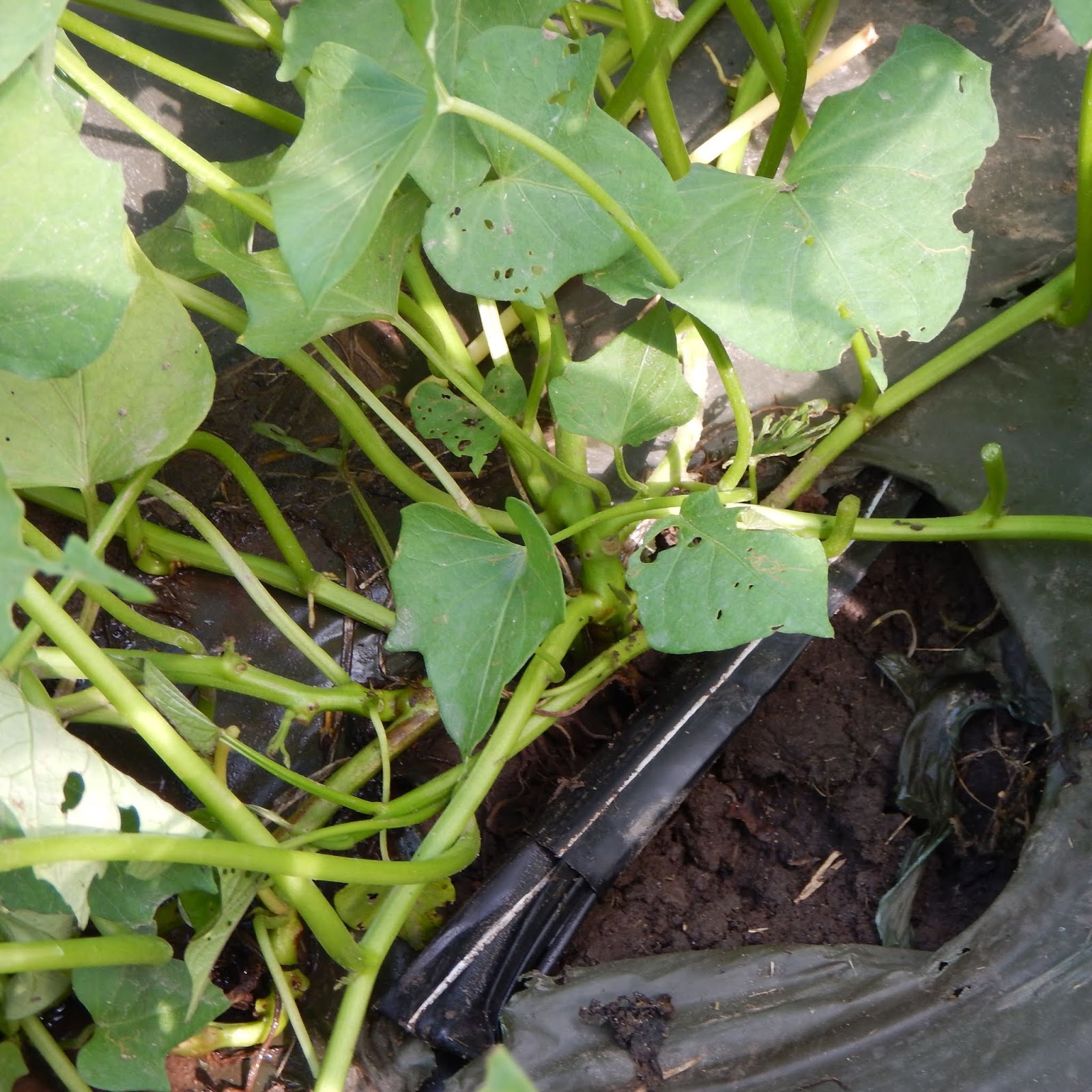
Drip tape line used to deliver nutrients to sweet potato plants.
As farmers, weather is always on our minds, so we might as well tackle this topic and get it out of the way!  There is some evidence that El Niño is finally turning to La Niña, which typically means less moisture and maybe even a bit of drought.  Since you just never know what you may get, we thought it prudent to update our irrigation permits and make sure our equipment is prepared and working well.  Whether we need irrigation as a means of delivering water to a crop or not, we use buried drip irrigation lines to deliver nutrients, microorganisms and trace minerals to our crops.  This year we are excited to expand our use of “sap analysis” to determine the specific nutrient needs of individual crops.  Sap analysis is kind of like a blood test for plants that allows us to better understand the plants’ nutritional needs at different points in growth.  Last year we saw some dramatic results when we used sap analysis to help us determine what support some of our crops needed in order to thrive.  We are planning to use sap analysis more proactively this year so we can be more aware of deficiencies and do what we can to correct them before they become a big problem.

As for crop planning, we’re laying out the plan and getting all the parts and pieces in place.  Sweet potato plants have been ordered, all 18,000!  We’ll be growing our two favorite orange varieties, Burgundy and Covington, and are also going to try a new variety called Bayou Belle.  We had better luck growing the white-fleshed Japanese sweet potatoes last year, so we’re going to expand that part of the planting a little bit.

Diana radishes, freshly washed!
We continue to appreciate the color and nutrition we get from our line-up of purple vegetables.  The color purple represents anthocyanins, plant compounds that play an important role in our physical health.  We’ll be doing one planting of the beautiful Amethyst beans and are considering growing the sweet and tasty purple tomatillos again this year.  Last year we also tried Diana radishes for the first time.  This is a spring radish that is shaped like a traditional red radish, but it has purple on the top and white on the root end.  We received positive feedback about this variety and we liked the way it looked in the field with regards to disease resistance, etc.  We have secured seed for our new favorite purple cauliflower, Purple Moon, and have our fingers crossed that we’ll get the Purple Majesty potato seed we have on order.  Lastly, we have to try a new bright magenta napa cabbage named “Scarrossa.”  We don’t typically grow napa in the fall, but that’s the recommendation for this variety so watch for this around October.

Fresh baby ginger with greens
We have been reviewing the results of our end of season survey that closed the fourth of January. We asked members for their input on which specialty produce items we should grow this year.  It’s clear that ginger is high on the list along with lemongrass!  We can’t make any promises at this point, but know we are trying to get some ginger “seed”.  Our supplier has closed ordering for now, but we’re on the list for an opportunity to purchase seed when they open ordering again sometime in February.  Wish us luck!  The other crop that had a lot of support was Egyptian Spinach.  This is a unique vegetable that grows in the heat of the summer when other greens struggle.  It is packed with nutrients and you just feel really good when you eat it!  It is a little challenging to grow, but we’re willing to give it a try!

Summer 2019:  Richard sampling and selecting
French Orange melon seeds
We continue to look for a personal-sized, yellow seedless watermelon, but there just isn’t anything available.  What about the French Orange Melons?  Good question.  For those of you who know the sweet, delicious, aromatic, one-of-a-kind French Orange melon, you may remember the sad story about how the producer has decided to drop the seed.  Richard has been working on saving seed for this melon for several years now.  This is not a quick or easy process.  The original seed was a hybrid.  When we plant the seed from melons produced from the original seed, we get a variety of results.  The sizing, color and characteristics of the melon are not always a direct reflection of the original seed.  As such, it takes several years of selecting the seed from the melons that most resemble the original set of characteristics and eliminate the off-types.  We feel like we are at a pretty good place with the quality of the seed we produced in 2019 and we finally have enough volume of seed that we can put in two nice sized plantings for actual production and harvest.  Richard will continue to carefully select seed and plant a separate seed production plot each year in an effort to refine our seed stock for this variety.  Wish us luck—we’re really hoping for a much better melon season than in 2019.  One of the problems we experienced last year was fewer pollinators.  We think the cold, late spring may have caused a decreased population of pollinator creatures.  It’s easy to take these little creatures for granted, but when something affects their population and they don’t show up, the results can be very dramatic!

Our crew happily putting together our first pollinator packs in 2016.
Speaking of pollinators, we are going to be planting pollinator packs again this year!  This is a project we started back in 2016.  In 2015 we published a series of newsletter articles we entitled “The Silent Spring Series.”  If you’re interested in reading these information-packed articles, you can find them all on our blog.  Basically the series took a look at the impact the use of agro-chemicals is having on our environment, ecosystem and our bodies.  The topic is pretty heavy and as we worked our way through the series we felt like we needed to create some light at the end of this very long tunnel.  We needed something positive to move the needle back to a point of hope.  We decided to plant pollinator packs, a garden pack with 9 different plants.  We started the seeds, transplanted them into the trays and delivered them to CSA members in the spring so everyone could use them to plant pollinator gardens in their own yard, on a patio space, in a community space or anywhere else they could think of where they would flourish, grow and serve to attract and support pollinator creatures (bees, butterflies, birds, wasps, etc).  We only intended to do it once, but it was so well-received, we get requests for them every year!  So, for those of you who already have an established pollinator garden, perhaps you’d like to add a few new plants to your space.  If you are just starting out, no worries!  We’ve included some plants in the pack that are easy to establish and will bloom in the first year!  Our order is nearly finalized and here is the list of seeds we ordered for this year’s packs.  Please note, the packs only hold 9 plants, but we’re ordering more than 9 different things just in case something doesn’t germinate very well and we can’t include it in all packs.  Here’s what we’re looking forward to:

Anise Hyssop, photo from Prairie Moon Nursery
Wild Bergamot, photo from Prairie Moon Nursery
Lance-Leaf Coreopsis, photo from Prairie Moon Nursery
New England Aster, photo from Prairie Moon Nursery
Brown-Eyed Susan, photo from Prairie Moon Nursery
Prairie Sage, photo from Prairie Moon Nursery
Lead Plant, photo from Prairie Moon Nursery
Little Bluestem Grass, photo from Prairie Moon Nursery
Blue Wild Indigo, photo from Prairie Moon Nursery
Leafy Prairie Clover, photo from Prairie Moon Nursery
Purple Coneflower, photo from Prairie Moon Nursery
Butterfly Weed, photo from Prairie Moon Nursery

We are looking forward to a great season and packing boxes for you and your families.  Once again we hope to strike a balance between supplying the staple items (onions, garlic, carrots, broccoli) and longtime favorites (sweet corn, tomatoes, green beans, strawberries) with some interesting and unusual selections to bring a little extra variety to your meals and challenge you, just a bit, to step out of your vegetable comfort zone and experience something new.  You never know, you just might discover a new flavor or vegetable you didn’t even know you liked!

In closing, we would like to share an excerpt from a note we received from a CSA family when they signed up for their second year with our farm.  Here’s what they shared:  “This past year was our first year getting a CSA share and it is not an understatement to say that it has changed our lives.  Thank you for doing what you do!  We love you guys!”  Thank you so much to all of you who send us notes like these.  We hope you understand how meaningful it is for us to read these and we also hope you understand that we think of you as we make our plans, select the varieties and pack your boxes each week.  Cheers to an awesome 2020 CSA season!

Wednesday, July 31, 2019

Making it Rain: Irrigation at Harmony Valley Farm


By Gwen Anderson

“Water is the driving force of all nature.”  --Leonardo Da Vinci

This year's irrigation crew: Vicente (left) and Manuel M. (right)
Ever since there have been farms, farmers have been finding ways to get the life-giving force of water to their crops.  The blessing of a nice, gentle rain at just the right time is a great boon, but you can’t be guaranteed anything of that sort in farming, despite your skill and grace at rain dancing.  As farmers, it is our job to care for our crops, to give them what they need at the time they are needing it, and that includes water.  To learn more about how we water our crops, I spent some time talking to Farmer Richard and the leader of the irrigation crew, Vicente.

Here at Harmony Valley Farm, we have two main ways to deliver water from its source to our crop fields: subsurface and overhead.  Subsurface, or drip, as we call it, is when a small hose is buried in the ground under the crop.  This hose, called drip tape or drip line, has tiny holes in it that allows water to be fed directly to the roots of our crops.  The other method, overhead irrigation, is something most people are familiar with: sprinklers.  We have two methods of using sprinklers, either many small ones connected in a line or one very large one we call “the gun,” which slowly pulls itself across the field with water pressure.

Drip line in our squash field.
Richard dug it up a little bit so we could see it in action.
Both types of irrigation have their advantages and disadvantages.  Vicente prefers the drip tape because it is a onetime set up and stays with the crop for the whole season.  When it comes time to water the crops, you just hook up the pump, check for leaks, and let it run.  The main disadvantage to this type of irrigation is that it is not reusable.  Every year, we need to purchase new drip line to replace what we used the year before.  Every spring, we bury the drip lines in the fields where we will plant the crops we use it for, and we have to pull it up at the end of harvest.  If you watched the garlic field tour video we posted to Facebook a few weeks back you saw some of our harvest crew removing the drip tape from the soil as the lifter brought the garlic out of the ground.  Due to the onetime use nature of drip tape, the price to use it to irrigate crops that are planted and harvested once, like radishes and cilantro, would be high.  Instead, we save the drip tape for long season crops, like onions, garlic, peppers, tomatoes, and potatoes.


This years onion crop, with cover crops planted to reduce
weeding needs and sequester carbon.
There is also the problem of leaks in the drip line.  If the line isn’t buried deep enough, or if a tractor gets off course even a fraction of an inch, the drip line can get ripped by our cultivating equipment.  While the pump is running, Vicente checks the fields to make sure water is running through the whole drip line.  If there is a spot in the field that isn’t getting water, it takes a little bit of detective work to find where the water stops, sometimes just by digging up portions of the line.  Vicente says it is easier to find the leaks in beds that have plastic mulch on them.  This is because the drip line isn't buried as deep as on a regular bed since we don’t have to use the cultivation equipment on beds with plastic mulch.  When the leaks are found, he cuts the ripped section of the tape out and replaces it with a hard plastic coupler to reconnect the two pieces of the spliced tape before burying the drip line again.  In recent years, we’ve been trying different techniques to alleviate the problem of ripping the drip tape with the cultivators.  Burying the drip tape deeper is one of those measures.  Another trial technique this year has been planting cover crops in the wheel tracks of some of our fields with drip tape in them.  Not only does it mean we don’t have to run the cultivators through those fields as often, but it has the added benefit of more green, living plants sequestering carbon out of the atmosphere.  That is a win all around!

Drip line is buried when the plastic mulch is laid.
The drip tape does allow us to do something we can’t do with sprinklers and the rain gun.  We can fertigate!  Fertigation is when we use the irrigation lines to “spoon feed beneficial nutrients right to the roots of the plant,” as Farmer Richard says.  Unlike other methods of applying fertilizer, with fertigation we aren’t applying it to everything that has access to the top soil, like weeds.  We can also use this method of applying fertilizer when the crops do not need to be watered.  We hook the fertilizer up to the pump, run it through the field with minimal water to facilitate the delivery, and turn the water off when the fertilizer has been administered.  No need to run the pump for 7 or more hours like Vicente would if the field was needing water.

What do we use to fertilize our fields?  I could write a whole article on fertilizer alone, so I’m just going to stick to a few highlights.  Any of the fertilizer we use with fertigation needs to be water soluble, or able to be dissolved in water.  There are two ways to do this: either have the fertilizer already be liquid, or use a water soluble solution.  The main fertilizers we use for fertigation are either liquid fish and seaweed, or a fish powder.  When the crops are starting to put on fruit, we give them extra potassium, the mineral plants use to produce fruit.  We also provide our crops with a vast assortment of beneficial microbials and other micro nutrients that do everything from promote total plant health to deter pests.  

Sprinklers running to sprout radish and cilantro seeds.
Overhead irrigation, or our sprinklers and “rain gun”, is mainly used to germinate seeds and when the crops are small.  This is the type of irrigation we use on our weekly planted crops, like radishes, and crops with small seeds, like carrots.  To use the sprinklers, Vicente and the irrigation crew lay out aluminum pipe in the field that needs to be watered.  These pipes are connected to a pump that has been placed in a water source near the field, either the Bad Axe River, a creek, or the well at our Hammel property.  Once the field has been watered for the appropriate amount of time, the pipes and pump are picked up and either stored or moved to another field to start the process over again.

The rain gun works in much the same way, except the pipes are not laid through the whole field.  Instead, the rain gun follows a thick, sturdy hose that needs to be laid out in the field we want watered.  Vicente uses a tractor to slowly pull the hose through the field, with one of his irrigation crew members ready to radio him when the hose is to the end so it doesn’t break.  Once the hose is laid and the gun is ready to use, the pump is turned on and the gun sprays water over the field, slowly following the hose back to the pump.  As the gun “walks” through the field, it coils the hose back up on a reel so it is nice and tidy for the next time Vicente and his team need to use it.  This particular method of irrigation is only used when the fields are very dry.  Luckily, we haven’t had to use the rain gun this year.

"Rain gun" being used in our kohlrabi field in 2017.
The advantages of overhead irrigation are reusability and portability.  The aluminum pipes are long lasting, thus we can use them season after season.  Since the pipes are also portable, we don’t need to worry about damage from our cultivation equipment.  However, that portability comes with its own challenges as well.  I mentioned earlier that Vicente runs the water pumps for at least 7 hours, and may need to run it for as much as 12 hours if the crop is very dry.  That can make for a long day if the pipes aren’t out first thing in the morning.  As leader of the irrigation team, it is Vicente’s responsibility to turn off the pumps at the appropriate time and to check on them during the watering process.  It is a responsibility he takes seriously.  “Sometimes, when I’m finished for the day, and I’m tired and want to go to bed, I can’t go to bed because I have a pump out there that I need to turn off.  I have to wait until the gun gets to the reel and shut off the pump so things don’t get over watered.”

Over watering isn’t the only reason to stay up and check your pumps, either.  If the pump needs a tractor to run it, you need to make sure it doesn’t develop a mechanical problem, or you risk damaging the tractor.  Also, if a hose comes loose and you don’t have an automatic shut off switch installed, you could be pumping water directly into the ground near the pump instead of through your field.  “I’ve never done it,” Farmer Richard told me, “but I’ve heard stories of if you didn’t get up in the middle of the night and catch it, the next morning you’d have a hole deep enough to fit two school buses in.”

Beautiful peppers from 2012, the fruit of the irrigation
crew's dedication and effort.
During a drought year, like the one we had in 2012, that lack of sleep can really add up.  “You start doing that for about 6 days in a row and it gets old,” Farmer Richard told me.  Vicente and his crew were working around the clock for two months to keep our crops watered and healthy.  “That was terrible,” Vicente admitted, but he was dedicated to ensuring the crops were getting taken care of.  Farmer Andrea recalled one night that year the irrigation team was having trouble getting a water pump started, and Vicente was exhausted.  She had told him to go home, but Vicente said “I can’t go home, I need to get the water going.”  After some reassurance, Vicente took her advice.  “It was a very hard year,” Farmer Andrea stated.  “He was up early shutting off pumps and switching things over, because he had to in order to stay on top of the water needs.”

However, the crops were beautiful.  Farmer Richard admitted to liking drought.  “These excess rains just promote disease like nobody’s business.”  Even Vicente said “we should have another year like that.”  In the end, the beautiful crops are what make all the work worth the effort.  It doesn’t have to be a drought year for the effects of ones efforts to be seen, either.  “When the crop is good, and I know it is producing nice,” Vicente told me, “that is what makes me feel good.”

An irrigation pump (right) connected to a water filter (left)
running water to the drip line in our squash field.
While both types of irrigation have different uses, they do share some of the same challenges.  With either type of irrigation, we use water pumps to get the water to where it needs to be.  Vicente is in charge of all of the equipment, and needs to ensure it is safely put away when not in use.  We do our best to keep an eye on the weather, but sometimes rain catches us off guard.  If it rains a lot and we have left a pump at a site near the river, we just might loose the pump to the water.

Administratively, we need permits from the Department of Natural Resources to pump the water to our fields.  The DNR assesses whether our water usage is going to have a negative impact on other people who also use the waterways in question.  There are strict guidelines the DNR uses to ensure this, and if we are awarded the permit, we are only allowed to pump the amount of water allocated on our permit.  Due to this, we have to report our water usage at the end of the year.  We lease land and use several different water ways, so we have several different permits.  The water usage reports are filed separately for each permit.  Vicente keeps records of where he pumps water, what kind of irrigation he uses, and how long he runs it.  He then calculates the water usage and turns it in to me at the end of the year.  It is my responsibility to enter the information into our records and file the reports with the DNR.

Vicente checking the sensor in the squash field.
No need to turn the water on here!
We’ve gone over the different methods we use to irrigate our crops and some of the challenges inherent to doing so, but how do we know when to do it?  Vicente uses a device called a tensiometer to measure the amount of water that is saturating the soil.  The sensor is buried in the ground at root depth, which for most of our crops is 6 inches, and then marked with a flag so Vicente can find it later when he needs to take a measurement.  He uses a portable sensor reader that he hooks up to the sensor that will display the kPa (kilopascals) reading.  Our tensiometer is set up to read 0 to 200 kPa.  0 kPa means the soil is as full of water as it can be.  Depending on the type of plant, the kPa reading they like to be at is different, so Vicente has a chart with the tensiometer to help him out.  Onions “drink a lot of water,” as Vicente says, so he waters them when the sensor reads 25.  If the sensor reads more than 25, it means he needs to get to work immediately and give the onions a drink.  Celeriac is another crop with a desired kPa level of 25.  Sweet potatoes, on the other hand, are a tropical crop and require a lot less water, 200 kPa according to Vicente’s chart.  Most of our crops land in the 45 kPa range.

Due to the nature of the sensors, we keep them where they are “planted” for the season. We do our best to have a sensor in every field, especially in fields where we have drip lines.  While the tensiometer is an invaluable tool used for irrigation, we sometimes have to just water the plants when they look thirsty.  Vicente keeps a close eye on the crops that don’t have sensors in them, and when they start showing signs that they are in need of a drink, he and his crew set up the irrigation systems.  Richard says that generally, our crops need about an inch of water per week.  “Are they going to die if 8 days go by and they haven’t had an inch [of water]?  No, but they might stop growing.”

2018 Sweet Potato Crop, which Vicente stated he was very
proud of due to the excellent production we had.
Luckily, here in Wisconsin, there isn’t a great need for irrigation like in some of the other arid states.  Mostly, we use irrigation to promote consistent growth in our crops and to germinate seeds.  “We don’t want to baby our crops too much,” Richard stated.  “If you continuously water one or more times a week they tend to have shallow roots, so when it does get dry they are not prepared for it.”  In the end, you see the literal fruits of the irrigation team’s labor in your CSA boxes every week.  Vicente and everyone here on the farm work hard to make sure you get the best tasting, nutritionally dense produce we can offer.  It is a job everyone is proud of.  I think Richard summed it up best when he told me “there is some nervousness around irrigation, but when it works, it is wonderful.  Our crops just grow like crazy.”