Showing posts with label garlic harvest. Show all posts

Thursday, July 28, 2022

Garlic Harvest 2022: The Full Farmer Report

2022 Porcelain Garlic Drying in the Greenhouse

by Richard de Wilde

We finished our garlic harvest with 48,000 bulbs of medium to large size garlic.  The harvest actually went quite smoothly this year with only one interruption due to rain.  We initiated harvest a little bit ahead of schedule knowing there were chances of rain in the forecast, so we had a little buffer and could pause harvest for a few days without it causing a setback.  In most years we have to hurry and hustle to get it all harvested before a rain, in between rains, after a rain for fear that the longer we leave it the greater the chance of rot.  But this year we just paced ourselves over several days without a crazy rush!  Our harvest is drying in the greenhouses right now and before the end of this week we’ll start the process of topping the garlic and then sorting and crating to put it into storage.  The smallest bulbs, including some that were extra from our green garlic planting, will be used for next year’s green garlic, planted 1-2 inches apart.  Most of the largest premium bulbs, about 15,000 total, will be set aside and saved to plant next year’s main garlic crop.  We’ll tuck it away in the cooler to keep it safe and dry until mid-October when we pull out these beautiful bulbs and “crack” them to separate the cloves for planting.  

Garlic sprouts poking through the 
thick straw mulch in March

Once planted, we’ll cover the beds with a layer of rye straw mulch to insulate the garlic over the winter and will hold the mulch in place by covering the entire field with a huge row cover secured with sand bags to keep it from blowing away over the winter.  We’ll also put up a deer fence to deter our deer friends from tromping and digging in the field over the winter.    

Many people think farmers are crazy to take the best garlic they can produce, forfeit a sale to receive a premium payment and instead break it up and stick it in the ground with fingers crossed that it will actually survive and produce something of value the following year.  Well, let me offer a little perspective.  You can buy certified organic seed garlic at very high prices, as much as $20/pound, but it comes with only a “promise” that it is “disease free.”  So after many years of buying seed, we decided it behooves us to save our own and for the last 25 years we have maintained our own seed stock of two basic varieties.   By doing this, we decrease the chances of introducing disease onto our farm and maybe we save some money on the cost of seed in the end, or at least break even!

Our main two varieties of garlic are Red Italian and Porcelain.  Both of these varieties are classified as hardneck garlic, which means the plant will produce a garlic scape.  There is also a classification of garlic called softneck.  This type does not produce a garlic scape and is the variety required for making garlic braids.  While softneck garlic looks quite beautiful woven into a braid, from a practical culinary standpoint it is a bit more cumbersome to use.  It produces many small cloves that are a challenge to peel at times.  Some of you who have been with our farm for many years may remember the beautiful garlic braids we made with red chili peppers, dried sage and oregano flowers.  After many years of maintaining seed stock for this softneck garlic, we decided to stop growing it when the quality of the garlic started to diminish.  Now we focus our efforts on the hard neck garlic as it is what really feeds us!  

Red Italian garlic, freshly washed right out 
of the field!

The Red Italian is our most dependable garlic and is characterized by a reddish tint to the skin and an average of 7-8 large cloves per bulb.  Our other variety, Porcelain, is also known as continental and has only 3-5 larger cloves on a bulb that is mostly white in color.   For most garlic lovers, the Porcelain types with only 3-5 large cloves to peel is preferred.  From a grower perspective, Porcelain is a huge investment in “seed stock” to produce at best a one to four increase from seed to harvested bulb given there are fewer cloves on each bulb.  In contrast, the Red Italian produces 7-8 cloves per bulb which will then produce as much as 8 bulbs from 1 seed bulb!  

Planting the 2022 crop in October 2021

Growing garlic in Wisconsin is not a way to “pay off the farm,” but rather is one of our “making friends” crops.  It is fraught with weather-related challenges and seed stock problems!  As an example, for this year’s crop we had very nice seed stock that was selected from a very good 2021 harvest.  It was carefully planted right on time on October 15, mulched and covered with beautiful, clean rye straw harvested from our rye cover crop.  Before the snow started to fly it was covered and fenced from deer.  We did everything we could to give it the greatest potential, but then we had a record setting warm fall.  The above normal temperatures caused the garlic (especially the porcelain varieties) to produce more than the expected roots.  The sprouts actually grew up and pushed through the straw late last fall only to be frozen off over the winter.  When spring came late this year, the plants failed to produce new growth and they were officially deemed “duds.”  The survival rate for the Red Italian was better, but our overall harvest was down 40% from a “good” harvest!  

Our 2021 Garlic piled high and filling the 
greenhouse.  Possibly our best crop ever!

While 48,000 bulbs is a lot, we had a much higher potential last fall.  This is why we always plan for abundance and plant more than we estimate we’ll need.  When factors out of our control affect a crop, we still have enough usable product so that on the receiving end a reduced crop is not a noticeable failure.  Well, there you have it.  I just let the cat out of the bag and now you know that while we’re very pleased with the quality of this year’s crop, I’m also a little disappointed with the losses.  On the bright side, we have enough large, disease free stock to save for our 2023 crop and have enough for the remaining CSA boxes as well.  Once it’s all clean and tucked away in the cooler, we’ll be able to assess whether or not we have enough garlic to also offer it as a “Produce Plus” option later this year as we know there are some of you who would like to head into winter with a hearty supply to keep you well until spring rolls around again!  

Richard & Rafael discussing farming while
surrounded by this year's garlic crop
There you have it, another garlic harvest on the books!  Andrea asked me how many garlic harvests I’ve done or managed over the course of my farming career.  Wow, I have no idea the exact number, but I think it’s over 40!  Despite my years of experience, I continue to learn more with each year’s crop and look forward to doing it all again for 2023!  I hope you enjoy the garlic we’ve grown for you this year and appreciate and enjoy it in your meals with an occasional thought of gratitude for our hardworking farm crew that worked diligently to make it happen for you!


Wednesday, July 17, 2019

The Lazy Days of Summer…..What?!


By Farmers Richard & Andrea

It’s been nearly six weeks since our early June farm update and a lot has happened!  The cold, wet start to our season quickly shifted to hot and humid.  The heat is great for some of our warm weather crops like peppers, melons, zucchini and cucumbers, but heat with high humidity can wreak havoc on other crops such as cilantro, baby bok choi, arugula, etc making them susceptible to leaf disease.  The weeds are also loving these hot days and sadly, they are growing quite nicely.  Our determined crew continues to do battle against weeds, hitting them from every angle possible in an attempt to save crops.  Despite these farming challenges, we have some really nice crops in the fields and a lot of exciting food coming your way very soon! 

Italian garlic, bunched and ready to bring in
Starting at the end of last week, our focus shifted to garlic harvest.  As we write this article on Tuesday, July 16, we only have about one third of the crop remaining to harvest….and it is a very nice crop.  This is probably the nicest crop of garlic we’ve seen in the past 10-12 years.  The past two years were pretty disappointing, so before we planted garlic last year we paused for a little field crew huddle and pep talk for ourselves.  Two poor crops, lets not add a third to that list.  So we made sure soil conditions were right, carefully planted the cloves at the right depth and then carefully covered the field with a nice layer of chopped straw mulch before the snow started to fall.  We were careful to give it enough of a mulch layer to insulate it, but not too much that would prevent the garlic from pushing through.  We also covered the field with row cover which also helped keep the straw mulch in place over the winter.  While many of you may still be cursing the harsh, cold, snowy winter we had last year, the conditions may have actually been somewhat favorable for this year’s garlic crop!  The garlic was tucked safely underground, covered by a thick layer of insulating snow which protected it from the polar vortex!  The result was a very high survival rate this spring.  By July 17 or 18 we plan to have the entire garlic crop tucked away safely in the greenhouse to dry and cure over the next few weeks.  Then the hard work of trimming, cleaning and selecting seed for next year’s crop will begin!

A pepper plant loaded with baby bell peppers
Based on the amount of zucchini in your boxes the past few weeks, you may have noticed that our zucchini is producing very nicely right now!  Zucchini is one of those crops that loves heat and production can skyrocket during a hot week.  Actually, we’re harvesting from both our first and second crops now.  Not quite the timing we had hoped for, but there isn’t any way to hold back the second planting so we’re just going for it!  Yesterday the crew picked 1,400# of zucchini!  We pick three times each week, so there’s the potential that we’ll pick over 4,000# of zucchini this week alone!  We’re only picking from our first cucumber crop right now, but it won’t be long before the second planting kicks in.  We’re just glad cucumbers and zucchini aren’t peaking at the same time!

Pretty soon we’ll have peppers and tomatoes to enjoy with all that zucchini.  The pepper field looks quite nice this year and the plants are full of blossoms as well as small, immature peppers.  It looks like we will be picking bell peppers and possibly jalapeño peppers as early as next week.  The tomatoes also have fruit set on.  While we haven’t seen any fruit turning color yet, this hot week ahead of us could accelerate the ripening.  We may be picking tomatoes for next week’s boxes as well! 

Sweet corn growing in the field.
If you were to walk through the melon and watermelon fields, you would find the cutest little melons set on the plants.  It’s exciting to think that in just a few weeks we’ll be slurping juicy slices of sweet melon!  What’s summer without sweet melons, watermelon and sweet corn?!  While our first two plantings of sweet corn are not quite what we had hoped for, we will have sweet corn coming soon.  We actually have five plantings of corn and the last three look really good right now!  Of course if we’re going to talk about corn we have to mention beans and edamame as well.  Our first two plantings of beans are usually the most challenging to grow, but both are looking pretty good with more plantings coming up behind them.  It looks like it’s going to be a pretty good year for green beans, and we hope our purple amethyst beans will produce well again this year!  The first crop of edamame has little fuzzy pods hanging from the vines.  Just a few more weeks and we’ll be popping the sweet, tender, bright green soybeans into our mouths! 

Don’t think we can breathe a sigh of relief and go on vacation after garlic harvest is done.  Well, we can breathe a sigh of relief but then we need to get ready to harvest onions!  It must be an allium favorable year because the onions are also looking pretty nice!  If we can keep the tops alive for a few more weeks we should have a pretty sizeable onion harvest which will leave us with just one problem….where are we going to store everything!  It’s a good problem and one we’re happy to have. 

Sprinklers running after irrigation crew laid pipe.
The irrigation crew has shifted their focus from just fertigation (providing nutrients via drip irrigation lines with minimal water) to now needing to deliver more water as well.  Over the past week fields have really dried out, going from a state of excess moisture to now needing to be watered.  On Monday the crew set up irrigation pipe for sprinklers to water some crops planted last week including carrots, cilantro and radishes.  They need water to soften the soil and make sure the seed has adequate moisture to germinate and break through the surface.   You just never know when the weather will shift to a drought, so we’re working hard to stay ahead of the game. 

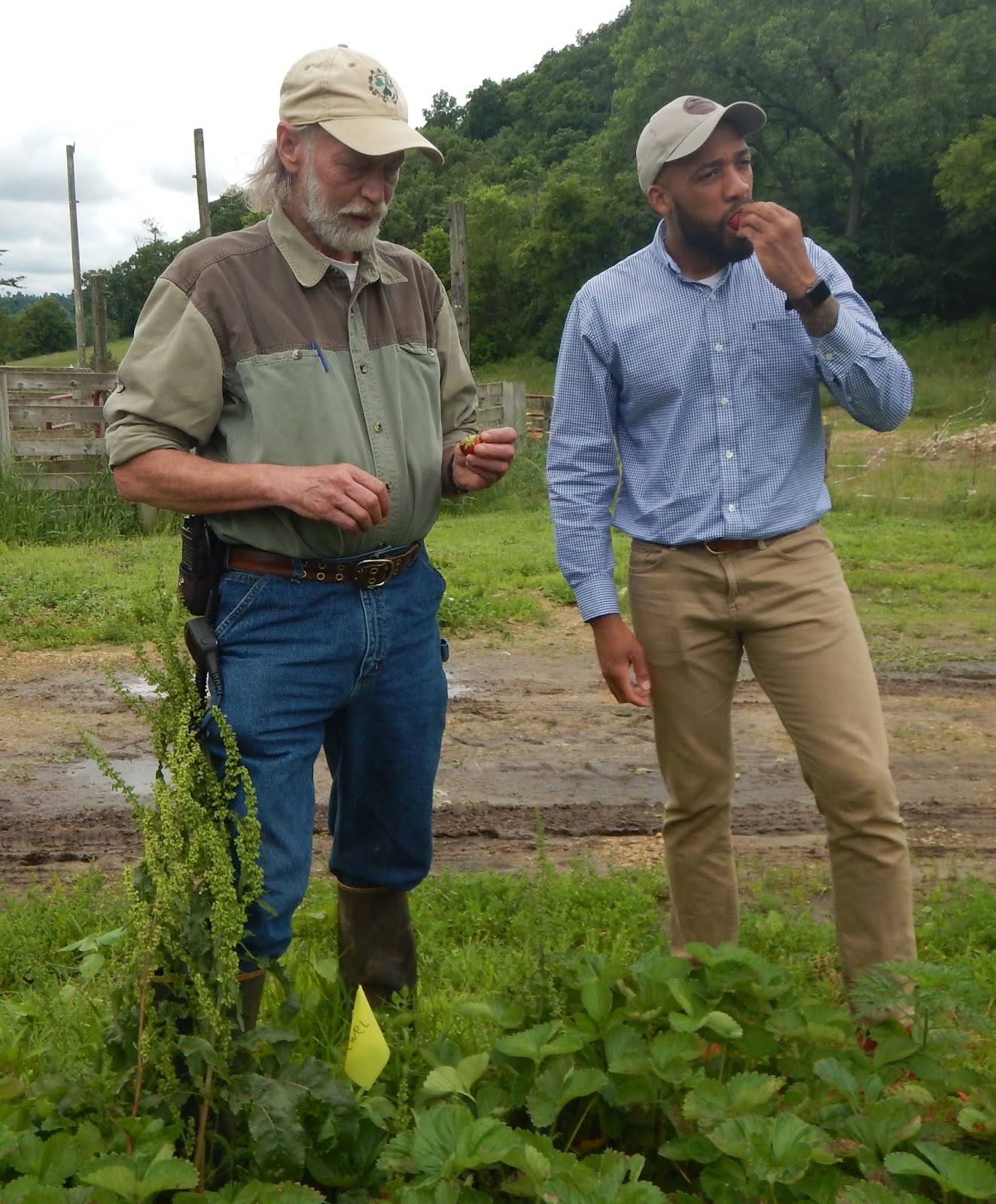
Farmer Richard and Lt. Governor Barnes
sampling fresh strawberries.
We’ve also hosted some visitors to the farm over the past 6 weeks.  On June 16 we had a great turnout for our annual Strawberry Day party.  We had a nice, pleasant day filled with good food, strawberry ice cream, laughs, questions and just a lot of fun.  Thank you to everyone who joined us in celebrating this year’s strawberry crop.  At the end of June we also had the pleasure of hosting Wisconsin’s Lieutenant Governor Mandela Barnes.  We had a pleasant visit with Lt. Governor Barnes including some great, honest conversation about a variety of topics including the importance of pollinator habitat, climate change and the impact erratic weather is having on Wisconsin farms and communities. 

We are also happy to have added a few more friendly faces to our crew.  Amy started the first week of June, coming to us from Colorado with a positive attitude and a willingness to learn…..everything!  Amy is our Packing Shed Support person who helps us stay organized in the packing shed by managing cooler and supply inventories as well as helping out wherever she’s needed from day to day.   She has also helped out in the greenhouses, is learning all there is to know about managing our seed inventory and in general is starting to put together the pieces of “the big picture” about what it takes to bring everything together to get vegetables to your tables!  We are also happy to welcome back Samuel and Silvestre. They weren’t able to join us earlier in the season, but made it back to the farm this past weekend and are hard at work! 

Cookies from Bloom Bake Shop
In the midst of all the hustle associated with summer and a busy growing season, we took time to relax a bit last Saturday, July 13 as we hosted our Annual Crew Appreciation Party.  We ended our work day at about 2:30 pm, got cleaned up and then met up at the Legion Park near our farm.  Nearly all our crew members were able to make it as well as some family members including daughters, sons, wives and husbands who live in the area.  We had a fun evening filled with goofy soccer and volleyball games, some card games, water balloons, music, a piñata and a delicious meal.  Angel and Ascencion roasted a goat in our underground brick oven so we had goat carnitas along with grilled HVF hotdogs.  We finished up the meal with our favorite Castle Rock ice cream and special cookies from Bloom Bake Shop.  Annemarie and her crew at Bloom made the cutest vegetable and farm animal cookies for us including cookies resembling broccoli, potatoes, carrots, sweet corn, peas, goats, pigs, cows, etc.  We had a really fun evening and this party always reminds us (Richard and Andrea) how blessed we are to be able to work with such a great group of people who are happy, hardworking, funny, sincere, creative, caring, talented individuals.

HVF crew playing volleyball at the Crew Appreciation Party.


Wednesday, July 18, 2018

King of the Farm


By Andrea Yoder

Crack it, Plant it, Cover it, Mulch it, Pray for it, Wait for it, Hope for it, Fork it, Catch a Glimpse of it, Feed it, Water it, Weed it, Feed it, Weed it, Feed it, De-scape it, Dig it, Bundle it, Dry it, Select it, Clean it, Store it, Eat it, Be grateful for it, and do it all over again.  The “It” is Garlic.  It’s a lot of work.  It’s a lot of gamble.  It’s a lot of skill.  It’s a lot of patience.  It’s a lot of trust.  It’s not negotiable.  In our minds, it’s a staple.  It’s essential.  It keeps us healthy, nourishes us, enhances our meals and life without garlic would just be pretty bland.  It just might be the King crop of our farm.

Our first load of garlic harvested in 2018!
We started our garlic harvest last Thursday afternoon.  Thus far we’ve harvested 33,720 bulbs of garlic and hope to finish harvesting the remainder of the field before the end of the week.  We only have about 10% of the crop remaining in the field.  Garlic harvest is a big deal.  Timing is everything and it takes a lot of hands on deck to make it happen in a timely manner.  The crew has done an excellent job once again.  We’ll be honest with you, this is not the best crop we’ve ever harvested.  We lost some garlic to rot early in the spring when it was cold and wet.  Once we saw the sprouts starting to try to push through the mulch, the crew went out and loosened the mulch so they could make it through the thick, insulating layer.  The next day, April 18, we got a foot of heavy, wet snow that packed the mulch back down on top of the delicate sprouts.  Some sprouts didn’t fare so well.  Once the snow melted, we forked the mulch off the plants again, the survivors pushed through and we carried on.  So, this year’s garlic crop isn’t as plentiful as we were hoping for, but we still have garlic!  The bulbs are smaller and we’ve noticed they don’t have as many cloves of garlic per bulb as they usually do.  Italian garlic generally produced 8-10 cloves per bulb and Porcelain garlic generally produces 4-5 cloves per bulb.  This year we’re seeing more in the range of 7 per bulb on the Italian and 2 per bulb on the porcelain. 

Garlic sprout peeking through the ground this spring
Garlic growth is heavily regulated by day length and spring is a very important time of the year for garlic to grow and develop.  The conditions were not very conducive for “normal” growth this spring, yet the biological clock inside the plant continued to tick along with the changing day length.  Once we did get back on more of a “normal” weather pattern, the garlic resumed normal growth rates however it was unable to compensate for the lost growth time and thus, we have small garlic.  That’s our theory. 

The good news is that we have garlic and will be able to select seed from this year’s crop to replant in the fall for the 2019 crop.  We will need to be very careful with our selection this year and will likely take a larger percentage of our overall crop for seed than we normally do, which means the garlic available for eating may be more limited.  Another piece of good news is that this year’s garlic looks really healthy and we aren’t seeing much, if any, disease on the bulbs.  This is important both for storage potential, but also for selecting seed stock.  We don’t want to replant any cloves from bulbs with disease as we risk carrying disease from one year into the next.

Richard enjoying the 2011 Garlic Diner
So that’s the state of this year’s crop.  It isn’t the biggest, most plentiful crop, but we’re thankful for what we have and that we’ll be able to continue to preserve our varieties by saving seed for the next crop.  Even though there’s less garlic on the tables in our greenhouse this year, we still feel rich when we walk down those aisles.  

Last Sunday we attended the annual garlic dinner hosted by Tami Lax at Harvest Restaurant in Madison,Wisconsin.  Tami has been hosting this dinner every year in July for seventeen years!  We enjoyed a five course meal that included garlic in every course!  Chefs Josh and Evan, along with their culinary crew, used almost forty pounds of our garlic in the meal.  They used our fresh garlic, which is harder to peel.  I think Chef Josh said it took them nearly 6 to 7 hours to peel all the garlic!  It is always fun to see how they choose to use the garlic in each course and the dinner always serves as a representation of just how versatile garlic can be in its uses.  We enjoyed whipped, rendered pork fat that had been infused with garlic and was served with grilled bread and a simple fennel and radish salad.  They made a delicious cucumber salad featuring burnt garlic salt and crisp garlic chips with mint and feta.  This was an interesting dish featuring our porcelain garlic.  The garlic chips were the perfect shade of golden and sweet, not bitter.  Chef Even had the idea to actually burn garlic by roasting it in the oven and then ground it with salt to make this cool black salt that was infused with the garlic flavor!  This was one of my favorite dishes.  Yes, they even incorporated garlic into the dessert!  They were not shy in making a garlic streusel topping for a cherry crumble and they served it with ice cream made from black garlic.  Black garlic is a means of preserving garlic by very slowly roasting it over the course of weeks.  The process develops the natural sugars in the garlic and the end result is much different than fresh garlic!  We had a fun evening and were grateful for the opportunity to share in this celebration of garlic.

We hope you enjoy the garlic you receive in this year’s remaining boxes and appreciate what we have as we look forward to another crop in the future.  Garlic is our labor of love and we’re grateful for each and every hand that helps along the way.
Some of the many hands helping us with our labor of love

Thursday, July 14, 2016

You Reap What You Sow… In Garlic & Relationships

By Farmer Richard (as told to Andrea)

A little over a week ago, Monday, July 4th to be exact, we finished harvesting the 2016 garlic crop.  We got it in just in time—it started raining within 30 minutes of closing the greenhouse door where it is stored.  Every garlic crop is a labor of love and despite the number of harvests I’ve been through, every crop meets me with a feeling of anxiousness around harvest time.  I can’t rest until it’s all in, safe and sound.  Learning how to grow garlic is a skill and an art I’ve learned over many years.  My lessons in garlic go back to the mid 70’s when I first started farming…..and tried to learn how to grow garlic from old Dave Frattalone.  Here’s the story.


 I started my farming career at my first farm, Blue Gentian, in St. Paul, Minnesota.  There were several old-timers I learned a lot from in those early days of farming.  Henry Hildebrandt & Dave Frattalone were two farmers who were in their 70’s and 80’s about the time I started farming.  Their families had a long history of growing vegetables for the people in the St. Paul area and sold their produce at the farmer’s markets.  Henry’s family had a long history of being good tomato growers and had 2 acres of cold frames that they used to grow vegetables in during the off-season—they even pulled off radishes in March!  Dave Frattalone was from a well-respected Italian family who had been supplying St. Paul for years.  Both of these gentleman were instrumental in teaching me many important things about farming that you just can’t learn about in a text book, seed catalog or really in any way other than by doing it.  So how do you get an old-timer to teach you things and share their knowledge?  You offer to plow their fields!  That tactic worked well with Henry who lived close to my farm.  In exchange for my labor, we developed a good neighborly relationship that opened up many doors for me to learn about growing vegetables.  Conversely, Dave lived further away in Little Canada and was a little harder to warm up to.  In Atina Diffley’s book, Turn Here Sweet Corn, she describes Dave as “The King of the Saint Paul Farmers’ Market.”  At that time, Dave was the only one at the market who grew and sold garlic.  I was intrigued by Dave’s garlic and tried to talk to him about growing it.  Unfortunately old Dave had no interest in talking to me about garlic.  It was clear he did not want to teach anyone else how to grow this valuable crop, so he remained tight-lipped for several years!

Let’s put the story into perspective.  In the late 1800’s and early 1900’s farmers’ markets were thriving.  It was the place people went to purchase their “groceries.”  Food was produced and purchased within the region, so people relied on their local farmers to show up at the markets each week.  The Frattalone and Hildebrandt families sold everything they could grow and left each market with an empty wagon.  Well, let me rephrase that.  They didn’t take vegetables home, but Henry’s family did have the contract to clean up all the horse manure after the market (remember there were still a lot of horses being used for transportation at this time).  They’d bring their wagon to market loaded with vegetables, and would take it home loaded with rich, nutritious horse manure for their cold frames!  In the same wagon--yikes!  Unfortunately, times started to change and with the development of grocery stores and transcontinental transportation, people shifted their purchasing from the farmers’ markets to the grocery stores.  By the time I entered the scene and started selling at the St. Paul farmer’s market, times were rough and a lot of farmers were taking large amounts of vegetables home with them each week instead of selling out.  The competition was thick and old Dave was just protecting his livelihood and the “monopoly” he had on the local garlic market.

Well, I still wanted to learn how to grow garlic, even if Dave wasn’t willing to help me.  At that time I did know Dave was buying garlic from an old seed company in California, Basic Vegetable.  He grew a softneck variety that he planted in the spring and produced small bulbs that he harvested in the fall.  Knowing little more than that about garlic, I had to do my own research.  I started reading and found a farmer in Canada who grew a different type of garlic, a hardneck variety.  He produced beautiful garlic, but one of the keys to his success was planting it in the fall.  I started experimenting with growing garlic and quickly learned some key lessons, including the importance of careful seed selection.  Since seed garlic wasn’t as readily available as it is today, I learned how to save “seed” from each year’s garlic crop to replant.  After several years of experimenting with growing garlic, I took one of my nicest bulbs of garlic over to Dave Frattalone.  When he saw the quality and size of my garlic, he perked up in interest and was all ears.  I willingly shared with him everything I had learned about garlic and on that day I broke through to old Dave.  After that experience, Dave was much more willing to share his farming knowledge with me, knowing I’d do the same for him.
   
To this day I still value the lessons I learned from these old-timers.  Maybe old Dave’s greatest contribution to my farming education was that he did not tell me his secrets to growing garlic!  If I had not been forced to seek out information on my own, I may never have found the Canadian grower who introduced me to the hardneck garlic we grow and rely on today.  In fact, our Porcelain garlic originated from seed garlic I got from him!  We’ve carefully maintained this variety and have saved seed from it for over 30 years now!  Thanks, Dave and Henry, for sharing your farming knowledge and experiences with me.  It is true that you reap what you sow…in garlic and in relationships.