Showing posts with label beet recipes. Show all posts

Wednesday, July 1, 2020

July 2, 2020 - This Week's Box Contents, Featuring Green Top Beets!

Cooking With This Week's Box


Purple & Green Scallions: Skillet Scallions; Scallion Pancakes
Red Batavia Head Lettuce: Cobb Salad
Snow or Sugar Snap Peas OR Strawberries: Gingered Stir-Fry with Shrimp and Peas
Green Top Red Beets: Beet Recipe Collection from DishingUptheDirt.com; Roasted Beet Frittata (see below); Beet & Goat Cheese Quesadillas with Yogurt & Lime (see below);  Caramelized Fennel & Beet Pizza

Welcome to the month of July!  We’ve reached the halfway mark for 2020—how is this possible!  Summer vegetables are coming on fast!  The peppers and tomatoes have set on blossoms.  The tomatillo plants are already loaded with little lantern-like tomatillo husks and we may be able to start picking them within a few weeks!  But before I get ahead of myself, lets get back to this week’s box and our featured vegetable—BEETS!  This week I will again refer you to Andrea Bemis’s collection of beet recipes on DishingUptheDirt.com.  Andrea has over 60 recipes with beets and this week we’re featuring two of them.  Andrea and I share the same love of beet greens, so many of her recipes make use of the top and the bottom of the beet!  Her Roasted Beet Frittata (see below) is on the menu for Sunday brunch and her Beet & Goat Cheese Quesadillas with Yogurt & Lime (see below) will make for a light lunch of dinner.
Caramelized Fennel & Beet Pizza
Beets and fennel usually come in together in early summer and that’s a good thing because they pair nicely together in recipes!  Fennel can be an intimidating vegetable for some individuals, so to get started I am going to refer you to the Fennel Vegetable Feature Article I wrote last summer.  You’ll learn which part of the plant you can eat (there’s more than just the bulb) and I included 25 recipes for you to choose from including some tasty things like Lemony Fennel Cupcakes!  You can also find tasty recipes on our website that we’ve featured in past newsletters.  Two of the most well-received recipes have been Caramelized Fennel & Beet Pizza and Pasta with Golden Fennel.  These two recipes have even been accepted by people who didn’t care for fennel but decided to give it a try......and now they’re converts to the “I eat fennel” club.  Lastly, I came across this recipe for Shaved Fennel, Dill & Cucumber Salad and have it on the menu to serve with grilled halibut later this week.  It’s the perfect summer salad, light and refreshing!
Homemade Gingerale with Cucumber, photo from food52.com

This week the cucumbers are kicking in and I’ve already made my first batch of Creamy Cucumber Salad!  Cucumbers are nature’s thirst quencher, so don’t be afraid to use them in refreshing drinks this summer.  I came across this recipe for Homemade Gingerale with Cucumber or try this Creamy Pineapple Cucumber Smoothie!

In our world, cucumbers and zucchini go together as they are planted and harvested at the same time, so before we move on we’ll cover zucchini.  If you missed last week’s Vegetable Feature Article about zucchini, you should check it out.  I compiled a list of 20 recipes using zucchini, but what I really want to do is grow that list to 100 recipes!  So, please send your favorite zucchini recipes my way and we’ll see if we can collectively grow that list!  In the meantime, here are a few ideas for how to utilize this week’s zucchini.  Check out this Zucchini Pizza Casserole, surely the kids will like this one!  They might also like this Cheesy, Garlic Zucchini Rice.
Scallion Pancakes
Photo by Kelli Foster for thekitchn.com
Last week I watched one of Food52.com’s “Genius” recipe videos for Skillet Scallions.  This recipe caught my attention because it only has 2 ingredients!  I made these earlier this week and they are not only super-simple to make, but they taste so good and made a great accompaniment to the steak I served with it.  The scallions are cooked by a combination of sautéing in butter and steaming.  They turn out very silky, slightly sweet and tender.  You really should try them!  The other recipe I want to use while we’re in the height of scallions is Scallion Pancakes.  I’ve never made this Chinese item, but I want to learn more about Chinese food, ingredients and cooking so I might as well give them a try!

We call it Sweetheart Cabbage, but I recently learned some people refer to this pointy head cabbage as Cone Cabbage.  This cabbage shines at its best in raw salads such as this Chopped Thai Chicken Salad that was suggested by a member in our Facebook Group.  I was also reminded of my own recipe for Summer Vietnamese Rice Noodle Salad that also uses this cabbage.  Both of these salads are great options for a light dinner or lunch item that you can put on the table in very little time.

This is our final week for garlic scapes and then we’ll transition to fresh garlic.  If you haven’t yet made a batch of Garlic Scape & Cilantro Pesto, I’d encourage you to do so.  I made a batch last week and we’ve been enjoying it on burgers, scrambled into eggs, on toast with a little wedge of cheese, etc.  The flavor is good the first day and even better the second!
Cobb Salad, photo by Joe Lingemen for thekitchn.com
We’re nearing the bottom of the box, but we do still have a few more items to cover!  We’ve been waiting with anticipation to harvest these beautiful heads of Red Batavia lettuce for you!  This is one of our favorite head lettuce varieties and it’s the perfect, crunchy, refreshing lettuce to layer up on burgers and sandwiches.  The leaves are also thick enough and large enough to use them a as a wrap around whatever filling you’d like to put inside!  This variety would also be a good choice for making a Cobb Salad.  While this is a recipe built on traditions, I’d encourage you to create your own version of this salad utilizing the vegetables you do have available!

I’m not sure why I saved collard greens towards the end when in fact they were on the top of your box?!  The collard field looks so nice right now that we couldn’t help but send these your way while everything looks so nice.  Use them in traditional preparations such as the traditional Collard Greens with Bacon or use them to make Collard Greens Spring Rolls.

Lastly, I’d like to say a few words about strawberries and peas.  This week marks the official end of strawberry picking for HVF.  Now that we aren’t having strawberries to tend to, we’re spending our time picking peas!  I admit, I seldom ever do more than just eat these, pod and all, but I just might try this recipe for Gingered Stir-Fry with Shrimp and Peas!

Ok, that’s it, we’ve conquered another box!  I hope you all have a safe and enjoyable holiday weekend!

Chef Andrea


Vegetable Feature: Green Top Beets


By Chef Andrea


Beets are a crop we have available starting in mid to late June with availability extending through December and sometimes even into January and February with storage beets.  There are some beet varieties better suited to harvest for storage and others that are intended to be harvested with the green tops still attached.  The green tops are not only a sign of freshness, they are also another vegetable that is intended to be eaten and are packed with flavor and nutrients!  This is another one of those “2-for-1” vegetables where you eat the entire plant!

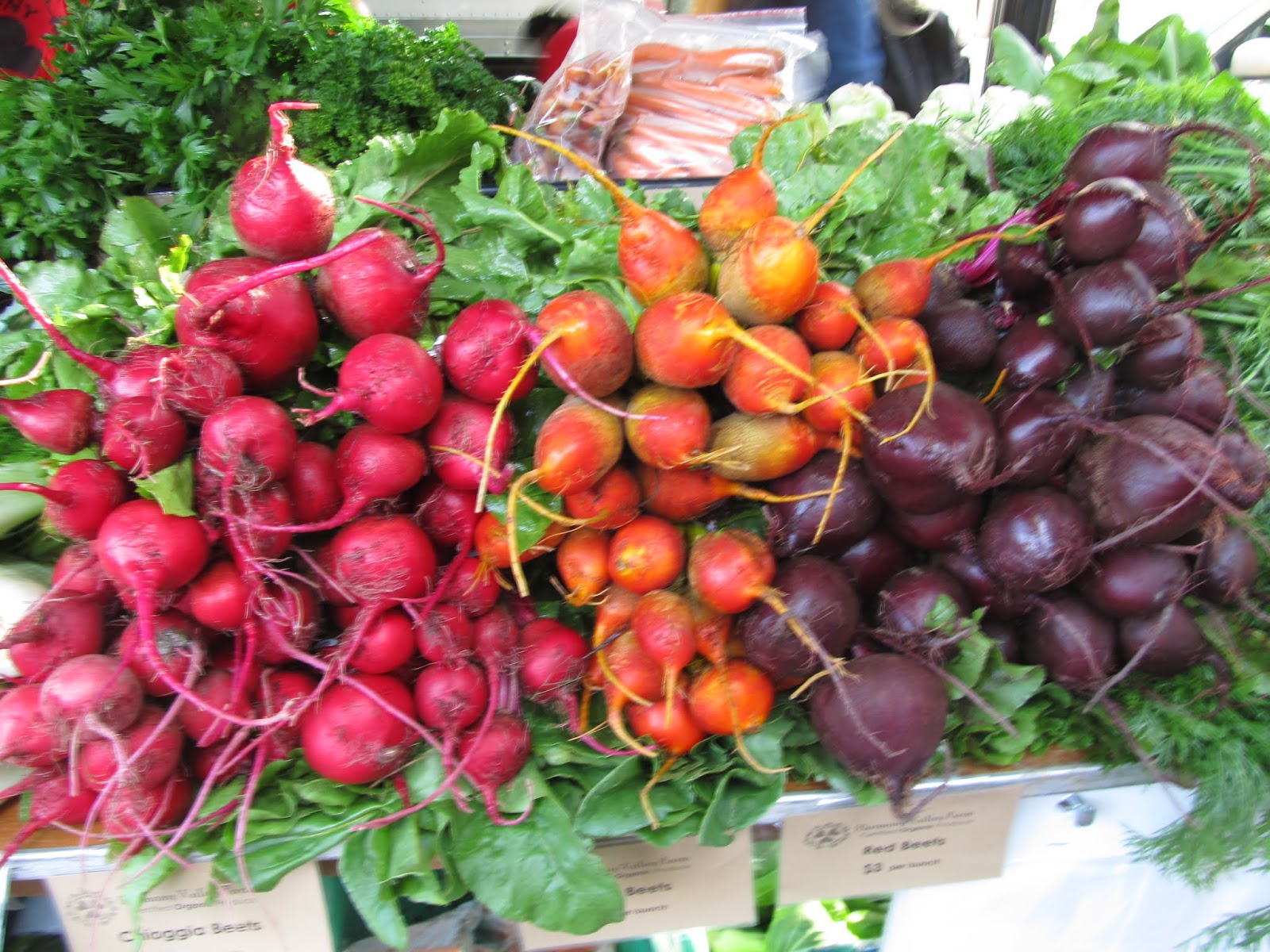
Most people are familiar with the traditional red beets, but did you know there are different colors of beets?  We grow three different colors including the traditional red beet as well as chioggia beets (candy striped inside) and golden beets.  In general, all beets, regardless of color, taste like beets.  Red beets have more of that traditional earthy beet flavor whereas chioggia and golden beets are generally more mild in flavor.  Golden and Chioggia beets are typically as sweet or sweeter than the red beets.  Individuals who think they don’t care for beets generally like and will eat golden beets.  If this is you, I hope you’ll give them a try.

Shaved Fennel & Beet Greens Salad
I mentioned earlier that both the beet root as well as the green tops are edible.  Beets are actually in the same family with chard and you’ll notice beet greens resemble chard in both their appearance as well as the texture of the stems and leaves.  Beet greens may be eaten raw or cooked and are a comparable substitute in any recipe that calls for Swiss chard.  They are also a delicious and nutritious addition to smoothies and could be substituted for other greens, such as spinach, chard or kale in a smoothie or green drink.

Beet roots are usually cooked, but may be eaten raw.  Thinly sliced or grated beets are a nice addition to salads and slaws.  As for cooking, beets are generally either boiled or steamed on the stove top or roasted in the oven.  The cooking time will vary depending upon the size of the beet.  The general recommendation is to cook beets with their skins on and the root tail intact.  For red beets in particular, this minimizes the leaching of the water-soluble color compounds from the beet.  Once the beets are cooked, cool them so you can handle them and the peel should be easy to remove.  You know a beet is fully cooked when the beet easily slides off a skewer, fork or cake tester stuck into the middle of the beet.

Balsamic Glazed Beets & Greens
Red beets do contain a water-soluble nutrient called anthocyanin.  This is an antioxidant that also gives red beets their color.  It will stain your hands (temporarily) and the color will bleed onto other ingredients if you’re using them in a salad, soup, or otherwise.  Golden beets and chioggia beets don’t lose their color or bleed color onto other ingredients.  If you are looking to preserve the beautiful candy-striped interior of a chioggia beet, it is best to roast them.  


Once cooked, beets may be used in salads or just simply reheated with a pat of butter and some salt.  You can also blend beets into hummus or other dips.  Beets pair well with a lot of other ingredients including vegetables such as fennel, celery, carrots, red onions, shallots, arugula and other salad greens as well as other root vegetables.  They also go well with fruits including apples, oranges, lemons, pears, avocadoes and pomegranates.  Additionally, beets pair nicely with goat cheese, feta cheese, blue cheese, butter, nuts, sunflower seeds and pumpkin seeds to name just a few ingredients.

It is best to store beets in the refrigerator.  When you get beets with the green tops still on, remove the tops and store them separately in a plastic bag.  Try to use them within 5-7 days.  Store the beets in a plastic bag in the crisper drawer.  They will last longer than the greens.

If you’re interested in learning more about the history and nutritional benefits of having beets in your diet, check out www.justbeetit.com which is entirely dedicated to beets!  I’ve also included a list below of several recipes using beets that we have featured in previous newsletters and are available in our recipe archives on our website.  Enjoy!


Beet & Goat Cheese Quesadillas with Lime & Yogurt


photo from dishingupthedirt.com
Yield:  2 servings

2-3 medium to large beets, cut into ½-inch pieces
1 bunch of beet greens or swiss chard (about 3-4 cups worth of greens)
Olive oil
1 small yellow onion, diced
2 cloves garlic, minced
¼ cup goat cheese
¼ cup mozzarella cheese, shredded
Salt & black pepper, to taste
4 whole wheat tortillas
¼ cup Greek-style plain yogurt or sour cream
Juice from 1 lime
½ cup chopped parsley

1.  Bring a large saucepan of water to a boil.  Add beets and cook until fork tender.  About 10 minutes.  Drain and set aside.

2.  Heat a large skillet over medium heat.  Add a little olive oil.  Add onions and saute for about 5 minutes.  Add garlic and stir in beet greens.  Turn heat to low and cook until greens are slightly wilted.  remove from the pan and set them aside.

3.  In a food processor or blender, combine the cooked beets with a little olive oil, salt and pepper.  Blend until smooth. 

4.  Spread the beet mixture on two of the tortillas, then divide the sauteed beet greens between the two tortillas and top each one with half the cheese.  Place second tortilla on top.

5.  Return the skillet you cooked the beet greens in to the stove over medium to medium high heat.  Cook for aabout 3-5 minutes per side or until the tortilla is lightly browned.  Flip them over and cook on the other side for another 3-5 minutes or until lightly browned.

6.  Cut each quesadilla into quarters and serve with a dollop of plain yogurt or sour cream, a squeeze of lemon and chopped parsley.

Recipe from Andrea Bemis's collection featured on her website/blog, www.dishingupthedirt.com.


Roasted Beet Frittata


photo from dishingupthedirt.com
Yield:  4-6 servings

4 medium sized beets with their greens
1 small red or yellow onion, chopped
Olive oil, as needed
1 pound ground pork sausage
1 ½ tsp dried sage
½ tsp crushed red pepper flakes
¼ tsp ground nutmeg
Hefty pinch of salt
6 large eggs
½ cup milk
Salt and freshly ground black pepper, to taste
4 ounces goat cheese
Flaky sea salt, as needed

1.  Preheat the oven to 450 degrees F.  Separate the beets from their greens and wash both well to remove any dirt.  Cut the beet roots into 1/4-inch thick wedges (peeling is optional) and roughly chop the greens.  Toss the beets and onion with a little olive oil to coat and place them on a baking sheet.  Sprinkle with a little salt and pepper and give them a good toss.  Roast in the oven until tender, about 25 minutes, tossing the veggies halfway through cooking.  Remove them from the oven and set aside.  Turn the oven temperature up to broil and move the rack so that it's 5 inches below the heat.

2.  In a bowl, whisk together the eggs, milk and a pinch of salt and pepper.  Set aside.

3.  In a large bowl, combine the ground pork with the sage, pepper flakes, nutmeg and a hefty pinch of salt.  Use your hands to mix well.

4.  Heat a 10-inch cast iron skillet over medium-high heat.  Add a little olive oil to the pan, and then the pork.  cook, using a wooden spoon to break up the meat a bit, until the pork is no longer pink and cooked through.  Add the cooked beets and chopped beet greens to the pork and give the mixture a good stir.  Add the egg mixture and cook the frittata, lifting up the cooked eggs around the edges with a rubber spatula to let the under cooked eggs flow underneath, 2-3 minutes.  Reduce the heat to medium and cook, giving the pan a shake now and again until the eggs are mostly set, but the center is still slightly jiggly, 5-7 minutes more.

5.  Dollop the top of the frittata with the goat cheese and sprinkle with a little flaky sea salt.  Place the pan under the broiler until the frittata is set and golden brown.  About 2-3 minutes.

Recipe from Andrea Bemis’s collection featured on her website/blog, www.dishingupthedirt.com.

Wednesday, August 1, 2018

August 2, 2018 - This Week's Box Contents, Featuring Green Top Beets


Cooking With This Week's Box:

 This Week’s Summary of Recipes and the Vegetables They Utilize:

Zucchini or Yellow Summer Squash: Zucchini Grinders


White Spanish Onions: Western Omelet Quesadillas; Golden Beet Risotto with Crumbled Ricotta Salata and Sautéed Beet Greens (See Below); Cauliflower, Broccoli & Pepita Salad


Sunorange Tomatoes: Sweet Corn Panzanella


Italian Frying Peppers and/or Green Bell Peppers: Western Omelet Quesadillas


Sun Jewel Melons: Slice and serve!

Sweet Corn: Sweet Corn Panzanella

Green Top Golden Beets:  Golden Beet Risotto with Crumbled Ricotta Salata and Sautéed Beet Greens  (See Below)

Happy August!  We’ve got a beautiful box for you this week including a bit more sweet corn and tomatoes.  We’ve just started picking our larger varieties, so we’re hoping to have more to send your way next week.  Lets start this week’s cooking with the featured vegetable, beautiful green top golden beets.  Gold beets are the beet variety most likely to be embraced by all—both those who love beets and those who are still learning to like them.  This week we’ll use the beets and their tops to make Golden Beet Risotto with Crumbled Ricotta Salata and Sautéed Beet Greens  (See Below).  Risotto takes a little time to make, but it’s really pretty simple and the end result is elegant.  Serve it with a glass of white wine and you’re set.

Creamy Pineapple & Cucumber
Smoothie, photo from Minimalist Baker
Our cucumbers in the second planting are approaching their peak production this week.  We’ve had a great run on cucumbers and zucchini this year, but there are so many ways to use these vegetables that we consider them to be summer staples.  This week I’m going to use cucumbers to make some refreshing summer smoothies.  I like this recipe for Creamy Pineapple & Cucumber Smoothie as a breakfast smoothie.  I also want to try this recipe for a Savory Cucumber Smoothie which is based on the concept of a Middle Eastern yogurt drink.  This recipe has dill, basil and mint which are excellent herbs to pair with cucumbers.  This drink is also finished with club soda, so it’s a little thinner than a smoothie and will make for a great afternoon refresher.  As for the zucchini and summer squash in this week’s box, I’m going to take the suggestion from one of our members who posted this recipe for Zucchini Grinders.  In her household the kids refer to these as “Pizza Subs.”  Sauteed zucchini is piled into a sub roll and topped with diced tomatoes and mozzarella cheese.  Wrap the sandwiches in foil and pop them in the oven.  What a great idea!

This recipe for Sweet Corn Panzanella popped into my inbox this week from Love and Lemons blog.  I love this version of panzanella featuring this week’s sweet corn, sunorange tomatoes and fresh basil.  This salad can serve as a main dish dinner.  Finish off the meal with slices of sun jewel melon and that’s what we call a simple summer meal.

This week I want to try the Cauliflower, Broccoli & Pepita Salad from Alexandracooks.com.  It looks pretty simple.  You chop the cauliflower and broccoli in a food processor, toss it with onions, minced jalapeno, sesame seeds, dates or other dried fruit and a light vinaigrette.  Top it off with toasted pepitas.  She says you can make it a day in advance and it travels well, so this will likely be served for dinner one night with a piece of grilled fish or steak.  Leftovers will be packed for lunches.

Carrot Cake Oatmeal Breakfast Bars
Picture from Eat Yourself Skinny
I’ve been on a western omelet kick lately since I’ve had green bell peppers and the delicious white Spanish onions on my counter.  This week I’m going to make Western Omelet Quesadillas for our breakfast item as long as the peppers last!

This week’s carrots will be used to make Carrot Cake Oatmeal Breakfast Bars.  These will make a great snack or may be breakfast for one of those days when we’re short on time in the morning.  I might even put some in the freezer for back-up to pull out on a week when I don’t have much time for baking or cooking and need a healthy option.

I think we’ve worked our way through this week’s box with a nice mix of some items to serve for dinner, a few ways to incorporate your CSA vegetables into breakfast and a few ideas to serve as snacks or light meals on the go.  Start pulling out your favorite pepper, tomato and corn recipes.  We’ll have more of these summer vegetables coming soon!  Have a great week!

—Chef Andrea

Featured Vegetable: Green Top Beets

Chioggia, gold, and red beets at our market stand.
Beets are a crop we have available starting in mid to late June with availability extending through December and sometimes even into January and February.  There are some beets better suited to harvest for storage and others that are intended for harvest with the green tops.  We grow three different colors of beets including the traditional red beet as well as chioggia beets (candy striped inside) and golden Beets.  At our market stand, we’re often asked to explain the difference between the different colors of beets.  In general, all of our beets, regardless of color, taste like beets.  Red beets have more of that traditional earthy beet flavor.  The chioggia and golden beets are generally more mild in flavor, but typically are as sweet or sweeter than the red beets.  Individuals who don’t care for beets generally like and will eat golden beets.  One of our market crew members calls golden beets “the gateway beet” that is a good starter beet for those who are still learning to like them and may not care for the earthiness of red beets.

Both the beet root as well as the green tops are edible and both are very nutritious.  Beet greens are generally eaten cooked, but may also be chopped finely and enjoyed in their raw form.    When cooking them, treat them like chard and lightly saute them or steam them until wilted and tender.  You can substitute beet greens in any recipe that calls for chard.  Beet greens can also be blended into smoothies.

Beets are usually cooked, but may be eaten raw.  Thinly sliced or grated beets are a nice addition to salads and slaws.  As for cooking, beets are generally either boiled or steamed on the stove top or roasted in the oven.  The cooking time will vary depending upon the size of the beet.  The general recommendation is to cook beets with their skins on and the root tail intact.  For red beets in particular, this minimizes the leaching of the water-soluble color compounds from the beet.  Once the beets are cooked, cool them so you can handle them and the peel should be easy to remove.  You know a beet is fully cooked when the beet easily slides off a skewer, fork or cake tester stuck into the middle of the beet. 

Red beets do contain a water-soluble nutrient called anthocyanin.  This is an antioxidant that also gives red beets their color.  It will stain your hands (temporarily) and the color will bleed onto other ingredients if you’re using them in a salad, soup, or otherwise.  Golden beets and chioggia beets don’t lose their color or bleed color onto other ingredients.  If you are looking to preserve the beautiful candy-striped interior of a chioggia beet, it is best to roast them.

Once cooked, beets may be used in salads or just simply reheated with a pat of butter and some salt.  You can also blend beets into hummus or make a delicious white bean & beet dip to eat with vegetables, crackers or use it as a spread for pizza or flat bread.  Beets pair well with a lot of other ingredients including vegetables such as fennel, celery, carrots, red onions, shallots, arugula and other salad greens as well as other root vegetables.  They also go well with fruits including apples, oranges, lemons, pears, avocadoes and pomegranates.  Additionally, beets pair nicely with goat cheese, feta cheese, blue cheese, butter, nuts, sunflower seeds and pumpkin seeds to name just a few ingredients.

It is best to store beets in the refrigerator.  If you get beets with the green tops still on, remove the tops and store them separately in a plastic bag.  Try to use them within 5-7 days.  Store the beets in a plastic bag in the crisper drawer.  They will last longer than the greens.

Golden Beet Risotto with Crumbled Ricotta Salata and Sautéed Beet Greens


Yield:  4 servings as a main course
Photo from Summer Tomato


2 medium golden beets, trimmed, peeled, and cut into ¼-inch dice

6 cups chicken stock or broth
4 Tbsp unsalted butter
1 Tbsp olive oil
⅔ cup diced white onion
1 ½ cups Arborio rice
Kosher or fine sea salt, to taste
1 cup dry white wine
Sautéed Beet Greens (see below)
¼ cup freshly grated Parmesan cheese
3 oz ricotta salata cheese, crumbled
2 Tbsp fresh flat-leaf parsley, chopped
Freshly ground black pepper, to taste
  1. In a 2-qt saucepan, combine the beets and stock and bring to a simmer over medium heat.  Cook the beets until tender yet still quite firm when pierced with a fork, about 15 minutes (They should be slightly underdone, as they will finish cooking in the risotto.)  Using a slotted spoon, transfer the beets to a bowl and set aside.  Adjust the heat so the stock barely simmers.
  2. In a heavy 4-qt saucepan over medium heat, melt 2 Tbsp of the butter and then add the oil.  Add the onion and sauté until translucent but not brown, about 3 minutes.  Add the rice and 1 tsp salt and stir until the grains are well coated with the butter and oil, about 1 minute.  Add the wine and let it come to a boil.  Cook, stirring constantly, until most of the wine is absorbed.
  3. Add the beets and 2 cups of the stock to the rice and cook, stirring frequently, until the rice has almost completely absorbed the liquid.  Adjust the heat so the risotto is kept at a slow simmer.  Repeat, adding 1 cup of the liquid at a time, stirring until it is almost fully absorbed before adding more.  Reserve ¼ cup of the liquid for adding at the end.  
  4. Meanwhile, prepare the sautéed greens as directed and keep warm.  
  5. After about 18 minutes, the rice will be plump, creamy, and cooked through but still slightly chewy and the beets will be tender when pierced with a fork.  Stir in the remaining ¼ cup stock.  Remove the risotto from the heat and stir in the remaining 2 Tbsp butter, the Parmesan cheese, and about half of the ricotta salata, and the parsley.  Season with salt and pepper.
  6. Spoon the risotto into warmed shallow bowls.  Mound a portion of the beet greens on top.  Garnish with the remaining ricotta salata and serve immediately.


Sautéed Beet Greens

Yield:  2 servings on its own

1 bunch beets, with green tops attached
1 Tbsp olive oil
1 large clove garlic, thinly sliced
1 tsp fresh lemon juice
Kosher or fine sea salt, to taste
Freshly ground black pepper, to taste.
  1. Trim off the greens, leaving 1 inch of the stem attached to each root.  Reserve the roots for another use.  Stack the leaves, then cut the stack in half lengthwise through the center vein.  Chop the greens crosswise into large pieces, about 2 inches wide.  Rinse the greens in several changes of cold water until they are clean and the water is clear.  Dry them in a salad spinner or blot dry with paper towels.
  2. In a large sauté pan, heat the oil over medium heat and swirl to coat the pan bottom.  Add the garlic and sauté until soft but not brown, about 1 minute.  Add the greens and toss with tongs until wilted but still crisp-tender and bright green, about 3 minutes.  Add the lemon juice, season lightly with salt and pepper, and then give the greens a final toss in the pan. Serve immediately.

This recipe comes from Diane Morgan’s cookbook entitled Roots.

Friday, March 20, 2015

Book Review

Deborah Madison’s The New Vegetarian Cooking for Everyone
Reviewed by Andrea Yoder

Deborah Madison has been one of my favorite chef-authors for many years.  She has written over 10 cookbooks including Vegetable Literacy and her most recent cookbook, The New Vegetarian Cooking for Everyone.  I have a weakness for her cookbooks, so when I saw a copy of her most recent book on the shelf at the bookstore I couldn’t resist.  Deborah has focused her career on preparing simple, seasonal, vegetable-based cooking.  In her early days she worked at Alice Water’s well-known San Francisco restaurant, Chez Panisse.  She later opened her own restaurant, Greens, which focused on vegetarian cuisine.
   The New Vegetarian Cooking for Everyone was preceeded by an earlier cookbook Deborah published in 1997 entitled Vegetarian Cooking for Everyone.  Her original work is considered a classic cookbook in the realm of vegetarian cuisine and has won several awards.  Her new cookbook is “for everyone interested in learning how to cook vegetables creatively, healthfully, and passionately.” The recipes are simple & written with the intent that they will be prepared at home, as opposed to being chef-y restaurant recipes. Since Deborah is cooking in a different region of the United States, there are a few times when you might need to make a minor substitution for an ingredient that we may not have available in a given season in Wisconsin.
   Deborah takes the time throughout the book to include her own personal commentary on most of her recipes.  She offers suggestions for making substitutions or slight alterations to recipes to give the cook more options to choose from.  She also makes suggestions for other recipes in the book that might pair well together so you can easily put together a full meal.  I also appreciate that she takes time in the beginning of the book to include some basic information about how to go about cooking in an approachable way.  She also includes a section on basic cooking fundamentals that enable any cook, no matter how much experience you may have, to become more savvy in the kitchen.
   While the list price for this book is $40, it is a value when you consider the book includes over 1600 recipes featuring many of the vegetables we grow on our farm over the course of the season.  If you’re looking for a good vegetable-centric cookbook to guide you through a CSA season, I’d encourage you to consider Deborah Madison’s The New Vegetarian Cooking for Everyone.  Her simple recipes & vegetable storage information will be helpful to those who may be new to CSA and are learning to cook new vegetables.  Her book also may be appealing to cooks with more experience who are looking for simple recipes that highlight the delicious vegetables they’ve grown to love.
   I selected 3 simple recipes from her book to feature this month.  If you have some of these vegetables remaining from the late season 2014 shares, perhaps you can find a use for them with some of Deborah Madison’s ideas.

Roasted Beets, Apples, and Onions with Cider Vinegar
“This is a bold dish, far greater than the sum of its parts. Any leftovers make a great little
salad or item on a composed salad plate. Use any color beet or a mixture.”
Recipe borrowed from Deborah Madison’s cookbook, The New Vegetarian Cooking for Everyone.

Yield: 4 servings
4 medium beets, steamed, peeled and cut into ½ –inch dice
2 cups diced apples, skin on
½ onion, diced
¾ tsp sea salt
2 Tbsp apple cider vinegar
⅛ tsp freshly grated nutmeg
1 Tbsp brown sugar, optional
1 ½ Tbsp butter or sunflower seed oil
Freshly milled pepper
Apple cider vinegar or horseradish, for serving

1. Heat the oven to 350°F. Lightly butter or oil a 4-cup casserole or
gratin dish.
2. Toss the beets with the apples and onions, season with the salt,
vinegar, and nutmeg. If you favor extra sweetness, add the sugar as
well.
3. Slide the vegetables into the baking dish and dot with the butter or
drizzle with oil. Cover and bake for 1 hour.
4. Serve warm or even chilled. Season with pepper and have extra
vinegar or horseradish on the table, if you like their extra bite

Roasted Onions with Vinegar & Rosemary
“Serve these easily prepared onions as a side dish, or add them, chopped, to arugula or
spinach salad or spoon them over bruschetta with slivered Manchego cheese.”
Recipe borrowed from Deborah Madison’s cookbook, The New Vegetarian Cooking for Everyone.

Yield: 4 to 6 servings
4 to 5 onions, sliced into ½-inch rounds
2 Tbsp olive oil
2 Tbsp balsamic or aged sherry vinegar
1 Tbsp finely chopped rosemary
Sea salt and freshly milled pepper

1. Preheat the oven to 400°F.
2. Toss the onions with the oil, vinegar, and rosemary. Season with salt and
pepper. Put them in a baking dish with a few tablespoons water.
3. Cover and bake for 30 minutes, then uncover and continue baking until the
onions are browned around the edges and tender, about 30 minutes more.
Give them a stir every 10 minutes or so toward the end.

Sweet Potato Muffins with Candied Ginger
“Chunks of candied ginger make these particularly good. If you don’t have ginger readily
at hand, replace it with chopped dates, raisins or fresh pineapple. Serve these with Brie or
other mild cheese, butter, or cream cheese.”
Recipe borrowed from Deborah Madison’s cookbook,The New Vegetarian Cooking for Everyone.

Yield: 10 to 12 muffins
⅓ cup chopped candied ginger
¼ cup butter, melted
⅓ cup unsulfured molasses
1 cup mashed cooked sweet potato
or winter squash
2 eggs, at room temperature
½ cup buttermilk
½ cup packed light brown sugar
1 ¾ cups flour
1 tsp baking powder
1 tsp baking soda
¼ tsp sea salt
1 tsp ground cinnamon

1. Preheat the oven to 375°F. Oil muffin tins.
2. Mix the ginger and wet ingredients in a bowl until smooth; mix the dry
ingredients in a second bowl. Combine the two, mixing gently until well
blended.
3. Spoon the batter into the muffin tins and bake on the middle rack until
lightly browned, 25 minutes