Showing posts with label ramps. Show all posts

Wednesday, May 8, 2024

May 9, 2024 - This Week's Box Contents Featuring Ramps


What's In The Box

Watercress:  This green is in the “cress” family and has a peppery, spicy flavor, similar to arugula.  It may be eaten raw in salads or lightly wilted down or blended into soup.  Fat & acidity help to balance the pungency of this green, such as dressing watercress with a vinaigrette or serving it as an accompaniment to fatty fish or roasted meat.  We have washed it for you, but we suggest you give it a final washing in a sink of clean, cold water before you use it.

Chives:  This week’s chives may have a purple bud or blossom, which is also edible!  The bright flavor of chives makes them a nice garnish for soup, scrambled eggs, casseroles, chive oil, and so much more!  You may also choose to blend them into chive cream cheese, chive compound butter, or with oil to make your own chive oil!

Ramps:  This week you will find two bunches of ramps in your box!  Both the leaf, stems and bulbous base are edible.  We are nearing the end of the season and had to harvest around the rainstorms, so the leaves in particular may be more delicate and should be eaten within a week.  Enjoy ramps lightly sauteed or raw in egg and pasta dishes, risotto, salads, etc.

Asparagus:  Store asparagus in the refrigerator with a moist cloth or paper towel wrapped around the base of the stalks to keep them crisp and firm.  While you can eat asparagus raw, it is most commonly cooked.  It may be roasted, sauteed, grilled, and stir-fried.  

Overwintered Cilantro:  We gambled a bit and planted this cilantro late last fall, hoping it would be ready before winter set in.  While we weren’t able to harvest it last year, this crop survived the winter due to the mild temperatures we had!  Cilantro is a great vegetable to incorporate into spring dishes as it helps the body cleanse and detoxify.

Overwintered Parsnips: We stored these parsnips over the winter in the field and dug them this spring.  They are sweet and delicious, almost like candy, especially when roasted!  You may notice some rusty blemishes on the exterior.  This is something we see sometimes in the spring.  It usually only affects the surface and may be cut away.  

Overwintered Sunchokes:  This is another root vegetable that we overwintered in the field and dug this spring.  They are a tuber that grows on a plant that resembles a sunflower.  They contain a nondigestible fiber called inulin which is considered a prebiotic and feeds our gut bacteria to help keep them healthy.  The unfortunate side effect is that some individuals experience digestive discomfort when eating them.  We’ve found it’s dose-dependent, so eat sunchokes in small amounts until you know what your threshold is!  Sunchokes may be eaten raw or cooked.  If cooked, you can prepare sunchokes in similar ways to how you’d use a potato.

Carola Gold Potatoes:  We squirreled away a few bins of potatoes from last fall’s abundant harvest.  They have stored pretty well in cold storage, but they are at a point in their lifecycle where they want to start sprouting.  Thus, we recommend you use these potatoes within a week of receiving them.  If you do have some that start to sprout, cut out the sprout and use the remainder of the potato as soon as possible.

Stinging Nettles: This green is named as such because it has “stingers” on the stems that can cause skin irritation if handled before cooked.  Once nettles are cooked, the sting goes away and you can touch them with bare skin.  For this reason, we recommend that you cook them and do not eat them raw.  For ease of handling, we have packed the nettles in a clear plastic bag.  If this is your first time, we encourage you to read our previous blog post from 2018 prior to opening the bag.  This blog post includes important information about how to handle and prepare nettles.   Use nettles in any way you would use cooked spinach, such as soups.

Overwintered Spinach:  Due to the early onset of spring this year, our overwintered spinach crop came in well ahead of schedule!  The crop is well past the “baby leaf” stage of growth, which is usually when we harvest it.  We let it grow to a larger leaf and have bunched it for you.  You’ll find this to be some of the most flavorful spinach of the year, but it is a more mature leaf.  At this stage we find it is best when cooked as it softens the leaf, making it silky and smooth.  


Vegetable Feature: Ramps

Ramps, sometimes referred to as “wild leeks,” are one of the first signs of spring we see emerging on the wooded hillsides of our valley. They have a very short season which is typically only 3-4 weeks. The flavor of ramps is similar to onions or garlic, but they really have a unique flavor that is best described as “rampy!” Ramps resemble a green onion, except they have tender, delicate, lily-like leaves and the base of the ramp becomes more bulb-like as it matures.

Ramps as far and wide as one can see!
Preparation & Usage:
Ramps may be eaten raw or cooked and can be used in ways, similar to a green onion. When raw, they can be quite pungent, however the flavor mellows with cooking. You can eat both the leaves and the lower bulb, just trim away the roots. Ramps pair well with cream, cheese, bacon and other spring vegetables including mushrooms, asparagus, nettles and spinach. Ramps also pair well with eggs in scrambles, frittatas and quiche and are often incorporated into pasta and rice dishes. Ramp pesto and ramp butter are simple preparations that may be used fresh or can also be frozen as a way to preserve that delicious spring flavor!

Storage Tips:
The leaves on ramps are delicate and the most perishable portion of the plant. Ramps that are more mature and harvested under wet conditions often have a shorter shelf life. Thus, we encourage you to eat them within a few days of receiving them. Store ramps in a plastic bag in the refrigerator.  If you are going to keep ramps for several days, it’s a good idea to wrap the leaves with a damp paper towel.  The bulb portion of the ramp will store longer than the leaves, so some may choose to separate the bulb from the leaves and store them separate.

Growing Information:  
Ramps grow wild in the woods on north-facing hillsides early in the spring.  While they can be replanted in woodland areas that are conducive to supporting ramp populations, it takes awhile for them to multiply and spread.

Additional Points of Interest:  We have been wild-harvesting ramps in our valley since the mid-80’s.  Many individuals are concerned about the sustainability of harvesting ramps.  Of course, we want our ramp populations to remain sustainable as well, thus we carefully manage our harvests.  We harvest from private land which allows us to rotate harvest areas. 

Additionally, ramps grow in clumps and we’re careful to only take about half of a clump while leaving the other half undisturbed.  We’ve been implementing this practice since the very beginning and our ramp populations remain strong and healthy!  With the future in mind, we have been planting ramps in a few wooded areas on our land over the past few years.  It will be awhile until we can harvest from these areas, but they are well-established and we’re hopeful they’ll thrive into the future!


Spring Tambuli with Ramps and Greens

Yield:  4-5 servings

Tambuli is a saucy Indian side dish based on leafy greens, spices and buttermilk or yogurt.  It is often served cold or at room temperature with steamed rice as a side dish or first course.   I (Chef Andrea) am still learning about Indian food, so I realize my adaptation of this recipe may not be the “traditional” way this dish is made in India.  However, the fun part of cooking is using food to explore other cultures, different ingredients, flavor combinations and cooking techniques.  This dish is very simple to make, but very flavorful.  You can enjoy it served simply with rice as a side dish in a meal or add protein to the dish (e.g. cooked chickpeas or chicken) and enjoy it as a main item.  This saucy preparation may also be served over cooked potatoes or with eggs, or use as a dip for pita, papadum or anything else! In my research, I also found that this dish is very adaptable to whatever ingredients you have in season.  So, if you like this recipe, don’t be afraid to experiment with different greens and onion varieties throughout the season.  And lastly, if anyone in our membership is from India or Indian descent and has anything they’d like to share with us about this dish, I’d love to learn and share more with other members!


4 cups lightly packed fresh greens such as spinach, nettles and/or watercress
1 bunch ramps, bulb and leaves separated
1 Tbsp ghee, coconut oil or vegetable oil
1 tsp cumin seeds
4 whole black peppercorns
2-3 pieces fresh or dried curry leaves (Optional)
1 cup yogurt or buttermilk
3 Tbsp coconut flakes
Sea Salt, to taste
Steamed Rice, for serving
For Finishing (Tempering):
2 tsp ghee, coconut oil or vegetable oil
1 tsp mustard seeds
1 dried red chile (crumbled) or a pinch of red chili flakes (to taste)
  1. Prepare the leafy greens by washing them well, shaking off excess water, then separate the leaves from the stems.  Roughly chop the leaves and any tender stems, set aside.  
  2. Finely chop the bulbous base of the ramps and set aside.  Cut the ramp leaves into thin strips and add them to the pile of chopped greens.
  3. Heat the ghee, coconut oil or vegetable oil over medium-high heat in a medium sauté pan.  When the oil is hot, add the chopped ramp bulbs, cumin seeds, black peppercorns, and curry leaves (if using).  Sauté, stirring frequently, until the ramps are tender, and the spices are aromatic.  Add the leafy greens to the pan and season with a few pinches of salt.  Cover and let the greens steam for a minute or so to wilt down.  Remove the cover and stir to combine.  When the greens are soft, remove the pan from the heat.
  4. Add the greens mixture to a food processor or blender along with the yogurt or buttermilk and coconut.  Blend until it becomes a fairly smooth paste.  Add a little water if it is too thick.  It should be thick enough to coat the back of a spoon, kind of like a thin yogurt.  Taste and add additional salt as needed.  Transfer to a serving dish.
  5. The finishing touch on this dish is called “tempering.”  For this step, heat another 2 tsp ghee, coconut oil or vegetable oil in the same sauté pan you used for the greens.  Heat the oil over medium high heat.  You may want to carefully tilt the pan slightly so all the oil pools on one side.  When the oil is hot, add the mustard seeds and chili pepper.  Fry them until they are fragrant, moving them back and forth in the oil with a spatula or spoon as they cook.  When the mustard seeds start to pop, remove the pan from the heat and carefully pour the oil mixture with the chiles and mustard seeds into the yogurt and vegetable mixture.  It should sizzle when the two mixtures come in contact, releasing flavors into each other.  Stir to combine.  It is ready to serve at room temperature.  Store any leftovers in the refrigerator.
Recipe adapted by Andrea Yoder from one entitled “Tambuli with Stinging Nettles or Spinach” found at Food52.com.

Wednesday, May 3, 2023

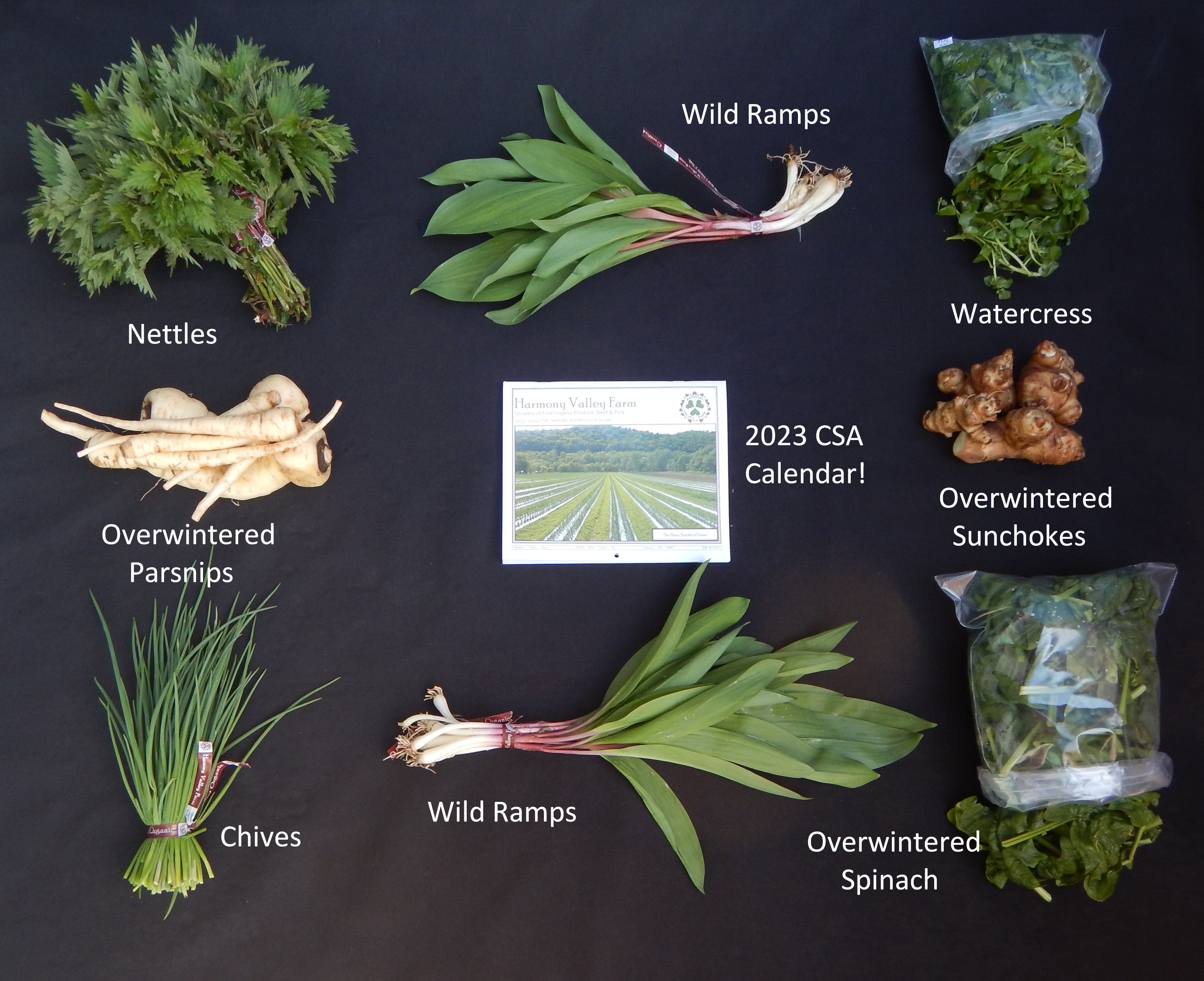
May 4, 2023 - This Week's Box Contents Featuring Nettles and Ramps


Cooking With This Week's Box

Wild Ramps:  
Photo from: www.growforagecookferment.com
Italian Nettle & Ramp Soup (See Below)

Nettles:  
Italian Nettle & Ramp Soup (See Below)

Watercress:  


Overwintered Spinach:  

Overwintered Parsnips:  

Overwintered Sunchokes (aka Jerusalem Artichokes):  

Chives:  

Welcome to the 2023 “Cooking With the Box!”  My name is Andrea and I am a trained professional chef and have 16 years of experience in seasonal cooking and eating!  While I enjoy an afternoon of leisurely cooking, I also understand the need at times to be able to put a healthy, vegetable-centric meal on the table with limited time. So I try to keep the “chef-y,” complicated recipes to a minimum and focus more on recipes of easy to moderate skill and time investment that incorporate multiple vegetables from your CSA box.  Each week I will share a recipe or two that incorporates our featured vegetable(s) for the week along with this collection of “Cooking With the Box” recipes.  The purpose of this article is to give you a starting point for planning how you are going to use every single item in your CSA box. Some weeks you may find a recipe you want to make, while in other weeks you may find inspiration that will lead you to your own recipe idea or an adaptation. Either way, I hope this is helpful and I hope you have fun creating some delicious food this year! If you are not already a member of our private Facebook Group, I encourage you to join. It’s another great resource for sharing recipes & ideas as well as asking questions.

Ok, with that introduction laid out, lets get into this week’s Cooking With the Box!  First of all, I’d like to share this week’s featured recipe for Italian Nettle & Ramp Soup (See Below).  Feel free to adapt this recipe to your liking. Leave out the beans and add some pork sausage for one variation, or make a batch of ramp pesto and use it to garnish the soup.  While this recipe incorporates both of this week’s featured vegetables, I also gave you a list of other recipes using these ingredients. Additionally, I provided links to several really good recipe collections where you’ll find many different ideas for how to use both ramps and nettles.

Overwintered parsnips are naturally sweet, so I often like to incorporate them into baked goods where I can take advantage of their sweetness as an opportunity to reduce the amount of sugar in the recipe! This week you’ll find a recipe for Parsnip & Orange Spiced Cake  and Hearty One-Bowl Parsnip Muffins.  As for overwintered sunchokes, consider Heidi Swanson’s recipe for Sunchoke and Cashew Stir-Fry or try these Smashed Sunchokes with Thyme Butter.  

Overwintered spinach leaves are generally more thick, yet tender and flavorful.  Use it to incorporate some greens into your dinner plan for the family with either of these main dish recipes for Creamy Spinach Chicken Casserole and Mushroom and Spinach Lasagna.  Pizza is one of those concepts that you can bend and adapt however you want to in any season of the year! If you’re up for a piece of the pie, consider making this Asparagus and Watercress Pizza or this Spring Onion and Chive Pizza with Genius Cream Sauce!

I hope you have a great week and enjoy cooking with fresh, green vegetables again!  Hopefully, we’ll have some asparagus to share with you next week.  Green garlic and red radishes will be here soon along with sorrel! Start gathering your recipes, it’s going to be a fun ride!

---Chef Andrea 
 

Vegetable Feature: Nettles & Ramps

by Andrea Yoder

This week we’re featuring two of our favorite wild-harvested spring vegetables.  The first is Stinging Nettles, which we both wild harvest and plant in the field. They need to be handled carefully, especially before they are washed and cooked.  They have little fibers on the stems that contain several compounds including formic acid, which will give you a “stinging” sensation if you touch them with your bare skin. “Why are you giving me a vegetable that will sting me?!  Are you trying to kill me?!”  No, quite the contrary!

Nettles are very nutrient dense and help our bodies wake up after a long winter through their ability to purify blood and cleanse our bodies. They have anti-inflammatory and antihistamine properties. They are high in protein, carotenoids, chlorophyll, iron, calcium, magnesium, zinc, potassium, selenium and vitamins B, C, D and K. Wow—that’s a lot of nutritional goodness!  Nettles give us that jump start we need in the spring and, they also taste great! Cooking destroys the stingers so you can safely handle them with bare hands.  They have a rich flavor similar to spinach, but even better!  

As for handling nettles, many of the stingers are removed with vigorous washing, which we’ve already done for you.  Even though we’ve washed them, I would still recommend you handle them carefully and avoid touching them with bare hands prior to cooking.  Some people are more sensitive to their sting than others, which is why we put them in a plastic bag to make it easier to get them home without touching them. You can use the bag as your “glove” to hold the bottom of the bunch while you remove the twist tie prior to washing them in a sink of water. While you are washing them, bring a pot of water to a boil. Transfer the nettles from the sink to boiling water using a pair of tongs. Boil for 2-3 minutes, then transfer to a bowl of ice water to cool them. Now you can handle them with your bare hands.  

The lower portion of the stems may be tough, so only use the leaves and tender upper stem portions. You can pluck or cut these off the main stem after they are cooked. Alternatively, you can hold each stem (with your gloved/bagged hand) and use a pair of scissors to snip the tender leaves off the main stem before you cook them. Check out this blog post we did on May 10, 2018, which demonstrates these processes and includes pictures. 

Nettle leaves are perishable, so it is best to cook them shortly after you receive them. The cooking water makes a beautiful tea, so don’t discard it.  You can drink the tea either hot or cold and mixed with honey and lemon. The water can also be used to cook pasta, rice, etc. Nettles grow in other areas of the world with similar climates to ours, such as areas of Scandinavia, the United Kingdom, Italy, and other parts of Europe as well as Turkey, Russia, and parts of Asia. Thus, you will find nettles incorporated into a wide variety of preparations from different cultures. Nettle soup is a widely popular way to use nettles, as well as dishes that incorporate eggs, grains and pasta.  They pair well with eggs, dairy, mushrooms, beans, asparagus, and other spring greens.

The second part of our feature is Wild Ramps! We forage for ramps in wooded areas where they grow on north-facing hillsides. They have a very short season lasting, at most, 3-4 weeks.  Their flavor is kind of oniony-garlicky, but honestly the best way to describe it is simply rampy.  They resemble a green onion, except they have tender, delicate lily-like leaves. Ramps grow in the woods and, while they can be replanted to establish new patches, it takes a long time for them to multiply. Many, us included, are concerned about the sustainability of ramps. Thus, it’s important to be mindful when harvesting them.  Ramps grow in clumps and we’re careful to only take about half the clump while leaving the other half undisturbed.  We also replant thousands of bulbs every year in an effort to ensure healthy ramp populations for many years to come!  If you’d like to learn more about our harvest practices, please read our blog post from April 20, 2017. 

Ramps may be eaten raw or cooked and both the leaves and lower bulb are edible. Eaten raw they can be quite pungent, but the flavor mellows with cooking. Ramps are often used in pasta and egg dishes, but can also be made into pesto, ramp butter and even added to baked goods. Ramps pair well with cream, cheese, bacon, and other spring vegetables including mushrooms, asparagus, nettles, and spinach. The leaves are the most perishable part and should be used within a few days. To store ramps, wrap the bunch in a damp paper or linen towel and keep them in the refrigerator. 


Italian Nettle & Ramp Soup

Yield:  4 Servings

1 bunch ramps
¼ cup olive oil
Pinch of dried crushed red pepper
1 can (15.5 oz) chopped & peeled tomatoes
1 bunch fresh nettles
Salt and freshly ground black pepper, to taste
6 cups chicken or vegetable stock
1 Tbsp balsamic vinegar
1 can (15 oz) chickpeas or cannellini beans
2 cups cooked short grain rice or small pasta

Serving Suggestions:
Extra-virgin olive oil
Lemon wedges
Grated Parmesan cheese

  1. Clean the ramps and separate the leaves from the white lower portion.  Finely chop the white bulb and set the leaves aside.  Prepare the nettles by using kitchen shears to snip the leaves off the main stem.  Discard the thick stem and set the nettle leaves aside until needed.
  2. In a medium stock pot, heat ¼ cup olive oil over low heat.  Add the finely chopped ramp and sweat just until softened.
  3. Add the crushed red peppers, tomatoes, nettles, 1 tsp salt, freshly ground black pepper, 6 cups stock and balsamic vinegar.  Bring to a simmer and cook for 15-20 minutes or until nettles are softened, stirring periodically.  
  4. While the soup is simmering, finely slice the ramp leaves.  After the soup has simmered for 15-20 minutes, remove from heat and stir in the ramp leaves.  
  5. Carefully blend the soup at this time using either an immersion blender or transfer the soup to a blender.  Return the blended soup to the pot and heat over low heat.  
  6. Stir in the chickpeas or cannellini beans and cooked rice.  Simmer briefly, then taste.  Adjust the seasonings to your liking by adding additional salt, pepper and/or balsamic vinegar as needed.  Serve hot with a drizzle of olive oil, lemon wedges and parmesan cheese if desired.  
If you happen to have some ramp or nettle pesto on hand, that is a great garnish as well!
Recipe adapted from an original recipe featured at www.foragerchef.com.

Thursday, April 14, 2022

Will We Have Ramps & Overwintered Spinach for the First CSA Deliveries?

Ramps emerging in the woods!
By Andrea Yoder

Spring is officially here, but some recent days have felt more like winter has returned!  For those of you who have been part of our farm in previous years, you know every good farmer conversation either starts with or gravitates to a discussion about the weather.  So, the leading question for today is “Is it an early spring or a late spring?”  Well, it’s been both! In mid to late March all indications were that it just might be an early spring.  Temperatures started to warm up, the garlic was pushing through, pussywillow started to bloom and we had to move fast to cut the willow before it went too far past its prime.  We also had to take the covers off the garlic field and loosen the mulch so the new sprouts would be able to push through.  Those two tasks occurred in the same week, posing a challenge for our small winter crew.  However, as always, they pulled it off!  

Snow Drops dusted with snow, March 31, 2022
Towards the end of March, that picture of an early spring started to show signs and symptoms more congruent to a late spring.  We woke up to a snow-covered valley on several occasions and we’re finishing up this week with a fierce, cold wind and temperatures forecasted to dip down to 25 degrees for several days in a row.  Vegetables don’t grow when it’s that cold, so what originally looked like an early start to spring is now officially a late start.  What is a farmer to do?  Great question and one we’ve been asking ourselves every day as we set up work plans and priorities for our crew!

On April 4 we welcomed back 25 members of our field crew who come from Mexico on a H2A visa to work with us for the growing season.  After a few months of rest with their families, they return to us refreshed and ready to get back into the fields!  Unfortunately, weather conditions have not been conducive to doing field work, so up until Monday and Tuesday of this week most of our work has been indoors.  We’ve taken advantage of these days to bring our farm back to a sense of order after winter.  We picked up sticks and cleaned up our farmyard in addition to doing some clean up around our fields and in the woods.  We’re working on cleaning up fallen trees, branches that blew down over the winter, and have been grading field roads.  We have also been able to do some cleanup work on some new land we’ll be farming this year as well as clearing some of our woods of the invasive honeysuckle.  All the tractors and field vehicles are being serviced, which means a lot of oil and filter changes!  Our CSA delivery trucks went in for their annual inspections this week and will return to the farm with a clean bill of health and, in the case of the Twin Cities delivery truck, a new set of tires!  These are just a few of the repair and maintenance projects we’ve been working on.  We’ve also been whittling away at our list of spring projects including spring cleaning our packing shed areas, doing some work on our employee housing, maintenance checks on all our fire extinguishers (over 60 in total…. safety first!), cleaning out the chicken coop and goat houses, and cleaning & sharpening all of the hand tools.

Pepper Seedlings in the Greenhouse
In the meantime, the greenhouses are nearly at capacity!  We’ve spent the last two weeks transplanting little celeriac and pepper seedlings into larger flats.  This is slow, tedious work, but Leonardo, Erik, Felix, Nestor, Ana and Lupe, as well as a few others have done a great job and the plants look great!  We have two crops of broccoli and cauliflower planted with a third crop of broccoli transplants scheduled to be seeded next week.  We have three plantings of head lettuce transplants, the first of which we will plant in our tunnel greenhouse next week.  We hope to include these in CSA boxes with the second or third delivery.  The onions and leeks look great and we’re hoping to transplant them into the field next week.  Earlier this week we had a little window of opportunity to do some field work and one of the priorities was laying the plastic mulch and drip take for the onion field.  This week we seeded the last two herb components for the Herb Packs we will be preparing for you!  In mid to late May we’ll send garden herb packs to all the CSA sites, and you’ll have the opportunity to pick one up as an additional item to supplement your CSA box!  The last exciting greenhouse update is that the ginger has started to sprout!  We know this is a favorite fall item for many members, and it’s a fun crop we enjoy growing and using as well.  

Trays of culinary herbs on their way to 
becoming CSA Herb Packs!
So, with CSA deliveries starting in just three short weeks, what are we planning on putting in the box?  Will there be overwintered spinach and ramps?  The answer is the same nearly every year…. “It depends on the weather!”  We sent scouts out to some of the woods where we harvest ramps, and we were encouraged with what they found.  The ramp bulbs are a good size for this stage of their growth, but overall, they are still immature.  Richard thinks they need one good week of warm weather to support their growth to the stage where we would consider harvesting them.  Given our forecast for low temperatures through the weekend and into the first part of next week, we do not anticipate we’ll be able to start harvesting ramps until the last week of April.  In terms of CSA boxes, this is great news!  While there are no guarantees, we are hoping we’ll be able to include ramps in the first two CSA boxes this year.  

Overwintered spinach is the other spring favorite we are keeping our eye on.  We removed the field cover at the beginning of the week, partly because the temperatures were a little warmer and also because we wanted to get a good look at the field.  The spinach is fairly large already.  Last week we were predicting that we’d start harvesting spinach next week and that it would be too big to harvest for the first box.  However, Richard’s assessment is that it really hasn’t grown much over the past week.  With regards to CSA boxes, this is good news as it increases the likelihood, we’ll be able to include it in the first and possibly second CSA box!  Right now, the spinach is uncovered and we’re a little concerned about the cold temperatures and high winds forecasted over the next few days.  While we typically would put the field cover back over the spinach to protect it from the cold, freezing temperatures, the high winds we’re experiencing poses a problem with doing so.  First of all, it’s hard to put the cover back on with high winds…think giant parachute!  If we can get the cover back in place the next trick is keeping it in place, but we have lots of sandbags to help with that.  The other issue is that with the high winds, the cover is going to be moving a lot which can cause abrasion injury to the spinach leaves.  So, what’s the right answer?  Do we battle the wind and try to put the cover back on the spinach knowing it may protect it from cold injury but may cause abrasion injury?  Or do we cross our fingers and hope for the best if we leave it uncovered?  The nice thing about overwintered spinach is that it is high in natural sugars which function as a built-in antifreeze.  Perhaps Mother Nature knows what she’s doing, and we should trust her on this one.  Who knows, this could turn out to be the sweetest, most delicious, overwintered spinach ever!  

Chives waking up from a long winter!
As we head into the final few weeks of April, we look forward to welcoming our second group of workers on April 25.  As soon as the fields dry out a bit, we’ll be back out harvesting overwintered sunchokes and the remainder of our overwintered horseradish.  The chives are looking good, and the sorrel is small, but it’s up.  The next thing we’ll start looking for are buds on the trees and asparagus shoots!  If you signed up for your shares already, watch the mail for your Welcome Packet which will be arriving within the next 1-2 weeks.  If you still haven’t signed up, what are you waiting for?!  Come join us and I guarantee you’ll eat well and be well in 2022.

Wednesday, May 5, 2021

May 6, 2021 - This Week's Box Contents, Featuring Wild Ramps!

Cooking With This Week's Box

Wild Ramps: 
Wild & Wonderful Ramp Chowder (See Recipe Below)
Wild Rice Bowl with Ramps and Asparagus (See Recipe Below)
Ramp Butter
Ramp Deviled Eggs
 
Overwintered Spinach: 
Creamed Ramps and Spinach
Spring Spinach Chop Salad with Creamy Buttermilk Ramp Dressing
 
Watercress:
Asparagus & Watercress Pizza
Mushroom, Parmesan and Watercress Omelet
 
Overwintered Parsnips:  
Spiced Honey Parsnip Bread
Roasted Parsnip Salad
 
Overwintered Sunchokes:
Important information about how to best utilize and enjoy Sunchokes.
Lacto-fermented Pickled Sunchokes
Chili-Roasted Sunchokes
 
Chives:
Sunchoke and Chive Soup
Chive and Parmesan Popcorn
 
Nettles:   
Important information about how to handle and prepare nettles.
Nettle & Mushroom Pizza with Ramp Cream
Nettle & Ramp Pesto
Nettle Tea
Nettle Soup
 
Green Garlic: 
Spaghetti with Green Garlic and Olive Oil
Asparagus & Green Garlic Soup with Parmesan Croutons
 
Asparagus: 
Roasted Asparagus with Breadcrumbs & Herbs
Asparagus, Spinach & Feta Quiche

Asparagus, Spinach & Feta Quiche
photo from twopeasandtheirpod.com
Welcome to the 2021 CSA season!  We’re happy you’ve chosen to journey through another year with us and I hope you are ready to roll up your sleeves and get cooking in the kitchen!  My name is Andrea and I am a professionally trained chef.  Each week I will share recipe ideas and links in this space we call “Cooking With the Box.”  Some weeks you may choose to prepare some of these recipes, while at times these recipe links may simply serve as a launching pad for your own creative cooking ideas.   Either way is perfect!
 
I also encourage you to use some of the other resources we have to offer you including the searchable recipe database on our website.  This is where we’ve archived recipes from past years, many of which have become farm and member favorites we turn to every year! Lastly, I encourage you to participate in our private Facebook Group, just for members.  This is a great platform for sharing recipes with other CSA members and is one way we can create a supportive community for each other. 

Nettle & Mushroom Pizza with Ramp Cream
This week’s box is packed full of special spring vegetables, an eclectic mix of wild-harvested vegetables we forage for as well as some crops we overwinter in order to extend the season and give us something to harvest and eat before our spring planted vegetables are ready.  If you are new to our CSA, some of these items may be new to you and you may be unsure what to do with them!  This is where I have to insert my vegetable mantra which is: “Never Be Intimidated by a vegetable!”  I hope the resources and support we offer you each week are helpful, but if you do have any additional questions you are always welcome to call or email me! 
 
Have a great week and enjoy your first CSA box!
--Chef Andrea


Vegetable Feature: Ramps!

By: Chef Andrea Yoder

Description: Ramps, sometimes referred to as “wild leeks,” are one of the first signs of spring we see emerging on the wooded hillsides of our valley.  They have a very short season which is typically only 3-4 weeks.  The flavor of ramps is similar to onions or garlic, but they really have a unique flavor that is best described as “rampy!”  Ramps resemble a green onion, except they have tender, delicate, lily-like leaves and the base of the ramp becomes more bulb-like as it matures.

Preparation & Use: Ramps may be eaten raw or cooked and can be used in ways, similar to a green onion.  When raw, they can be quite pungent, however the flavor mellows with cooking.  You can eat both the leaves and the lower bulb, just trim away the roots.  Ramps pair well with cream, cheese, bacon and other spring vegetables including mushrooms, asparagus, nettles and spinach.  Ramps also pair well with eggs in scrambles, frittatas and quiche and are often incorporated into pasta and rice dishes.  Ramp pesto and ramp butter are simple preparations that may be used fresh or can also be frozen as a way to preserve that delicious spring flavor!

Ramp Pesto
Storage: The leaves on ramps are delicate and the most perishable portion of the plant.  We are in our final week of harvest and did have rain ahead of harvesting some of this week’s ramps.  Ramps that are more mature and harvested under these conditions often have a shorter shelf life.  Thus, we encourage you to eat them within a few days of receiving them.

Store ramps in a plastic bag in the refrigerator.  If you are going to keep ramps for several days, it’s a good idea to wrap the leaves with a damp paper towel.  The bulb portion of the ramp will store longer than the leaves, so some may choose to separate the bulb from the leaves and store them separate.

Cultural & Historical Background: Back in the early days before ramps were popular and customers came looking for them, Farmer Richard actually gave ramps away at the farmers’ market!  That’s right, he couldn’t sell them so he gave them away with hopes that people would give them a try and come to like them so much they’d buy them!

Ramps growing in the woods
Growing Information: Ramps grow wild in the woods on north-facing hillsides early in the spring.  While they can be replanted in woodland areas that are conducive to supporting ramp populations, it takes awhile for them to multiply and spread.

Additional Points of Interest: We have been wild-harvesting ramps in our valley since the mid-80’s.  Many individuals are concerned about the sustainability of harvesting ramps.  Of course, we want our ramp populations to remain sustainable as well, thus we carefully manage our harvests.  We harvest from private land which allows us to rotate harvest areas.  Additionally, ramps grow in clumps and we’re careful to only take about half of a clump while leaving the other half undisturbed.  We’ve been implementing this practice since the very beginning and our ramp populations remain strong and healthy!  With the future in mind, we have been planting ramps in a few wooded areas on our land over the past few years.  It will be awhile until we can harvest from these areas, but they are well-established and we’re hopeful they’ll thrive into the future!

Wild & Wonderful Ramp Chowder

Yield:  4 Servings

photo from healthstartsinthekitchen.com
2 Tbsp butter
1 cup ramp bulb and greens roughly chopped
4 cups russet potatoes, peeled & diced
4 cups chicken or vegetable broth
⅛ tsp white pepper
Sea salt, to taste
2 cups half & half
2 cups sharp cheddar cheese 

Optional Toppings:
Crumbled bacon
Shredded Cheese
Ramp greens, thinly sliced

  1. In a Dutch oven or other heavy bottom pot, over medium heat, melt butter.  Sauté ramps in butter until soft.
  2. Add the potatoes, broth and pepper.  Simmer, covered, for 20 minutes or until potatoes are cooked through. (Note:  Taste your broth while heating and season with sea salt.  Ideally the liquid that the potatoes are cooking in should be well salted, perhaps a little tiny bit over salted).
  3. Reduce heat to low.  Add half & half and shredded cheddar cheese, stir well to combine.  Cook over low heat until everything is well incorporated, do not boil.  
  4. The flavors deepen and it will thicken up a little more if you let it set off heat for 30 minutes before gently reheating and serving.  If you prefer an even thicker soup, you can blend 1-2 cups of the soup in your blender until smooth, then add it back into the pot.
  5. Garnish individual bowls with toppings of your choice including crumbled bacon, shredded cheese or thinly sliced ramp greens.
Recipe borrowed from healthstartsinthekitchen.com.

Wild Rice Bowl with Ramps & Asparagus

Yield:  Serves 2 as a main, 4 as a side

photo from abetterhappierstsebastian.com
1 cup wild rice
1 pound asparagus
1 bunch wild ramps
½ cup slivered almonds
2 Tbsp butter, divided
Salt and pepper, to taste

  1. In a medium pot over high heat, bring 3 cups water to a boil.  Stir in wild rice, reduce to a simmer and cover.  Cook 40-45 minutes or until rice kernels just begin to open.  Fluff with fork and drain off any excess cooking liquid.  Place a clean kitchen towel over the pan and put the cover back on.  Set aside, off heat until ready to assemble the dish. (Note:  the towel will absorb any steam or moisture from the rice so it will be fluffy)  
  2. Meanwhile, while rice is cooking, trim the ends of the asparagus spears and cut into ¾-inch pieces.  Set aside.  Divide the ramp greens from the bulbs.  Chop the greens into bite-sized pieces and dice the bulbs.  Set aside.
  3. In a skillet over medium heat, melt 1 Tbsp of butter.  When the butter is foaming, add asparagus, season generously with salt and pepper and cook until just slightly wilted, tossing frequently, about 4 minutes.  Remove asparagus from skillet and set aside.  Return pan to medium heat and melt additional ½ Tbsp butter.  Add ramp bulbs and sauté briefly, about 1 minute.  Add in ramp greens, season with salt and pepper and cook an additional minute until the greens are wilted.  Remove from heat and set aside.
  4. Over medium heat, melt remaining ½ Tbsp butter.  Continue cooking down butter until it begins to brown slightly, swirling the pan to cook evenly.  When lightly browned, add slivered almonds, salt and pepper, tossing to coat.  Continue to cook over medium heat until almonds are toasted, about 3 minutes.
  5. Reduce heat to low and add rice, asparagus, and ramps back to the pan.  Toss to combine all ingredients and season with additional salt and pepper to taste.  Serve warm.
Recipe adapted from abetterhappierstsebastian.com.

Friday, April 16, 2021

April Farm Update…..Ramps, Overwintered Spinach and the start of a new CSA Season!

By Andrea Yoder & Richard de Wilde

Rows of gorgeous Green Garlic!
Spring is here and we’re just 3 weeks away from the first CSA deliveries of the 2021 season!  Every day we see a little more green filling our valley as our wooded hillsides come out of winter hibernation.  Despite the fact that we’ve had a quite chilly week with temperatures in the low thirties overnight, we would still describe this as an early spring.  Things are changing quickly and the growing season is starting to take shape.  Here’s a little glimpse of what’s happening on the farm.

Remember those gorgeous sunny, warm days back in March?  Those were the days that jump started the garlic crop and we had to strip back the cover and loosen the mulch to make sure the sprouts could push through!  The green garlic looks quite nice and we are planning to start harvesting some next week.  Richard can’t remember ever putting green garlic in the first CSA box of the season, but it will be in the first boxes this year!

Unloading our first ramp harvest this week!
You cannot talk about spring happenings at Harmony Valley Farm without talking about ramps and overwintered spinach.  These are two crops many people, ourselves included, look forward to every spring.  We started harvesting overwintered spinach last week and yesterday we did our first ramp harvest!  We know everyone would like to receive these two items in the first few CSA boxes in May, and we hope we’ll be able to include them.  Unfortunately, we’re at the mercy of Mother Nature and the season for both of these crops is starting a little early this year.  So if you are one of those people who needs to get your fill of ramps and overwintered spinach before their short season is over, we encourage you to head to your local food co-op and stock up on these items now!  If we are still able to harvest ramps in May, they will certainly be in your box.  And that overwintered spinach?  We are doing our best to manage the crop and hope to be able to time it just right so we can do a second harvest off these plants for the first few CSA deliveries.

Antonio hand-harvesting
Overwintered Spinach
We are also happy to report we had a very good harvest of overwintered parsnips and sunchokes.  The parsnips are so sweet and delicious, they need nothing more than to be tossed with oil, salt and pepper before roasting them.  Our spring sunchoke harvest was very plentiful and we’ve been staying busy washing and packing them for our wholesale partners.  Not only are they an important part of our spring diet, they also help us financially while we’re getting the season underway.

Last week we did our first plantings of salad mix, baby spinach, arugula, cilantro, radishes, baby bok choi, dill, hon tsai tai and baby white turnips.  While we plan to plant these crops in the first week of April, we seldom have the opportunity to actually do so!  The radishes are already up and we’re crossing our fingers that they will be ready for the first week of deliveries!

While we are anxious to plant more crops, it takes awhile to get fields ready in the spring.  Over the past two weeks the guys have been working hard to spread compost and minerals, subsoil, rototill and shape beds for planting.  This year we partnered with a new supplier for our compost and we’re very pleased with the product.  We had to pay a little more for it, but it is well-made, easy to spread and for the first time in many years we have had favorable conditions to be able to spread compost on all of our fields in the spring!  We also invested heavily in mineral applications, including trace minerals.  Adequate fertility in the soil is a key to producing delicious vegetables, but it’s also important for producing healthy plants that pass their nutrients on to us!  We were also able to put minerals on our pastures where we graze our animals as well as the fields where we grow hay to feed them in the winter.  Just like humans, animals can taste the difference and always favor the mineral rich parts of the pastures.  I guess you could say they are grass connoisseurs and definitely have discerning palates!

Germ testing beet seed in the
greenhouse to test seed quality
As we finish preparing fields, we’ll move on to planting.  We hope to see warmer temperatures next week which will be more favorable for direct seeding beets, carrots, parsnips, chard and possibly even the first peas.  We did start transplanting onions a week ago.  It takes quite awhile to plant all of our onions and we hope to finish them today.  We are anxious to transplant more crops including the first broccoli and cauliflower, kohlrabi, cabbage and leeks.  We are also anticipating a shipment of strawberry and asparagus plants today, purchased from Nourse Farm in Massachusetts.  It’s already time to plant next year’s strawberry field!

While we’ve completed about three-fourths of the plantings on our greenhouse plan for this year, we still have plenty of greenhouse work to complete over the next few weeks.  Next week we’re scheduled to plant our first tomato seeds in the greenhouse and we hope to plant zucchini before this week is finished.  It’s also time to transplant the herb packs we’ll deliver for you in mid May!

Leonardo, Antonio and Isidro
transplanting peppers 
So who is doing all this work?  Good question!  We welcomed back 24 of our field crew who comes from Mexico on agricultural guest worker visas.   We were happy to see them on March 29, but from a distance as they had to quarantine due to their recent travel.  Thankfully they had an uneventful quarantine period and everyone remained healthy and well without so much as even a cold!  While we all wish the pandemic would move into the past, we also acknowledge it is still very much a concern at present.  Our crew members understand the importance of how our individual choices impact the work we’re able to do at the farm and they did their part to minimize their risks of exposure both before they departed their homes as well as during their travels.  Their efforts were clearly effective and we are thankful they are all in good health, ready and eager to work!  We are looking forward to welcoming another group of workers the last week in April and have our fingers crossed that they will arrive without any delays.  We are also grateful for the opportunity to work with Family Health La Clinica, an organization that offers mobile health services to migrant workers.  They have been an invaluable resource for our farm as they have helped us navigate managing our workspace throughout the pandemic to keep our workers safe.  They will be coming to the farm to administer vaccinations to any crew members who would like to receive it.  In the meantime, we continue all of our precautionary practices to do the best we can to remain healthy so we can all keep farming!

We’ve received several emails from CSA members inquiring about the use of plastic liner bags in the CSA boxes this year.  Just as we are continuing our precautionary practices on the farm, we will also continue to take a precautionary approach to CSA deliveries as well as with CSA pick up procedures.  While we hope that we’re collectively making forward progress in moving past the pandemic with vaccinations, etc, we also feel that we need to continue to be precautionary and would like to continue to offer a safe pick-up option for all our members knowing some of you are high-risk individuals or live with high-risk individuals.  We realize the concerns for transmission of the virus on touch surfaces may be less than we thought one year ago, however using the plastic liner bag in the CSA boxes serves other purposes as well.  We want to limit the time each member is in the site and continue to ask that only one member enters the site at a time.  The use of the bag also helps achieve a quick in and out pick up.  Thus, we will continue to use the plastic liner bags for now.  We’ll certainly reassess as the year goes on and if at some point we feel it is appropriate to discontinue using them we will do so.

Repurpose CSA bags as covers for
storing artwork!
In the meantime, we do ask all CSA members to continue to follow the pandemic procedures we laid out last year to facilitate a quick, safe CSA pick-up.  This includes wearing a mask when you go to pick up your share, physically distancing at the site and only one person enters the site at a time.  As for the bags, we encourage you to find ways to repurpose them in your own homes or communities.  Last year we compiled a list of ways you, our members, were creatively repurposing them in your homes.  You can view that list HERE, and we ask that you continue to send us your creative ideas as you find more ways to repurpose them.  If your collection goes beyond what you can use in your own home, you may also consider checking with other organizations in your community such as your local food pantry, schools, community centers, etc.  They may be able to use them for projects, etc. in their organizations and might appreciate the donation!  At the very least, the bags are recyclable.

Transplanting onions one week ago....
just before it started to rain!
This certainly is not everything we are doing on the farm, but at least it gives you a snapshot.  We are looking forward to growing food for you and your family this year and hope you are ready to start cooking and eating some tasty meals!  We do still have room to accept more sign-ups for all of our delivery areas, so if you haven’t signed up yet we encourage you to do so!  If you have a friend, neighbor, or know of someone who is interested in joining, please refer them to us.  We will keep adding members until we’re officially sold out!

Enjoy the rest of April and we’ll see you in May!