Showing posts with label Sweet Potatoes. Show all posts

Wednesday, October 25, 2023

October 26, 2023 - This Week's Box Contents Featuring Sweet Potatoes


Cooking With This Week's Box


Sweet Potatoes:
Sweet Potato & Carrot Cakes with Cashew Lime Sour Cream (See Below)
Thai Sweet Potato & Cauliflower Lettuce Wraps (See Below)

Yellow Onions:
Onion Cake 
Cream of Onion Soup 


Here we are, wrapping up the final week of October and just a few weeks away from Thanksgiving!  We’re preparing for our first potential ‘hard’ frost of the season coming this weekend, which means we’re harvesting cabbage, sensitive greens and as many root crops as we possibly can!  We’re also putting out row covers to protect our late season fall greens including escarole and radicchio.  One of the benefits of this cold weather is the effect it will have on the Brussels sprouts.  We’re planning to harvest them for the next two boxes and they should taste exceptional after this weekend!  While there are still some fun selections yet to come, we’re excited to be sharing sweet potatoes with you this week! 

Sweet potatoes are a very versatile vegetable and may be used in many ways.  This week’s recipes pair sweet potatoes with some of this week’s other vegetable selections.  Check out this recipe for Sweet Potato and Carrot Cakes with Cashew Lime Sour Cream (see below).  This is a recipe from Amy Chaplin, a very accomplished vegetarian chef and cookbook author.  The other recipe makes use of this week’s lettuce for Thai Sweet Potato and Cauliflower Lettuce Wraps (See Below).  Of course, I sprinkled a few other sweet potato recipes in amongst the list this week with crossover pairings with other vegetable selections.  This recipe for Ginger Coconut Sweet Potatoes is one of my favorites.  You may also consider pairing this week’s fresh baby ginger with sweet potatoes to make this simple, yet elegant Silky Ginger Sweet Potato Soup.

This week’s Peter Wilcox potatoes are one of my all-time favorite varieties.  I think they would pair nicely with this week’s carrots and cauliflower in this ChickenPot Pie Soup.  If you’re looking for some other main dish inspiration for the week, check out this Creamy Garlic Chicken Pasta or perhaps you may choose to make an entrée salad with this recipe for Kale Power Salad with Sweet Potatoes & Spicy Almond Dressing.

This week’s box has not one but two varieties of squash!  Butterkin squash may be used interchangeably in recipes calling for butternut squash.  There are plenty of recipe options contained in these two recipe collections entitled 28 of Our Best Butternut SquashRecipes To Make This Fall and 30 Butternut Squash Recipes To Make This Fall.  Jester squash is similar in use to either delicata or acorn squash, so you may choose to look for recipe ideas that use these two varieties and may be adapted to the Jester squash.  I am looking forward to trying this recipe for Cranberry Apple Stuffed   Squash.

I’m going to wrap it up here with one reminder for everyone.  Next week is the week when we will be delivering both Green & Brown week deliveries in the same week!  So, if you are a brown week customer typically receiving a box every other week, make sure you check your calendar and give yourself a reminder to go pick up your box!  Have a great week and I’ll meet you back here next week!

---Chef Andrea

Vegetable Feature: Sweet Potatoes

by Andrea Yoder

Sweet potatoes seem to be one of our most popular fall crops that CSA members look forward to every year. They are a staple fall vegetable with a long storage potential that will sustain us for the next 4-6 months! They are also very versatile in their uses, which means you have the opportunity to get creative and enjoy sweet potatoes in a wide variety of recipes over the next few months!  

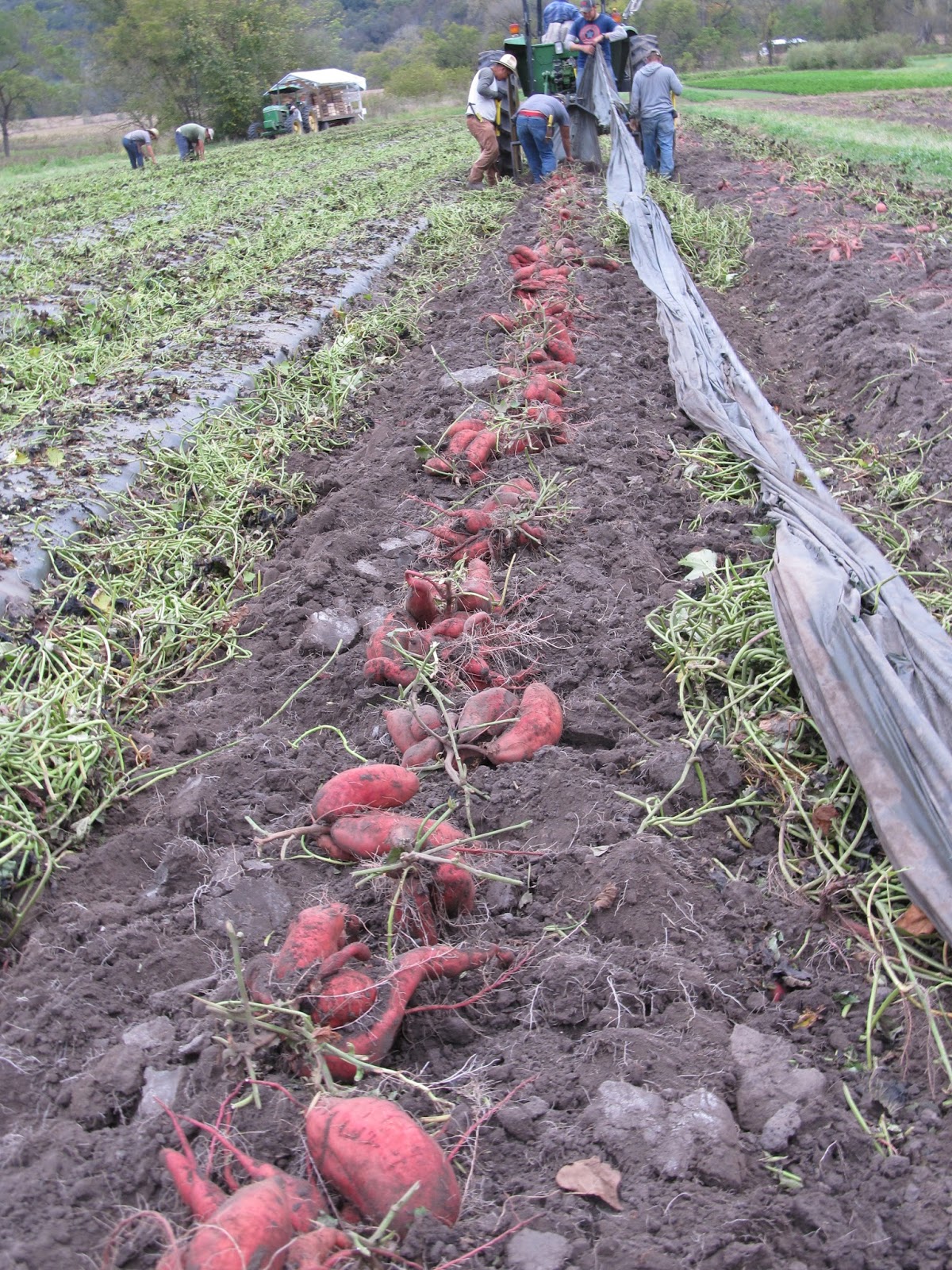
Freshly Harvested Sweet Potatoes
Sweet potatoes are a tropical vegetable, which makes it a bit of a challenging crop to grow in our northern climate. Over the years we’ve learned a lot about growing sweet potatoes and have refined a pretty good production system.  We wait until we are past the last frost in late May before we plant our sweet potato slips (slips is the term we use for the young plants we transplant into our field). We plant them into raised beds that are covered with a dark green plastic mulch to trap heat, making the plants think they are in a tropical environment. This summer’s heat wave was actually not too bad for the sweet potatoes, although we had to make sure they received enough water and nutrients through the drip irrigation lines buried under the plastic mulch.  Harvest typically happens in late September or early October. We always cross our fingers for a stretch of several dry days without precipitation to finish the harvest. This fall we were not so lucky as to have the “Perfect” harvest conditions, but with rain in the forecast we knew we had to get them out of the field. So, over the course of just a few days, we had two separate harvest crews in the field at the same time and raced against the weather! Despite a rainy afternoon, the crew pushed on and managed to finish the harvest. Yes, we brought in a lot of mud, and we had a huge pile of very muddy gloves at the end, but it felt great to have 34,000 pounds of sweet potatoes safely tucked away for storage! 

Crates of sweet potatoes ready to "cure" in 
our greenhouse
Straight out of the field, our sweet potatoes taste ok, but not good enough to eat (in our opinion). That’s right, we have a rule around here that you don’t really eat sweet potatoes until they have been 'cured'.  When first harvested they are starchy, not very sweet or tasty, and the skins are very tender requiring careful handling.  Sweet potatoes aren’t truly sweet potatoes until we “cure them.”  Curing is a process by which we hold the sweet potatoes at high heat and high humidity for 7-10 days. During this time, the starches in the potatoes are converted to sugars and the skins become more stable for long term storage. Richard checks the brix levels (a measure of sugar content) before, during and at the end of this process. Once they are cured, we reduce the temperature and humidity levels for longer storage. 

If stored properly you can eat sweet potatoes all winter! The ideal storage temperature for cured sweet potatoes is 55-65°F. If you don’t have the perfect location to store them at their ideal temperature, it’s better to store them at room temperature instead of putting them in the refrigerator.  

Harvesting sweet potatoes!
Sweet potatoes are less starchy and more sweet and moist than a regular potato and have a wide variety of uses. You can simply bake them whole until fork tender and eat the flesh right out of the skin. They are also delicious, cut into bite-sized pieces and roasted or cut them into wedges or thin slices and make roasted fries or chips. Sweet potatoes also make delicious, hearty soups and stews, may be added to chili, shredded, and fried like hash browns, or just simply cook and mash or puree them. They are also delicious incorporated into biscuits, rolls, quick breads, cookies, bars, cheesecake and more! 

Sweet potatoes are also very nutritious! They are a great source of complex carbohydrates and are high in fiber as well as vitamins and antioxidants that are helpful for preventing cancer, reducing inflammation and boosting immunity.  If you’d like to read more about the health benefits of sweet potatoes, you may enjoy this article entitled Sweet Potato—A Valuable Medicinal Food:  A Review.  I also came across an interesting research article entitled Sweet Potatoes for Cancer Prevention citing the health benefits from eating sweet potato peels for cancer prevention! While sweet potatoes are often peeled, they don’t have to be, and you just might want to take advantage of those valuable nutrients!  


Sweet Potato & Carrot Cakes with Cashew Lime Sour Cream

Makes about 14 2 ½-inch cakes
1 ¼ cup red lentils, rinsed
1 ½ cups water
2 Tbsp extra virgin coconut oil, plus more for brushing pan and cakes
1 large onion, finely chopped
6 cloves garlic, minced
Sea salt, to taste
1 tsp dried turmeric
1 red chili, thinly sliced, plus more to garnish
⅓ cup finely chopped cilantro stems, from one bunch cilantro
3 medium carrots, grated, divided (about 6 cups)
2 small sweet potatoes, grated
1 cup chopped cilantro leaves, plus more to garnish
2 scallions thinly sliced
1 tsp tamari, plus more to taste
1 ½ tsp brown rice vinegar

Cashew Lime Sour Cream
1 cup cashews, soaked 4 to 6 hours
Zest of one lime
3 to 4 Tbsp fresh lime juice
2 Tbsp extra virgin olive oil
¼ cup plus 2 Tbsp filtered water
½ tsp sea salt, plus more to taste
  1. Combine lentils and water in a small pot and bring to a boil over high heat. Cover pot, reduce heat to low and simmer for 10 minutes, remove from heat and set aside covered while you prepare the other ingredients.
  2. Line a baking sheet with parchment paper, brush paper with coconut oil (you may have to melt it first) and set aside.
  3. Preheat oven to 375°F if you have a convection setting, or 400°F if you don’t have a convection setting.
  4. Warm coconut oil in a wide skillet over medium heat and add onion. Sauté for about 5 minutes or until golden. Add garlic and a large pinch of salt and continue cooking for another 3 minutes. Stir in turmeric, chili and cilantro stems and cook 2 minutes longer. Reserve about 1 cup of grated carrot and add the rest to the skillet along with the grated sweet potato. Cook, stirring for 4 to 5 minutes or until vegetables are tender but not soft. Remove from heat, stir in remaining carrot, cilantro leaves, scallions, tamari, and rice vinegar and set aside.
  5. Remove 1 cup of red lentils from the pot and save for another use. Place remaining red lentils into skillet and mix to combine. Season to taste with salt and tamari and set aside until cool enough to handle.
  6. Shape into cakes, using a ¼ cup measure as a guide. Flatten them a little, place on prepared tray and brush with coconut oil. Bake for 20 minutes or until browning on the bottom. Flip over and continue baking for another 10 to 15 minutes or until golden brown on each side.
  7. To prepare the Cashew Lime Sour Cream, drain and rinse cashews and place in an upright blender. Set lime zest aside and add remaining ingredients. Blend until completely smooth and velvety, scraping sides, as necessary. Season to taste and add reserved lime zest. Pulse to combine and pour into a bowl. Place in the fridge for an hour or until ready to serve. This will last 2 to 3 days in an airtight container.
  8. Serve the Sweet Potato and Carrot Cakes warm and topped with the Cashew Lime Sour Cream.
Recipe borrowed from www.amychaplin.com.


Thai Sweet Potato and Cauliflower Lettuce Wraps

Yield: 2-3

1 cauliflower
Photo from www.cupfulofkale.com
2 medium-large sweet potatoes
2 tbsp oil
½ tsp garlic powder
½ tsp onion powder
1 tbsp Thai red curry paste
Salt and black pepper, to taste
250g firm tofu, drained
1 tbsp soy sauce or tamari
Fresh lettuce leaves, washed and dried
Thinly sliced red onions (optional)
Fresh Cilantro, roughly chopped (optional)
Sesame seeds, toasted (optional)

Peanut Sauce:
1 heaping tbsp peanut butter
3 tbsp coconut milk 
1 tsp maple syrup
1 tsp red Thai red curry paste
½ lime
  1. Preheat oven to 350°F.
  2. Peel the sweet potatoes and cut into ½ inch cubes. Cut the cauliflower into similar sized pieces and place in a large roasting pan with the sweet potatoes.
  3. In a small bowl mix together the oil, garlic, onion, Thai red curry paste and some salt and pepper.
  4. Pour the mixture over the vegetables and toss so they are all coated. Pop in the oven for 30-40 minutes.
  5. Make the peanut sauce by whisking all the ingredients together in a bowl. Thin with a little water if needed. Set it aside for later.
  6. Heat a frying pan on medium high heat with 1 tbsp soy sauce and some oil. Using your hands crumble the tofu into the pan.
  7. Fry for 5-10 minutes, stirring occasionally and cook until the tofu turns brown and crispy.  When done, remove from heat and set aside.
  8. Check the roasted vegetables. The sweet potato should be soft through and the cauliflower crispy and browned. 
  9. When the vegetables and tofu are finished, put both in a serving bowl and mix together. Serve with the peanut sauce, lettuce leaves and toppings ready to assemble your lettuce wraps!
Borrowed from  www.cupfulofkale.com.

Wednesday, October 27, 2021

October 28, 2021 - This Week's Box Contents, Featuring Sweet Potatoes!


Cooking With This Week's Box

Escarole:  

Porcelain Garlic:  

Yellow Onions:  

Poblano Peppers:  

Guajillo Peppers:  

Russet Potatoes:  

Butternut Squash:  

Brussels Sprouts:  

Burgundy Sweet Potatoes:  
Sweet Potato Muffins with Pecan Streusel (See Below)
Gold Beets:  

Green Curly Kale:  

Purple Daikon: 

Hello Everyone! 

It’s finally time to send sweet potatoes your way!  This year’s Burgundy sweet potatoes are quite sweet and tasty, as well as unique in appearance.  These may be the most interestingly shaped sweet potatoes we’ve ever grown!  Nonetheless, I’m excited to share this recipe for Sweet Potato Muffins with Pecan Streusel (See Below).  I discovered this recipe last winter and I’ve made them countless times.  They never get old!  One thing I really like about this recipe is its versatility.   The original recipe is vegan, but it works well with dairy items (milk and butter) as well, so I often use whatever I have on hand.  You can also change up the nuts you use.  I often use almonds, but walnuts, hazelnuts, etc. would work too.  Now this week we’re focusing on sweet potatoes, so you really should make your first batch using them.  That being said, I’ve made this same recipe using winter squash puree in place of the sweet potatoes.  Butternut squash, Orange Kuri, Kabocha, or the Tetsukabuto squash we’ll send your way in December are all good varieties to cook, puree and use to make these muffins.  I’ve also made this recipe using bananas and applesauce as well---you guessed it, equally as delicious!  Ok, two more modifications I want to share.  I like to substitute ½ cup of almond flour for the spelt flour.  It makes a light, very tender muffin.  The last time I made this recipe I realized I didn’t have any muffin liner papers.  Yes, you can grease the muffin tins, but honestly I’d really recommend using the papers for this recipe as they are much easier to extract without falling apart.  Instead of making muffins, I used a small Bundt pan (6 cup capacity) and made a cake!  I poured the batter in the pan and then put the streusel topping on top.  After it was baked I turned it out onto a plate so the streusel was then on the bottom.  With this cake strategy, you can turn this recipe into a nice dessert or coffee cake!  If you haven’t picked up on it yet, I really like this recipe!
 Photo from Brussels Sprouts Hash and Eggs

Time to move on as there are a lot of other great recipes to try this week!  I know we’re going to be eating these Sheet Pan Sweet Potato, Poblano and Black Bean Quesadillas for lunch later this week.  Quesadillas are a quick and easy item to make and then reheat in a toaster oven.  Perfect for a quick lunch or keep them in the fridge for the kids to heat up after school!   The other fun recipe I came across this week was for these Garlic Pizza Sliders Dip.   They are ooey-gooey, cheesy delicious!  Great for the kids, great for game night, or movie night.

Brussels sprouts are another exciting crop this week!  I love vegetables for breakfast, so I’m going to make this Brussels Sprouts Hash and Eggs.  My other breakfast dish idea for this week is this Chickpea and Kale Shakshuka.

This week we’re sending Russet potatoes, one of the few drier, starchy potatoes we grow.  This is the variety traditionally used to make baked potatoes.  My favorite way to eat this is baked with a salt crust.  If this interests you, check out this article, How To Make Salty, Crispy Skinned Baked Potatoes.  

Ok, that’s all I’m going to comment on today.  Take a look at this week’s recipe suggestions and see for yourself if anything looks good!  Have a great week and I’ll see you next week to celebrate the first week of November and ginger harvest! –Chef Andrea


Vegetable Feature: Sweet Potatoes

By:  Richard deWilde

Most Midwest farmers would not even consider growing a tropical plant like sweet potatoes or ginger (spoiler alert…coming in next week’s box!).  But we’ve never fit the profile for a typical Midwest farm and we’ve attempted many unconventional challenges and new crops.  Learning how to grow sweet potatoes has been one of our more favorable attempts.  Still, every year presents a new set of challenges to overcome and we continue to learn from each experience.  

Sweet Potatoes starting out this spring
Of the many varieties of sweet potatoes from around the southern parts of the world, only a handful stand a chance of producing in Wisconsin.  We have tried them all and will continue to try any new ones available.  For now we have settled on two varieties that consistently produce a yield in our unconventional system.  We start our sweet potato crop from plants called “slips.”  We depend on slips grown in outdoor beds by two organic growers in North Carolina.  Time is of the essence for us as we need to maximize the growing season.  Thus, we want to plant as soon as possible after the last frost date in May.  When we order, we hedge our bets and divide our order between the two suppliers.  They are affected by weather too and in years past they’ve been hit by tropical storms, cold weather snaps, etc. which affects the timing and quality of the slips they are harvesting.  But, if all goes as planned, we get the slips by the end of May.  We transplant them into raised beds covered with dark green plastic which helps hold heat to make the plants think they’re in their preferred tropical environment!

Jose Luis & Oscar showing getting ready to 
start picking up the sweet potatoes
I mentioned we have two favorite varieties and those are Burgundy and Covington.  Covington is a dependable producer of nice banana-bunch like clusters of four to six potatoes.  They typically have nice shape and size, but generally fall slightly below in “brix,” which is a measure of sweetness.  Burgundy has moved to the top of the list with its deep orange color and sweetness for several years.  It tends to lag behind in yield, only producing two to three nice tubers in a cluster, but we love their rich taste and sweetness so are willing to compromise a bit on yield.  

Every year is different and this year defies these typical descriptions in many ways!  It was very dry and hot when we planted them, just what sweet potatoes like!  We have a water line under the plastic cover to deliver water and nutrients, but sweet potatoes do not require much fertility and we know that excess water produces thin, stringy potatoes and few tubers.  So we refrained from too much water based on the readings we took from our moisture sensors.  The vines were very prolific, vines on top of vines that were knee high!  In September when we cut them back to dig a test cluster, it was disappointing.  We only found one to three potatoes on each plant.  So in early October, we put a cover on them to trap in heat and prevent frost damage.  No frost came, but fearing wet and cold weather, we removed the cover, chopped the vines and dug them!  It took most of three days with a crew of ten to carefully lift and crate them.  Approximately 30,000 pounds went into the greenhouse where we “cured” them for about ten days.  This means we held them in an environment with temperatures around 85°F with very high humidity for 8-10 days which helps set the skins so they are more stable for storage and the starches in the tubers are converted to sugars enhancing their sweetness.  

Digging a few samples and digging the whole crop are pretty different.  The covers and waiting definitely produced more size to tubers, but it did not change the number of tubers in a cluster.  The Burgundy that is in this week’s box was a mystery to watch come out of the ground as I followed behind the digger.  The initial clusters remained at only 1 or 2 nice tubers, but below, very deep, about 18 inches was another crop of sweet potatoes that were long, skinny and beautifully twisted.  Needless to say, they are less than perfect in shape, but they still taste delicious! So while they may not look like the standard graded sweet potato you may see on a store shelf, we chose to include them in your boxes and hope you’ll embrace the unique individuality expressed in each one!  

This year the Covington and Burgundy both came out of the field with a Brix of 8-10 where we usually see 4-6.  After the curing process they both measured fairly equal at 11-12.  These two varieties do have different natural sugar profiles, so even if they measure similarly with a Brix reading, they can be two very different flavor and tasting experiences.  So, you be the judge!  Let us know what you think about the flavor of the Burgundy and compare it to the Covington variety we’ll be sending to you in several weeks.   

It’s best to store sweet potatoes at room temperature.  We do not recommend storing them in the refrigerator as they are susceptible to chill injury.  And that’s this year’s sweet potato story.  We hope you enjoy this year’s unique crop as you use them in soups, casseroles, tacos, desserts, baked goods and so much more over the next few weeks.  


Sweet Potato Muffins with Pecan Streusel


photo from thefirstmess.com
Yield:  10-12 muffins

Streusel Topping:
½ cup pecan halves, chopped
5 Tbsp coconut sugar or brown sugar
½ tsp ground cinnamon
Pinch fine sea salt
2 ½ Tbsp cold butter or vegan substitute

Muffins:
2 cups light spelt flour*
1 tsp ground cinnamon
1 tsp baking powder
1 tsp baking soda
¾ tsp fine sea salt
1 ½ cups mashed, cooked sweet potato flesh
½ cup maple syrup
⅓ cup melted coconut oil or butter, at room temperature
2 Tbsp milk or non-dairy alternative 
1 tsp vanilla extract
  1. Preheat the oven to 400°F.  Lightly grease 10 cups of a standard size muffin tin and set aside.  Alternatively, line the muffin tin with muffin papers.
  2. Make the streusel topping.  In a small bowl, mix together the chopped pecans, coconut sugar, salt and cinnamon.  Add the butter to the bowl and mix it in with your fingers, or use a pastry cutter.  Break up the bits of butter and cut them into the sugar and pecans.  Once you have a sandy, crumbly texture, and the streusel sticks together when you pinch it with your fingers, set aside in the refrigerator.
  3. In a large bowl, combine the spelt flour, cinnamon, baking powder, baking soda, and sea salt.  Stir with a spatula to evenly mix.
  4. In an upright blender, combine the mashed and cooked sweet potato, maple syrup, coconut oil, milk and vanilla.  Blend on high until totally smooth and creamy.  Alternatively, whisk these ingredients by hand in a medium mixing bowl.
  5. Pour the sweet potato mixture into the large bowl with the flour mixture.  Use your spatula to get all of the sweet potato mixture you can out of the blender.  Gently stir and fold everything together until JUST combined.  
  6. Divide the muffin batter evenly among the 10 prepared muffin cups.  Remove the pecan streusel from the fridge and divide it evenly amongst the tops of the muffins.  Press it in a bit with your fingers.  
  7. Bake the sweet potato muffins for 18-20 minutes, or until the tops are domed, slightly golden and a pairing knife or cake tester inserted into the middle of one comes out clean.  Let the muffins cool completely before enjoying!
*Note Regarding Spelt flour:  If you do not have this type of flour available, you may substitute standard all-purpose flour, whole wheat pastry flower or gluten free flour of your choosing.

Recipe adapted slightly from TheFirstMess.com.

Thursday, May 26, 2016

Spring Farm Update

by Farmer Richard
Crew transplanting onions.

This has been a weird and unpredictable spring!  It warmed up in late February and March. The snow melted, the maple sap started to run….perhaps a bit too early? The ramps came up in early April and by the second week of April we started harvesting them.  All indications pointed towards an early, warm, dry spring! We planted our first salad greens, radishes, beets and carrots on April 14. Early?  Yes, but we love it!

We had fairly dry weather early in April which allowed us to get the overwintered parsnips and sunchokes out of the cold winter ground. The overwintered spinach looked pretty good and by the end of April we started to see signs of the asparagus starting to come up. We were thinking “Yes!  We’re going to have nice early season boxes for our members!” ….and then our fortunes changed.  Cold, damp weather going into the first of May slowed all growth to a crawl!  Some crops did continue to grow, despite the cold temperatures. The garlic, rhubarb, and spring onions looked good, until we had an unsuspected and freakish hail/slush storm with strong north winds. It was quite a
Jose Manuel and Alvaro laying plastic for sweet potatoes.
storm! It moved through quickly but managed to dump about two inches of hail and sleet balls on us in just about 15-20 minutes! Unfortunately the rhubarb and overwintered onions took a beating as the hail hit the tops of the onions and the rhubarb stalks. The wind was coming from the north, so one side of the plant looked pretty bad while the other side of the plant was virtually untouched!  Whoa here, what happened to our early spring?!

After the storm, it was on the dry side so we continued to plant on schedule, even early sweet corn and green beans. The first 24 hours after a seed is planted are probably the most important.  If we plant on a warm day and plant shallow, we can usually germinate the seed. Voila!  Our first planting of beans germinated, pushed through the ground and were looking good. They were just coming up and then on May 15, our average last light frost date, we had a freeze!  27-28°F was our low temperature that set in for about 6-8 hours overnight and into the morning. The green bean sprouts that were still under the ground froze!  The sweet corn froze too, but recovered with new shoots. Most of the beans, however, did not survive.  Despite the fact that we had a cover over the strawberries, some of the blossoms were damaged. It looks like about 40% of the blossoms were damaged, but still a lot of smaller strawberries are ok and coming.
   
The zucchini and cucumbers were under a cover as well.  While the zucchini toughed it out and had a pretty good survival rate, the cucumbers in the same field didn’t fare so well.  They had about an 1% survival rate. So sad. On a brighter note, the beets, carrots, chard, burdock, broccoli, fennel, cauliflower, cabbage, etc are all alive and just waiting for warm weather to grow!

We picked the asparagus hard before the frost on May 15, but some asparagus still froze off and we lost 5 days of production.  That’s why there was such a small bunch of asparagus in last week’s box!  We were very happy to see larger harvest numbers this week when the crew picked on Monday.
Captain Jack supervising.
 No, the asparagus season is not over!
 
 With some extra time on our hands, we turned our attention to that which we always turn to when we have a free moment during the growing season….weed control! Can you believe it has been so cool that even the weeds haven’t been growing!! While we’ve been waiting for the vegetables to grow, our crew has been busy trimming around fields, has done a lot of landscaping, painted our barn and the nursery greenhouse, cultivated and cleaned every small weed from the plantings.
 
Finally, this week the warm weather came and we have been busy transplanting some of our warm weather plants including eggplant, tomato, pepper, squash and melons. While it has been a challenge to manage things this spring and provide a nice box, the tide is turning. The crops…and the weeds will grow!

Thursday, November 19, 2015

Vegetable Feature: Sweet Potatoes

by Lisa Garvalia
Sweet Potato Harvest
Sweet potatoes, the sweet vegetable that you don’t have to feel guilty eating! Sweet potatoes are a great source for our daily nutritional needs. They are packed full of beta-carotene, calcium, potassium, iron, Vitamin A and Vitamin C. They are cholesterol free, have no saturated fats and are full of antioxidants. Oh, and did I mention they are sweet and delicious as well?


So, how does the sweet potato get that delicious sweet flavor?  Choosing the right variety of sweet potato, good soil, adequate watering and close monitoring during the growing season are all necessary to get the best tasting sweet potato. After the sweet potatoes are dug and brought in from the field, they are immediately put in the greenhouse and left to cure. The curing process is what changes the starch in the sweet potato to sugar and also ‘toughens’ up the skin so they can be easily handled and have a longer storage potential. The greenhouse is kept at a constant temperature of 85-90 degrees with the humidity level being the same and the process takes up to 7-10 days.


Sweet Potatoes Curing in the Greenhouse
Sweet potatoes do store well and they get better with age. The ideal storage for sweet potatoes, because of the high sugar content, is 55-60 degrees. Keep them in a dry, dark, well ventilated area. Sweet potatoes are sensitive to colder temperatures so keeping them at or above the suggested temperatures is best. If you do find spots on your sweet potatoes during storage it is a good idea to cook and freeze them if you are unable to eat them right away.

Sweet potatoes are very versatile when choosing how to cook them. They pair well with a variety of ingredients including apples, oranges, coconut, cranberries and limes. Common spices used with sweet potatoes include cumin, coriander, chilies, thyme, rosemary, chili powder, curry powder and more. If you want to keep it basic you can simply place a sweet potato in the oven and bake until tender. Cut it open and add butter, salt and pepper, or keep it in the fridge for a simple left-over, just warm and serve.

Best Whipped Sweet Potatoes with Caramelized Apples

Yield:  6 servings
3 pounds sweet potatoes
3 Tbsp unsalted butter, divided
2 Tbsp heavy cream
½ cup applesauce
2 tsp grated fresh ginger
Coarse salt and freshly ground pepper
2 apples, peeled & cored
3 Tbsp sugar
  1. Preheat oven to 375°F.  Place sweet potatoes on a parchment-lined baking sheet;  pierce each several times with a fork.  Bake until very tender when pierced with a knife, about 50 minutes.  Remove from oven;  let cool slightly.
  2. Cut open potatoes;  scoop flesh into the bowl of an electric mixer fitted with the paddle attachment (may also use a food processor).  Add 2 Tbsp butter and the cream, and beat until smooth.  Add applesauce and ginger;  beat to combine.  Season with salt and pepper.
  3. Transfer sweet potato mixture to an ovenproof serving dish.  Place in oven until heated through, 10 minutes.
  4. Meanwhile, cut the apples into 1-inch pieces.  Melt remaining butter in a nonstick skillet over medium-high heat.  Add apples and sugar;  saute until golden and nicely caramelized, about 8 minutes.  Remove from the heat.  
  5. Remove serving dish from oven and top with caramelized apples.  Serve immediately.

Recipe sourced from Martha Stewart Living Annual Recipes 2003.

Sweet Potato Rolls

Yield:  20 rolls
¼ cup warm water
1 envelope active dry yeast (1 scant Tbsp)
1 cup milk
⅓ cup unsalted butter
½ cup sugar
1 ½ Tbsp coarse salt
1 tsp ground cardamom
2 cups cooked sweet potatoes (about 2 medium)
1 tsp freshly squeezed lemon juice
1 large egg, lightly beaten
7 cups sifted all-purpose flour
Vegetable oil, for bowl
Melted butter, for brushing
  1. Place the warm water in a small bowl and sprinkle with yeast. Let stand until yeast is dissolved and mixture is foamy.
  2. In a small saucepan, heat milk over medium heat just until it begins to steam and bubble around the sides. Remove from heat; add the butter, and stir until melted and combined. Stir in sugar, salt and cardamom. Let cool slightly.
  3. Combine sweet potatoes and lemon juice in the bowl of an electric mixer fitted with the paddle attachment; beat until smooth, 2 to 3 minutes. Beat in egg, and the milk and yeast mixtures until smooth.
  4. Switch to the dough-hook attachment. Add flour, 1 cup at a time, beating until dough forms. Continue kneading dough on medium speed until smooth, about 8 minutes. The dough will be slightly sticky.
  5. Transfer dough to large oiled bowl. Cover with a clean kitchen towel, and let rise in a warm place until doubled in bulk, about 1 hour.
  6. Preheat oven to 400 degrees. Line a baking sheet with parchment paper; set aside. Punch down dough and turn onto a clean work surface. Knead again with your hands, just until smooth. Using a bench scraper or sharp knife, cut dough into 20 equal pieces, and shape into round rolls.
  7. Place rolls on prepared baking sheet, about 2 inches apart; cover with a clean kitchen towel, and let rise again in a warm place until double in bulk, about 40 minutes.
  8. Using kitchen scissors or a sharp paring knife, snip an X in the top of each roll. Brush tops with melted butter. Bake until tops of rolls are golden, about 20 minutes, rotating pan halfway through. Transfer to a wire rack to cool slightly.
Note:  Excellent served with the Cranberry Maple Butter recipe featured in our fruit newsletter on November 22, 2014.

Recipe sourced from Martha Stewart Living Annual Recipes 2003.

Friday, March 20, 2015

Book Review

Deborah Madison’s The New Vegetarian Cooking for Everyone
Reviewed by Andrea Yoder

Deborah Madison has been one of my favorite chef-authors for many years.  She has written over 10 cookbooks including Vegetable Literacy and her most recent cookbook, The New Vegetarian Cooking for Everyone.  I have a weakness for her cookbooks, so when I saw a copy of her most recent book on the shelf at the bookstore I couldn’t resist.  Deborah has focused her career on preparing simple, seasonal, vegetable-based cooking.  In her early days she worked at Alice Water’s well-known San Francisco restaurant, Chez Panisse.  She later opened her own restaurant, Greens, which focused on vegetarian cuisine.
   The New Vegetarian Cooking for Everyone was preceeded by an earlier cookbook Deborah published in 1997 entitled Vegetarian Cooking for Everyone.  Her original work is considered a classic cookbook in the realm of vegetarian cuisine and has won several awards.  Her new cookbook is “for everyone interested in learning how to cook vegetables creatively, healthfully, and passionately.” The recipes are simple & written with the intent that they will be prepared at home, as opposed to being chef-y restaurant recipes. Since Deborah is cooking in a different region of the United States, there are a few times when you might need to make a minor substitution for an ingredient that we may not have available in a given season in Wisconsin.
   Deborah takes the time throughout the book to include her own personal commentary on most of her recipes.  She offers suggestions for making substitutions or slight alterations to recipes to give the cook more options to choose from.  She also makes suggestions for other recipes in the book that might pair well together so you can easily put together a full meal.  I also appreciate that she takes time in the beginning of the book to include some basic information about how to go about cooking in an approachable way.  She also includes a section on basic cooking fundamentals that enable any cook, no matter how much experience you may have, to become more savvy in the kitchen.
   While the list price for this book is $40, it is a value when you consider the book includes over 1600 recipes featuring many of the vegetables we grow on our farm over the course of the season.  If you’re looking for a good vegetable-centric cookbook to guide you through a CSA season, I’d encourage you to consider Deborah Madison’s The New Vegetarian Cooking for Everyone.  Her simple recipes & vegetable storage information will be helpful to those who may be new to CSA and are learning to cook new vegetables.  Her book also may be appealing to cooks with more experience who are looking for simple recipes that highlight the delicious vegetables they’ve grown to love.
   I selected 3 simple recipes from her book to feature this month.  If you have some of these vegetables remaining from the late season 2014 shares, perhaps you can find a use for them with some of Deborah Madison’s ideas.

Roasted Beets, Apples, and Onions with Cider Vinegar
“This is a bold dish, far greater than the sum of its parts. Any leftovers make a great little
salad or item on a composed salad plate. Use any color beet or a mixture.”
Recipe borrowed from Deborah Madison’s cookbook, The New Vegetarian Cooking for Everyone.

Yield: 4 servings
4 medium beets, steamed, peeled and cut into ½ –inch dice
2 cups diced apples, skin on
½ onion, diced
¾ tsp sea salt
2 Tbsp apple cider vinegar
⅛ tsp freshly grated nutmeg
1 Tbsp brown sugar, optional
1 ½ Tbsp butter or sunflower seed oil
Freshly milled pepper
Apple cider vinegar or horseradish, for serving

1. Heat the oven to 350°F. Lightly butter or oil a 4-cup casserole or
gratin dish.
2. Toss the beets with the apples and onions, season with the salt,
vinegar, and nutmeg. If you favor extra sweetness, add the sugar as
well.
3. Slide the vegetables into the baking dish and dot with the butter or
drizzle with oil. Cover and bake for 1 hour.
4. Serve warm or even chilled. Season with pepper and have extra
vinegar or horseradish on the table, if you like their extra bite

Roasted Onions with Vinegar & Rosemary
“Serve these easily prepared onions as a side dish, or add them, chopped, to arugula or
spinach salad or spoon them over bruschetta with slivered Manchego cheese.”
Recipe borrowed from Deborah Madison’s cookbook, The New Vegetarian Cooking for Everyone.

Yield: 4 to 6 servings
4 to 5 onions, sliced into ½-inch rounds
2 Tbsp olive oil
2 Tbsp balsamic or aged sherry vinegar
1 Tbsp finely chopped rosemary
Sea salt and freshly milled pepper

1. Preheat the oven to 400°F.
2. Toss the onions with the oil, vinegar, and rosemary. Season with salt and
pepper. Put them in a baking dish with a few tablespoons water.
3. Cover and bake for 30 minutes, then uncover and continue baking until the
onions are browned around the edges and tender, about 30 minutes more.
Give them a stir every 10 minutes or so toward the end.

Sweet Potato Muffins with Candied Ginger
“Chunks of candied ginger make these particularly good. If you don’t have ginger readily
at hand, replace it with chopped dates, raisins or fresh pineapple. Serve these with Brie or
other mild cheese, butter, or cream cheese.”
Recipe borrowed from Deborah Madison’s cookbook,The New Vegetarian Cooking for Everyone.

Yield: 10 to 12 muffins
⅓ cup chopped candied ginger
¼ cup butter, melted
⅓ cup unsulfured molasses
1 cup mashed cooked sweet potato
or winter squash
2 eggs, at room temperature
½ cup buttermilk
½ cup packed light brown sugar
1 ¾ cups flour
1 tsp baking powder
1 tsp baking soda
¼ tsp sea salt
1 tsp ground cinnamon

1. Preheat the oven to 375°F. Oil muffin tins.
2. Mix the ginger and wet ingredients in a bowl until smooth; mix the dry
ingredients in a second bowl. Combine the two, mixing gently until well
blended.
3. Spoon the batter into the muffin tins and bake on the middle rack until
lightly browned, 25 minutes


Thursday, October 16, 2014

Sweet Potatoes

by Farmer Richard and Farmer Andrea


First there was the rush to get them planted, then the waiting and hoping game…will they get enough
warm days to form sizeable sweet potatoes? Next came the threat of frost, which for this tropical vegetable would mark the end of its life cycle. We scurried to get covers on them and just in time. Safe from frost and warm under their covers, they pushed through a few more weeks of growing time. Finally, it was time to harvest. After several good, hard days of harvest, over 45,000 pounds of sweet potatoes were safe in the greenhouse! Every year we anticipate the first tastes of sweet potatoes, and they are finally ready!

So where did sweet potatoes come from? Who knew a sweet little vegetable could have such a sordid history and cause so much controversy. The answer is, well– it depends on where you look for the answer. There are a lot of different theories and stories. In our research, we found they have been domesticated for at least 5,000 years. While there are no definite answers as to their origin, which was more than likely South America, it seems they made their way to Europe via Columbus somewhere in the late 15th century. There are references to sweet potatoes dating back to the 16th century in China. Asia and Africa come into the picture in the 17th and 18th centuries. Sweet potatoes are the most widely grown root by quantity in the world, although China feeds quite a bit of them to their animals. (How silly!) Most of the sweet potatoes grown in this country come from southern states and California.

Sweet potatoes are a member of the Morning Glory family, not the ‘Potato’ family also known as the Solanaceae family. It is true that the sweet potatoes pre-date the ‘regular’ potato. Now that we’ve made that distinction, lets tackle the controversy between sweet potatoes and yams. George Washington started calling them ‘sweet potatoes’ to distinguish them from the traditional ‘Irish’ potatoes. The term yam was used to distinguish the orange flesh sweet potatoes from the traditional white flesh sweet potato in Louisiana. Yams and sweet potatoes are not related. Yams have dry, starchy and often white-colored flesh. Sweet potatoes have a more sweet and moist flesh. While both the yam and the sweet potato are considered tropical plants, the sweet potatoes are also a temperate plant. Yams will only grow in tropical climates.

Sweet potatoes are not senescent, which means they do not grow old and die. Tropical countries are able to replant a piece of the vine to regrow them year to year. We ‘propagate’ our sweet potatoes from a new shoot or vine growing from selected potatoes saved from last year’s crop. This does require quite a bit of greenhouse space in April, so we supplement our plants with ‘slips’ from the south. In the warmer climate, they can be produced in outside beds. This year we had a new supplier from North Carolina who is certified organic. It has been challenging to source organic sweet potatoes slips in the past, but this farm sent us a timely shipment of very nice slips. We plant a total of 16,000 slips on raised, plastic covered beds. We used a variety called Covington, which originated from The University of North Carolina. There are really only 3 (maybe 4) varieties of sweet potatoes that will yield well in our area of the North. Thus far, we like the Covington variety better than the Beauregard or the Georgia Jets.

Covers extend the growing season of our sweet potatoes.
Because it was a cool summer, we covered our 2 acre field in September to protect the sweet potatoes from frost and trap heat under the cover. They grew up very well to yield 46,000 pounds of very nice size and shaped tubers. The national average yield is 14,500 pounds per acre, so we are well above that number! Although that number is still below the 30,000 pound average per acre that a good southern grower might get, we are still pretty happy with our yield.

The average sweet potato consumption in the United States is down to about 5 pounds per person per year, although I bet the average CSA member’s annual sweet potato consumption is much greater than this. In the 1920’s that number was closer to 29 pounds per year, which is a huge change. In recent years, the average number is again on the rise, and that is being attributed to a renewed interest in their high nutritional value, including the beta carotene content.

Sweet potatoes curing in greenhouse at high temperatures
and high humidity.
Because the sweet potato is not senescent, it will never develop a thicker skin in the field. We must harvest them with ‘kid gloves’ so to speak and handle them with extreme care until they have cured fully. We cure our sweet potatoes in our greenhouse a full week at temperatures of 85° – 90°F and the same high humidity. This will ‘toughen’ up the skin so they can be easily handled and have a longer storage potential. The curing process also converts the starches in the sweet potatoes to sugars, thereby making them a truly “sweet” potato.

Sweet potatoes do store very well and they are so versatile that it’s hard to grow tired of them! They can be baked, roasted, boiled, pan-fried and even deep-fried. You can dice them up and add them to soups and stews. You can bake them and then scoop the flesh out and puree it. The puree can then be used in baked goods, desserts (sweet potato pie or cheesecake!), breads or as a spread or ingredient for pizza, quesadillas, lasagna, etc.

Because sweet potatoes are part of cultures all around the world, you’ll find many different ways to prepare them. They pair well with a variety of ingredients including apples, oranges, coconut, cranberries and limes. Common spices used with sweet potatoes include cumin, coriander, chiles, thyme, rosemary, chili powder, curry powder and more. Sweet potatoes can be accompanied by a variety of cheese, including Parmesan, fresh goat cheese, gouda or others. One of the most basic ways to enjoy a sweet potato is to simply pop the whole sweet potato into the oven and bake it until it is tender. Cut it open and garnish it with coconut oil or butter and a dash of cinnamon or chile powder. Captain Jack’s all-time favorite way to eat sweet potatoes is sweet potato French fries….hold the spice and add a side of gravy if you really want to win him over.

Sweet potatoes will only get better with time, so don’t feel like you have to eat them all within a week (although it’s hard not to!) The ideal storage temperature for sweet potatoes is about 55°- 60°F. If you want to store sweet potatoes well into the winter, try to find the spot in your home that is closest to this temperature range. Sweet potatoes are sensitive to cold temperatures, so if you don’t have an ideal storage location it’s better to err on the side of a little warmer instead of a colder temperature.

We have a lot more sweet potatoes to come your way. While we have our favorite ways to prepare them, we’re always looking for new recipes. If you have a favorite recipe, we’d love for you to share it with us! You can email them to csa@harmonyvalleyfarm.com.

Sweet Potato Vinaigrette
Recipe adapted from Lorna Sass’ Complete Vegetarian Kitchen. 

Yield: About 1 cup
1 medium (8 oz) sweet potato, baked until very soft
¼ cup plus 2 Tbsp sunflower oil
3 to 4 Tbsp apple cider vinegar
2 Tbsp maple syrup
Large pinch ground cloves
½ tsp cumin
⅛ tsp cayenne
Sea salt, to taste
¼ cup water, approximately

1. Peel and mash the baked sweet potato. (You should have about ½ to ¾ cup)

2. In a blender or food processor, combine the sweet potato, oil, 3 Tbsp vinegar, maple syrup, cloves, cumin, cayenne, salt and enough water to create a thick but pourable dressing.

3. Taste and add more vinegar and salt as required. Allow the vinaigrette to set for about 15 minutes, then taste and adjust seasonings to your liking. Use immediately or refrigerate in a tightly sealed container for up to 5 days. If the dressing thickens in the refrigerator, thin it with a tablespoon or two of water.

Variation: Add complexity to the dressing by substituting ¼ cup hazelnut or walnut oil for ¼ cup of the sunflower oil.

Serving suggestions: I (Andrea) was intrigued by this recipe and had to give it a try…I would never have thought to use sweet potatoes to make vinaigrette! I recommend using this vinaigrette to dress a fall spinach salad garnished with thinly sliced red onions, chunks of apples and toasted nuts. You could also use this vinaigrette as a dipping sauce or sandwich spread. You might even toss roasted vegetables with this vinaigrette for the last 5 to 10 minutes of cooking time.

Peanut & Sweet Potato Soup
“This Africa-inspired peanut soup is roundly seasoned with spices, enriched with peanut butter, and given a crunchy, aromatic finish with roasted peanuts, cilantro and red pepper flakes.” –Deborah Madison, Vegetable Literacy.


Yield: 6 servings
1 small bunch cilantro
2 to 3 Tbsp roasted peanut oil
1 large onion, diced
2 large cloves garlic, finely chopped
1 (1-inch) piece ginger, peeled and finely chopped
1½ tsp ground cumin
1 tsp ground coriander
½ tsp cinnamon
½ tsp ground turmeric
½ tsp red pepper flakes
2 pinches of ground cloves
1 cup crushed canned tomatoes
3 cups sweet potato, medium diced (about 1½ pounds)
Sea salt, to taste
½ cup organic peanut butter
½ cup salted, roasted peanuts
Juice of 1 small lime
Red pepper flakes, to taste

1. Wash the cilantro, including the stems, then separate the stems from the leaves. Finely slice the stems and set the leaves aside.

2. Warm the oil in a wide soup pot over medium-high heat. When the oil is hot, add the onion and cilantro stems, give them a stir, and cook until the onions have begun to soften and even brown in places, 5 to 10 minutes. Stir in the garlic, ginger, cumin, coriander, cinnamon, turmeric, pepper flakes and cloves. Add the tomatoes, sweet potatoes, 1¼ tsp salt and 4½ cups water. Bring to a boil, then lower the heat and simmer, partially covered, until the sweet potatoes are tender, about 30 minutes. Stir in the peanut butter. Taste for salt.

3. Puree 3 cups of the soup in a blender until creamy. Stir the puree back into the pot. Or, if you prefer a completely creamy textured soup, puree the whole amount. Taste for salt and stir in half the chopped cilantro leaves.

4. Chop the rest of the cilantro with the peanuts, leaving some texture, and mix in a few pinches of pepper flakes and the lime juice. Ladle the soup into bowls and add a spoonful of the peanut-cilantro mixture to each.