Showing posts with label Farmer Richard. Show all posts

Wednesday, December 1, 2021

Wrapping up 2021 and Rolling Out 2022!

By Farmer Richard

Rolling out row covers on the Strawberry Field!
Here we are, ushering in the final month of the year and wrapping up yet another bountiful CSA season.  We have already started working towards the next growing season and as we look ahead to 2022, it’s a promising outlook.  We have had a very busy, but very productive fall.  About 90% of our fields are going into winter with established cover crops.  We value cover crops greatly and rely on them to keep our soil in place over the winter while also building fertility for next year!  We are hopeful for next year’s garlic crop which was planted using very nice bulbs we selected from this year’s harvest.  We are confident we’ve given it a good start and we’re happy to report it already has 2 inches of roots protected under a nice layer of mulch!   We also have a nice field of spinach to overwinter for harvest next spring.  It is covered with a big field blanket for a little extra protection over the winter and we anxiously await that day in the spring when we can peel it back and look for that sweet, new growth!  Nearby we also have a very nice, new field of strawberries that we will harvest for the first time in only about 7 ½ short months!  That crop is also nicely mulched and all of these fields are surrounded by deer fencing to deter our four-legged friends from entering them over the winter!

Compost Temperature Reading
We’ve also spent a considerable amount of time doing some field and land maintenance in preparation for next year.  Earlier this year we had the opportunity to purchase a new piece of land that gained us a very nice 12-acre organic field.  Having a secure land base upon which to grow vegetables well into the future is always at the forefront of our minds.  As we go into next year we will be losing some land that we have leased for many years, but we also have some new land we’ll be leasing.  We’ve invested some time this fall into cleaning up the perimeters of some of these new parcels of land as well as making sure roads are accessible for the work we’re going to need to do early in the spring.  We did soil tests this fall and will use that valuable information to formulate a solid management plan we’ll implement next spring including applications of compost, minerals, etc.  On that note, Silvestre has been diligently managing our compost windrows this fall.  He’s closely monitored the temperatures and has been very timely in turning the rows to keep the piles “hot” to make some very nice compost.  These are just a few of the many things we’ve been working on in the luxury of this very nice, mild fall.  We know the snow will be flying soon, so we’re just trying to maximize every nice day!

Compost Turning

The pace of the farm is changing as we slowly say good-bye to our H2A visa crew.  We’re down to the final group of crewmembers who will help us put the finishing touches on this year with our final CSA deliveries before they return to their homes in Mexico for the winter.  We are hopeful that each and every one of them will be returning to work with us again next year.  Labor shortages are a very real struggle in the produce industry and have only become worse in recent years.  We hear stories about produce rotting in the field because there aren’t enough hands to pick it and we are even more grateful to have a skillful, experienced, longtime crew that is dependable and an overall joy to work with.

As we prepare for the new growing season, of course it’s time to also start signing up for the 2022 CSA Season!  This week our “Rollover” email will go out to all of our CSA members who pay through our monthly electronic withdrawal option.  If you are one of those individuals, watch for that email to land in your inbox!   As we put together our offerings for 2022, we are not making too many changes.  The majority of our CSA site hosts will be working with us again next year, however there are a few changes to our delivery sites.  We are also not making any changes to our Vegetable share offerings and a few minor changes to our meat share packages.  While most things will remain consistent with this year, we have decided to increase pricing for both our vegetable shares and meat shares for the 2022 growing season. This is the time of year that we have to assess profitability as we project (guess) what next year will hold.  It’s very difficult to set a price and make a one-year commitment to deliver on that price and it’s no secret that the cost of many things in our economy have increased, and in some cases may continue to rise.  In our business, we’ve seen significant increases in packaging costs this year, but also fuel, fertilizer, and the list goes on.  Just this week I saw reports coming from AgWeb that fertilizer costs are up 43% and seed cost is up 7%.  We don’t want to fuel inflation with increased prices, but we also want to remain profitable and viable so we can continue to feed families into the future.  

It is also worth mentioning that labor is almost half of our annual expenses.  I mentioned earlier how much we value our crew members and they deserve to earn a fair wage for the work they do.  Their wages are set by the government and have increased each year since 2018 with annual increases ranging from 2% to 6.3%.  The 2022 wage rates will be announced soon, but initial thoughts in the industry based on labor surveys are that we’ll see another significant wage increase of as much as 6% for 2022.  This next wage increase will take them over $15 per hour, plus with the H2A visa program we are also responsible for providing free housing, cover all their visa fees and transportation.  

2020 Fall CSA share box

The last time we increased our vegetable CSA share prices was in 2018.  Each year since then we’ve chosen to hold our price and instead focus on building efficiencies and increasing our membership so we can defer the overhead costs of operating a CSA program over more shares.  While we didn’t plan for a pandemic to be the catalyst that brought our CSA numbers back up to a sustainable level, it did make a huge difference in the profitability of the CSA portion of our business.  Unfortunately, we can’t absorb wage and input costs forever and still remain viable.  Thus, for the 2022 season we did increase our vegetable share prices by 5%.  While we haven’t finalized our meat share pricing for 2022 yet, we are planning to increase our meat prices as well.  We are thankful to have a dependable processor, but they raised their processing costs earlier this year and we anticipate we’ll see another increase after the first of the year.  

As we confidently move forward into another growing season, we acknowledge there is a big unknown on our shoulders.  We know the pandemic brought us many new customers and, thankfully, many of you stayed with us for a second season!  But the unknown we face is whether those members will come back for a second or third season.  Will people continue to value CSA as a safe, reliable way to source their food and recognize the value in sourcing locally or will a large percentage of individuals choose to go back to “business as usual?”  We also hope members will consider the actual value of produce packed in the boxes this year.  Based on our secret shopper pricing data to date, if you were to purchase the items in your CSA box at a local food co-op or a national natural food store, you would have paid an average of 32% more for the same quantity of food.  Of course, some items are not always available organic and there are some items we include in boxes that you will seldom to never find on a store shelf.    This is the nature of CSA—when there is bounty, members reap the benefits of a bountiful year by receiving full boxes packed with so much goodness!  Plus, you receive weekly communications, recipes, the opportunity to take advantage of special offers, and most importantly a connection with the source of your food.  This is a very precarious time for our business, but it is also a precarious time for our nation, our economy and our supply chain.  The pandemic has shown us the vulnerabilities in our supply chain and, at the same time, it has become even more evident that a local food system is a more sustainable and reliable system to support.

Gerardo packing CSA boxes 2021!

I suppose any conversation about a new growing season and a new year would not be complete with out mentioning COVID.  What will 2022 hold for us from the perspective of the pandemic?  It’s been a long and challenging two years for all of us.  As business owners, the amount of pandemic-induced decisions, considerations and costs has been overwhelming at times.  Thankfully, we have been able to move forward in good health and continue to do the best we can to make decisions that are in the best interest of our employees as well as our customers.  We’ve done due diligence in minimizing risks of exposure on the farm, but also at our CSA sites.  We know there are differing levels of comfort and opinions about what is necessary.  We continue to assess our practices on the farm as well as the protocols for our CSA sites.  We will be sending out a short survey within the next week or two and would value a few minutes of your time to gather your input.  We want to get your feedback about our COVID related protocols for CSA sites and what your opinions are about what is necessary moving forward into a new year.  

We know many of you would like to see the use of the plastic liner bag be discontinued.  We agree and hope we can resume our previous method of packing vegetables directly into the boxes with members doing a quick transfer of the contents to their own reusable bag, cooler, etc when they pick up their box.  Over the past two years we’ve received some emails from members who are concerned about the amount of plastic and packaging we use to pack our CSA shares.  Couple this with the worldwide use of single-use plastic due to the pandemic and we agree, we can do better.  Over the winter we will be looking at ways we can decrease plastic use in our CSA shares as well as other ways on our farm.  There are some new packaging products available now that are more eco-friendly and may be appropriate for packaging some items we now put in plastic.  One example is a new recyclable cardboard clamshell some growers are using to package small items like grape tomatoes and berries.   Of course, if you have suggestions for packaging vegetables in a CSA box, we’ll gladly consider your input!  

Every year holds a new set of opportunities and I am certain 2022 will not disappoint.  Regardless of what evolves with the pandemic, wage rates, the cost of fuel, etc, we plan to remain steadfast to our goal.  That is to produce the healthiest food we can for our community so all of you can continue to contribute to our world in positive ways.  We hope you enjoy the final deliveries of 2021 and we look forward to growing for you again in 2022! 

Wednesday, August 12, 2020

Why Onions?

 By Farmer Richard with Gwen Anderson
Red Cipollini Onions drying in the Greenhouse
Onions were one of the first vegetables that came to Richard’s attention as having significant health benefits.  Four years ago, we published an article called Alliums to Fight Cancer that delved into some of the health benefits of onions and garlic specifically regarding their cancer fighting properties. Onions also boast the ability to help prevent osteoporosis, lower blood pressure, lower the level of cholesterol and triglycerides in the blood, have anti-clotting benefits, as well as being anti-inflammatory, antibacterial and antiviral. This is due largely to the organosulfur compounds that onions contain.  Organosulfur compounds contain some powerful antioxidants, including quercetin and other flavonoids that encourage glutathione production.  Quercetin is known to slow tumor growth, especially in colon cancer, promote prostate health, and is an antihistamine.  Flavonoids may reduce the risk of stroke as well as Parkinson’s and cardiovascular disease.  One study done by the Journal of Hypertension in 2017 reported that participants that consistently ate more alliums (onions and garlic, to name a few) reduced their risk of cardiovascular disease by 64%.  Glutathione is a powerful antioxidant that boosts the immune system and protects the heart as well as removing toxins.  Sulfur, found in organosulfur compounds, is also the main component that assists with protein synthesis and creating cell structures.


Onion field from June this year
The organosulfur compounds are most beneficial when raw, but you can maximize the benefit of cooked onions (and garlic, too!) by allowing them to set for 10 minutes after cutting them before cooking them.  This process allows the enzymes released by the onions while being cut to fully react with the sulfur-containing molecules, converting them into their beneficial forms.  Aside from the organosulfur compounds, onions are also an excellent source of vitamin C and phytonutrients.  Phytonutrients help overall in maintaining good health and contain anticancer and antimicrobial properties.  Onions also contain fiber and folic acid, a B vitamin that helps make healthy new cells.  They are low calorie, very low in sodium, and have no fat or cholesterol.

Egyptian Walking Onion
It was over 40 years ago when Richard first learned about the health benefits of onions.  Since then, he has persisted in finding varieties of onion that can be available year round locally, allowing us to eat some form of onion every day.  Besides the huge health benefits, onions add flavor to almost every meal.  Our goal is to have one or more members of the onion/garlic family in every box of our 30 box season.  We start the season with perennial chives and two multiplying heirloom onions, potato onions and Egyptian Walking Onions, as well as the wild ramps harvested from our woods.  These meet our onion needs until our grown-from-seed transplants are ready.  We grow about 379,000 onion plants in our greenhouses, starting in late February, and transplant them to the field in early April when they are ready for the move
.
We are presently delivering the very fast growing sweet Spanish type called Zoey in this week’s CSA boxes.  The very fast growing Spanish varieties, including Sierra Blanca which we delivered previously, are very mild, even when raw.  The later, slower growing varieties allow us to store onions for six months or more!  These storage onions have a stronger flavor than the earlier varieties when raw, due to the higher amount of sulfur compounds, which also aid in storage.  When cooked, much of the sulfur volatilizes and leaves us with a sweet caramelized onion flavor.  This is because onions also contain a high amount of sugar, which becomes more pronounced when the sulfur compounds break down.

Green Scallions planted on raised beds with reflective plastic mulch.
Onions are sometimes challenging to grow because they grow slowly and are poor weed competitors.  They also have a tiny insect pest called the onion thrip that lives in the growth point of the onion.  The thrips pierce tiny holes in the young leaves, which allows bacteria to enter the plant.  That bacteria can later cause a soft rot in the top of a mature dry onion.  To solve these problems we plant our tiny greenhouse onion plants into a raised bed covered with a reflective plastic mulch that prevents the thrips from finding the onions.  It works!  Without the thrips, we have almost no neck rot, even in a wet, stormy year.

Onions require regular water to thrive.  Our onions received water with fertilizer that includes sea weeds, micro and macro nutrients and beneficial bacteria through the line buried under each row at least once a week.  Our irrigation/fertigation crew did a great job this year.  Alejandro also did regular foliar applications to provide additional nutrients and for disease prevention.  The result: a record yield with excellent quality that should supply all boxes through December and still allow produce plus for your winter stash!  This year’s crop appears to be our best ever!
Red Onions and Shallots safely drying in the greenhouse
Last week, we did a big onion and shallot harvest.  Of our 1.8 acres of onions, two-thirds are safely stored in the greenhouse and cooler right now.  We hope to finish the harvest later this week or early next week.  We estimate the total yield form this crop will equate to about 9 onions in each box for the remainder of the season!  The harvest so far has been abundant, as it was earlier this season with the early purple and green scallions and then purple Cipollini onions we delivered.  We bring onions in from the field when there is still some green in the top.  To leave them in the field longer risks sun burn on hot days and bacteria entering the neck.  We hand pull all of our onions when ready for harvest, then leave them to dry briefly in the field.  After a day or two, the onions are crated, hauled back to the farm and organized onto our greenhouse benches to finish drying.  The greenhouse roof is now covered with an 85% opaque cloth, which helps shade the onions from direct sunlight and reduces the temperature in the greenhouse.  After 1-2 weeks of drying, we top and clean the onions before transferring them to a cold, dry cooler for storage.

Shallots drying in the greenhouse
Our production system involves a great deal of manual labor!  Conventional onion production involves nasty neonicotinoid systemic insecticides to control the thrips.  Neonicotinoids are an insecticide that has been linked to many adverse human health and ecological effects, including decimating the honey bee and bird populations.  Conventional producers also use a mechanical topper to top and clean onions.  We have a mechanical topper, but find that it causes damage to the onion, so we chose to top them by hand instead.

While growing onions is challenging and labor intensive, we firmly believe the benefits of providing them year round makes the challenge well worth the effort.  We hope you have gained a greater appreciation for the health powerhouse that is the onion.

Wednesday, July 15, 2020

July Farm Update

By Farmer Richard

Tomatillo fruit hanging heavy on the vines
and filling out their husks!
Despite the fact that we just did a farm and field update last month, a lot has changed and happened since then and we want to let you know what’s happening at the farm! We are at the apex of the season, halfway through the calendar year and one-third of the way through our CSA delivery season. The spring crops and weather were quite moderate and we were able to pack quite nice boxes for the early part of the season. But we know you can only eat so many radishes and lettuce and many of us look forward to all the delicious vegetables of summer! We’ve been delivering cucumbers and zucchini for several weeks and we’re in our second week of beans, but there are more summer favorites coming up very soon! If you don’t have time to read all the details of this week’s update, at least take a look at the pictures! Our hope is that we can connect you with our farm virtually so you know where your food is coming from and can have those images in your mind when you unpack your box each week!

The start of this year's garlic harvest, drying in the greenhouse.
Summer did not enter gently this year. The past two weeks have been a new challenge of very hot and humid days. We had a stretch of days reaching 88-90°F every day with high humidity that left us all with beads of sweat running down our brows early in the day. We started off the summer in a bit of a dry spell, but that has quickly changed as we’ve had frequent rains totaling about 9 inches in the past two weeks. If our more normal spring was a result of the extreme cutback in emissions related to COVID-19 changes in travel, etc, then it leaves us wondering if the sudden and recent switch to extreme weather is connected to “opening up.” Hmm….maybe we don’t want to “go back to normal!” Well, normal or not, we are looking forward to the second half of the season and we have a job to do. So here’s a glimpse of what is yet to come.

Rows of tomatoes in our 1st planting--staked,
tied and setting on fruit!
Spring days are highlighted by lots of planting and weed control. While we’re trying to get everything in the ground and keep up with flame weeding, mechanical cultivation and hand weeding spring crops, we are also planting and caring for the summer crops that will follow. Our efforts to control weeds are directly related to the hand of weather conditions we are dealt. While our crew members have done a good job keeping up with timely cultivations, rainy, wet conditions limit what we can do mechanically. Unfortunately, the weeds thrive in these hot, wet conditions which adds salt to our wound and leaves us with some big hand weeding jobs! We’re doing the best we can, but hand weeding requires a lot of crew time that we just don’t have many days. We’ve had a dedicated crew of four people who were hired specifically for focusing on hand weeding missions, but the weeds are growing faster than they can pull them! While the majority of our experienced H2A crew members arrived back in April, we did have several who received “administrative hold” and were not issued visas. Due to pandemic-related changes with the consulate’s office in Mexico, these members had to return home and wait for the call to return for further evaluation. They were also restricting visas to only those who had had a visa previously and were not considering any new applicants. Finally, the
A hillside sweet corn field....look carefully and
you'll see the deer fence surrounding the
field to help deter the critters.
first week in July we received notice letting us know the consulate’s office was ready to look at their cases. We are happy to report that four more crew members received their visas and made the long journey to Viroqua arriving last Thursday! We have only seen them from a distance as they will remain quarantined for 14 days, separate from the rest of our crew and with no contact with others in the community. They arrived healthy and well, going directly to the house we prepared for them complete with a fully stocked kitchen! They’ll reside in this location until the end of their quarantine and will stay busy during the day tackling their own weeding missions in fields we’ve assigned to them safely distanced from any other people. Thankfully, that is the beauty of being in the country where there are wide open spaces! We look forward to integrating Alvaro, Silvestre, Samuel and Joel into our crew in the near future. They all have special skills and contribute greatly to our farm. We’ve really missed them and are thankful to have them here!

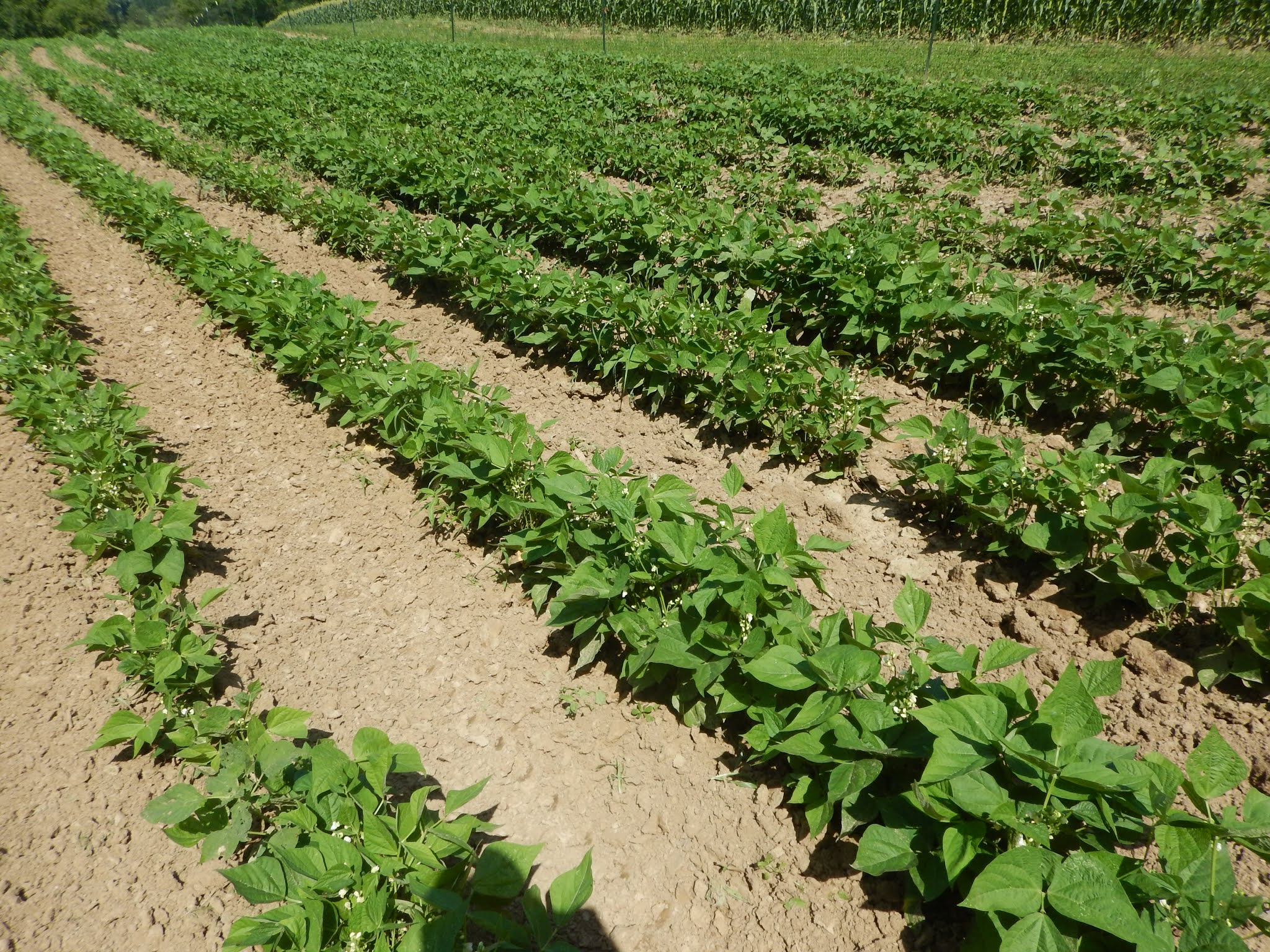
An upcoming crop of green beans,
nicely cultivated and setting on blossoms!
That’s enough about weeds though, lets look at some crops! Our first two crops of beans have yielded very nicely and after this week we still have three more crops coming up. They are all looking good and we’re hopeful we’ll be able to keep the bags of beans coming your way! We also have three crops of edamame coming up. The deer population in our area is fully informed that we grow edamame, so we have to be proactive and make sure we keep these crops surrounded by a tall deer fence to keep them from eating the plants! So far, so good and we hope to deliver the sweet, tasty fresh edamame in the near future.

An early crop of sweet corn, notice the small ears of corn.
Summer isn’t summer without sweet corn! While sweet corn isn’t a big money maker for our farm, I’ve always said it’s a crop worth growing because it earns us friends! Every year we have the goal of growing “the best sweet corn ever!” We’ve had many successful years doing so and hope we can pull it off again this year! We have planted five crops and they’re looking pretty good! The first crop suffered some loss from red-winged blackbirds that dug up about 50% of the seed. The remaining crops fared much better, but we still need to be diligent about keeping the critters out of the field! If the raccoons, deer and birds get a taste of the sweet ears of corn, they can really do some damage. These fields are also fenced and we’ll be monitoring them very closely as the corn matures and reaches the point of harvest. We’re also monitoring for the corn earworm moth which migrates from the south. With the reduced bat populations we have a larger challenge to produce sweet corn without these worms. The researchers and experts say it can’t be done organically, but with careful monitoring and a high level of management we have pulled it off many times before! So, we know it can be done and we’re going to do our best. Please know this is quite challenging to achieve, so if you do find a worm, please be forgiving.

The beloved SunOrange tomatoes--so sweet they're like candy!


The cutest little watermelon!
Tomatoes are another beloved summer crop we know you are all looking forward to. We actually had our first sweet taste of SunOrange tomatoes this week! I only found enough to pick a small handful and between Andrea and Amy, they didn’t last long. We have two crops of tomatoes planted, mulched, staked and tied and looking great! The first crop has a lot of fruit set on and we’re hoping we can start picking some of the early varieties within the next few weeks. The eggplant field is also looking quite nice. The plants have blossoms and the start of some small fruit setting on. Things could happen fast at this point, so we anticipate we’ll start harvesting eggplant within the next few weeks.

Our melons and watermelons are not far from the eggplant field, so it seems fitting to report their status now as well! After a few low yielding, disappointing years, this year’s melon and watermelon fields are looking good and setting fruit.  We’re keeping our fingers crossed that this continues and we’ll all be eating some of those “juice dripping down my chin” melons very soon! Lastly, I want to mention the peppers. We’re finally starting to see some fruit set on. The ½-inch jalapenos are quite cute and we’re hoping some of the other varieties will be ready to pick very soon.

While we’re in the midst of summer, we’re already looking to fall crops! The sweet potato vines are spreading nicely and the winter squash fields look great! On our field tour last Sunday we even spotted a nice-sized festival squash! It will be awhile before it’s mature and ready to harvest, but seeing that fruit made us realize how quickly this year is going! We’ve also started planting our fall root crops and within the next couple of weeks we need to plant beauty heart radishes, black Spanish radishes, daikon, turnips, etc.

A view of the sweet potato (left) and winter squash (right)
fields with blue skies overhead!
We also have to look ahead to the next growing season. We are already selecting and reserving fields for a new crop of strawberries knowing we need to plant a new field in 2021. We are also in the midst of garlic harvest which means we’re selecting and saving garlic for next year’s crop. We have had an unexpected increase in CSA members this year, more than double from last year. We welcome this increase and are hope you will all join us again next year as well! CSA is our preferred market to grow for and benefits our farm in many ways. We’ll see what the next year holds. Later in the fall we will be asking you to commit to the 2021 growing season so we may better plan for next year. We hope you will end this season with an increased appreciation for local and high quality organic produce along with a desire to make a commitment for next year. But for now, enjoy the rest of the season!

Wednesday, July 1, 2020

Reflections of a South Dakota Farm Boy….Lifting the Veil of Ignorance On Racism

By Richard de Wilde
Richard's high school senior year photo...
before he became a hippie!
I grew up in a remote South Dakota community that was all white, immigrant family descendants.  There was no racism evident to me at the time, but then why would there be when everyone around me looked the same.  There were, however, plenty of “judgments” made by my father.  For example, “if you work hard and work smart, anyone can succeed in America.   If people are poor, it is because they are lazy.”  Also, in retrospect I wonder about the “Indians” from the Sisseton Reservation?  My father had a contact there and would make the one hour drive to the reservation on Monday to pick-up four or five guys to pick rock on our farm.  They stayed at our farm for the week and slept in the barn.  I am sure my mother fed them and Dad would return them to the “Res” on Friday or Saturday.  He would always tell us they would not be available to work again for at least a week, “until they drank up their week’s pay!”  I didn’t think much about it at the time, but in retrospect I understand my father’s attitude towards these people was such that they were a lesser group of people compared to us.  Prejudice?  Racism?  Only later, after I spent some time with a group of Native Americans in the Badlands of South Dakota during college, did I realize these “Indians” were wonderful people and I shared their love and connection with nature and “Mother Earth.”
I didn’t come face-to-face with full blown racism and discrimination until I spent the summer between my junior and senior year in college working in a coal mine in Bluefield, on the border of West Virginia and Virginia.  I was studying mining engineering and that summer I was assigned to a small electrical crew at the mine.  We traveled the underground passageways through the mines on a low electric “scooter” powered by a pole riding on an electric cable near the ceiling.  As I was the youngest and newest man on the crew, I was designated “Pole Man.”  The spring-loaded pole would frequently bounce off the wire and hit the ceiling.  As “Pole Man,” I would quickly and gracefully put the pole back on the electric wire in a matter of seconds.  One day I was in the scooter with several other guys including our crew leader and a black co-worker everyone called “Boots.”  Our scooter pole jumped off the cable and we were stalled.  Tiny flakes of shale started raining down on us.  In a matter of just a few seconds I saw Boots jump out of the scooter and run back in the direction we had come from.  I looked at the crew leader as he jammed his hand down putting the scooter on full throttle while looking at me with a look in his eyes that immediately told me I needed to get the pole back on the wire.  I did, and with the lightening speed and pride of a Midwest farm boy.  The scooter shot forward as the pole connected and just behind us a foot thick slab of shale roof fell onto the tracks we had just vacated.  Boots was on the other side of the roof fall, safe from the falling debris and thankfully, no one was hurt that day.  The next day we returned to this spot to clear the debris from the tracks.  My brother, Dennis, was also a mining engineering student and was working in the same mine that summer.  The white foreman looked at us, and with an air of contempt in his voice, said “What do you kids want?  Blood?”  This was the same time in history as the Kent State protests against the Vietnam War when protesters had just been shot by National Guard troops.  I had started to grow a beard and my hair was probably one inch over my ears.  The foreman looked at me and thought I was one of the “hippies” protesting the war.  When questioned about my appearance, I told them it was a college senior tradition.  This foreman informed me that he thought I might be OK, “but if he thought I was one of those X!#*!X damn hippies, I just might have myself an ‘accident’ and would not leave the mine alive.”  He went on to explain that there was a new young engineer on the mine staff and it was clear he despised this young, inexperienced “kid” telling him what to do.  Periodically the engineer would go down in the mine in an elevator to inspect the tunnels, etc.  During the winter ice sometimes formed at the top of the elevator shaft.  The foreman described his plan to cause a chunk of ice to fall on the elevator, which it was clear to me could be a fatal accident.  Well, this was quite a shocking revelation for this Midwest farm boy!  I had no idea a difference of opinions and points of view could cut so deep as to motivate someone to harm another person, let alone to create an “accident” that could cause fatal harm to another human.  I had never seen such hate before!
On my last day of work for that summer, I was sent to the bottom of the mine to shovel wet coal that had fallen off the conveyor belt.  My sole companion on that job was Boots.  We shoveled wet coal for a time and then Boots suggested we take a break.  We sat down and turned our headlamps off.  It was so dark that even two hours later you could not see your hand in front of your face!  Boots explained to me that this clean-up job was only done once per year and it was the worst job in the mine.  He was there because he was a black man who sometimes “spoke up.”  He told me I was there because I was suspected of being a hippie.  You know, if he hadn’t told me that I don’t think I ever would have realized that either of us were the subject of discrimination.  We spent the rest of that shift sitting and talking, becoming friends.  Boots pointed out that of all the black miners at the mine, not one held any position of leadership as a foreman.  I hadn’t thought about it, but it was true.  Boots also told me he felt very bad about the earlier “roof fall” event when he had seen the shale flakes, knew it was a sign that meant a roof fall was coming, and chose to save his own life knowing I did not know what was coming.  My quick action on the pole saved the scooter, my life and the lives of others with me that day, but it could’ve also been a fatal accident that may have killed us.  Boots felt really bad about what happened. 
In the ensuing hours sitting in total darkness, I came to feel that this was the first “older man” that I could totally respect.  The way he talked about his family, his children made me wish I could have had a warm, loving father like him.  Before I left to go back to school, Boots invited me to visit his family.  So I drove my ’55 Chevy Coup to his little town near Tazewell, Virginia.  I was greeted by a dozen barefoot children who obviously knew I was coming and they took me to Boots’ house, or maybe you would call it a shack.  It wasn’t much, but everyone was super warm and friendly and then the truth was told that I was the first “white boy” anyone could remember ever visiting their town.  Hmm, a separate town for blacks only?
While living in West Virginia that summer, my experiences in the mine were not the only life changing events that I experienced.  One night that summer my brother Dennis and I went to a disco club.  We were standing outside the entrance when three college-aged women approached.  Two of the women were white, one was black.  Dennis and I thought all three were attractive and seemed intelligent, so we couldn’t understand why they were denied entry and told it was because they didn’t have a “membership card.”  No one had asked us for a membership card when we entered.  I watched this happen and didn’t understand what was going on, so I approached the women as they were walking away and asked them what just happened.  They explained that they knew they would be denied entry because their friend was black!  What?!  Dennis and I decided to forego the disco club and hung out with these three girls instead.  We became friends over the course of the summer and never chose to return to “the private club.”  Dennis later married one of the girls, Carol Sue.  Needless to say, after that summer both of us declined good paying jobs in the underground coal industry.  I took a job with the Bureau of Mines at Fort Snelling, Minnesota and befriended the only black man on the staff there.  However, my tenure there was brief and I was soon looking for “more meaningful work.” 
I moved to a farm in Eagan, Minnesota and volunteered at the neighboring Dakota County Developmental Learning Center, a school for “special” children.  I came to learn that these children were in fact very special.  What these children lacked in intellect was more than made up for in their extreme loving nature.  The staff at that school were equally loving.  The school day was hard work, but fun and after the children left for the day, the staff stayed on to socialize and party!  This was a work environment like none I had ever known!  This was also the first time I had ever met gay people, who at that time were often considered outcasts.  As I got to know the staff members, some of which were gay, I realized they were all wonderful, accepting human beings.  Yet another stereo type to throw out the window! 
Ronnie, one of Richard's foster kids, playing in the bean field.
After working in special education for several years, including working with autistic children, I turned to farming with teenagers in foster care.  After multiple frustrations with the system returning them to abusive homes, when “my boys” turned 18 they were on their own, I left social work and turned to farming full-time. 
As a vegetable farmer in need of much manual labor, I have experienced a wide variety of people over the course of my career. High school and college kids on summer break do not work well for our longer season, so we have utilized Vernon County jail inmates on Huber program (day time work release), Laotian Hmong, workers from Mexico, both local year round residents and H2A visa seasonal workers.  This has given me a unique chance to experience several cultures, work with many individual personalities, and get to know many wonderful human beings.
An early crew picture from Richard's first farm,
Blue Gentian Farm in St. Paul, MN.
I feel blessed to have been exposed to a variety of people that have changed my narrow “Midwest farm Boy” perspective to a more worldwide view.  That is all human beings, worldwide, rich or poor, any color of skin, have certain unalienable rights such as being given basic respect as human beings, the right to healthy food, clean water, shelter, freedom from abuse, economic security, medical care and a safe environment free from chemical contaminants, corporate greed and monopolies.  The hatred, the racism, greed and militarism that has caused so much harm worldwide needs to be “reined in,” voted out.  Ok, it’s true I was and still am a “peace & love” hippie and proud of it!
We need a huge change in focus and redistribution of resources.  I still believe that if we all work together we can still save our planet, our human race and all the divine life that we depend on.  This pandemic and the events of this year have brought many long standing issues to the forefront.  Lets not just wish to get back to normal, but work to create stable, sustainable local food systems and just economies and communities.  This is a huge, but achievable, task if we all take the time to examine our own prejudices and misconceptions of others.  Change can happen when we do our best to show kindness and respect to our fellow human beings.  It is contagious and good things happen.  We change the world.

Wednesday, May 6, 2020

Welcome to the 2020 Harmony Valley Farm CSA Season!


By Andrea Yoder

Welcome to the 2020 CSA Season!  We are happy to be kicking off another year of seasonal eating and are grateful for the opportunity to grow food for you and your family this year.  We have a lot of new members joining our farm for the first time this year. We also have many members who are completely new to CSA.  So before we go any further we want to introduce ourselves to you along with some of the things you can expect, places to go for resources, etc.

Richard de Wilde, HVF Founding Farmer
I am Andrea Yoder.  I have been at Harmony Valley Farm (HVF) since 2007 and am one of the co-owners.  I am both a professional chef and a farmer and fill a variety of roles on the farm.  You can read more about me in this article published on our blog in 2019.  Richard de Wilde is our farm founder and has been growing organic vegetables since the early 70’s.  He’s considered by many to be a pioneer of organic farming in the Midwest.  You can read more about Richard in this article we published on our blog last year.  Richard’s vision is that Harmony Valley Farm will continue to be a leader in organic farming in the Midwest well into the future.  In order to fulfill that vision, Richard restructured the farm into an LLC over ten years ago to create a structure for farm succession and to provide opportunity for longtime employees to become farm owners.  Last year he invited Rafael Morales Peralta to become an owner as well.  Rafael will be sharing his story in a few weeks so you can get to know more about him and his role on our farm.

Cover photo of our 2020-21 CSA Calendar
Vegetable farming is very labor intensive and we could not do what we do without our hardworking crew members.  During the peak of our season we employ about 50 people.  While we may not meet the common definition of a family farm, we believe that in many ways we are a “Family Farm.”  When you work closely with the same individuals day after day, year after year, you really have an opportunity to get to know them quite well!  Many of our crew members have been working with us 10-15 years or more!  They are a great group of people with a wide range of skills, talents and unique personalities.  Every year we create a “CSA Calendar & Resource Guide” for our members.  The theme of this year’s calendar is “The Faces of Harmony Valley Farm.”  This week everyone will receive a calendar in your box and we’ll have them at our pickup sites in the weeks to come.  Please take a little time to review this calendar as it will help you get to know our farm a little better AND it’s packed full of useful information that will help to guide you through the season.

The Nash Family on their annual visit to the farm!
When you signed up for CSA, you may not have fully realized what you were signing up for because CSA is more than just a box of vegetables.  For those who are joining our farm for the first time this year, we want to let you know you are in for an adventure!  You may have signed up for our CSA because you were looking for a safe way to get food in the midst of the pandemic.  You will definitely get a box of food with each delivery.  What you may not have realized is that you just embarked on an experience that has the potential to change your life and positively impact your future in ways you may never have imagined.  Many of our longtime CSA members are a testament to the positive impact participating in our CSA has had on their lives.  CSA has helped them achieve health and longevity and it’s contributed to raising many healthy, intelligent, beautiful children.  CSA is connection, both with the people and the place your food is grown.  With this connection comes transparency.  We are real people and you can actually talk to us, ask us questions, have dialog so you can learn more about how your food is being grown.  Of course our primary goal is to provide you with the highest quality, most nutritious vegetables we can grow.  Our health is our greatest asset and so we take this job very seriously.  Of course in order to reap the benefits of nutrition, you have to eat the vegetables!  So, we also feel it is very important that we provide you with resources and support to help you make the most out of your purchase!  Every week we share information including recipes, storage information and farm updates with you in our weekly emails, blog posts, newsletters and on social media.  We’re here to help you have the best experience possible!

Picture of box contents from September 2019
We try to balance the contents of our boxes over the course of the season, providing a strong base of “staple” vegetables along with some more unusual vegetable to push you outside your comfort zone where you can be exposed to items you may not be familiar with.  Seasonal eating also means yielding to Mother Nature.  The season and weather patterns directly impact what is available throughout the season.  This means we have to adjust our eating, meal planning and recipes to match what’s available.  Sometimes this means we need to make substitutions in recipes or wait to make a recipe until the ingredients are in season.  We encourage you to use your resources each week to learn more about the vegetables in your box as well as how to use and prepare them.  Don’t get overwhelmed.  Yes, you may have a learning curve and a period of adjustment.  Many members tell us it takes three full years of CSA to fully make the transition to “Eating out of the box.”  Yes, from time to time something may get pushed to the back of the refrigerator and go to waste.  Compost it, return it to the earth and move on with the goal of making improvements each week so you can fully utilize your box contents.  Along the way I’ll try to give you quick and easy tips for streamlining food prep.  If you invest a little time each week washing and prepping your vegetables, meal prep can be quick and easy and eventually you’ll switch into autopilot.

HVF co-owner Rafael Morales Peralta
helping children dig carrots at our 2019 Harvest Party
At some point once this pandemic has moved on, we will once again open our farm to you as well!  We invite you to come and visit so we can show you our farm and you can spend some time in nature!  You see, this is part of the whole CSA experience.  CSA is not just food for your body, but also food for your soul.  Connections to people and places will help expand the meaning of sourcing vegetables beyond a purchasing transaction and this is where your food will take on a greater level of meaning.

We’ve always believed the CSA model has some inherent qualities that have allowed it to stand the test of time and, in a time of uncertainty in our world where other parts of the food system are struggling, CSA is something we can all turn back to.  We focus a lot on the agriculture, or food, aspect of CSA, but I think it’s important we don’t forget how important the “C” for community is as well.  So, welcome to our community.  We’re happy you’re here and we hope you enjoy your experience with us this year!

Thursday, April 30, 2020

April Farm Update


By Richard de Wilde & Andrea Yoder

Strawberry plants poking through the straw mulch.
Before the month of April slips away, we want to fill you in on what’s been happening in our quiet valley!  The past month has been a bit of a whirlwind with CSA orders coming in by the piles, more crew members joining us, the start of field work, and in the midst of it all we continue to navigate the pandemic.  So here’s a little insight into our world.

In the first few days of April we uncovered a nice field of overwintered spinach, which had been under a big field cover for the winter.  We also removed the cover on the garlic field and just recently, the strawberries as well.  After the covers came off we had to walk the garlic and strawberry fields with pitchforks to tease and loosen the straw mulch where it was compacted in some places.  This made it easier for the plants to push through.  We’re happy to report that it looks like we had a very good survival rate over the winter!  In fact, we’ll likely start harvesting green garlic as early as next week!

Transplanting onions!
Our first actual day doing field work was April 8.  With only our small winter crew, we prepared 2 acres of plastic covered raised beds to plant onions and shallots into.  We like to lay the reflective silver plastic mulch about two weeks in advance of planting so opportunistic weeds that might sprout will be smothered by the plastic before we poke holes in it for the plants.  Despite a bit of inexperience, they did a very nice job!  The field looks great with straight beds covered tightly on the sides and on the ends.  A critical detail that keeps the plastic anchored when we have high winds.

While we continued to do greenhouse plantings, accept CSA orders, and do the initial field work to prepare for the season, we also waited with uncertainty to find out if our experienced, skillful seasonal field crew would be granted visas and be allowed to travel from Mexico.  Thankfully, in the evening of April 8 we got the good news that 31 healthy individuals were en route to Wisconsin!  We all breathed a huge sigh of relief knowing they’d be joining us soon, for without them farming this season would have been an even bigger challenge.  We were so happy to see them, although we haven’t actually seen most of their faces as they arrived with face masks and have them on nearly all the time they are at work!  We have learned that you can tell a person is smiling by looking at their eyes, and we’ve also noticed the familial resemblance many of our crew members have to their uncles, nephews, etc.  If you put a mask on Antonio Cervantes he can easily be mistaken for his nephew, Jose Manuel.  They have the exact same eye features!

Planting a new field of asparagus!
While we were thrilled to greet these guys, we also knew we had to be prepared for a higher level of management in order to navigate the necessary precautions related to the pandemic.  The last few weeks have been filled with new procedures and practices on the farm along with extensive training (with a professional Spanish interpreter) in an effort to maintain a safe working environment.  We now have three groups of crew members that each have their own lunch area, designated bathrooms, and guidelines for which buildings on the farm they are permitted to enter.  We all continue to limit our movement in the community and are doing our best to do what we can remotely, electronically and with as little contact with the outside world as possible!  We actually started communications with our crew members several weeks before they ever left their homes in Mexico.  We let them know what was happening in the USA and advised them to self-isolate as much as possible, practice social distancing, and do everything they could to keep themselves in good health.  They did a great job and took preventative measures all along the way.  They all arrived totally healthy, not even a single cold!  Now our goal is to continue to be diligent about maintaining preventative practices so we can all remain in good health!

Now that our crew is back in action we’ve been making great strides in getting things done in the fields.  We did the first planting of radishes, salad mix, cilantro, arugula, etc on April 18.  Some of these plants were emerging, so we went ahead and did a second planting last Saturday.  We need to get more direct seeded crops planted, but it takes time to prepare the fields with applications of compost, minerals, trace elements, etc.  Today we're planting peas and parsnips.  Before the week is finished we hope to complete plantings of beets, carrots, burdock, chard and then, shortly after, sweet corn and green beans.

Field of freshly transplanted dandelion plants
enclosed by a deer fence.
The greenhouses, which just 2 short weeks ago were nearing capacity, are gradually looking more empty.  Onions were the first crop to go to the field and after three days of transplanting they were finally all in the ground.  The transplanting crew immediately moved on to broccoli, cauliflower, kohlrabi and cabbage followed by dandelion which is one of our major wholesale crops.  The deer seem to enjoy a nice field of tender dandelion plants, so we immediately put up a fence to keep them out.  Our first parsley field is planted and all 30,000 celeriac are standing up like rows of soldiers in the field.  We started off this week by loading fennel plants.  Despite some breakthrough rain showers in the morning, the crew was able to continue planting and when the sun came out in the afternoon they moved on to our first planting of kale and collards!

We have already started some of our warmer weather crops in the greenhouse.  The pepper seedlings look beautiful.  The zucchini and first planting of tomatoes pushed through the soil over the weekend and we planted watermelons earlier this week!  We’ll keep these plants snug and warm in the greenhouse for a few more weeks until we make sure the threat of frost has past us.

Nettles, Sorrel, and Chives happily growing in the field.
In between field and greenhouse work, we continue to wash and pack vegetables.  Overwintered parsnips and sunchokes along with spinach, ramps and burdock root are part of our weekly line-up.  We’re in week two of ramp harvest and crossing our fingers that Mother Nature will bless us with at least two more weeks if not three!  It all depends on the weather, but we must admit the weather has been more cooperative thus far than in some recent springs.  The jet stream seems to have moved north, so cooler air with less moisture.  Maybe this is the bright side of the pandemic?  Reduced economic activity has greatly reduced pollution and carbon emissions.  Maybe nature will give us an immediate reward of nice weather.  We can hope!

Our CSA sign-ups are up about 20% over last year and we have a lot of new members joining us for this season!  We are at about 70% capacity for the season and we are still accepting orders.  Kelly, Gwen and Amy are doing their best to get orders processed and welcome packets distributed before the start of deliveries next week!  We normally spread our order processing work out over several months, but with the state of the world orders have been compressed into just a few weeks!  We’re doing our best to get them processed as quickly as possible, but appreciate your patience.  We started sending Welcome Packets out last week and will continue to send them as we process your order.  Please, Please, Please take the time to read the important information contained in these packets.  The “C” in CSA (Community Supported Agriculture) is very important this year in order for everyone to have a positive, safe pick-up experience.  We’re looking forward to the start of a new CSA season and we’re grateful for every member who has committed to join us on this journey this year!