Showing posts with label greenhouse. Show all posts

Thursday, January 26, 2023

It All Starts With A Single Seed!

By Andrea Yoder

New shipments of seeds for 2023! 
While spring may feel like it is a long ways off, we are only three short weeks away from initiating our first plantings in the greenhouse for our 2023 growing season!  January has been a busy month for us and one of our major tasks has been securing our seed supply for this year.  It doesn’t matter how many growing seasons I’ve been through, I still am in awe of how nature can take a small amount of seed that I can hold in the palm of my hand and turn it into thousands of pounds of food!  As farmers, we hold the utmost respect for the intelligence held within each seed.   Our job is to help each seed obtain its highest level of potential by providing for it and the plant it becomes as it grows and develops into the food we all need to nourish our bodies.  Every year we source seed for over 75 different crops and are able to produce tons of vegetables from our modest 100 tillable acres of land.  While we’re still compiling our production numbers from last year, I can tell you that we produced about 709 tons of produce in 2021!  That is a lot of food! Sourcing the seeds to produce this much food is no small task and usually takes us about two weeks to complete. We finalized our orders earlier this month and the seeds have already started to arrive.  So we thought we’d kick off this year by offering you a little insight into our process for managing our seed purchases and inventory along with some seed stats and a glimpse into some of our plans for the crops we’ll be growing this year!

As certified organic growers,
we do not plant any GMO seed.
We source our seeds from a variety of companies, but as organic growers we focus on those that offer either certified organic seed or untreated seed.  When available, we purchase certified organic seed and undergo a sometimes very extensive seed audit at our annual organic inspection. As we are ordering seeds we document our seed search to demonstrate that we’ve checked with at least three sources and have purchased organic seed as a priority.  We are also required to keep all of our seed tags and have a thorough record of where our seeds come from, when they are being planted, etc.  We maintain all that data in a seed database which comes in handy when our organic inspector hands us a list of 20 different seeds that he wants to review to ensure they meet the standards for organic production.  As organic producers, we never use seeds that are genetically modified or have any type of a chemical seed treatment.  Additionally, most of our suppliers stand behind “The Safe Seed Pledge,” a statement created by a coalition of seed companies that reads as follows:

“Agriculture and seeds provide the basis upon which our lives depend.  We must protect this foundation as a safe and genetically stable source for future generations.  For the benefit of all farmers, gardeners and consumers who want an alternative, we pledge that we do not knowingly buy or sell genetically engineered seeds or plants.  The mechanical transfer of genetic material outside of natural reproductive methods and between generations, families or kingdoms poses great biological risks, as well as economic, political and cultural threats.  We feel that genetically engineered varieties have been insufficiently tested prior to public release.  More research and testing is necessary to further assess the potential risks of genetically engineered seeds.  Further, we wish to support agricultural progress that leads to healthier soils, genetically diverse agricultural ecosystems and ultimately healthy people and communities.”

We purchase our seeds from four main companies along with a handful of other suppliers that offer some unique items and specialty crops.  We have been working with Seedway, Osborne Seeds, High Mowing Organic Seeds and Johnny’s Selected Seeds for many years.  They all have a strong reputation for distributing quality seed that is tested for disease and germination potential.  These are important factors for us as we are looking to source the highest quality seed for the best outcomes!  This month we purchased over $70,000 worth of seeds!  In addition to these purchases, we will plant some of the seed we already have in inventory from previous years.   If stored properly, many seeds will remain viable for several years.  In many cases we like to have a little extra seed on hand just in case something unexpected comes up and we need it in short order.  We also tend to buy a little extra seed for varieties that we highly value and for which there are not suitable substitutes.  From time to time a seed producer may have a crop failure and seed may not be available for 1-2 years.  If that happens, we are covered!

Sugar Ann snap peas have been a customer 
favorite for many years!
Over the years we have trialed a lot of different varieties and have come to know which varieties do best on our farm.  There are some varieties that we plant year after year because they produce a superior product.  Sweet corn is one of these crops. There are literally hundreds of varieties of sweet corn we could grow, but not all varieties will thrive in our region.  We are fortunate to be able to work with Phil Timm from Seedway.  He is our seed rep for the company and is very knowledgeable.  Over the years he has made some excellent recommendations for sweet corn varieties that will do best for us and he has hit the nail on the head with nearly every recommendation!  Every year we order our sweet corn seed early to make sure we can get our favorite varieties with names like “Fantastic” and “Awesome.”  Sugar Ann peas are another variety that are hard to beat and have proven to be a superior Sugar Snap Pea year after year.  We always make sure we order early as this variety has been sold out some years!  

2022 Cilantro Field
Before we make the final purchasing decision, we have to take some time to consider whether we want to duplicate our planting plans from the previous year or if we need or want to make changes.  Once we have an idea of what we want to accomplish, then we evaluate the varieties we’ve been planting.  This is also when we consider availability, take a look at any new varieties on the market and take into account any carryover inventory we may have available from the previous year.   Once we have all this information we can figure out how much seed we need to order.  Every crop is different and has to be figured individually.  For example, cilantro is one of our top three major crops and we plant it weekly starting in the spring for a total of 20-22 plantings per year.  In 2021 we planted 360 pounds of cilantro seed, which is quite a lot of seed.  This is the part of the equation that always amazes me as that 360 pounds of seed produced 53,000 pounds of cilantro!  Baby Bok Choi is another one of our top three crops.  Bok choi seed is very small and while we plant it weekly just like cilantro, we only planted 6.39 pounds of seed to produce 72,656 pounds of bok choi!  Is anyone else amazed by the multiplication potential here?!  
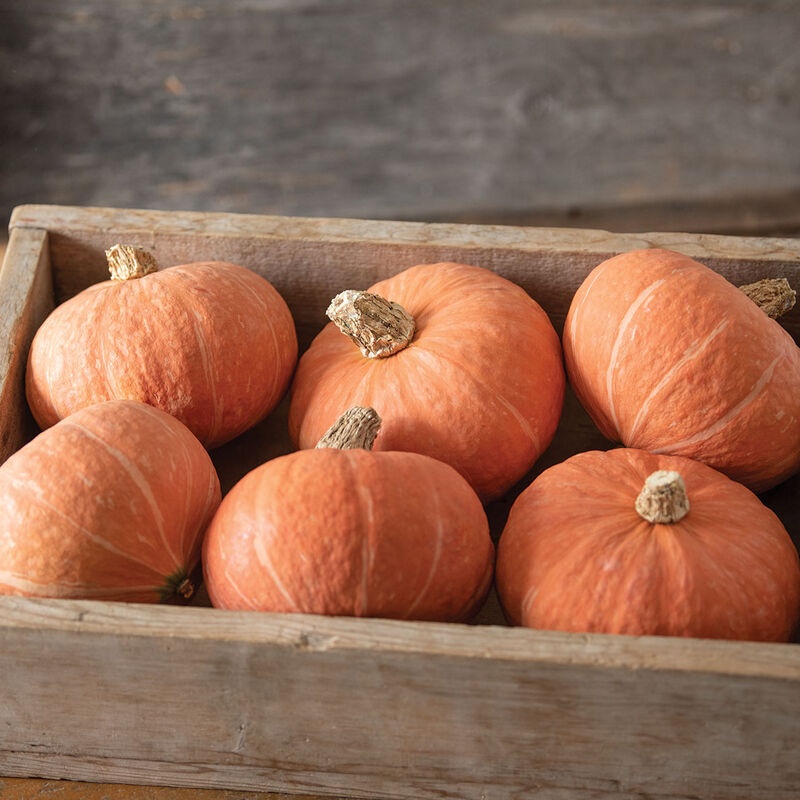
Marmalade Kabocha Squash 
(photo sourced from johnnyseeds.com)
Looking ahead to our upcoming growing season, we have a few fun things we’re planning to plant in addition to our staple items like carrots, broccoli, green beans, tomatoes, sweet corn, etc.  This year we’re planning to plant jicama and lemongrass which are on our list of crops we choose to plant once every few years.  If you have never had freshly harvested jicama, you are in for a treat!  We are also on the search to find a tasty kabocha squash to replace Sunshine, a variety we grew previously.  Sunshine had excellent flavor and sweetness, but it succumbed to disease in challenging growing conditions which subsequently impacted its shelf life.  The last few years we grew it we threw away such a large percentage that went bad and made it hard to justify growing them. This year we’re going to give “Marmalade” a try.  This is a small, coral-colored kabocha variety available from Johnny’s Seed.  They describe it as “….ideal for small family dinners and tucks nicely into CSA boxes….Vibrant color option for late fall, with improved storage life compared to Sunshine.”  Evidently we weren’t the only growers who experienced the shortened shelf life of Sunshine!  We are also trying a cute little green buttercup squash (similar to kabocha) called “Bon Bon.”  It’s described as being “Tasty, uniform and high-yielding,” and weighs in at 4-5 pounds which fits nicely in a CSA box!
Sugar Magnolia Peas
(photo sourced from osborneseed.com)

We are also planning to grow a few new purple vegetables.  We know some of you love purple colored vegetables more than others, but we know that the purple color comes from the presence of a powerful class of plant compounds called anthocyanins.  These compounds function as antioxidants in our bodies and provide a whole host of health benefits.  The first in this class that we hope to share with you is the Sugar Magnolia Pea.  This variety produces dark purple pods with bright green peas that are described as being “…sweet and delicious.  A real stunner!”  The plant for this pea does grow 6-7 feet tall, so we’ll have to trellis the plants to keep them off the ground and make them easier to pick.  We also ordered some “Purple Majesty” potato seed.  We have grown this variety at least one time in the past and our recollection is that it was not only a very tasty potato, but it held its color much better than most purple or blue varieties that turn gray when you cook them.  Lastly, we are trying a new purple sweet potato called “Purple Splendor.”  This looks to be a gorgeous potato with purple skin and dark purple flesh that is described as follows:  “Cooked flesh is on the dry side with notable sweetness.”  We’ve purchased purple sweet potatoes in the grocery store and loved the flavor and sweetness, but have not been able to find plants to grow them.  Hopefully we’ll see favorable outcomes with this variety this year!  
Artemis Cherry Tomatoes
(photo sourced from osborneseeds.com)

Our tomato and pepper line-ups are pretty solid and consistent, but we do have a few new varieties to add to the mix this year.  While we usually focus on grape tomatoes and haven’t grown cherry tomatoes for many years, we were drawn to the “Artemis” cherry tomato from Osborne Seeds.  They are supposed to be bright red and are described as “….Supersweet red cherry consistently our favorite for flavor.”  Sounds like a winner! We are also trying the “Round of Hungary” pimento pepper.  We grew pimento peppers previously, but it’s been awhile.  This is a dark red pepper that has a flattened shape with ribs.  It’s a sweet pepper that is good for stuffing.   

We have our work cut out for us over the next few weeks leading up to our first greenhouse plantings.  We need to give our seed storage cooler its annual “top to bottom” cleaning before we put the new seeds into their storage location.  We will be washing and sterilizing our greenhouse flats, thawing the potting soil and need to take care of a few repair projects before we start preparing the nursery greenhouse.  If you’ve already signed up for your 2023 CSA shares, we thank you and are excited to have you on this year’s journey with us!  If you are yet to sign up for your 2023 CSA shares, I want to remind you to do so before February 28 so you can take advantage of our Early Bird Sign-Up Offer!  We have a great season of vegetables ahead of us and look forward to growing for you and your family this year!

Wednesday, June 6, 2018

June Farm Update


By:  Farmer Richard

It’s been 7 weeks since the last farm update we shared with you on April 19, written with a foot of snow on the ground!  In that update we reported that this year sets the record for the coldest and wettest spring in the forty plus years since I started farming!  Despite that crazy, wet, snowfall in late April, we were able to do our first spring planting on April 24 which is one full week later than any other year I’ve had farming.  The late start to the season would suggest that all of the crops would be later and heat loving crops like tomatoes, sweet corn and peppers would be equally late and have a short season, barely making it before the first fall frost!  Well folks, keep reading as I have some good news!!

Onions in the greenhouse
We had to plan our greenhouse transplants for a “normal” year.  We started planting in late February and actually had some really nice, sunny days in March.  We have new plastic on all the houses, so our early seeded crops took off nicely and even when the days became more cloudy, the crops continued to grow and were ready pretty much on schedule.  As soon as the skies cleared (and the snow melted away), we seized the few dry days we had to prepare ground, lay plastic (for some of our transplants like onions and tomatoes) and tried to keep our field plantings on schedule.  When greenhouse transplants are ready, they really need to get to the field!  However, just because you get a plant to the field it doesn’t mean it’s going to take off and grow, especially when it’s cold as it has been this spring.  


Antonio, Jose Luis & Carlos laying out hoops to cover zucchini
We decided to invest the time and energy into covering some crops with row covers to help trap heat and accelerate plant growth.  We cover some crops every year, but this year we had so many fields to cover that we had to fill an extra 1,000 sandbags and cut 1,000 new wire hoops to put over the beds to keep the covers from damaging the transplants under them.  Without the hoops we risk giving the plants cover abrasion and we need the sandbags to hold all the covers in place!  We couldn’t have covered all of these crops without our amazing crew!  When we had only a few dry days to plant and cover, they were asking “can we work late to finish?”  They repeatedly tell me, “if we don’t plant it and take care of it, we don’t have a crop to harvest!”  It’s important to get the big picture! 

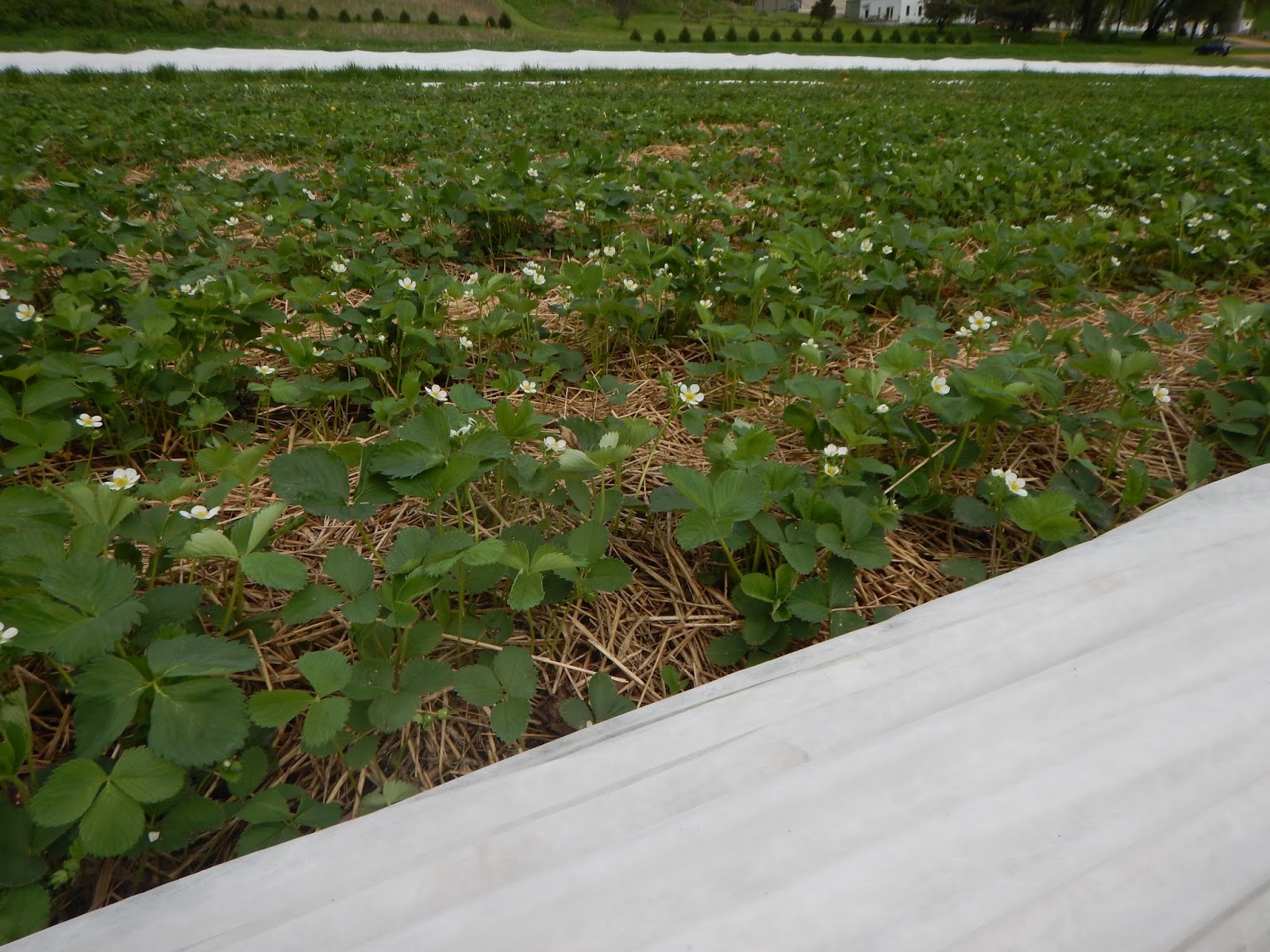
Strawberries right after the covers were taken off.
We are well aware that it is our crew’s dedication to getting the crops planted on time, covered for protection from cold and storms and willingness to work late some nights that has changed the picture from coldest/latest spring to bring us pretty much back on schedule!  Does anyone remember that heat wave we had at the end of May?  We went from cool growing weather to blazing hot!  Those covers we had on everything…..most of them had to come off because now we ran the risk of the crop getting too hot!  We had to uncover the zucchini, cucumbers, tomatoes, peppers and eggplant.  When we did, we were really happy to see beautiful plants that now appear to be growing at a normal rate!

Zucchini plants thriving after being uncovered!
Vicente and the irrigation crew members receive some acknowledgement here as well.  They have worked diligently to set up all the drip irrigation making it possible to give many of our new transplants a small drink of water mixed with fish and kelp fertilizer shortly after they were planted.  The combination of water and nutrients followed by a week of unseasonable, warm temperatures and we really saw some growth under those covers!  We are now ahead of schedule for zucchini, cucumber, melons, tomatoes, eggplants and peppers!! 

We have two crops of sweet corn and beans up and growing and one planting of edamame.  We lost about 25% of the first planting of corn to the Red Wing Black Birds.  Unfortunately they found that they could dig up the corn seed that was planted shallow because the soil was cold and we wanted the seeds closer to the surface so they would receive heat from the sun.  These were pretty determined birds that didn’t seem to mind the “scare eye” balloons and shiny streamers we put in the field to try to deter them.  They ignored our tactics and continued to dig up the seeds.  So our solution was to feed them organic corn on the edge of the field.  That actually did work as a decoy and and we still have 75% of the crop!  It’s hard to get upset with these birds, after all they have babies to feed and we’re always encouraging parents to feed their young ones more organic vegetables! 

Luis and Felix G mastering the new cultivator
If the weather cooperates we can still have a great year!  Right now we’re working really hard to battle the weeds.  Rafael has done a superb job of flaming crops to kill weeds just before a crop comes up.  Our local Cenex crew has been super cooperative in keeping our flamer filled and repaired.  A few gallons of propane used on the precise day saves hours and hours of weeding later!  The result of being diligent and staying on top of flaming is the main reason we have two beautiful crops of early carrots and five acres of parsnips, cilantro & dill!  Rafael has also done a lot of mechanical cultivating and has been instrumental in directing other cultivating crews.  Luis and Felix G have become masters at operating our new Kult/Cress German cultivator.  They’ve learned how to work together to use this machine to mechanically kill a lot of weeds! 

HVF crew hand weeding parsnips.
Andrea gets huge credit for keeping ahead of our frantic spring planting schedule.  Simon has also been a key player in helping us keep the greenhouse plantings on track and has helped with our “hot water” seed treatment for some seeds and biological seed treatments for others.  Andrea has also worked hard to maintain our seed inventory and provides planting plans for each crew every time they go out to plant.  Gwen is now learning the ropes of managing our records once a planting is done.  It’s super important that we have good, complete records both for our own use as well as for maintaining our ability to trace crops back. 

Our Strawberry Day event is coming up on June 17, and yes it looks like we’ll have strawberries!  We hope to see you at the party, or join us for the weekend and do some camping!  We have had a few CSA member visitors this spring and we welcome more.  If you’re interested in camping, we’d love to offer you a spot in one of our two campgrounds or reserve our cabins for your stay. 

Bee pollinating the strawberries
As I write this article on my back porch, I have marveled at the dozens of hummingbirds and the many bumblebees that I see coming to visit the columbine flowers in our yard.  Our strawberries are being pollinated by small bees I collectively call “sweat bees.” As the light dims and the day turns to night, I am in awe of the whippoorwills singing to me.  After a five year absence when we didn’t hear them in our valley, we’re very thankful that they’ve returned!  Every night we listen as they sing us to sleep and every morning they wake us up like an alarm clock, right outside our window.  Despite a challenging spring, life is good!

Thursday, April 19, 2018

April Farm Update


View after the April 18th snowfall and new 
crew members below that we hope 
won't be staying around too long!

Well friends, if we had to choose one word to describe April it would be “Challenging!”  Over the course of the past forty years of farming, we are typically able to start field work and planting late March or the first of April.  Sometimes the weather is still cool and things grow slowly, but at least we can start marking things off the planting list.  Historically, April 18 was the latest date we started field work which means we’ve set a new record this year for the latest spring!  Here we are on April 19 with nearly a foot of snow (although it looks like it could melt fast)!  Back in March it looked like we were going to have an early spring and we pushed hard to secure appointments with the consulate in Mexico so our crew members could get their visas and return to Mexico by the first of April.  We are thankful to have 29 of our crew members back at the farm.  They are ready and willing to work and have helped us get caught up on our greenhouse work as well as tackle some big cleaning and repair projects.  Unfortunately, they’ve had to take some days off as there are limits to what we can do on days when it’s snowing, raining or just too muddy and cold to do what needs to be done in the field.  They’ve been advised to rest and take advantage of the down time as we have some long days of work ahead of us as soon as this snow melts!  In those years when we were able to start our field work earlier, it didn’t necessarily mean crops were ready much earlier.  As mentioned, things grow more slowly in the cool of the spring than they do when they are planted later when the day and night temperatures are higher.  It is helpful though when we can get things in the ground, even if they grow slowly, as it spreads out our workload.  Now we’re facing some long days and the time crunch to get it all done!

Head lettuce transplants in greenhouse
While we enjoyed some gorgeous sunny days and warmer temperatures in March, April has definitely proven itself to be wet and cold.  Last week we had 2.75 inches of hard rain accompanied by hail.  That was followed by about 8 inches of wet, heavy snow over the weekend.  Much of the snow had melted away, but now our valley is once again blanketed in white.  We know, all too well, that sometimes Mother Nature trumps us despite our best efforts to overcome weather challenges such as these.  There isn’t much we can do aside from being prepared to hit the ground running and put forth our best effort as soon as the snow melts away and we can get into the fields.  We’re preparing machinery, getting seeds ready and making sure everyone is ready to go when the conditions are favorable.  With a few warm, sunny days, the picture could change and we just might get a window of opportunity.


Herb Packs 
Our greenhouses are nearly full and the plants look really good right now.  The onions and our first plantings of broccoli, cauliflower, kohlrabi, cabbage, kale and collards are residing in our cold frame greenhouse where they enjoy breezy days and chilly nights with temperatures dipping down into the 40’s.  Our goal is to keep them on the cool side to toughen them up and keep them growing at a moderate rate so they develop into strong, sturdy plants.  The peppers and celeriac plants were transplanted into larger cell trays last week and they look very good.  Earlier this week Leonardo, Lupe, Miguel, Pepe and Leon spent a sunny day in the greenhouse planting herb packs for you!  We are planning to deliver them in mid to late May so you can plant them in your own garden space or put them in pots on your patio and enjoy fresh herbs throughout the season.  Our pollinator packs are also looking really good!
Celeriac seedlings in the greenhouse


We were scheduled to plant zucchini this week, but we’re planning to delay that planting a week or so.  Zucchini grows very fast and when it’s ready it needs to go to the field.  We are hoping to transplant some head lettuce into our tunnel greenhouse next week, if the weather is a bit more favorable.  The goal is that we would have mini romaine head lettuce by late May, a few weeks ahead of lettuce that will be transplanted into the field.
Perky pepper transplants

French Breakfast Radishes
CSA deliveries start in just two more weeks.  What does all this snow mean for the start of our CSA deliveries?  Good question.  The early boxes may be limited in variety, but we’re hoping to fill them with delicious overwintered spinach, parsnips, sunchokes and ramps!  If you’ve been with us in previous CSA seasons you know that we often struggle to have overwintered spinach and ramps in our early CSA boxes.  Sometimes these crops come in early in April and are nearly done by the start of CSA.  We’ve even had years when we aren’t able to include ramps in May boxes.  Perhaps the silver lining in this year’s late spring will be that we get to enjoy the luxury of more ramps and overwintered spinach in our early boxes!  That’s not such a bad tradeoff!   Yes, the early boxes might be more limited, but we do have our perennial crops to rely on until we can start harvesting spring planted crops such as radishes, salad mix, bok choi, etc.  Some of those perennial crops include asparagus, sorrel, chives and nettles.  We will also have green onions that were planted last fall to round out the selections until the green garlic and spring scallions are ready.  This is the adventure of eating and cooking with the seasons.
Chives


This week we welcomed a new crew member to our team.  Gwen has joined us in the office to help Kelly and Andrea with a wide variety of tasks.  We’re very happy to have her on our team and look forward to teaching her the ins and outs of managing the many details of a vegetable farm!  On April 30 we anticipate our final eleven crew members will arrive for their first day of work.  We’ll be welcoming four new crew members to our team this year and are anxious to meet them. 

Our CSA numbers are still down and we still have plenty of shares available.  If you haven’t sent in your order yet, please do so soon!  We appreciate the referrals we’ve received and ask that you continue to share your CSA experience with your friends, neighbors and co-workers.  We’re looking forward to getting this growing season underway and thank you for your continued support of our farm! 

Wednesday, September 20, 2017

Fall is Here!


We started harvesting sunchokes earlier this week
This Friday marks the official transition from summer to fall and on Sunday, September 24th, we’ll celebrate this year’s harvests with our annual Harvest Party shin-dig.  We’ve been talking about this seasonal transition now for several weeks as things have started to change in our fields.  This week however we are feeling it more than ever.  We’re harvesting purple top and sweet scarlet turnips, sunchokes, daikon radish, fall carrots and we will be packing Soup Mix before the week is finished!  The leaves are starting to change colors, hickory nuts are dropping to the ground, and we know it’s just a matter of time before we get our first chilly, frosty night.  We hope you are planning to attend the party this weekend so you can see our valley and fall crops for yourself!

Honeynut butternut squash curing in the greenhouse
A lot has been happening in our fields over the past few weeks, so we wanted to catch you up on our activities with a field report.  We said goodbye to watermelons, melons, zucchini and cucumbers over the past few weeks, but there were more crops entering the stage as these summer favorites dwindled.  We are nearly done with winter squash harvest.  We have harvested and cured most of our winter squash and will go back to harvest the last few loads remaining in the field before the end of the week.  We’re planning to start packing winter squash in your boxes possibly as early as next week.

Our first planting of tomatoes is nearly finished, but the second planting still looks pretty good and continues to produce.  We have been having pretty cool days and nights, so the tomatoes have been ripening slowly.  We’ll keep picking right up until the first frost.  We’ve also been hitting our pepper field pretty hard with harvests.  There isn’t a whole lot remaining at this point.  Our orange Ukraine plants are pretty much done.  They produced a lot for us, but there isn’t much remaining on them.  The Orange Italian Frying peppers are still producing and we’ll be able to pick for this week and next, but I’m not sure how much will remain beyond that.  We’re planning to deliver mini-sweet peppers in next week’s box, but these plants don’t have a lot of fruit remaining on them. 
Celeriac with green tops freshly washed!

This week’s featured vegetable, celeriac, comes to you with its green top still on.  This is another sign of the transition point in the season.  While we’re still harvesting them as green top, we’ve already started to mechanically harvest these roots for storage.  They’ll all need to be harvested within the next few weeks as they will not tolerate more than a touch of a frost.  This marks our transition in cooking as well.  Soon we’ll all be enjoying more root-focused soups, stews and braised dishes to warm us up on the cold days. 

 Scarlet & Purple Top Turnips harvested last Saturday
There are some vegetables that make their appearance in the spring and then return in the fall.  Fall is a special time in many ways for some of these crops as the cool fall days and nights help to intensify the colors of vegetables and the flavors of some things mellow out and are sweeter.  We’re harvesting a beautiful crop of fall fennel right now and just started harvesting our fall crop of baby white turnips.  Next week we’ll be resuming baby spinach and salad mix harvest.  The color on these crops is always very impressive this time of year.  The green colors of spinach are more intense and the red lettuces are stunningly gorgeous! 

At the farmers’ market we’ve already been getting inquiries of “When will Brussels sprouts be ready?” Well, they are making sprouts and looking pretty good, but this is one of the brassica crops that benefits from a few frosty nights before harvesting.  All brassicas undergo changes in flavor in cold weather.  Their flavor becomes more sweet and well-balanced.  So the best estimate I can give you for when we’ll harvest them is after it frosts.  We also have our eye on the sweet potatoes and will be harvesting those before too long.  We’ll have to do a sample dig at the party this weekend to check the progress in growth and gauge just how much longer it will be before we’re ready to pull the trigger and do the big harvest! 

Jicama, sweet potatoes, squash and more coming soon!

Newly planted escarole and radicchio plants
Next week we’ll be delivering jicama in the boxes.  It’s in the process of being cured right now to set the tender skins.  This year’s crop looks pretty good!  We’re still learning how to grow jicama but I think we’re making progress!  We did harvest some that don’t look so pretty.  If you come to the party on Saturday, we’ll share those with you.  They don’t look good but they are still good to eat!  We also have a crop of tat soi slated for a late season harvest and we’re trying a new growing method for some late season chicories.  This week Scott, Simon and Jose Antonio finished planting escarole and radicchio transplants in our cold frame greenhouse.  We did a pretty good job of growing head lettuce in the cold frame greenhouse this spring and delivered it in the May boxes.  We’ve never grown escarole and radicchio in a greenhouse, but thought we’d give it a try and hopefully they’ll be ready for some of the last boxes of the season in November and December.  They are more cold hardy greens that can take cold weather and frosty nights and their flavor actually improves in cold weather.  In the field they can sometimes get damaged when the nights get really cold, so we’re hoping the more protected environment of the greenhouse will allow us to get the benefit of the cold weather but gain the protection from deep frosts.  Wish us luck!

In addition to harvesting crops,  we’ve also managed to stay on top of planting cover crops.  As we finish harvesting a field, we move right into preparing it for  winter and includes establishing a cover crop.  Did you read last week’s newsletter regarding the importance of regenerative farming methods related to mitigating climate change?  Well, we’re trying to do our part by getting cover crops on bare ground so they can capture carbon from the atmosphere and store it in the soil.  How cool is that?!  We’ve also finished putting up stored hay for our animals to eat this winter and we’ve returned to some of our woods management projects.  The high winds we had in July along with the rains took the tops off of a lot of our trees in the woods. We’ve been scouting the woods identifying where the damaged and downed trees are.  We’ll focus on salvaging what we can this fall.


Despite the challenges of the July weather event, we’re gearing up for a bountiful fall harvest and we’re hoping Mother Nature will be cooperative!  There are still a lot of delicious vegetables remaining to experience this season as we continue our journey in our seasonal eating adventure.  I’m already starting to look forward to some favorite winter dishes such as Turnip-apple quiche, sweet potato casserole and rutabaga mash!  We hope to see you at the party this weekend and hope you enjoy the last few months of vegetables!

Monday, April 17, 2017

Happy Spring Everyone!

 By Andrea Yoder

Onions still in the greenhouse
April showers bring May flowers…..and green hillsides on our farm!  The pace of the farm has picked up and we’re rocking and rolling again!  This week we returned to the fields to harvest, work ground and plant.  Spring cleaning is happening in the packing shed and we’re all starting to get back into our vegetable groove.  Our CSA deliveries start in just three weeks and we’re excited to return to Madison, Wisconsin this weekend for our first farmers’ market of the season!  Things are changing fast and there’s quite a lot to fill you in on this month!


Both planting crews out in the fields
Our first group of field crew members returned from Mexico and started work on Monday.  We were thankful for their safe travels and were happy to see their smiling faces.  They hit the ground running on Monday.  Rafael, Juan, Jose Ramon and Nestor started off the week getting tractors, trucks and equipment out of winter storage.  By noon Nestor had already prepared ground for planting, so after lunch Rafael and Tomas were in the field doing our first direct seeding of the season!  Manuel and Juan Pablo followed behind and planted our first baby lettuces on Monday as well.  Angel and Juan Pablo have been working on fencing in the pastures……the cattle are anxious to be back out on grass and are happy to see the hillsides greening up.  Other crew members hopped on spring cleaning projects, joined the packing shed crew to transplant baby pepper plants in the greenhouses and started working on some field clean-up projects.
Ramps ready for DCFM
We decided to start our harvest for the farmers’ market on Wednesday, seeing rain in the forecast for Wednesday night and the latter part of the week.  While the ramps are still a little small, the crew was able to find enough to take to market and we anticipate they’ll be ready for larger harvests next week.  In the afternoon they went to the spinach field and spent the afternoon harvesting some sweet, tender overwintered spinach.  The hum of vegetable sorting and washing has returned to the packing shed this morning.


Lettuce planted in the Flower Tunnel
We have had some rain this week, so some of our field work is on hold.  We’re hoping to see some dry days in the near future so we can get some critical things done.  The onion transplants are almost ready to go to the field, but first we need to prepare their beds by covering them with the reflective plastic mulch that helps with weed and pest control as well as heat gain.  Next week we will be receiving some rhubarb and strawberry plants and need to get those fields ready for planting as well.  We are also anxious to plant some of our other early-planted crops including parsnips, burdock root and our first carrots and beets.


Transplanting pepper plants

The greenhouses are almost at full capacity, with only about two tables left in the nursery greenhouse……and we need those to finish the plantings on this week’s schedule!  The plants are looking very nice and many will be ready to go to the field within the next few weeks.  This year we’re trying something new.   Usually we use our greenhouses for transplant production only in the spring and we have one small house we seed edible flowers in for our salad mix.   This year we decided to try growing some early season head lettuces in these houses.  Simon, Scott and Gerardo started preparing the soil for planting last week and on Monday Scott and Leonardo finished planting the lettuce.  We’re hoping they’ll be ready for CSA boxes and the farmers’ market by the first to middle part of May which is several weeks earlier than the head lettuce we’ll harvest from the field.  


Jicama starting to come up in the greenhouse
Over the winter, Richard and Lisa spent quite a bit of time reviewing the results of the survey we did at the end of last year.  We really appreciate the input we received from those who chose to participate.  One of the questions we asked was for input on helping us choose three vegetables from our list of “unique crops” that you would like us to grow this year.  The top three vegetable choices were jicama, broccoli raab and dried beans!  We’re happy to report the jicama is planted and started sprouting this week.  The broccoli raab will be planted within the next few weeks and we’ll probably do a fall planting too.  It’s a little early to plant beans, but we have the seed!


Eagle in the tree
Farmer Richard is getting very excited for the May Woods Walks that he has planned.  In case you haven’t heard, we’ve invited our members to come to the farm this spring to join Farmer Richard for a walk through our wooded hillsides.  You will have the opportunity to explore areas of the farm we don’t usually feature at our other farm events.  There are a lot of treasures to discover in our woods and Farmer Richard is looking forward to guiding you on a walking tour using the new trails he and his crew made last fall!  As you hike through the woods, you’ll have the opportunity to look for spring wildflowers, learn how to identify different species of trees by their leaves and bark, forage for wild edibles, listen and look for birds, and you might even stumble on a morel mushroom or two!The two dates are May 13 and 20.  You’ll find more information about the event in this week’s email. This event is for CSA members only and space is limited, so we do ask that you email with an RSVP in advance.


We do still have CSA shares available for this year’s season, so please remind your friends and neighbors to sign up soon!  If you are in Madison, please stop by and visit us at the farmers’ market starting this weekend.  If you reside in the Twin Cities or our local area, please read your email for more details about some of the other events going on in the next few weeks.  Ok, that’s a wrap for now…time to water the greenhouses!

Friday, March 24, 2017

Early Spring Farm Update!

by Andrea Yoder

Spring is officially here and our first week of CSA deliveries is only 6 weeks away!  Here at the farm we are looking forward to the return of spinach, salad greens, spring onions, ramps, asparagus, chives, baby bok choi……we love seasonal eating!   We’ve had an exciting first week of spring and within just a few more weeks, the pace of the farm is going to quicken.  As we transition into a new season, we thought we’d share a little glimpse of farm happenings.
Onions looking forward to going in to the Cold Frame
Greenhouse to 'toughen up' before the journey to the fields!

Back in February we fired up our nursery greenhouse.  Despite a few snow days that slowed us down, our small winter crew worked diligently to get the house cleaned and set up before starting to plant.  Our onions are now 4 weeks old and were fertilized for the first time last week.  They enjoyed a few bright, sunny days earlier this week and were so happy they shot up a few inches over the past two days!  We also have some pretty little lettuce plants, the fennel poked through this week and the celeriac is finally coming up!  Celeriac takes almost two weeks to germinate, so it can be a real nail-biter waiting for it to come up!  This week Beatriz & Laurel seeded all of the first plantings of broccoli, cauliflower, spring cabbage and kohlrabi as well as our first planting of kale and collards.  Over half of the herbs for the herb packs are planted and we’ll be putting those together in just a few short weeks so they’ll be ready to deliver to your CSA sites in May!  
Beatriz, Gerardo and Laurel
in the Nursery Greenhouse.
Our second greenhouse is quickly filling up, so we’ve been working on preparing the third and final house.  This is our cold frame greenhouse which has rollup sides to give the plants a bit of a controlled dose of reality before they are transplanted in the field.  They get tickled by the wind blowing in the sides and their nights are chillier than they are in the other houses.  The plants will spend a few weeks in this house to toughen them up before they are transplanted into the field.  


John, Scott and Simon finishing up the
Cold Frame Greenhouse plastic project!
This year we had to replace the plastic on the cold frame greenhouse.  Imagine giant sheets of plastic billowing in the air….a magical image, right?  Not in our world!  On our first attempt, there were reports of large men (Scott and Richard) being lifted right off their feet by the force of the gentle wind coming up under the plastic.  We’re thankful that Beatriz held on tight and she landed on two feet!  After having to abort the effort on Tuesday, we regrouped and tried again on Wednesday morning.  Everyone on the farm came in at 7 am and we were able to successfully get the plastic anchored onto the frame before those seemingly gentle gusts of wind came up.  Simon and Scott will finish putting the house back together today and the onions will move into that house on Monday!


Early Wednesday morning
greenhouse re-plasticing project!
Our winter crew members have been doing a great job keeping up with our greenhouse schedule, getting the willow trimmed and bunched, etc, but when we look at our to-do lists for the next few weeks, we acknowledge we’re going to need more hands to get everything done before the first week of CSA deliveries!  This week we were thankful to get our final approval and be able to move forward with the process to obtain H2A visas for our field crew members in Mexico.  Yes, we’ve been a bit nervous and won’t fully rest until our guys have safely returned.  We expect the first group to return the second week of April.  Keep your fingers crossed that the rest of the process and their travels will go smoothly and safely!  

Out in the pasture, the ducks and chickens are anxiously awaiting the return to their summer pasture by the creek.  The ducks are looking forward to playing in the creek again….the puddles just aren’t as satisfying.  Our goat herd has expanded by two kids this month and there are 5 more expectant mothers.  The cows are healthy and have had a good winter.  They’ve enjoyed their “chocolate” hay on cold, wet, snowy days when they eat inside the barn, but prefer to eat outside in the sunshine where we feed them their special haylage bales.  Within the next month we hope to add pigs to our pastures and then our “Old MacDonald” farm animal collection will be complete.

One of our roosters saying 'Hello'!
Ducks waddling in a puddle waiting
 to go back to their creek across the road! 


Farmers Richard & Andrea
holding one of the new baby goats!
In the office, Kelly and Lisa have been busy processing CSA orders and working on the 2017-2018 CSA Calendar.  Richard has been working on his crop plan, ordering field supplies and sneaking in some time to work on a few wood projects.  Over the winter John has been working on finishing the inside of the new solar kiln for drying lumber.  Laurel and I enjoyed attending the MOSES Organic Farming Conference in LaCrosse, Wisconsin at the end of February.  One of the highlights of the conference included a keynote presentation by Mas Masumoto, one of our fruit growers from California!  I had the opportunity to have dinner with him at the conference and will share more about his story and our conversations in our fruit newsletters this summer.  


Farmer Richard working on a
walnut coffee table
And finally….Farmer Richard has a field report for us.  The overwintered spinach is alive! We had large row covers on it for the winter and perimeter fence to keep the deer out. Several weeks ago we had high winds that lifted some of the corners got tangled up in the fence and made a real mess!   Scott and Richard replaced the fence before the deer realized it was down and turned the field into an all-you-can eat salad bar.  The garlic sprouts are pushing through the straw mulch and our rye cover crops are a bright, dark green.


Dreaming of Summer Strawberries!
We are looking forward to the start of a new CSA Season and hope you are too!  Our supply of canned tomatoes, frozen mini-sweet peppers and berries is dwindling.  The stored onions are starting to sprout and the last portion of our winter supply of potatoes are starting to look more like seed potatoes!  I have a stack of seasonal recipes I’ve been collecting and am looking forward to trying them as the vegetables come into season.  Before we know it, we’ll be enjoying thick over-wintered spinach salads, fresh oven-roasted beets, juicy ripe strawberries, fragrant basil pesto and sweet sungold tomatoes bursting in our mouths!