Showing posts with label Celeriac. Show all posts

Wednesday, September 21, 2022

September 22, 2022 - This Week's Box Contents Featuring Celeriac


Cooking With This Week's Box

Photo from www.tastesoflizzyt.com
Green Top Celeriac:  
Celeriac and Hash Brown Cake (See Below)
Quick Celeriac Remoulade (See Below)

Leeks:  

Orange Carrots:  

Purple Viking Potatoes:  

Photo from www.debraklein.com
Orange & Red Italian Frying Peppers:

Mini Sweet Peppers:  

White, Purple or Yellow Cauliflower or Broccoli Romanesco:  

Broccoli:  

Jalapeño Pepper:   

Poblano Peppers:  

Italian Garlic:  

Salad Mix:  

Head Lettuce:  

Guajillo Peppers:  

Sugar Dumpling Squash:  

Hello!

I can hardly believe we are two-thirds of the way through this CSA year, but this week will mark the first day of Autumn and we’re packing the first winter squash in this week’s box!  I told you a shift was coming this week and it’s here.  Leeks, celeriac, and winter squash replace watermelon, sweet corn, and tomatoes. Here on the farm, we can feel the changing of the seasons with the shifts in our work.  We’re starting to whittle away at our long list of root crop harvests.  We’ve harvested about half of our celeriac and burdock crops and we’re bringing in our fall storage cabbages this week!  I guess it’s time to shift back to soups and hearty cold weather fare!

This week’s featured vegetable is the subtle, yet sophisticated, celeriac. I tend to use celeriac in very simple ways, such as with this week’s featured recipes.  The first recipe pairs celeriac with potatoes to make Celeriac and Hash Brown Cake (See Below). The second recipe is for a traditional celeriac preparation, Celeriac Remoulade (See Below).  This is a simple slaw that goes nicely with a variety of things including baked fish and grilled chicken.

There are a lot of peppers in this week’s box! I pulled up a few of my favorite recipes for poblano peppers from past years. Those of you who have been with us for a while will likely remember these recipes, but they are keepers!  I also offered up a few suggestions for how to put one jalapeno to use in recipes for breakfast!

Green salads are back on the menu with the return of head lettuce and salad mix.  This week’s recipe suggestions are for homemade dressings and vinaigrettes you can make yourself to dress these lovely greens! 

I hope you enjoy this transition week as we collectively celebrate the official start of Autumn. Pull out your favorite winter squash recipes and don’t forget to share your culinary creations with us in our Facebook Group!  Happy cooking…and eating!

—Andrea 

Vegetable Feature: Celeriac

by Andrea Yoder

Celeriac, or celery root as it is also known, can be a bit intimidating if you’re encountering it for the first time.  However, as with all vegetables, there’s really no need to be intimidated…it’s just a vegetable!  Celeriac is in the same family as celery. The difference is that celeriac is grown for its root and celery is grown for its stalks. While this week’s celeriac has tops, we only harvest them with the tops in late summer or early fall. Pretty soon we will mechanically harvest the entire crop to put them into storage. When we do this, the top is cut off and we store only the root. The stalks on celeriac resemble celery and have a lot of delicious flavors in them, however they are more tough and fibrous than celery and are not usually eaten as you would eat a celery stalk.  If you ever get celeriac with the tops still on, don’t throw them away!  Their flavor can add depth to a pot of stock or soup. 

Now for the root bulb. First, scrub the exterior of the root the best you can. Next, thinly slice away the top and bottom of the root so there is a flat side on the top and the bottom. You’ll probably need to take a little more off the bottom to get past the majority of the roots and get into the more usable bulb portion of the root.  At this point, I usually cut the root in half or into quarters, so it is easier to handle. Using a paring knife, carefully trim away the outer skin. Once you’ve removed the outer skin, rinse the remaining piece of celeriac and clean your cutting board if there’s any residual dirt.  The inner portion of the root is white, solid, and entirely edible. 

Celeriac has a subtle celery flavor that provides a background to soups, stews, and root mashes. It also makes a delicious soup or gratin on its own or combined with potatoes or other root vegetables. It can also be eaten raw in salads and slaws paired with other fall fruits and vegetables. There is a classic French preparation called Celeriac Remoulade which is basically a creamy celeriac slaw.  I like to make a slaw based on this concept, but add apples and fresh, chopped cranberries as well as parsley when available. I’ve also noticed more “paleo” recipes are encouraging the use of celeriac as a substitute for starchy potatoes, noodles, etc.  

Celeriac stores quite well, thus it is an important part of our seasonal winter diets. It can actually be stored for up to 6 months!  Keep it in your refrigerator loosely wrapped in plastic or in the crisper drawer until you are ready to use it.


Quick Celeriac Remoulade 
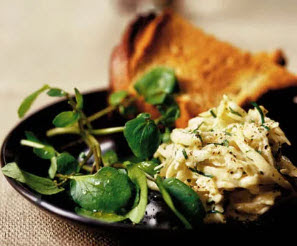
Photo from bbcgoodfood.com
Yield: 4 servings

7 Tbsp good quality mayonnaise
3 Tbsp Dijon mustard
1 lemon, juice only
1 celeriac 
  1. In a large bowl, mix the mayonnaise, mustard and lemon juice together thoroughly with a generous sprinkling go salt and some freshly ground black pepper, so it all becomes one sauce.
  2. Peel and quarter the celeriac, then, working quickly, coarsely grate it and stir into the sauce until evenly coated.  It will keep in the fridge for up to 2 days.

Recipe borrowed from www.bbcgoodfood.com

Celery Root and Hash Brown Cake 

Yield:  2 to 4 servings

1 pound potatoes
1 celeriac (about 12 ounces or more)
4 Tbsp sunflower seed oil, butter, or a mixture
2 large shallots or 1 yellow onion, finely diced
Sea salt and freshly ground pepper, to taste
A few pinches of celery seeds
½ cup Gruyere cheese, Gouda, or a medium cheddar
Finely chopped celery leaves or parsley, to finish

  1. Scrub the potatoes, and then peel them or not as you wish. Coarsely grate them on a hand grater or in a food processor, then peel and grate the celeriac as well.
  2. Heat the oil and/or butter in a 10-or 12-inch nonstick or cast-iron skillet over medium heat. Add the shallots and cook for about 1 minute. Add the potatoes and celeriac and season with ¾ tsp salt, a few grinds of pepper, and the celery seeds. Stir to coat the vegetables with the oil, then let the mixture sit undisturbed for 5 minutes or so. Fold the browned and crisp outside into the center, then pat the mixture down again. Continue in this fashion, allowing the vegetables to brown and crisp before folding them together, until all are cooked and nicely browned, about 20 minutes. Now, pat the mixture into the pan one more time, forming a nice even cake, and cook a few minutes longer so that it develops a golden crust. Scatter the cheese over the surface and leave to melt into the cake. 
  3. Season with pepper and add the celery leaves or parsley. Cut the cake into wedges (or scoop it out of the pan) and serve.

Recipe sourced from Deborah Madison’s book, Vegetable Literacy.

Wednesday, October 24, 2018

October 25, 2018 - This Week's Box Contents, Featuring Celeriac


Cooking With This Week's Box


Burgundy and/or Japanese Sweet Potatoes: Japanese Sweet Potato Oven Fries with Wasabi Aioli

Russet Potatoes: Carrot and Potato Mash

Baby Red Beets: Blueberry Beet Muffins

Spaghetti Squash: Spaghetti Squash Pad Thai


Celeriac: Wild Rice & Celeriac Gratin (see below); Celeriac Salad with Buttermilk Dressing (see below)

Green Top Red Radishes: Fried Fish Sandwiches with Radish Slaw

   
It’s time to transition to hearty fall and winter fare.  Braised vegetables and meats, casseroles, hearty stews and crispy root vegetable winter salads.  Lets dive into this week’s box and tackle celeriac first.  You may be surprised by how far even one medium celeriac will go, and it’s a pretty versatile vegetable to use.  I really enjoy the how the flavors of wild rice and celeriac go together as both are very hearty and slightly earthy.  You’ll enjoy this combination in this week’s featured recipe for Wild Rice & Celeriac Gratin (see below).  This dish can stand on its own as a main dish or you could serve it as a side dish along roast beef or braised pork.  The other recipe we’re featuring this week is for a simple raw Celeriac Salad with Buttermilk Dressing (See Below).  This recipe calls for celery, which I don’t have right now so I’m going to use shaved carrots instead.  If you don’t have fresh pomegranate seeds, you could also use fresh or dried cranberries in place of them.

Kohlrabi & Chickpea Curry
Photo from DishingUpTheDirt.com
Wait until you taste the kohlrabi in the box this week!  We don’t always grow kohlrabi in the fall, but thought we would include it this year so we have another crispy, crunchy option to enjoy in salads and just as a raw vegetable after all the other fresh vegetables are harvested.  If it seems too big for you, don’t think you have to use it all at one time.  Just cut off the portion you want to use and return the remainder (unpeeled) to the refrigerator, well wrapped to keep it from drying out.  Richard’s been asking for Kohlrabi slaw, so this week I want to make this Kohlrabi and Apple Slaw using some of the apples we got in our fruit share last week.  I’ve never used kohlrabi in any kind of a curry dish, so I’m intrigued by Andrea Bemis’s recipe for Kohlrabi & Chickpea Curry.
 
I have a big jar of red lentils on my shelf, so this week I’m going to make Red Lentils with Winter Squash & Greens.  We featured this recipe in a previous newsletter and recommended using mustard greens or spinach.  We’re done with both mustard greens and spinach so I’m going to use the green curly kale in this week’s box.

A few weeks ago I made this simple Carrot and Potato Mash and it was so delicious!  I usually put about 4-5 different roots in our root mash, but opted to keep it simple and the result was so good.  It’s light, fluffy and slightly sweet.  We’re going to have this for dinner this week with pot roast, with a little gravy of course.

Blueberry Beet Muffins
Photo from TheLeanGreenBean.com
I usually opt for simple steamed beets or a beet salad, but I have to try this recipe for Blueberry Beet Muffins!  I never would have paired beets and blueberries together, but think about all the antioxidants you’ll get in these pink muffins!  This was a recipe a member shared on our Facebook group.  Thanks for sharing this Greta!

I have really been enjoying trying new spaghetti squash recipes this year.  Thankfully these squash have been storing well despite the fact that this variety historically is one that we try to use sooner than later.  This week I’m going to try this recipe for Spaghetti Squash Pad Thai.

I hope you enjoy trying some of the Japanese sweet potatoes this week.  We don’t have many, but we’re going to include a little bit in as many boxes as we’re able to.  I want to try this recipe for Japanese Sweet Potato Oven Fries with Wasabi Aioli.  Of course this recipe will work with regular orange sweet potatoes as well so I’ll be using both, which will look really beautiful along with some white and black sesame seeds sprinkled on top.  These will go well with Fried Fish Sandwiches with Radish Slaw.  The recipe for the radish slaw calls for salad turnips, but I’m going to use kohlrabi instead.

We’ve reached the bottom of yet another CSA box and have quite a variety of recipes in the lineup for this week.  Just because we’re heading into the season of storage vegetables doesn’t mean our meals can’t still be diverse, flavorful and exciting to prepare and eat!  Have a great week and start thinking about Thanksgiving. It’s time to start planning the menu and getting the recipes lined up!—Chef Andrea 

Featured Vegetable: Celeriac

Celeriac, or celery root as it is also known, can be a bit intimidating if you’re encountering it for the first time.  However, as with all vegetables, there’s really no need to be intimidated…it’s just a vegetable!  Celeriac is in the same family as celery.  The difference is that celeriac is grown for its root and celery is grown for its stalks.  The stalks on celeriac resemble celery and have a lot of delicious flavor in them, however they are more tough and fibrous than celery and are not usually eaten as you would eat a celery stalk.  While this week’s celeriac do not have tops, we do sometimes deliver green top celeriac.  If you ever get celeriac with the tops still on, don’t throw them away!  Their flavor can add depth to a pot of stock or soup. 

Now for the root bulb.  First, scrub the exterior of the root the best you can.  Next, thinly slice away the top and bottom of the root so there is a flat side on the top and the bottom.  You’ll probably need to take a little more off the bottom to get past the majority of the roots and get into the more usable bulb portion of the root.  At this point, I usually cut the root in half or into quarters so it is easier to handle.  Using a paring knife, carefully trim away the outer skin.  Once you’ve removed the outer skin, rinse the remaining piece of celeriac and clean your cutting board if there’s any residual dirt.  The inner portion of the root is white, solid and entirely edible. 

Celeriac has a subtle celery flavor that provides a background to soups, stews, and root mashes.  It also makes a delicious soup or gratin on its own or combined with potatoes or other root vegetables.  It can also be eaten raw in salads and slaws paired with other fall fruits and vegetables and a simple creamy dressing.  There is a classic French preparation called Remoulade which is basically a creamy celeriac slaw.  I like to make a slaw based on this concept, but add apples and fresh, chopped cranberries as well as parsley when available.  I’ve noticed more “paleo” recipes are encouraging the use of celeriac as a substitute for starchy potatoes, noodles, etc. 

Celeriac stores quite well, thus it is an important part of our seasonal winter diets.  It can actually be stored for up to 6 months!  Keep it in your refrigerator loosely wrapped in plastic or in the crisper drawer until you are ready to use it.
  

Celeriac Salad with Buttermilk Dressing

Yield: 4 side salads

1 celeriac (about ¾ pound)
¾ cup Buttermilk Dressing (recipe follows)
1 cup pomegranate seeds
1 cup fresh flat-leaf parsley leaves
1 cup peeled and shaved celery
1 Tbsp extra-virgin olive oil
1 tsp freshly squeezed lemon juice
Kosher salt

  1. Use a vegetable peeler to peel the celeriac, and then finely julienne it.  In a bowl, dress the celeriac with ½ cup of the buttermilk dressing.
  2. In a small bowl, combine the pomegranate seeds, parsley, celery, olive oil, and lemon juice.  Season to taste with salt, and toss well.
  3. Spoon 1 Tbsp of the remaining buttermilk dressing on each plate, and spread it out with the back of your spoon.  Divide the dressed celeriac among the plates, and then spoon the pomegranate, parsley, and celeriac salad evenly over the top.
Recipes borrowed from The Broad Fork, Recipes for the wide world of vegetables and fruits by Hugh Acheson


Buttermilk Dressing

Yield: 1 cup

½ cup buttermilk
1 Tbsp Dijon mustard
1 Tbsp freshly squeezed lemon juice
¼ cup mayonnaise
2 Tbsp crème fraiche
½ tsp kosher salt
Freshly ground black pepper, to taste

Combine the buttermilk, mustard, lemon juice, mayonnaise, crème fraiche, salt, and pepper in a small bowl.  Whisk to combine, and serve.  The dressing will keep in the refrigerator for 5 days.

Recipes borrowed from The Broad Fork, Recipes for the wide world of vegetables and fruits by Hugh Acheson

Wild Rice and Celeriac Gratin


Yield: 4 to 6 servings


¼ cup minced shallot or onion
3 Tbsp butter or oil
2 Tbps flour
1 ½ cups milk, scalded (can be nondairy milk)
½ tsp sea salt
Freshly milled white pepper
½ tsp grated nutmeg
1 Tbsp butter
1 small celeriac, peeled and grated
Juice of 1 lemon
1 clove garlic, minced
2 Tbsp chopped parsley, plus extra for garnish
Sea salt and freshly milled pepper
3 cups wild rice, cooked
½ cup grated Gruyère
¼ cup freshly grated parmesan


  1. Cook the shallot in 3 Tbsp butter in a small saucepan over low heat for 3 minutes.  Stir in the flour and cook for 2 minutes more.  Whisk in the hot milk all at once, then cook for 20 minutes, stirring frequently, or for 30 minutes in the top of a double boiler.  Season with ½ tsp salt, a little white pepper, and the nutmeg. Set the sauce aside.
  2. Preheat the oven to 400°F.  Lightly butter or oil a baking dish.  Melt 1 Tbsp butter in a medium skillet over medium heat.  Add the celeriac with the lemon juice, garlic, and parsley and cook until tender, about 5 to 7 minutes.  Season with salt and pepper to taste.  Combine the wild rice, celeriac, and sauce and stir in the cheeses.  Turn into the dish and bake until firm, about 25 minutes.  Sprinkle with chopped parsley and serve.

Recipe adapted from The New Vegetarian Cooking for Everyone by Deborah Madison

Wednesday, September 20, 2017

Fall is Here!


We started harvesting sunchokes earlier this week
This Friday marks the official transition from summer to fall and on Sunday, September 24th, we’ll celebrate this year’s harvests with our annual Harvest Party shin-dig.  We’ve been talking about this seasonal transition now for several weeks as things have started to change in our fields.  This week however we are feeling it more than ever.  We’re harvesting purple top and sweet scarlet turnips, sunchokes, daikon radish, fall carrots and we will be packing Soup Mix before the week is finished!  The leaves are starting to change colors, hickory nuts are dropping to the ground, and we know it’s just a matter of time before we get our first chilly, frosty night.  We hope you are planning to attend the party this weekend so you can see our valley and fall crops for yourself!

Honeynut butternut squash curing in the greenhouse
A lot has been happening in our fields over the past few weeks, so we wanted to catch you up on our activities with a field report.  We said goodbye to watermelons, melons, zucchini and cucumbers over the past few weeks, but there were more crops entering the stage as these summer favorites dwindled.  We are nearly done with winter squash harvest.  We have harvested and cured most of our winter squash and will go back to harvest the last few loads remaining in the field before the end of the week.  We’re planning to start packing winter squash in your boxes possibly as early as next week.

Our first planting of tomatoes is nearly finished, but the second planting still looks pretty good and continues to produce.  We have been having pretty cool days and nights, so the tomatoes have been ripening slowly.  We’ll keep picking right up until the first frost.  We’ve also been hitting our pepper field pretty hard with harvests.  There isn’t a whole lot remaining at this point.  Our orange Ukraine plants are pretty much done.  They produced a lot for us, but there isn’t much remaining on them.  The Orange Italian Frying peppers are still producing and we’ll be able to pick for this week and next, but I’m not sure how much will remain beyond that.  We’re planning to deliver mini-sweet peppers in next week’s box, but these plants don’t have a lot of fruit remaining on them. 
Celeriac with green tops freshly washed!

This week’s featured vegetable, celeriac, comes to you with its green top still on.  This is another sign of the transition point in the season.  While we’re still harvesting them as green top, we’ve already started to mechanically harvest these roots for storage.  They’ll all need to be harvested within the next few weeks as they will not tolerate more than a touch of a frost.  This marks our transition in cooking as well.  Soon we’ll all be enjoying more root-focused soups, stews and braised dishes to warm us up on the cold days. 

 Scarlet & Purple Top Turnips harvested last Saturday
There are some vegetables that make their appearance in the spring and then return in the fall.  Fall is a special time in many ways for some of these crops as the cool fall days and nights help to intensify the colors of vegetables and the flavors of some things mellow out and are sweeter.  We’re harvesting a beautiful crop of fall fennel right now and just started harvesting our fall crop of baby white turnips.  Next week we’ll be resuming baby spinach and salad mix harvest.  The color on these crops is always very impressive this time of year.  The green colors of spinach are more intense and the red lettuces are stunningly gorgeous! 

At the farmers’ market we’ve already been getting inquiries of “When will Brussels sprouts be ready?” Well, they are making sprouts and looking pretty good, but this is one of the brassica crops that benefits from a few frosty nights before harvesting.  All brassicas undergo changes in flavor in cold weather.  Their flavor becomes more sweet and well-balanced.  So the best estimate I can give you for when we’ll harvest them is after it frosts.  We also have our eye on the sweet potatoes and will be harvesting those before too long.  We’ll have to do a sample dig at the party this weekend to check the progress in growth and gauge just how much longer it will be before we’re ready to pull the trigger and do the big harvest! 

Jicama, sweet potatoes, squash and more coming soon!

Newly planted escarole and radicchio plants
Next week we’ll be delivering jicama in the boxes.  It’s in the process of being cured right now to set the tender skins.  This year’s crop looks pretty good!  We’re still learning how to grow jicama but I think we’re making progress!  We did harvest some that don’t look so pretty.  If you come to the party on Saturday, we’ll share those with you.  They don’t look good but they are still good to eat!  We also have a crop of tat soi slated for a late season harvest and we’re trying a new growing method for some late season chicories.  This week Scott, Simon and Jose Antonio finished planting escarole and radicchio transplants in our cold frame greenhouse.  We did a pretty good job of growing head lettuce in the cold frame greenhouse this spring and delivered it in the May boxes.  We’ve never grown escarole and radicchio in a greenhouse, but thought we’d give it a try and hopefully they’ll be ready for some of the last boxes of the season in November and December.  They are more cold hardy greens that can take cold weather and frosty nights and their flavor actually improves in cold weather.  In the field they can sometimes get damaged when the nights get really cold, so we’re hoping the more protected environment of the greenhouse will allow us to get the benefit of the cold weather but gain the protection from deep frosts.  Wish us luck!

In addition to harvesting crops,  we’ve also managed to stay on top of planting cover crops.  As we finish harvesting a field, we move right into preparing it for  winter and includes establishing a cover crop.  Did you read last week’s newsletter regarding the importance of regenerative farming methods related to mitigating climate change?  Well, we’re trying to do our part by getting cover crops on bare ground so they can capture carbon from the atmosphere and store it in the soil.  How cool is that?!  We’ve also finished putting up stored hay for our animals to eat this winter and we’ve returned to some of our woods management projects.  The high winds we had in July along with the rains took the tops off of a lot of our trees in the woods. We’ve been scouting the woods identifying where the damaged and downed trees are.  We’ll focus on salvaging what we can this fall.


Despite the challenges of the July weather event, we’re gearing up for a bountiful fall harvest and we’re hoping Mother Nature will be cooperative!  There are still a lot of delicious vegetables remaining to experience this season as we continue our journey in our seasonal eating adventure.  I’m already starting to look forward to some favorite winter dishes such as Turnip-apple quiche, sweet potato casserole and rutabaga mash!  We hope to see you at the party this weekend and hope you enjoy the last few months of vegetables!

September 21, 2017 - This Week's Box Contents, Featuring Celeriac


Cooking With This Week's Box


As we dive into this week’s box, we’ll start with our featured vegetable of the week which is green top celeriac!  This week’s newsletter features two different types of ways you can use your celeriac, one is raw and the other is cooked.  The Sesame Chicken Celeriac Salad (see below) is a main entrée salad that is very easy to make and will travel well for lunch the next day if you have leftovers.  If you’d prefer to make something warm, you might want to consider making the Celeriac, Potato and Apple Puree (see below).  This wasn’t my original plan for a recipe, however we had the opportunity to dine at Harvest Restaurant in Madison, WI last Sunday at their special 17th Anniversary Dinner. Chef Jon served a delicious celeriac and potato mash.  I had stumbled over this recipe over the weekend and once I sampled some of the apple from this week’s fruit box I decided the combination of celeriac, russet potatoes and apples was on the list for this week.  This puree will make a delicious accompaniment to any pork dish, grilled beef, duck or roasted chicken.

If you choose to make the Sesame Chicken Celeriac Salad, the recipe calls for chicken breasts.  If you are making the salad this week, you might as well use a whole chicken.  You can take the breasts off and cook them for the salad and then use the thighs and legs to make Jamie Oliver’s Tender and Crisp Chicken Legs with Sweet Tomatoes & Basil. The recipe calls for 4 chicken quarters to serve 4 people.  If you’re using just one chicken you’ll have to cut the recipe in half and your yield will be for just 2-3 servings.  This recipe can be made with some of the tomatoes in this week’s box as well as garlic and basil from your herb garden.  Serve this with cannellini beans, mashed potatoes or pasta.

At the dinner last Sunday, we had another delicious course that included halved grape tomatoes served with an herbed buerre blanc sauce.  While I’m not going to get that fancy this week, I was inspired to take make this recipe for Marinated Cherry Tomato Salad.  Of course we’ll use the grape tomatoes, cut them in half and marinate them in vinegar, herbs and oil.  This can be served as a salad on its own or use it as a condiment to top off seared salmon, grilled steak or serve it on top of a bowl of lentils or cannellini beans. 

Well, sweet corn season is coming to a close but we still have a few ears to enjoy!  This week I’m going to cut the kernels off the cob and use them, along with one of the tomatoes, to make this Tomato, Basil & Corn Pizza.   The recipe calls for baking it in the oven, but you could put this on the grill too for a little extra smoky flavor.  I always like peppers on my pizza, so I’ll thinly slice the green bell pepper and add it along with the corn.  The orange Italian Frying Peppers are going to go on a tossed salad made with either the red Boston or red Batavia lettuce.  I’m going to toss the salad with this Creamy Roasted Garlic Vinaigrette and garnish it with some thinly sliced onions, croutons and some canned water-packed tuna for an entrée salad to eat at lunch. Any extra orange Italian frying peppers left over this week are going straight into the freezer so I have some to use on pizzas during the winter.  If I have time I’ll slice the peppers before freezing, but if time is short they can go into the freezer whole and I’ll deal with cutting them in February!

The remainder of the potatoes as well as this week’s leeks are going to be used to make Potato Leek Soup with Poblanos and Crispy Bacon.  I tried this recipe last fall and it is delicious!  I never would’ve thought to pair the gentle leek with a hot pepper, but the combination works and this combination is actually very good.  The recipe calls for Yukon Gold potatoes, but this week’s russet potatoes will work just fine. 

For some reason I have Mac & Cheese on my mind this week, so some of the broccoli is going towards making Macaroni & Cheese with Broccoli.  The remainder of the broccoli will end up in a frittata for Sunday brunch.

The gorgeous red chard in this week’s box is going to be used to make vegetarian Tacos with Black Beans and Chard. I’ll serve this with Green Rice with Jalapeño, Garlic and Lime.  We have limes in this week’s CSA fruit share, so that’s one less thing I’ll have to pick up at the grocery store!

Well, that brings us to the bottom of another CSA Box.  Next week we’re hoping the Jicama is ready to go in boxes.  So, pull out those jicama slaw recipes and get ready!  If you’ve never had jicama, you have something new to look forward to!  
—Chef Andrea


Featured Vegetable:  Celeriac


Celeriac, or celery root as it is also known, can be a bit intimidating if you’re encountering it for the first time.  However, as with all vegetables, there’s really no need to be intimidated…it’s just a vegetable!  Celeriac is in the same family as celery.  The difference is that celeriac is grown for its root and celery is grown for its stalks.  The stalks on celeriac resemble celery and have a lot of delicious flavor in them, however they are more tough and fibrous than celery and are not usually eaten as you would eat a celery stalk.  Don’t throw them away though!  Their flavor can add depth to a pot of stock or soup.  If you aren’t going to use them all now, put them in the freezer and use them later this fall or winter.

Now for the root bulb.  First, scrub the exterior of the root the best you can.  Next, thinly slice away the top and bottom of the root so there is a flat side on the top and the bottom.  You’ll probably need to take a little more off the bottom to get past the majority of the roots and get into the more usable bulb portion of the root.  At this point, I usually cut the root in half or into quarters so it is easier to handle.  Using a paring knife, carefully trim away the outer skin.  Once you’ve removed the outer skin, rinse the remaining piece of celeriac and clean your cutting board if there’s any residual dirt.  The inner portion of the root is white, solid and entirely edible. 

Celeriac has a subtle celery flavor that provides a background to soups, stews, and root mashes.  It also makes a delicious soup or gratin on its own or combined with potatoes or other root vegetables.  It can also be eaten raw in salads and slaws paired with other fall fruits and vegetables and s simple creamy dressing.  I’ve noticed more “paleo” recipes are encouraging the use of celeriac as a substitute for starchy potatoes, noodles, etc.  If you have a spiralizer, you can even make celeriac noodles (do we call them celoodles?)


Celeriac stores quite well, thus it is an important part of our seasonal winter diets.  It can actually be stored for up to 6 months!  Keep it in your refrigerator loosely wrapped in plastic or in the crisper drawer until you are ready to use it.  


Sesame Chicken Celeriac Root Salad

Photo credit from thekitchen.com
Serves 4

2 large carrots, peeled
1 large celeriac, peeled
3 cups shredded cooked chicken breast (see Recipe Note)
½  cup chopped fresh basil, or cilantro
1 small clove garlic, peeled and grated with a microplane, or finely minced
2 Tbsp white vinegar
2 Tbsp toasted sesame oil
1 Tbsp dark pure maple syrup
1 Tbsp reduced-sodium tamari or soy sauce
2 tsp sesame seeds
1 ½ tsp grated fresh ginger root
½ tsp salt

¼ tsp black pepper
  1. Shred carrots and celeriac on a box grater or with the grating attachment of a food processor.
  2. Combine the carrots, celeroac, chicken, and basil (or cilantro) in a large salad bowl.
  3. Combine garlic, vinegar, sesame oil, maple syrup, tamari, sesame seeds, ginger, salt, and pepper in a jar and shake to combine. Pour the dressing over the salad and toss to combine.
  4. Divide among 4 large plates to serve.

Recipe Notes: 
To cook chicken: Bring 6 cups of water to a boil in a large saucepan. Add ½ tsp salt and stir to dissolve. Add 2 boneless skinless chicken breasts and return to a simmer over high heat. Reduce heat to medium-low to maintain a gentle simmer and cook, turning occasionally to make sure it cooks evenly, until the chicken is cooked through, 15 to 17 minutes. Transfer the chicken to a cutting board to cool, at least 20 minutes before shredding.

This recipe was adapted from thekitchn.com.


Celeriac, Potato and Apple Puree


Yield:  3-4 servings

1/2  pound potatoes, peeled and cut in half*
1 large celeriac, peeled and cut into large pieces
1 small to medium tart apple, such as a Granny Smith, peeled, cored and quartered
¼ cup, approximately, warm milk or broth from the celeriac.
1 Tbsp butter or walnut oil, plus more to taste
Salt, to taste
Freshly ground black pepper, to taste

  1. Place the potatoes in one saucepan and the celeriac and apples in another.  Barely cover each pan with water and add salt to each pan as well, about ¼- ½ tsp per pan.  Bring to a boil, reduce the heat and simmer until tender, 15 to 20 minutes.
  2. Turn off the burner that the potatoes are on and remove the pan.  Drain the potatoes, and return the pot to the burner (do not turn the burner back on).  Leave the lid off and allow the potatoes to set for 5-10 minutes to steam and dry out. 
  3. Drain the celeriac and apples through a strainer set over a bowl to catch the cooking liquid. 
  4. Puree all of the celeriac and apple mixture as well as the potatoes in a food mill or a potato ricer.  (If you don’t have either of these tools, you can also use a food processor and process the potatoes separate from the celeriac/apple mixture.  The other option is to just mash the vegetables by hand with a potato masher.  The end result will be more chunky, but will taste just fine). 
  5. Combine the potato puree along with the celeriac and apple puree in a bowl.  Whisk in the milk or broth until the mixture is fluffy.  Add the butter or walnut oil to the hot puree, stir until the butter melts, and season to taste with salt and pepper.

*Chef Andrea Note:  The original recipe calls for Yukon gold potatoes.  I would recommend using our russet potatoes for this recipe as it will yield a lighter, fluffier mash.
Recipe adapted from Martha Rose Shulman’s recipe featured on cooking.nytimes.com.