Showing posts with label planting. Show all posts

Thursday, January 26, 2023

It All Starts With A Single Seed!

By Andrea Yoder

New shipments of seeds for 2023! 
While spring may feel like it is a long ways off, we are only three short weeks away from initiating our first plantings in the greenhouse for our 2023 growing season!  January has been a busy month for us and one of our major tasks has been securing our seed supply for this year.  It doesn’t matter how many growing seasons I’ve been through, I still am in awe of how nature can take a small amount of seed that I can hold in the palm of my hand and turn it into thousands of pounds of food!  As farmers, we hold the utmost respect for the intelligence held within each seed.   Our job is to help each seed obtain its highest level of potential by providing for it and the plant it becomes as it grows and develops into the food we all need to nourish our bodies.  Every year we source seed for over 75 different crops and are able to produce tons of vegetables from our modest 100 tillable acres of land.  While we’re still compiling our production numbers from last year, I can tell you that we produced about 709 tons of produce in 2021!  That is a lot of food! Sourcing the seeds to produce this much food is no small task and usually takes us about two weeks to complete. We finalized our orders earlier this month and the seeds have already started to arrive.  So we thought we’d kick off this year by offering you a little insight into our process for managing our seed purchases and inventory along with some seed stats and a glimpse into some of our plans for the crops we’ll be growing this year!

As certified organic growers,
we do not plant any GMO seed.
We source our seeds from a variety of companies, but as organic growers we focus on those that offer either certified organic seed or untreated seed.  When available, we purchase certified organic seed and undergo a sometimes very extensive seed audit at our annual organic inspection. As we are ordering seeds we document our seed search to demonstrate that we’ve checked with at least three sources and have purchased organic seed as a priority.  We are also required to keep all of our seed tags and have a thorough record of where our seeds come from, when they are being planted, etc.  We maintain all that data in a seed database which comes in handy when our organic inspector hands us a list of 20 different seeds that he wants to review to ensure they meet the standards for organic production.  As organic producers, we never use seeds that are genetically modified or have any type of a chemical seed treatment.  Additionally, most of our suppliers stand behind “The Safe Seed Pledge,” a statement created by a coalition of seed companies that reads as follows:

“Agriculture and seeds provide the basis upon which our lives depend.  We must protect this foundation as a safe and genetically stable source for future generations.  For the benefit of all farmers, gardeners and consumers who want an alternative, we pledge that we do not knowingly buy or sell genetically engineered seeds or plants.  The mechanical transfer of genetic material outside of natural reproductive methods and between generations, families or kingdoms poses great biological risks, as well as economic, political and cultural threats.  We feel that genetically engineered varieties have been insufficiently tested prior to public release.  More research and testing is necessary to further assess the potential risks of genetically engineered seeds.  Further, we wish to support agricultural progress that leads to healthier soils, genetically diverse agricultural ecosystems and ultimately healthy people and communities.”

We purchase our seeds from four main companies along with a handful of other suppliers that offer some unique items and specialty crops.  We have been working with Seedway, Osborne Seeds, High Mowing Organic Seeds and Johnny’s Selected Seeds for many years.  They all have a strong reputation for distributing quality seed that is tested for disease and germination potential.  These are important factors for us as we are looking to source the highest quality seed for the best outcomes!  This month we purchased over $70,000 worth of seeds!  In addition to these purchases, we will plant some of the seed we already have in inventory from previous years.   If stored properly, many seeds will remain viable for several years.  In many cases we like to have a little extra seed on hand just in case something unexpected comes up and we need it in short order.  We also tend to buy a little extra seed for varieties that we highly value and for which there are not suitable substitutes.  From time to time a seed producer may have a crop failure and seed may not be available for 1-2 years.  If that happens, we are covered!

Sugar Ann snap peas have been a customer 
favorite for many years!
Over the years we have trialed a lot of different varieties and have come to know which varieties do best on our farm.  There are some varieties that we plant year after year because they produce a superior product.  Sweet corn is one of these crops. There are literally hundreds of varieties of sweet corn we could grow, but not all varieties will thrive in our region.  We are fortunate to be able to work with Phil Timm from Seedway.  He is our seed rep for the company and is very knowledgeable.  Over the years he has made some excellent recommendations for sweet corn varieties that will do best for us and he has hit the nail on the head with nearly every recommendation!  Every year we order our sweet corn seed early to make sure we can get our favorite varieties with names like “Fantastic” and “Awesome.”  Sugar Ann peas are another variety that are hard to beat and have proven to be a superior Sugar Snap Pea year after year.  We always make sure we order early as this variety has been sold out some years!  

2022 Cilantro Field
Before we make the final purchasing decision, we have to take some time to consider whether we want to duplicate our planting plans from the previous year or if we need or want to make changes.  Once we have an idea of what we want to accomplish, then we evaluate the varieties we’ve been planting.  This is also when we consider availability, take a look at any new varieties on the market and take into account any carryover inventory we may have available from the previous year.   Once we have all this information we can figure out how much seed we need to order.  Every crop is different and has to be figured individually.  For example, cilantro is one of our top three major crops and we plant it weekly starting in the spring for a total of 20-22 plantings per year.  In 2021 we planted 360 pounds of cilantro seed, which is quite a lot of seed.  This is the part of the equation that always amazes me as that 360 pounds of seed produced 53,000 pounds of cilantro!  Baby Bok Choi is another one of our top three crops.  Bok choi seed is very small and while we plant it weekly just like cilantro, we only planted 6.39 pounds of seed to produce 72,656 pounds of bok choi!  Is anyone else amazed by the multiplication potential here?!  
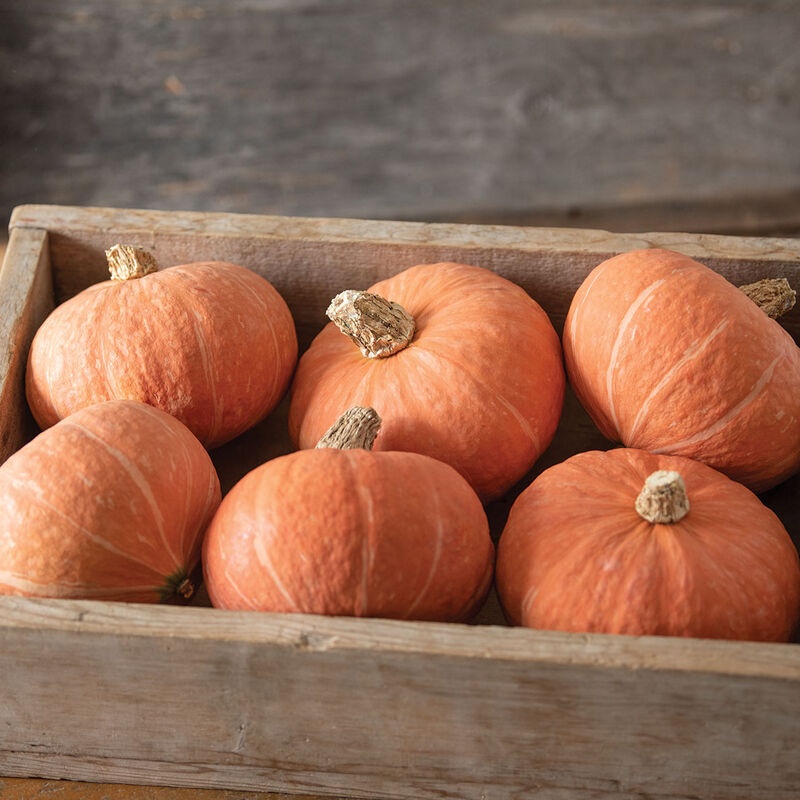
Marmalade Kabocha Squash 
(photo sourced from johnnyseeds.com)
Looking ahead to our upcoming growing season, we have a few fun things we’re planning to plant in addition to our staple items like carrots, broccoli, green beans, tomatoes, sweet corn, etc.  This year we’re planning to plant jicama and lemongrass which are on our list of crops we choose to plant once every few years.  If you have never had freshly harvested jicama, you are in for a treat!  We are also on the search to find a tasty kabocha squash to replace Sunshine, a variety we grew previously.  Sunshine had excellent flavor and sweetness, but it succumbed to disease in challenging growing conditions which subsequently impacted its shelf life.  The last few years we grew it we threw away such a large percentage that went bad and made it hard to justify growing them. This year we’re going to give “Marmalade” a try.  This is a small, coral-colored kabocha variety available from Johnny’s Seed.  They describe it as “….ideal for small family dinners and tucks nicely into CSA boxes….Vibrant color option for late fall, with improved storage life compared to Sunshine.”  Evidently we weren’t the only growers who experienced the shortened shelf life of Sunshine!  We are also trying a cute little green buttercup squash (similar to kabocha) called “Bon Bon.”  It’s described as being “Tasty, uniform and high-yielding,” and weighs in at 4-5 pounds which fits nicely in a CSA box!
Sugar Magnolia Peas
(photo sourced from osborneseed.com)

We are also planning to grow a few new purple vegetables.  We know some of you love purple colored vegetables more than others, but we know that the purple color comes from the presence of a powerful class of plant compounds called anthocyanins.  These compounds function as antioxidants in our bodies and provide a whole host of health benefits.  The first in this class that we hope to share with you is the Sugar Magnolia Pea.  This variety produces dark purple pods with bright green peas that are described as being “…sweet and delicious.  A real stunner!”  The plant for this pea does grow 6-7 feet tall, so we’ll have to trellis the plants to keep them off the ground and make them easier to pick.  We also ordered some “Purple Majesty” potato seed.  We have grown this variety at least one time in the past and our recollection is that it was not only a very tasty potato, but it held its color much better than most purple or blue varieties that turn gray when you cook them.  Lastly, we are trying a new purple sweet potato called “Purple Splendor.”  This looks to be a gorgeous potato with purple skin and dark purple flesh that is described as follows:  “Cooked flesh is on the dry side with notable sweetness.”  We’ve purchased purple sweet potatoes in the grocery store and loved the flavor and sweetness, but have not been able to find plants to grow them.  Hopefully we’ll see favorable outcomes with this variety this year!  
Artemis Cherry Tomatoes
(photo sourced from osborneseeds.com)

Our tomato and pepper line-ups are pretty solid and consistent, but we do have a few new varieties to add to the mix this year.  While we usually focus on grape tomatoes and haven’t grown cherry tomatoes for many years, we were drawn to the “Artemis” cherry tomato from Osborne Seeds.  They are supposed to be bright red and are described as “….Supersweet red cherry consistently our favorite for flavor.”  Sounds like a winner! We are also trying the “Round of Hungary” pimento pepper.  We grew pimento peppers previously, but it’s been awhile.  This is a dark red pepper that has a flattened shape with ribs.  It’s a sweet pepper that is good for stuffing.   

We have our work cut out for us over the next few weeks leading up to our first greenhouse plantings.  We need to give our seed storage cooler its annual “top to bottom” cleaning before we put the new seeds into their storage location.  We will be washing and sterilizing our greenhouse flats, thawing the potting soil and need to take care of a few repair projects before we start preparing the nursery greenhouse.  If you’ve already signed up for your 2023 CSA shares, we thank you and are excited to have you on this year’s journey with us!  If you are yet to sign up for your 2023 CSA shares, I want to remind you to do so before February 28 so you can take advantage of our Early Bird Sign-Up Offer!  We have a great season of vegetables ahead of us and look forward to growing for you and your family this year!

Wednesday, October 25, 2017

Fall "Crunch Time" is Here!

by Farmer Richard

Do you remember the three foot deep snowfall on October 29, 1993?  I do!  I remember harvesting carrots by hand in the melting slush of that snow, not fun!  We love the cool, sunny days of fall, harvesting roots to take us through late fall and early winter boxes and wholesale sales.  Planting garlic, horseradish and sunchokes for next year after first selecting our seed pieces.  Preparing fields for winter by chopping crop residue, composting and planting cover crops—have to get ready for a new year! We have a long “to do” list and time is quickly slipping away.  The reality we face is we need 2 to 3 weeks of dry weather to get everything finished! 

Austraian Peas already doing their job,
growing nitrogen fixing nodules!


Four weeks ago we were caught up, every available acre was composted and cover cropped, some 60 acres of very nice cover crops with the Austrian peas already producing impressive nitrogen fixing nodules on their roots.  They were planted into very dry soil, but came up nicely with the first rain.  But then it rained again, and again…  We’ve had 6.42 inches of rain in October alone.  We still have about 30 acres of fields that need to have cover crops planted and we have fields to clean up including removing plastic and tomato stakes from the tomato, eggplant, pepper and basil fields.  Last Saturday afternoon we started planting our garlic fields, but only got 2 beds planted before the end of the day…and then it rained another inch that evening!

Do you sense some urgency here?  Some nervous apprehension?  We do!  We can harvest greens and herbs in the rain or wet soil, but those crops are almost done.  The warm weather of September and October (still no frost) has sped up the maturity rate of all crops.  We did some late plantings of beets, red radishes, cilantro, baby bok choi, etc knowing they might be a gamble if it got cold earlier.  We’re harvesting those crops this week and many will be finished for the season by the end of the week.  We’re thankful to be able to continue these harvests this late in the month and we’ve saved huge amounts of time and the expense by not having to put covers over crops to protect them from frost!  We expect our first frost to be more of a freeze (lower than 25°F), but by the time we see that, all of the vulnerable crops will be out of the field.  Now that it’s getting colder, the soil isn’t drying out as fast as it does when it’s warmer.  With more rain in the forecast, we’re concerned we won’t see the two weeks of dry weather we need to wrap this season up. 

The harsh reality is winter is coming.  As I sit on the back porch writing, I can hear the coyotes howling on the hillsides.  I love it!  They too sense the coming winter!  But we still have that garlic field to finish planting, plus most of the burdock field, parsnips, carrots, radishes, turnips and rutabagas to harvest and almost 2 acres of sunchokes to both harvest and replant!  This fall is much different than last fall.  Despite the challenges we face this fall, we’re thankful to have such a plentiful harvest in contrast to the crop losses we had last fall.  When we had extra crew time last year, we gambled and planted extra sunchokes and horseradish, with hopes of having a really good harvest this fall to make up for some of last year’s losses!  Well, our strategy worked and these crops have done well and sales are good.  But we still have to harvest and replant so we can do it all over again next year! 

Rufino, Luis, Jose Antonio and Alejandro coming
to the packing shed with broccoli romanesco,
cauliflower and broccoli.
Earlier this week on Monday, we mudded out some more daikon radish and finished our first fall carrot field.  I only got stuck in the field one time while pulling out a load of carrots, but despite the mud the harvest went pretty well.  We also went through our last three broccoli fields to find the small heads that continue to grow off the sides of the plant.  The pieces aren’t big, but they are tasty!  The broccoli romanesco field looks great!  This crop will survive a frost as low as 20°F and will actually sweeten a bit with the frost so we aren’t in a big hurry to harvest them.  There are still Brussels sprouts coming too!  We’ve intentionally held off on harvesting them because we want them to have a few frosty nights to sweeten them up.  We plan to harvest cabbage before the weekend freeze-up when our temperatures are forecasted to be 27°F.  It can sometimes be colder in the valley, so we’ve already started preparing so we aren’t caught off guard.  Irrigation pumps, filter trailers, etc are all drained and put away for the winter.  Bins of firewood are in place and I am back on winter wood stove duty.  We have a beautiful fire burning in the fireplace as I write.   It sure helps to take the chill off on cold evenings. 


Some of our crew 'cracking' garlic to get ready to plant!
Or crew is anxious to return home to their families and they are waiting for our final decision as to when they can start booking plane tickets to go home.  While some crew members have asked and volunteered to stay late this year, others are anxious to make it home in time to be with their wives when the babies they’re expecting are born!  Others have fields of hay on their family’s farm waiting to be cut and baled.  There will be coffee and corn to harvest, and of course there are anxious kids counting down the days until their dad comes home.  It’s hard to predict when our workload will lessen, but we do our best to make estimates and work efficiently.  We are trying to make the most of our time, spending frosty mornings and rainy days cracking garlic for planting, cleaning garlic and onions, trimming root crops stored in the cooler, washing sweet potatoes, etc.  But the bottom line is that we need those dry, sunny days!  Wish us luck and lets hope Mother Nature offers us a brief reprieve with some nice weather!  

Thursday, May 26, 2016

Spring Farm Update

by Farmer Richard
Crew transplanting onions.

This has been a weird and unpredictable spring!  It warmed up in late February and March. The snow melted, the maple sap started to run….perhaps a bit too early? The ramps came up in early April and by the second week of April we started harvesting them.  All indications pointed towards an early, warm, dry spring! We planted our first salad greens, radishes, beets and carrots on April 14. Early?  Yes, but we love it!

We had fairly dry weather early in April which allowed us to get the overwintered parsnips and sunchokes out of the cold winter ground. The overwintered spinach looked pretty good and by the end of April we started to see signs of the asparagus starting to come up. We were thinking “Yes!  We’re going to have nice early season boxes for our members!” ….and then our fortunes changed.  Cold, damp weather going into the first of May slowed all growth to a crawl!  Some crops did continue to grow, despite the cold temperatures. The garlic, rhubarb, and spring onions looked good, until we had an unsuspected and freakish hail/slush storm with strong north winds. It was quite a
Jose Manuel and Alvaro laying plastic for sweet potatoes.
storm! It moved through quickly but managed to dump about two inches of hail and sleet balls on us in just about 15-20 minutes! Unfortunately the rhubarb and overwintered onions took a beating as the hail hit the tops of the onions and the rhubarb stalks. The wind was coming from the north, so one side of the plant looked pretty bad while the other side of the plant was virtually untouched!  Whoa here, what happened to our early spring?!

After the storm, it was on the dry side so we continued to plant on schedule, even early sweet corn and green beans. The first 24 hours after a seed is planted are probably the most important.  If we plant on a warm day and plant shallow, we can usually germinate the seed. Voila!  Our first planting of beans germinated, pushed through the ground and were looking good. They were just coming up and then on May 15, our average last light frost date, we had a freeze!  27-28°F was our low temperature that set in for about 6-8 hours overnight and into the morning. The green bean sprouts that were still under the ground froze!  The sweet corn froze too, but recovered with new shoots. Most of the beans, however, did not survive.  Despite the fact that we had a cover over the strawberries, some of the blossoms were damaged. It looks like about 40% of the blossoms were damaged, but still a lot of smaller strawberries are ok and coming.
   
The zucchini and cucumbers were under a cover as well.  While the zucchini toughed it out and had a pretty good survival rate, the cucumbers in the same field didn’t fare so well.  They had about an 1% survival rate. So sad. On a brighter note, the beets, carrots, chard, burdock, broccoli, fennel, cauliflower, cabbage, etc are all alive and just waiting for warm weather to grow!

We picked the asparagus hard before the frost on May 15, but some asparagus still froze off and we lost 5 days of production.  That’s why there was such a small bunch of asparagus in last week’s box!  We were very happy to see larger harvest numbers this week when the crew picked on Monday.
Captain Jack supervising.
 No, the asparagus season is not over!
 
 With some extra time on our hands, we turned our attention to that which we always turn to when we have a free moment during the growing season….weed control! Can you believe it has been so cool that even the weeds haven’t been growing!! While we’ve been waiting for the vegetables to grow, our crew has been busy trimming around fields, has done a lot of landscaping, painted our barn and the nursery greenhouse, cultivated and cleaned every small weed from the plantings.
 
Finally, this week the warm weather came and we have been busy transplanting some of our warm weather plants including eggplant, tomato, pepper, squash and melons. While it has been a challenge to manage things this spring and provide a nice box, the tide is turning. The crops…and the weeds will grow!

Wednesday, August 20, 2014

Salad Planting, Team Effort

Juan Pablo and Manuel, our Salad Planting
Team and so much more!

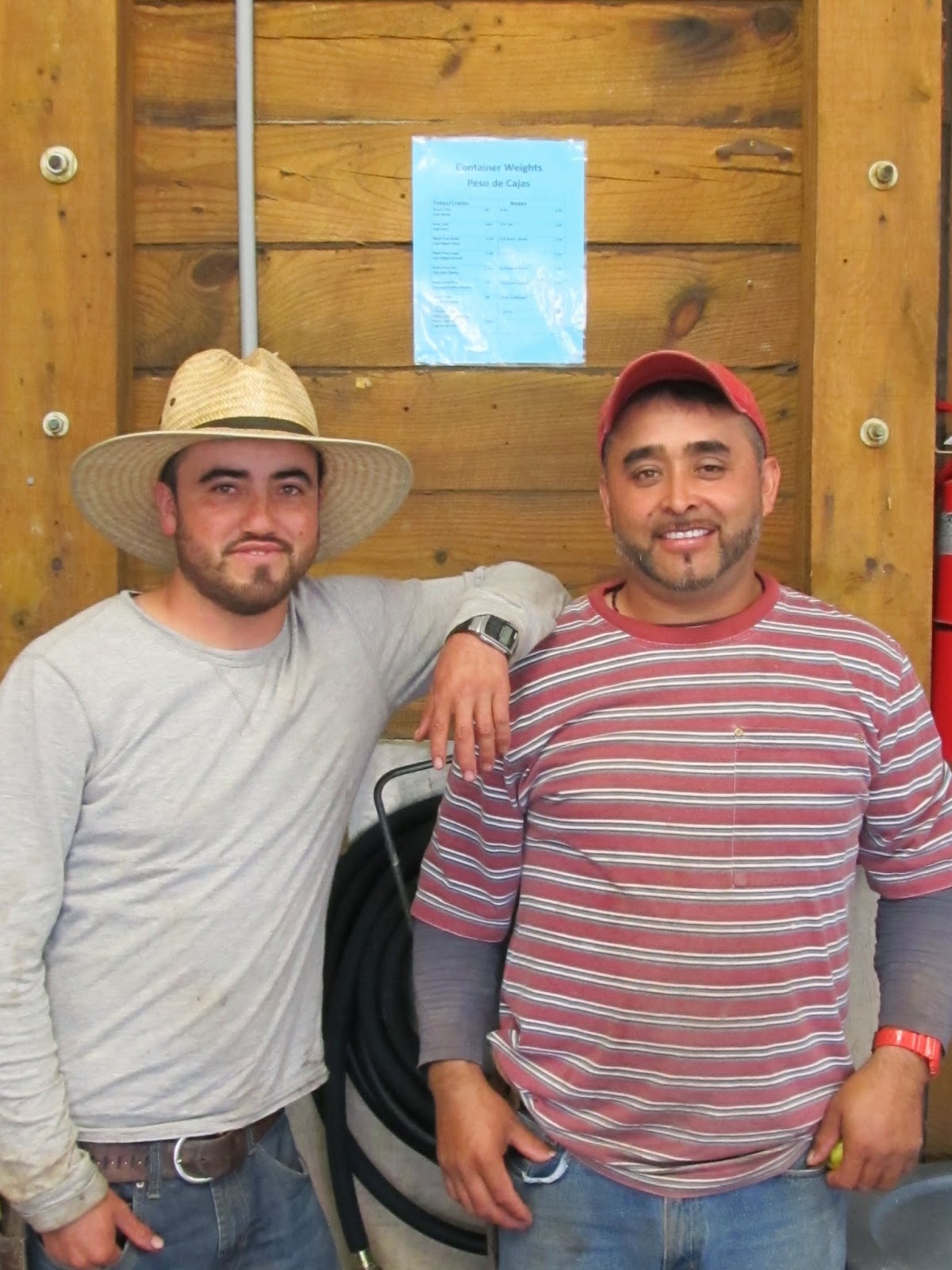
Let me start out by saying that we may call Manuel Morales Peralta (aka Caliman) and Juan Pablo Cervantes Correa (aka Pablito) our salad planters, but they plant a lot more than just salad greens. Their almost weekly plantings consist of radishes, cilantro, baby bok choi, baby kale, arugula and more! They have been the salad planting team for the past two years, and they have done a great job! They understand and participate in the entire process from preparing the beds for planting to irrigating and putting on row covers after planting and finally the harvest.
Weighing the seed to calibrate the salad
planter before heading to the field


Juan Pablo and Manuel
  calibrating the salad planter
They are very conscientious about each planting and pay attention to all the fine details. If we have a new lot of seed, they calibrate the salad planting machine to make sure we put out the right amount of seed. Machines aren’t always right though. They follow up in the field to make sure everything is planting at the correct rate. There is a lot to keep track of: seed depth, seeds per foot, rows per bed, planter settings, etc. They execute this process every week, complete with a full set of records and maps for our files.

So far this year they have done 17 plantings with a few more to go. There are a lot of steps in the process to get to the final product – a bag of washed salad mix packed into your CSA box. There are many people involved in making that happen, but we wanted to focus on these two gentlemen this week so you can get to know them better. They not only share a bond here at Harmony Valley Farm, but also at home in Mexico!

Juan Pablo always happy,
even when calibrating
the salad planter

Manuel and Juan Pablo making sure everything is okay before
moving ahead with planting. Notice the irrigation pipe in
background waiting to to be laid out in the field to water the
newly planted seeds.


So what is the deal with Manuel and Juan Pablo anyway? We have written a little about Manuel in a previous newsletter that included his brothers who also work on the farm. You can find that newsletter in October 17-19, 2011. At that time there were only 3 brothers here. However, we are happy to say there are now four Morales brothers working with us. That is it for the Morales brothers, there are no more, but there are a few sisters, One of which is a girlfriend to Juan Pablo! I will talk more about her in a moment. Manuel is married to a beautiful woman named Veronica with three boys at home. Eric is the oldest at 15, Manuel is 10 and Alexander is 5. Of course I asked the question, “Are you planning a child every 5 years? Maybe a new baby this year?” So, both Manuel and Alvaro (one of Manuel’s brothers helping to translate) shook their head and laughed a pretty straight forward no.
The Morales brothers: Manuel, Rafael, Jose Alejandro and Alvaro
Manuel lives near his entire family in the San Miguel area in Mexico. When back home he likes to go to the park and out to eat with his family and even dancing with Veronica. They have almost weekly meals at their parents’ house with his siblings and their families. I picture the Christmas chaos at my house and admire this family all the more. The genuine love and caring for not only their family, but the entire crew is admirable. They even invite Juan Pablo over for most of these dinners and he will go a lot of places as a member of the family. This brings me to, who is Juan Pablo?
Cervantes Correa brothers: Alfredo and Juan Pablo
So Juan Pablo is a single guy with his eye on Araceli Morales, a sister to Manuel. They have been ‘dating’ a few years now and Juan Pablo has been building a house in Mexico for when they get married, and no wedding before it is completed. Before you get too excited, there is no date planned yet, although I have been pushing for one. I was asked to go and of course I would love to attend that wedding. We will see when they actually set a date. I hear that the house is almost complete, just a few more windows and smaller framing work to finish it up. I started going through Juan Pablo’s family and found that each brother or sister has a whole story so I think I have them all with 7 siblings’ total. One of which, Alfredo, started working with us last year and is also ‘dating’ another Morales sister. The two families do like each other! One of Juan Pablo’s older brothers, Francisco, was killed in an accident last year at the age of 26. That was a hard story to hear, and for him to tell. His entire family is, in Alvaro’s words, ‘very religious’. They attend church together weekly and both Juan Pablo and Alfredo were helpers in their Catholic church in Mexico. Two of their sisters, Maria Carla and Alicia, still play piano, guitars and other instruments for their church at least once a week. Juan Pablo said they are actually there most nights. When in Mexico and not working on his house, Juan Pablo helps his father, Juan, with his business fixing tires in his tire shop.
One big family: Alfredo, Manuel, Rafael, Jose Alejandro, Alvaro and Juan Pablo

So now that I am not on the newsletter, I have a little more room to write. I have watched the way all of these six men interact with each other and it warms my heart to know that they truly care about not only each other, but the work they do as well.  I talked with Andrea and Richard about these guys and here are some of their comments.  

Manuel is always upbeat and ready to go.  He is willing to do anything that needs to be done.  Some of his other responsibilities include, but not limited to: irrigation, planting cover crop seeds and loading trucks after hours and so much more!

Juan Pablo gives the biggest, most sincerely warm hugs and always has a smile and a giggle to share.  He has stepped up this summer and has taken over animal responsibilities. He has a gentle touch with each one of them.  He also helps in irrigation and harvest crews.

Bottom line is that we really appreciate these two men and all they have contributed to Harmony Valley Farm.  We are lucky to have them and look forward to many more years of them helping us out here!