Showing posts with label radicchio. Show all posts

Wednesday, November 15, 2023

November 16, 2023 - This Week's Box Contents Featuring Radicchio


Cooking With This Week's Box

Radicchio:  
Maple Bacon Brussels Sprouts
Photo from www.wellplated.com
Asiago Cremini Pasta Bake with Radicchio (See Below)

Brussels Sprouts:  

Purple Viking Potatoes: 

Red & Yellow Onions:  

Italian Garlic:  

The Best Sweet Potato Cheesecake
Photo from www.bakerbynature.com
Sweet Potatoes:  

Butternut Squash or Autumn Frost Squash:  

Celeriac:  

Orange Carrots:

Green Savoy Cabbage:  

Sweet Potato & Beet Chips
Photo from www.madeitateitlovedit.com
Red Beets:  

Cauliflower or Broccoli Romanesco:  

Green Curly Kale:  

As the Thanksgiving holiday approaches, we look forward to celebrating the bounty of this year’s harvests….and it certainly has been a bountiful year! We are still harvesting vegetables, including “greens” from the fields! This week one of our “greens” is actually not green, but a beautiful burgundy red color.  You’ll know radicchio when you see it!  This week’s featured recipe is a rich main dish, but the bittersweet radicchio pairs well with salty, fatty cheese in this recipe Asiago Cremini Pasta Bake with Radicchio (See Below). You may also want to check out this recipe collection entitled: 16 Stellar Ways To Use Radicchio.

I have been saving the Purple Viking potatoes for this delivery in particular because they are my absolute favorite variety to use for mashed potatoes and I know there will be many households making mashed potatoes next week!  Personally, I like to put garlic in my potatoes so I included a recipe this week for Easy Garlic Mashed Potatoes.  This is also a great variety to use for Shepard’s Pie!

Celeriac & Sausage Stuffing
Photo from www.jessicaburns.com
As we finish out our final few deliveries, the boxes are going to be heavy on root vegetables including this week’s celeriac. We like to include celeriac in our Thanksgiving meal as it makes its way into either our bread dressing or stuffing. Thus, I included a recipe for Celeriac & Sausage Stuffing.  Brussels sprouts are another Thanksgiving dinner favorite.  Perhaps you want to introduce a new dish to the table this year with this Fall Panzanella with Brussels Sprouts & Apples.  

As for this week’s sweet potatoes, you may get some funny shaped ones in your box this week…. just saying!  The shape doesn’t matter if you’re going to cook them and turn them into puree to make Sweet Potato Bread with Dates & Cranberries or The Best Sweet Potato Cheesecake.

I hope you have a wonderful holiday week. We will not be doing CSA deliveries next week, but we’ll be back in the game the following week to finish our final few deliveries of the year!  Happy Thanksgiving! 

Chef Andrea

Vegetable Feature: Radicchio

by Andrea Yoder

Radicchio in the field
The brilliant burgundy red and white leafy vegetable in this week’s box is radicchio. Radicchio is a bitter green that does best when grown in cool months, which is why it is one of the last crops we harvest late in the fall. It is a popular winter vegetable in Italy where they grow many different varieties and shapes. Many varieties are named for the regions in Italy which they are thought to have originated or where they are grown. The variety we grow, Chioggia Radicchio, is one of the most common and is named for the city of Chioggia which is a coastal town located in northeastern Italy along the Adriatic Sea. This variety is similar to Boston lettuce in the way it grows round, compact heads, although a head of Chioggia radicchio is usually more densely packed than Boston lettuce.  

One of the reasons it is best to grow radicchio in cool weather is because the cold treatment helps to balance the bitterness with a touch of sweetness making the overall eating quality much more balanced and enjoyable. The challenge for us though is protecting it from critters and extreme cold temperatures. Deer are particularly fond of this crop, so we put up a tall fence to deter them. Radicchio can take some frost, but can be permanently damaged with temperatures in the low 20’s. Thus, we usually cover the radicchio with a double layer field cover held up off the crop by wire supports. The other challenging part of growing radicchio is that the rate of growth slows significantly with cool temperatures making it difficult to grow a sizeable head before our winter truly sets in. Thus, every year it’s a gamble as to whether or not we’ll be able to harvest this crop.  This year we gambled and won!

From a nutrition perspective, radicchio is rich in minerals and vitamins. The compounds which lend to its bitterness also help aid digestion and help support the liver in detoxifying the body. One article found at lacucinaitaliana.it describes radicchio as “a precious ally for our health because it is a true mine of antioxidants, able to counteract free radicals and cellular aging….”  

The key to preparing and eating bitter vegetables is balance. Bitter is balanced by sweetness, acidity, and fat, so while you may not find a big bite of a leaf to be to your liking, you may find you really like this vegetable when it is incorporated in dishes with other ingredients that help to balance and complement the bitterness.  I also prefer to thinly slice radicchio instead of eating it in big pieces. Lastly, cooking can help to mellow out the bitterness and techniques such as grilling and roasting help to bring out some of the sweetness in this vegetable as well. So, what I’m saying is, please give this beautiful, bittersweet vegetable a try! 
 
Given radicchio’s popularity in Italy, many of the classic pairings and ways radicchio is used go back to Italian cuisine. Radicchio can be eaten both raw and cooked.  In its raw form, radicchio is often paired with other greens as well as fruits such as apples, pears, figs, oranges, dates, pomegranate, grapefruit, and persimmons to make delicious fall salads. It is also often incorporated into pasta dishes, risotto, savory pies, omelets, baked au gratin, or used as a topping for focaccia or pizza. Many dishes will pair radicchio with other ingredients such as walnuts, hazelnuts, pistachios, chestnuts, avocados, and fatty cheese such as Parmesan, Gorgonzola (blue cheese) or Taleggio. It is also often paired with seafood as well as bacon or other pork products, eggs, olive oil, Brussels sprouts, sweet potatoes, and caramelized onions. 

We encourage you to use the radicchio within a week as it may be more perishable given it has seen multiple freezing nights. Store it in a plastic bag in the refrigerator to keep it from wilting. You can use the entire head, including the core. Carefully peel back the layers, wash well and pat dry before using.


Asiago Cremini Pasta Bake with Radicchio

Yield: 1 9x13-inch baking dish
1-16 oz package shell or macaroni pasta
1 medium or 2 small heads radicchio
2 Tbsp olive oil
1 pound cremini mushrooms, sliced
1 small red onion, diced
½ tsp salt, plus more to taste
¼ tsp ground black pepper, to taste
4 cloves garlic, minced
2 Tbsp minced fresh sage
¼ cup butter
¼ cup all-purpose flour
2 cups milk
3 cups grated Asiago cheese
1 ½ cups heavy whipping cream
1 ½ cups freshly grated Parmesan cheese, divided
½ cup panko breadcrumbs
  1. Bring a large pot of lightly salted water to a boil. Cook pasta in boiling water, stirring occasionally until still firm to the bite, about 9 minutes.  Drain and set aside.
  2. Preheat oven to 350°F. Butter a 9 x 13-inch baking dish.  
  3. Prepare the radicchio by cutting the head in half and removing the core. Thinly slice the leaves and set aside.
  4. Heat olive oil in a large pot over medium heat. Add mushrooms, onion, salt, and pepper to taste. Cook and stir until mushrooms have browned and onion is translucent, about 7 minutes. Add radicchio, garlic, and sage; cook until radicchio has wilted, and garlic is fragrant, about 3 minutes.  Remove from heat and stir in pasta. Set it aside.
  5. Melt butter in a saucepan over medium-high heat. Whisk in flour; cook until foaming.  Pour in milk, whisking constantly, until mixture comes to a boil and thickens, about 5 minutes. Remove from heat; whisk in Asiago cheese, heavy cream, 1 cup Parmesan cheese, ½ tsp salt and ¼ tsp black pepper until sauce is melted and smooth.
  6. Pour sauce over pasta mixture; stir until thoroughly combined.  Transfer to prepared baking dish. Combine the remining ½ cup Parmesan cheese with the panko breadcrumbs and spread evenly over the pasta mixture.  Bake in the preheated oven until bubbly, about 30 minutes. If you wish, broil for about 1 minute or until the topping is golden brown. 
Recipe borrowed from www.allrecipes.com.

Wednesday, November 16, 2022

November 17, 2022 - This Week's Box Contents Featuring Radicchio


Cooking With This Week's Box

Radicchio:  
Radicchio & Grapefruit Salad (See Below)
Red Monastrell & Calibra Yellow Onions:  

Italian Garlic:  

Sweet Potatoes:  

Brussels Sprouts:

Peter Wilcox Potatoes:  

Baby Ginger:  

Autumn Frost Squash:  

Celeriac:  

Beauty Heart Radish:
Photo from culinaryhill.com

Orange Carrots:  

Green Curly or Lacinato Kale Tops:  

Broccoli: 

Hello Everyone—

Thanksgiving is coming up next week and we’re sending you a full box of vegetables to create a tasty feast!  Of course I realize this one feasting day is not the only meal you’ll be preparing before the next CSA delivery in two weeks, so this week’s Cooking With the Box suggestions include a variety of recipes ranging from ones that are appropriate for every day cooking to some recipes that may be considerations for the big Thanksgiving day feast.  I’ve also included a few recipes to utilize leftovers as well as some appetizer type ideas for the start of holiday gatherings!

Lets start with this week’s featured vegetable, radicchio.  This is a stunning vegetable and you can create some gorgeous salads using it.  This week’s featured recipe for Radicchio & Grapefruit Salad (See Below) is incredibly easy and delicious. It’s best to dress the salad with the vinaigrette just before serving.  If you like things a bit more sweet, you could use oranges along with or in place of the grapefruit.  I also included links to a few other recipes including this Fig, Pomegranate, Radicchio, Orange & Feta Salad which is so beautiful.  Lastly, if you’re not into raw radicchio ideas, try this Radicchio & Caramelized Onion Quiche.  You can never go wrong with quiche!

We’re happy to still have some green items in the box despite the fact that it’s snowing this week!  Turn this week’s broccoli into Broccoli, Cheddar & Wild Rice Casserole or use it to make this Broccoli Salad with Bacon & Dried Cranberries.

As for the kale, how about a traditional recipe for Colcannon (Irish Mashed Potatoes with Kale) or a less traditional Kale Bacon Salad with Maple Candied Walnuts.

If you’re looking for some festive recipes, check out this cocktail recipe for Cranberry & Ginger Bourbon Smash or Bourbon Sweet Potato Casserole with Sweet ‘n’ Savory Bacon Pecans.  I have also made this No-Bake Paleo Pumpkin Cheesecake for holiday desserts using either sweet potatoes or this week’s Autumn Frost squash.  Lastly,  this 
Butternut Squash & Caramelized Onion Galette could make a lovely vegetarian main dish for Thanksgiving if you’re not into turkey!

I hope you enjoy some delicious meals over the course of the next two weeks until we meet again. We have a lot to be grateful for this Thanksgiving season as we reflect on a bountiful harvest season. I’ll see you back here in a few weeks to finish up the final two CSA boxes of the season before we all hunker down for the winter!  Happy Thanksgiving

—Chef Andrea 


Vegetable Feature: Radicchio

by Andrea Yoder

This week’s featured vegetable is a gorgeous farming gamble with a bittersweet story. The brilliant burgundy red and white leafy vegetable in this week’s box is radicchio. Radicchio is a bitter green that does best when grown in cool months, which is why it is one of the last crops we harvest late in the fall. It is a popular winter vegetable in Italy and there are many different varieties and shapes. Many varieties are named for the regions in Italy which they are thought to have originated or where they are grown. When I visited Italy several years ago, I was excited to see many different varieties of radicchio, most of which I’ve only ever seen on the pages of vegetable seed catalogs!  Our winters are more extreme than the mild winters in most parts of Italy, thus not all varieties are conducive to our growing region. The variety we grew this year, Chioggia Radicchio, is one of the most common and is named for the city of Chioggia which is a coastal town located in northeastern Italy along the Adriatic Sea. This variety is similar to Boston lettuce in the way it grows round, compact heads, although a head of Chioggia radicchio is usually more densely packed than Boston lettuce. 

One of the reasons it is best to grow radicchio in cool weather is because the cold treatment helps to balance the bitterness with a touch of sweetness making the overall eating quality much more balanced and enjoyable. The challenge for us though is protecting it from critters and extreme cold temperatures. Deer are particularly fond of this crop, so we put up a tall fence to deter them.  We also have to cover the radicchio with a double layer field cover held up off the crop by wire supports.  In Italy, many people harvest radicchio from their gardens all winter long. We have a shorter window for growth and harvest and while radicchio can take some frost, very low temperatures in the teens and twenties can cause frost damage.  The other challenging part of growing radicchio is that the rate of growth slows significantly with cool temperatures making it difficult to grow a sizeable head before our winter truly sets in. Thus, every year it’s a gamble as to whether or not we’ll be able to harvest this crop.  This year we gambled and won!

I am always curious about the health benefits of different foods, and one has to assume that a vegetable with the intensity of color you see in radicchio has got to have some valuable nutrients!  One article found at lacucinaitaliana.it describes radicchio as “a precious ally for our health because it is a true mine of antioxidants, able to counteract free radicals and cellular aging….”  Radicchio is rich in minerals and vitamins. The compounds which lend to its bitterness also help aid digestion and help support the liver in detoxifying the body.

The key to bitter vegetables is balance. Bitter is balanced by sweetness, acidity, and fat, so while you may not find a big bite of a leaf to be to your liking, you may find you really like this vegetable when it is incorporated in dishes with other ingredients that help to balance and complement the bitterness. I also prefer to thinly slice radicchio instead of eating it in big pieces. Lastly, cooking can help to mellow out the bitterness and techniques such as grilling and roasting help to bring out some of the sweetness in this vegetable as well. So what I’m saying is, please give this beautiful, bittersweet vegetable a try! 

Given radicchio’s  popularity in Italy, many of the classic pairings and ways radicchio is used go back to Italian cuisine.  Radicchio may be eaten both raw and cooked. In its raw form, radicchio is often paired with other greens as well as fruits such as apples, pears, figs, oranges, grapefruit, and persimmons to make delicious fall salads. It is also often incorporated into pasta dishes, risotto, savory pies, omelets, baked au gratin, or used as a topping for focaccia or pizza. Many dishes will pair radicchio with other ingredients such as walnuts, hazelnuts, pistachios, chestnuts, fatty cheese such as Parmesan, Gorgonzola (blue cheese) or Taleggio. It is also often paired with seafood as well as bacon or other pork products, eggs, olive oil, Brussels sprouts, sweet potatoes, and caramelized onions.

While we encourage you to use the radicchio within a week or two, you’ll find it stores pretty well and you can likely keep it for several weeks.  Store it in a plastic bag in the refrigerator to keep it from wilting. You can use the entire head, including the core. Carefully peel back the layers, wash well and pat dry before using.


Radicchio & Grapefruit Salad

Yield:  4 servings

¼ cup walnut pieces (or other nut of your choice)
1 large red grapefruit
2 Tbsp extra-virgin olive oil 
1 Tbsp balsamic vinegar 
1 tsp honey 
¼ tsp fine salt
¼ tsp freshly ground black pepper
3 cups lightly packed, torn radicchio leaves
¼ small red onion, thinly sliced
2 ounces soft goat cheese
  1. In a small dry skillet over medium heat, toast the walnuts, tossing or stirring frequently, until fragrant, 3 to 5 minutes. Remove from the heat, transfer to a small bowl, and let cool.
  2. Using a sharp paring knife, trim the top and bottom off the grapefruit. Stand it on one end and, cutting downward following the curve of the fruit, remove all the rind and white pith. Hold the fruit over a medium bowl and cut each grapefruit segment from its membrane, letting the segment drop into the bowl. Squeeze any juice from the remaining membrane into a small bowl or jar.
  3. In another medium bowl, whisk together the oil, vinegar, honey, salt, pepper and 1 Tbsp of the grapefruit juice. (Reserve the remaining juice for another use, such as drinking it!)  Just before serving, add the radicchio to the bowl with the dressing and toss to coat.
  4. To serve, arrange about ¾ cup of the radicchio onto each plate then evenly divide the grapefruit segments, onion, goat cheese and the walnuts over each portion. Alternatively, you can also arrange the salad in a large salad bowl and serve it family-style.

Recipe written by Ellie Krieger and published in The Washington Post.

Wednesday, November 3, 2021

November 4, 2021 - This Week's Box Contents, Featuring Radicchio!


Cooking With This Week's Box

Red & Yellow Onions:  

Italian Garlic:  

Burgundy Sweet Potatoes:  
Maple Gochuhang Roasted Brussels Sprouts
Photo from dishnthekitchen.com
Sweet Potato Kim Chi Pancakes 

Brussels Sprouts:  

Radicchio:
Radicchio and Caramelized Onion Quiche (See Below)

Peter Wilcox or Purple Viking or Gold Carola Potatoes:

Fresh Baby Ginger:
Gingery Sesame Noodles  (Substitute Kale for the spinach)
Maple-Sage Roasted Black Futsu Pumpkin

Lacinato Kale:

Black Futsu Pumpkin:

Parsnips:

Orange Carrots:

Green Savoy Cabbage:

Hello Everyone!

We’re rolling into the home stretch with only three more CSA vegetable boxes remaining after this week!  As I write these words it is frosty and cold outside, the coldest morning we’ve had this fall!  We’re nearly finished with our field work, but we do still have some vegetables out in the field that we hope will be ok after this frosty morning so we can harvest them over the next few weeks.  In two weeks when we deliver the next CSA Box, we hope to include a harvest report so you know what our fall has been like!  Until then, lets turn our attention to this week’s box which includes a couple exciting items!  First of all, lets talk about the gorgeous heads of radicchio!  So this week’s “green” is actually not green, but rather a gorgeous magenta/burgundy color.  If you are not familiar with this vegetable, take a moment to read this week’s vegetable feature article.  As for recipes, our featured recipe this week is a Radicchio and Caramelized Onion Quiche (See below).  It takes a little time to make a quiche, but none of the steps are complicated and leftovers are always a plus!  If you’re looking for some other ideas for how to use radicchio, check out this article entitled 36 Radicchio Recipes That are Ridiculously Good.

Gingery Sesame Noodles
Photo from halfbakedharvest.com
Another exciting item in this week’s box is Fresh Baby Ginger!  If you’ve never had our ginger, please take a moment to read a little more about it in our 2020 Baby Ginger Feature Article.  Last year we featured recipes for making Ginger Syrup and Homemade Pickled Ginger.  Of course you could also use it in your meals this week to make Gingery Sesame Noodles or this Ginger Garlic Soup!  Fresh baby ginger is different than ginger you typically buy in the store.  Because fresh ginger has a thin skin, it’s best to use it within one week while it’s at the peak of quality.  We recommend storing it at room temperature until you use it.   If you won’t be using it all within a week, you can also preserve it by freezing it.  I usually cut the ginger into small 1 inch pieces before freezing it.  This allows me to remove one or two smaller pieces when I need them without having to thaw the entire piece.  When you’re ready to use frozen ginger, just let it rest at room temperature for 5-10 minutes before you cut it for use.

Brussels sprouts are another frequently loved vegetable in this week’s box.  If you used some of your Korean chili peppers to make your own Gochujang (Korean chili-garlic sauce) and you still have some remaining, pull it out and make these Maple Gochujang Roasted Brussels Sprouts!  The other recipe I included this week is for Grilled Brussels Sprouts.  I’ve never even considered grilling Brussels sprouts, but I have to admit this sounds good!  Be sure to either thread them onto a skewer or put them in a grill basket while grilling them, especially if they are small.

Now that we’re into chilly weather, it’s time to pull out some of those classic, warm, nourishing comfort foods such as Coq au Vin Chicken Meatballs or Classic Homemade Beef Stew.  Both of these recipes make use of carrots as a “behind the scenes” ingredient to flavor the cooking liquid.

That’s a wrap for this week’s cooking recommendations.  Of course there are more delicious recipes in the list, so hopefully there is something that resonates with your preferences this week.  The next delivery will be November 18/19/20, just one week before the big Thanksgiving Day holiday!  Get ready as we’re going to start sifting through all the Thanksgiving recipes to find some gems we can use not only this month, but throughout the winter!

Have a good week, stay warm and eat well!

---Chef Andrea 


Vegetable Feature: Radicchio

By:  Andrea Yoder

Description:  We don’t grow radicchio every year, but it holds a special place in our seasonal lineup as a late “green” and we like a good challenge!  Radicchio is a bitter green that does best when grown in cool months, which is why it is one of the last crops we harvest late in the fall.  It is a popular winter vegetable in Italy and there are many different varieties and shapes.  Many varieties are named for the regions in Italy which they are thought to have originated or where they are grown.  Our winters are more extreme than the mild winters in most parts of Italy, thus not all varieties are conducive to our growing region.  The variety that is best suited for our growing conditions is Chioggia Radicchio, named for the city of Chioggia which is a coastal town located in northeastern Italy along the Adriatic Sea.  This variety is similar to Boston lettuce in the way it grows round, compact heads, although a head of Chioggia radicchio is usually more densely packed than Boston lettuce. 

Growing Information:  One of the reasons it is best to grow radicchio in cool weather is because the cold treatment helps to balance the bitterness with a touch of sweetness making the overall eating quality much better.  The challenge for us though is protecting it from critters and extreme cold temperatures.  Deer are particularly fond of this crop, so we put up a tall fence to deter them.  Some years we also have to cover the radicchio with a double layer field cover held up off the crop by wire supports for additional frost protection.  In Italy, many people harvest radicchio from their gardens all winter long.  We have a shorter window for growth and harvest and while radicchio can take some frost, very low temperatures in the teens and twenties can cause frost damage.  If you see a bit of browning on the edges of the outer leaves, that’s the cause.  The other challenging part of growing radicchio is that the rate of growth slows significantly with cool temperatures making it difficult to grow a sizeable head before our winter truly sets in.  This year, however, we were thrilled to be able to harvest pretty good sized heads that are densely packed!

Brussels Sprouts with Caramelized Onions & Radicchio 
Nutritional Benefits:  Radicchio is rich in minerals and vitamins.  The compounds which lend to its bitterness also help aid digestion and help support the liver in detoxifying the body.  One article found at lacucinaitaliana.it describes radicchio as “a precious ally for our health because it is a true mine of antioxidants, able to counteract free radicals and cellular aging….”  If you are not a fan of bitter vegetables, you may take one bite of raw radicchio and say “Andrea, why did you give me this vegetable?!”  To answer your question, “Because it is good for you AND can be very delicious!”  

Preparation & Use:  The key to preparing bitter vegetables is balance.  Bitter is balanced by sweetness, acidity and fat, so while you may not find a big bite of a leaf to be to your liking, you may find you really like this vegetable when it is incorporated in dishes with other ingredients that help to balance and complement the bitterness. I also prefer to thinly slice radicchio instead of eating it in big pieces.  Lastly, cooking can help to mellow out the bitterness and techniques such as grilling and roasting help to bring out some of the sweetness in this vegetable as well.  

Given radicchio’s popularity in Italy, many of the classic pairings and ways radicchio is used go back to Italian cuisine.  Radicchio may be eaten both raw and cooked.  In its raw form, radicchio is often paired with other greens as well as fruits such as apples, pears, figs, oranges and persimmons to make delicious fall salads.  It is also often incorporated into pasta dishes, risotto, savory pies, omelets, baked au gratin, or used as a topping for focaccia or pizza.  Many dishes will pair radicchio with other ingredients such as walnuts, hazelnuts, pistachios, chestnuts, fatty cheese such as Parmesan, Gorgonzola (blue cheese) or Taleggio.  It is also often paired with seafood as well as bacon or other pork products, eggs, olive oil, olives, Brussels sprouts, sweet potatoes, and caramelized onions.  

Storage:  While we encourage you to use the radicchio within a week or two, you’ll find it stores pretty well and you can likely keep it for several weeks.  Store it in a plastic bag in the refrigerator to keep it from wilting.  You can use the entire head, including the core.  Carefully peel back the layers, wash well and pat dry before using.

Radicchio and Caramelized Onion Quiche


Yield:  8 servings

1 recipe Perfect Piecrust (see below)
1 large egg white
3 Tbsp grated Gruyere cheese (about ¾ ounce)
3 Tbsp extra-virgin olive oil
1 large red onion, halved and thinly sliced 
1 ¼ tsp kosher salt
¼ tsp sugar
1 medium radicchio, halved and thinly sliced (about 8 ounces)
1 tsp balsamic vinegar
3 large eggs
1 ½ cups heavy cream
¼ tsp freshly grated nutmeg
½ tsp freshly ground black pepper
1 Tbsp unsalted butter, cubed
Pinch fleur de sel (Flaky sea salt)

  1. Preheat the oven to 375°F.  On a lightly floured surface, roll the dough to a ⅜-inch thickness and press into a 9-inch pie pan.  Line the dough with foil and fill with pie weights, rice, or dried beans.  Bake for 20 minutes, then remove the weights and foil and bake for additional 5 to 7 minutes, until lightly golden. 
  2. Take the crust out of the oven and brush the bottom of the crust with the egg white and sprinkle on the Gruyere cheese in an even layer.  Return the crust to the oven and bake for 10 to 13 minutes, until lightly browned.
  3. Meanwhile, in a large pan, heat 2 Tbsp of oil over medium heat.  Add the onion, ½ tsp salt, and sugar and cook, stirring occasionally, until the onion is soft and browned, about 15 minutes.
  4. Stir in the radicchio and the remaining tablespoon oil and ¼ tsp salt and cook, stirring constantly, until the radicchio is very wilted and jammy, about 10 minutes.  Stir in the balsamic vinegar and cook 1 minute more.
  5. In a medium bowl, whisk together the eggs, cream, nutmeg, the remaining ¾ tsp salt, and pepper.
  6. When the crust is lightly browned and the cheese is melted, sprinkle on ½ cup of the radicchio-onion mixture and carefully pour in the custard.  Dot the top with the butter pieces, sprinkle on the fleur de sel, and return to the oven.  Bake for 25 to 35 minutes, until the top of the quiche is puffed up and golden and the middle is almost set.  Allow the quiche to cool slightly, about 10 minutes, before serving with the remaining radicchio-onion-mixture sprinkled on top.

Recipe created by Melissa Clark as featured in her book, Cook This Now.


Perfect Piecrust
Yield:  1 (9-inch) single piecrust

1 ¼ cups all-purpose flour
¼ tsp kosher salt
10 Tbsp unsalted butter, chilled and cut into ½-inch pieces
2 to 5 Tbsp ice water

  1. In a food processor, briefly pulse together the flour and salt.  Add the butter and pulse until the mixture forms chickpea-size pieces (3 to 5 1-second pulses).  Add the ice water, 1 Tbsp at a time, and pulse until the mixture is just moist enough to hold together.
  2. Form the dough into a ball, wrap with plastic, and flatten into a disc.  Refrigerate at least 1 hour before rolling out and baking.

Wednesday, December 2, 2020

December 3, 2020 - This Week's Box Contents, Featuring Radicchio!

Cooking With This Week's Box

Chioggia Radicchio: Brussels Sprouts with Caramelized Onions and Radicchio (see below); Fig, Taleggio and Radicchio Pizza (see below)


Red Onions: Brussels Sprouts with Caramelized Onions and Radicchio (see below); Turkey Minestrone Soup; Cranberry Almond Apple Coleslaw

German Butterball Potatoes: Instant Pot Beef Stew; Chicken Pot Pie


Brussels Sprouts: Brussels Sprouts with Caramelized Onions and Radicchio (see below); Chicken, Apple, Sweet Potato and Brussels Sprouts Skillet


It doesn’t seem possible that we are in the final month of the year and down to just one more CSA delivery after this week.  We are officially transitioning into winter and it’s time to hunker down and cook some hearty meals!  In an effort to extend our “greens” as long as we can, we gambled on this week’s featured vegetable, Radicchio.  Try this delicious, unique vegetable paired with Brussels sprouts, caramelized onions and bacon in the first of this week’s featured recipes, Brussels Sprouts with Caramelized Onions and Radicchio (see below).  Since radicchio is a popular Italian vegetable, it’s fitting to use it to make this Fig, Taleggio and Radicchio Pizza (see below).  This recipe only makes one serving, so make sure you multiply it for the number of pizzas you want to make.  If you can get your hands on some Taleggio cheese, it’s a real treat.  Taleggio is creamy, washed-rind cheese from Italy.  If you can’t find it, you could substitute another cheese such as camembert or grated gouda.

Butternut Squash and Kale Lasagna
photo from delishknowledge.com
Some members have been wondering why we haven’t delivered much butternut squash this year.  No, it wasn’t a crop failure.  Rather, we had a very nice crop of butternut squash and it’s storing very well so we’re saving it until the end!  Use it to make a delicious Butternut Squash and Kale Lasagna.  You could also roast the squash and use it to make this creamy and delicious Roasted Butternut Squash Risotto.

Cabbage is a great winter vegetable because it not only stores well, but it is also very versatile in its use.  Lets start with a few slaw recommendations.  First, this fall-inspired Cranberry Almond Apple Coleslaw is a fall-inspired version of a classic coleslaw concept expanding on the traditional cabbage and carrots with the addition of apples, dried cranberries and almonds.  This recipe also calls for green onions, for which I’d substitute thinly sliced red onion.  If you’re looking to take cabbage slaw in a little different direction, consider this Asian Slaw with Sesame Ginger Dressing.  This is a tasty, light slaw featuring cabbage, carrots and apples.  The recipe calls for both green and red cabbage, so if you have some red cabbage hanging out in your refrigerator from a past delivery, pull it out and put it to use this week!  The dressing for this slaw is a light dressing with rice vinegar, soy sauce, toasted sesame oil and a touch of mayonnaise seasoned with fresh garlic and ginger.  The author of this recipe recommends serving this slaw with Slow Cooker Honey-Garlic Chicken.  If you’re not feeling like a raw slaw, use the cabbage to make this Creamy Sausage Pasta with Cabbage.

Instant Pot Beef Stew
photo from feastingathome.com
Some members get overwhelmed by all the root vegetables in the late season boxes.  Don’t let the abundance distract you—it’s a good thing and means you’ll be eating well into the new year!  The nice thing about root vegetables is they take the pressure off of having to use everything all at once because they can be stored.  Here are a few recipes from past newsletters that make good use of root vegetables, especially this week rutabagas, potatoes and sweet scarlet turnips.  First, Cornish Pasties.  If you’ve never made these, it’s easy, you just need a little time.  You could also make Chicken Pot Pie.  This is my recipe utilizing a drop biscuit topping which I prefer to a pastry crust.  If you’re into Instant Pot or crockpot cooking, you could also make a hearty Instant Pot Beef Stew.  If you need more ideas for how to use rutabagas, refer to the 2019 Rutabaga Feature Article.  Lastly, I mention this recipe every year and this year is no different.  One of my favorite ways to use turnips is in this Apple Turnip Quiche. I wish I could take credit for the recipe, but I can’t.  It’s from one of my favorite restaurants in the Twin Cities—The Birchwood Café.

Sweet Potato Tacos
photo from shelikesfood.com
I have just a few more recipes to mention before we reach the bottom of this week’s box.  If you’re looking for a tasty soup recipe to make use of this week’s green curly kale, check out this Turkey Minestrone Soup.  If you need a “make ahead” kind of item, consider these Sweet Potato Tacos.  This is a little different way to make tacos, but the thing I like about this recipe is they are baked and the author offers guidelines for freezing them so you can make them in advance and just pull them out of the freezer for a quick meal.  You could also use this week’s sweet potatoes to make this tasty Chicken, Apple, Sweet Potato and Brussels Sprouts Skillet utilizing the last of this year’s Brussels sprouts.

And the last item in this week’s box, the stunning purple daikon radish.  Use them to make Daikon Chicken Soup or if you’re looking for a fun adventure, make these Pan-Fried Daikon Radish Buns!

That’s it for this week.  I’ll see you back in two weeks for our final article of the season!  Take care and have a great week!—Chef Andrea

Vegetable Feature: Radicchio

By Chef Andrea

This week’s featured vegetable is a gorgeous farming gamble with a bittersweet story.  The brilliant burgundy red and white leafy vegetable in this week’s box is radicchio.  Radicchio is a bitter green that does best when grown in cool months, which is why it is one of the last crops we harvest late in the fall.  It is a popular winter vegetable in Italy and there are many different varieties and shapes.  Many varieties are named for the regions in Italy which they are thought to have originated or where they are grown.  When I visited Italy last winter, I was excited to see many different varieties of radicchio, most of which I’ve only ever seen on the pages of vegetable seed catalogs!  Our winters are more extreme than the mild winters in most parts of Italy, thus not all varieties are conducive to our growing region.  The variety we grew this year, Chioggia Radicchio, is one of the most common and is named for the city of Chioggia which is a coastal town located in northeastern Italy along the Adriatic Sea.  This variety is similar to Boston lettuce in the way it grows round, compact heads, although a head of Chioggia radicchio is usually more densely packed than Boston lettuce.

A selection of Italian radicchio varieties,
Mercato di Testaccio in Rome
One of the reasons it is best to grow radicchio in cool weather is because the cold treatment helps to balance the bitterness with a touch of sweetness making the overall eating quality much better.  The challenge for us though is protecting it from critters and extreme cold temperatures.  Deer are particularly fond of this crop, so we put up a tall fence to deter them.  We also had to cover the radicchio with a double layer field cover held up off the crop by wire supports.  In Italy, many people harvest radicchio from their gardens all winter long.  We have a shorter window for growth and harvest and while radicchio can take some frost, very low temperatures in the teens and twenties can cause frost damage.  If you see a bit of browning on the edges of the outer leaves, that’s the cause.  The other challenging part of growing radicchio is that the rate of growth slows significantly with cool temperatures making it difficult to grow a sizeable head before our winter truly sets in.

Radicchio amongst other
vegetables, Mercato di
Testaccio (Rome)

I am always curious about the health benefits of different foods, and one has to assume that a vegetable with the intensity of color you see in radicchio has got to have some valuable nutrients!  One article found at lacucinaitaliana.it describes radicchio as “a precious ally for our health because it is a true mine of antioxidants, able to counteract free radicals and cellular aging….”  Radicchio is rich in minerals and vitamins.  The compounds which lend to its bitterness also help aid digestion and help support the liver in detoxifying the body.  If you are not a fan of bitter vegetables, you may take one bite of raw radicchio and say “Andrea, why did you give me this vegetable?!”  To answer your question, “Because it is good for you AND can be very delicious!”

The key to bitter vegetables is balance.  Bitter is balanced by sweetness, acidity and fat, so while you may not find a big bite of a leaf to be to your liking, you may find you really like this vegetable when it is incorporated in dishes with other ingredients that help to balance and complement the bitterness.  I also prefer to thinly slice radicchio instead of eating it in big pieces.  Lastly, cooking can help to mellow out the bitterness and techniques such as grilling and roasting help to bring out some of the sweetness in this vegetable as well.  So what I’m saying is, please give this beautiful, bittersweet vegetable a try!

Radicchio and Sweet Potato Salad with Candied Nuts
photo from goop.com
Given radicchio’s  popularity in Italy, many of the classic pairings and ways radicchio is used go back to Italian cuisine.  Radicchio may be eaten both raw and cooked.  In its raw form, radicchio is often paired with other greens as well as fruits such as apples, pears, figs, oranges and persimmons to make delicious fall salads.  It is also often incorporated into pasta dishes, risotto, savory pies, omelets, baked au gratin, or used as a topping for focaccia or pizza.  Many dishes will pair radicchio with other ingredients such as walnuts, hazelnuts, pistachios, chestnuts, fatty cheese such as Parmesan, Gorgonzola (blue cheese) or Taleggio.  It is also often paired with seafood as well as bacon or other pork products, eggs, olive oil, Brussels sprouts, sweet potatoes, and caramelized onions.

While we encourage you to use the radicchio within a week or two, you’ll find it stores pretty well and you can likely keep it for several weeks.  Store it in a plastic bag in the refrigerator to keep it from wilting.  You can use the entire head, including the core.  Carefully peel back the layers, wash well and pat dry before using.

In addition to this week’s featured recipes, I’ve included a short list of a few more ideas to get you started if you aren’t sure how to use radicchio.  Enjoy!


Fig, Taleggio and Radicchio Pizza

photo by Ed Anderson for finecooking.com
Yield: 1 serving

Note: If you want to make this when fresh figs are in season, by all means do so; skip the soaking-in-wine step and you’ll be good to go.

3 dried Mission Figs
½ cup dry red wine
2 Tbsp raw walnut pieces
All-purpose flour
1 (6 oz) ball pizza dough
2 Tbsp extra-virgin olive oil
¼ cup shredded radicchio
2 oz Taleggio or another pungent cheese, cut into small pieces (may substitute camembert, blue cheese, gouda, smoked cheddar or sharp cheddar)
  1. If the dough has been refrigerated, transfer it to the countertop to let it rise for about 1 hour before making pizza.
  2. Preheat the broiler function in your oven with the rack set 5 inches from the element.  If you do not have a broiler, preheat your oven to 400-450°F.  If you are using a cast-iron skillet or griddle pan for the pizza, set it over medium-high heat on the stove top until it gets smoking hot, about 15 minutes.  Transfer the skillet (turned upside down) or griddle pan to the oven so it stays hot until you’re ready to bake the pizza.  If you are using a baking stone, heat it in the oven while the oven is coming up to temperature.  
  3. Put the figs in a small skillet set over medium heat, pour in the wine and bring to a simmer.  Turn off the heat and let the figs soak for at least 30 minutes.  Drain, then chop into ½ inch pieces.
  4. Toast the walnut pieces in a small, dry skillet over medium-high heat, shaking the skillet frequently, until they are very fragrant and starting to brown, 3 to 4 minutes.  Immediately transfer to a plate, let cool, and then coarsely chop.
  5. To shape the dough, dust a work surface liberally with flour and put the ball of dough on it.  Sprinkle with flour and knead a few times until the dough comes together and holds its shape when you form it into a ball.  Add more flour if necessary.  Form it into an 8 inch round by pressing from the center out toward the edges, leaving a 1 inch border thicker than the rest.
  6. Make sure you have all the topping ingredients measured out and ready before you assemble the pizza, because once you place the dough on the cooking surface you can’t easily move it.
  7. Open the oven door and carefully remove the pan, griddle or baking stone you will be cooking the pizza on.  Pick up the dough and quickly transfer it to the cooking surface, pressing it back into shape if need be, while being careful not to touch the cooking surface with your fingers.
  8. Drizzle 1 Tbsp of the oil onto the dough, scatter the walnut pieces on top, then the radicchio, then the chopped figs, and then the cheese.  Slide the pan back into the oven and close the door.
  9. Broil or bake the pizza until the crust has puffed up around the edges, the pizza has blackened in spots, and the cheese had melted.  If you’re using the broiler, this may happen fast in as little as 3 to 4 minutes, so watch carefully!
  10. Remove the pizza with a wooden or metal pizza peel or a large spatula.  Transfer it to a cutting board, and let it rest for a few minutes.  Drizzle the remaining 1 Tbsp of oil on top, cut the pizza into quarters, transfer it to a plate and enjoy!
Recipe borrowed from Serve Yourself: Nightly Adventures in Cooking for One by Joe Yonan, as published on finecooking.com.

Brussels Sprouts with Caramelized Onions & Radicchio
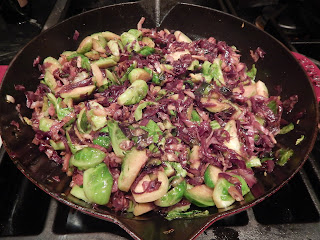
Yield:  4 servings

1 Tbsp olive oil
2 cups thinly sliced red onions
¼ tsp salt, plus more to taste
Freshly ground black pepper, to taste
½ cup red wine
1 Tbsp balsamic vinegar
4 oz bacon, small dice
12 oz Brussels sprouts, quartered (about 3 cups)
4 cups thinly sliced radicchio
2 tsp maple syrup
  1. Preheat olive oil in a medium saute pan over medium heat.  Add the sliced onions and season with ¼ tsp salt and a touch of black pepper.  Saute for 15-20 minutes, stirring periodically.  Adjust the heat as needed to prevent the onions from browning.  This is not a process you want to rush, rather let the onions sweat so they release moisture and concentrate their natural sugars.  
  2. Once the onions are very soft and the steam coming off the pan has lessened, add the wine.  Allow the wine to come to a simmer and cook until it has nearly entirely evaporated, stirring periodically. Once the wine is nearly all gone, remove from heat and add the balsamic vinegar.  Set aside.
  3. While you are patiently caramelizing the onions, prepare the remainder of the ingredients.
  4. Heat a medium to large saute pan over medium high heat.  Add the bacon and cook until crispy and brown.  Remove the bacon from the pan, leaving the grease in the pan.  You will need about 1-1½ Tbsp of fat total.  If necessary, remove some fat from the pan.  If your bacon was lean and there is not enough fat, add a bit of olive oil. 
  5. Next, add the Brussels sprouts and about ½ tsp salt.  Saute until they are tender.  Add the radicchio to the pan and stir carefully to combine.  Let the radicchio start to wilt down, then add the bacon and caramelized onions.  Stir to combine all the ingredients and cook until everything is heated through and the radicchio is fully wilted down.  Remove from heat and add the maple syrup.  Stir to combine and add additional salt and pepper to your liking.  Serve immediately.
Recipe created by Chef Andrea Yoder.