Showing posts with label Organic Farming. Show all posts

Wednesday, November 17, 2021

Wrapping Up the Season….The Bounty & The Blessings

By Andrea Yoder
Aerial view looking down our valley

It is simply amazing just how much food can be produced off of our 110 acres of land tucked away in a valley.  In comparison to some of the large produce farms out west, 110 acres is just a little drop in a bucket, and yet we can produce tons (literally) of food!  It doesn’t matter how many seasons I go through, I think it will always amaze me to see how the seeds that we store in one small room can, over the course of the season, be turned into tons of produce that at times comes close to exceeding our storage facilities!  This week we wanted to give you a little glimpse of what’s been happening on the farm this fall.

The past seven weeks have been a bit of a whirlwind of activities.  Up until about the last week of October we continued to harvest some herbs, greens and other fresh vegetables.  Thankfully we had a pretty mild fall and some of our late planted gamble crops of cilantro, red radishes, baby bok choi and mustard had enough time to mature so we could harvest them.  While we continued those harvests, we also had to prioritize harvesting our crops to put into storage!  First it was a push to get all the sweet potatoes in, totaling around 30,000 pounds.  Next it was burdock root.  This is a high dollar value crop that is very important to our farm.  We can store it for almost an entire year and there are only a few growers in this country who produce burdock root so we have many customers who depend on us!  It also has very long roots so it’s best to dig it when conditions are dry.  We started harvesting some in mid-September, but really did a push to get it all out by the end of the first week of October.  Thankfully we managed to get it all dug before we had rain and our harvest came in at well over 60 bins or about 25,000-30,000 pounds!  That’s a lot of burdock root and to think it came from only about 8 pounds of seed!

Rows and rows of
Beauty Heart Radishes!
Beauty heart radishes were also a priority and with the warm fall we had, they were growing rapidly pushing them close to the edge of being too big.  But we know they are best after some cold weather so we tried to hold off until we got a few frosty nights.  Thankfully we did get that little bit of cold and we started the harvest.  The other tricky part of harvesting beauty heart radishes is they can be very brittle.  If we machine harvest them we often lose a lot that crack in the process.  So we made the decision to maximize our yields and harvest them all by hand this year.  Overall we harvested well over 20,000 pounds and we still have about 14,000 pounds remaining in the cooler that we’ll continue to wash for orders and CSA boxes we’ll be delivering through the end of the year.  

Brussels Sprouts on the stalk,
going into storage
As our main cooler started to fill up, I knew it was almost time to transition our warm temperature cooler to a cold storage area.  No problem, except at that time we were storing about 30 bins of potatoes in that cooler!  I held off as long as possible, but then Richard declared it time to harvest Brussels sprouts.  In late October we saw the first forecasts for temperatures dipping into the low 20’s.  While Brussels sprouts can withstand multiple frosty nights, dangerously low temperatures in the 20’s can cause damage.  In Richard’s 30 plus years of living in this valley, he also knows that a forecasted temperature of 25 degrees can mean an actual temperature of up to 10 degrees colder in the valley.  Brussels sprouts are too important of a crop to lose, so we started loading up wagon after wagon with bins to bring them in on the stalk.  It takes a lot more storage space, but it’s a much faster harvest and on frosty mornings we can snap them off the stalks.  Just before the first load came in, we emptied the potato storage cooler and moved all the potato bins to a refrigerated trailer that we use once a year in the fall.  I decreased the temperature in our previously warm cooler to 34 degrees and it was ready to store Brussels sprouts.  I lost track of how many bins we harvested overall, but it was around 40 or maybe a little more.  We still have about 20 bins in the cooler and overall we’ll yield about 5,000-6,000 pounds of sprouts!  

As we closed out the month of October, we’d fill up our already full coolers at the beginning of the week as we prepared to pack CSA boxes on Wednesday and ship wholesale orders for the first part of the week.  We had to get creative, we had to remain very organized.  Everything had to have a place and there were some days when there was one way into a cooler and one way out.  On a few occasions, we had 20-30 bins of root vegetables stacked outside at the end of a busy harvest day.  But after the crews unloaded we always managed to find more space to get everything into the appropriate storage environment.  At the end of the day on Wednesday after we had loaded all the trucks, we’d breathe a sigh of relief only to wake up the next morning and do it all again for the end of the week!  While our rutabaga crop was mostly a loss and this year’s carrot crop was a disappointment with very low production, we have still had a very bountiful fall harvest and year overall!  So facing the challenge of exceeding storage capacities is actually a good problem to have!   

The majority of our crops are in now.  We still have a little tat soi in the field along with our little planting of specialty crosnes.  Aside from that, our mission now is to trim, wash, pack and deliver all these vegetables!  This week we’ll be delivering about 52,000 pounds of vegetables total including all of our CSA deliveries as well as orders we’re sending to our wholesale and retail partners.  That’s a lot of vegetables!!   Our crew has been working very hard all season, but especially over the past few weeks to help us get everything harvested as well as working diligently so we can fill our orders, pack CSA boxes and meet all of our deadlines.  We’ve already said goodbye to 11 of our H2A crew members who returned to Mexico at the end of October.  This week we’ll be sending 14 crew members back to their families who are very anxious to welcome them home!  We’ll be taking a little break next week to celebrate Thanksgiving, but we’ll be back at it the next week washing and trimming more vegetables, finishing the last of our field work and some of the other outside missions still remaining on the list.  It’s been a busy, yet very rewarding fall.
2021 HVF Crew Photo (brief moment without masks)

Thus is the nature of our business, the push and the pull, the cycles and the seasons.  As we move into winter we look forward to a little bit of rest and rejuvenation.  We also pause to reflect on the many blessings we’ve received this year, the bountiful harvests we’ve brought in and the thousands of people who have received nourishment from the food that has come off our land.  As we celebrate Thanksgiving next week, it’s an understatement to say we have a lot to be thankful for this year.  

As we wrap up this growing season, we’re already working towards next year.  Our garlic, horseradish and sunchoke crops are planted as is our overwintered spinach.  Fields have been composted and planted to cover crops.  Irrigation equipment is tucked away in storage and we have a list of supplies that need to be ordered to be ready for next season.  Now we’re focusing on cutting and storing firewood, maintenance and repair projects and cleaning up some brush and field perimeters of overgrown trees, etc.  We’re also working on the 2022 CSA season and will be sharing more information about that with the next CSA delivery in December.  

We hope you have a wonderful Thanksgiving in whatever way you choose to celebrate.  We are grateful for your support of our farm and hope you have enjoyed the bounty of the 2021 season.  Take care and we’ll see you in December to officially wrap up our 2021 CSA Season!

Wednesday, July 4, 2018

Maintaining Organic Integrity


By Farmer Richard

Last week we had our annual organic inspection.  We’ve had this annual inspection every year for over forty years and have been inspected by three different certifying agencies.  Despite our history, we go through this inspection and our practices are reviewed every year in order for us to continue to be certified organic producers.  I’ve always been an advocate for organic certification and have encouraged many farmers to do the same over the years.  In fact I was part of some of the earliest efforts to form and support organic certification and was one of the first farms to be certified in the Midwest.  In order to understand today’s organic marketplace, I think it’s important to understand a little history.

The OGBA (Organic Growers and Buyers Association) of Minnesota was one of the first independent certifiers and was the certifier I worked with to get my organic certificate and be recognized as a “Certified Organic” grower when I was farming in Eagan, Minnesota back in the 70’s and early 80’s.  After moving to our present farm in Wisconsin I helped start the OCIA Wisconsin Chapter#1 (Organic Crop Improvement Association), which is still in existence and continues to certify worldwide.  From OCIA Wisconsin Chapter #1 was born MOSA (Midwest Organic Services Association) which is headquartered out of Viroqua, Wisconsin and is our current certifying agency.  They are a good, trustworthy organization!
 
In 1990 Congress passed The Organic Foods Production Act which mandated that the USDA would develop and write regulations to establish national standards for organic producers.  The purpose of this legislation was to bring clarity to the organic market place and establish a set of national standards.  Organic inspections are done by dozens of independent inspection agencies.  The USDA audits those agencies for compliance with the NOP (National Organic Program) standards.  The NOP is guided by the NOSB (National Organic Standards Board) appointed by USDA to oversee organic standards.  The NOP is now the federal regulator of these organic standards.

Organic inspectors are part of an independent certification organization where they receive training and guidance from experienced inspectors.  They do not “work for” any one certifier, but may do inspections for more than one.  I took certifier training in 1988 when I helped found OCIA Wisconsin Chapter#1.  Not because I intended to be an inspector, but wanted to know how well inspectors were trained.  I wanted consumers to trust “certified organic” and the certification process.  We have “trained” new inspectors through our own organic inspections and have been part of USDA Audits.  I have seen numerous producers who want to sell in the organic market, but want to hang on to their favorite conventional practices.  “I’ll just use a little Round-Up to keep the weeds out of my asparagus, it is safe!”  “A little ammonium sulfate fertilizer is needed to keep my crops green.”  “I can’t do all the paperwork that is required for certification.”  I’ve heard these phrases many times over the years and I’ve learned that the people saying these things are really saying “I do not have a clue about my operation because I don’t keep records!  I have no ability to ‘trace back’ and I don’t really know what inputs are approved for organic production.”   Part of going through organic certification is also about education and awareness, which is good for any farmer!

One of the reasons I’m an advocate for organic certification is that I don’t think consumers should have to be able to ask a producer about the many details of their production.  A consumer should be able to trust the standards upon which an organic farmer is held to and know what that certification represents.  There are hundreds of suppliers trying to sell products as “natural & organic,” but are they?  There’s another organization called OMRI (Organic Materials Review Institute) that is very important for organic growers.  They precede the NOP and continue to be approved by the NOP to review all products including additives and fillers to get “OMRI approval.”  We only use OMRI approved products because we trust their scientific diligence more than any sales person or brochure and it makes certification much easier when we’re using products we know are already approved.

So what does an inspection involve?  Our inspector arrived at 9:00 am.  We started with a facilities tour, at which time he chose three crops to audit for trace back.  We continued the inspection and showed him all of our buildings, every field, all the animals, animal housing, pastures and our ducks. He was also able to view the first hatch of 21 ducklings!  We showed him our intentional habitat for pollinators and beneficial insects and creatures.  He also observed our crop production systems including the use of reflective mulch to deter pests.  We use this as a first line of defense for problem pests and consider it a “must” before we use any organic based pesticide.

Then the paperwork!  We were asked to show every input from seed to harvest, from field to end customer as part of the trace back audit.  All of our products are assigned a lot number that allows them to be traced back to the field they were grown in, the day they were harvested, who harvested the crop, etc.  Additionally, we have to provide documentation of what seed was planted, the field work associated with the crop, etc.  Compare that to the recent illness and death from contaminated romaine lettuce and pre-cut packs.  It took weeks and still no resolution for the cause of contamination.  Most conventional foods have no trace-back or lot number system and thus, no transparency.  If you want cheap food, that is what you get, no accountability.  Certified organic has always required traceability!  We passed our audits, provided all the information and supporting evidence he asked for and did our exit interview at 3:30 pm.  Our inspector submitted his report to MOSA where it will be reviewed by the MOSA review board and we expect to receive our renewal that will include our “free-range organic ducks” this year! 

Organic Integrity?  Is it a process you can trust?  If the certifier is MOSA, for sure.  In my opinion, they are the best certifying agency available.   The USDA Organic seal?  Well there are some problems!  When organic sales rose to several billion dollars, the Big Ag players wanted to get in on the market.  Of course, they didn’t like the rules so they paid politicians to represent them and get the rules changed.  They got the animal welfare and pasture rules thrown out and “no soil” hydroponic production is now in.  So if you buy the cheaper organic at the larger chains you probably are getting milk from cows that never see a blade of grass and organic eggs from chickens stacked three deep per square foot and never see the outdoors.  MOSA says they will not certify those farms, but there are several certifiers who will.  You can look at scorecard reports from Cornucopia Institute, an
excellent “organic watch dog” organization.  They have reviewed many companies who say they are organic, yet there practices are not in line with the standards.  USDA has not done
due diligence to preserve “organic integrity.”  There were significant quantities of fraudulent organic grain shipped from Turkey and Russia that should have been stopped at the port of entry.  We are now watching the development of standards that go “beyond” USDA organic that are being developed by the Organic Farmers Association  headquartered at Rodale Institute. They plan to certify farmers for all aspects of “organic integrity.”  In the meantime, buy with care and, as always, it is best to know your farmers!

Wednesday, June 27, 2018

Evolution of a Farmer

By Dennis de Wilde

Dennis was out checking the crops with
Farmer Richard on Monday. Looks like the
tomatillos will be ready soon!

So, I am on my semi-annual visit to my brother’s Harmony Valley Farm….always an enjoyable experience to be in “the valley” and observe the bustle of more than 40 people engaged in the work of raising and marketing over 100 different varieties of organic vegetables while hearing how this large “farm family” is dealing with the accompanying weather and every year’s new business challenges. (As a retired business consultant, I find the depth and breadth of these challenges and the solutions to deal with them to be fascinating and inspiring.)  And, I often wonder, “How did this brother (Farmer Richard as he is now known) evolve, from the teenage rebel I grew up with, into the successful businessman/Farmer he is today?!”

Now and Then: Richard with his
high school yearbook.
In some ways, it is not so hard for me to look at who he was and to see how he became who he is today.  As brothers who were born only 16 months apart and were more or less of the same physical size since age 8/9, we shared equal responsibility for yard chores and later farming duties on the 800 acre family beef and grain farm in northeastern South Dakota.  But, it was clear from the start that Richard was the leader (or the brains of this duo), while I was a skinny version of the brawn - in other words, he laid out our daily work program and I executed (Richard also did his share). But more importantly, he answered to (or argued with) Dad regarding the planning decisions he made and the results from our efforts – Dad had a part-time day job, once this two-son crew was able to take on the farming duties.  Richard was leader, yes; but no one would have thought he was destined to be a Farmer – he left the farming to me and a younger sister every summer after his sophomore year in high school.  He spent the first summer weed-walking bean and corn fields in Nebraska, he worked a salmon fishing boat in Alaska the next and it was the stone quarry after that.  Now, while some might observe that he was a young lad mostly interested in young ladies during those summers away from the farm, I remember him returning with observations connecting the how and why regarding the way they did things in these different environments – he was an explorer and a learner.  When he returned at the end of the summers, he saw no reason not to put his new learnings into practice – an independence that may not have always been appreciated by the farm owner, his father.  No problem for Richard; he just did it his way – at the farm and, now that he had used his summer earning to buy a ’55 Chevy,’ in his personal life!  A rebel was born in of all places, South Shore, South Dakota.
 
As he entered college, his explorations, learnings, and independence became a way of life.  It was the late sixties; long-hair and non-conventional ways were in.  The rebel bought a motor bike (650 BSA) and chopped it!  He spent a summer hitch-hiking to California. He met people who thought differently about the world – where it had been and where it was going.  Earth-day was born – the seed of a cause was planted and Richard was a welcoming vessel.

He graduates college, with a degree in Mining Engineer and takes a conventional position with the US Bureau of Mines – a “new age” rebel with a bureaucratic day job. The Earth-day cause has far more pull for this explorer and learner than coming into an office day after day.  The questions “What is the purpose of this work, how can I change things, why am I here?” must have been bouncing around his head every day and night.  Without a connection between his cause and the work he was doing, the passion was missing – the separation from the Bureau of Mines was inevitable.

Blue Gentian Farm, Eagan, MN,
where Richard started exploring organic farming
Richard starts hanging around a day-care center for autistic children.  He enrolls in a graduate program to study autism.  He rents an old farm house – he is effectively back on the farm!  He wonders if there is a connection between chemical proliferation in the farming industry and the increase in the rate of the development of autism.  He re-connects with his farm upbringing, but he connects that with his Earth-day passion – he explores organic farming before organic farming was a defined methodology in the US agricultural community. It is 1973 – he has a cause and the rebel is determined to make it a career.  He will do it his way.  He will prove that you can integrate the honoring of “Mother Earth” and business success.  He will commit to a holistic lifestyle as a businessman (oh, that word was not used until years later, but it is fair to say it was that even then).  He will commit to making the world a better place by changing how farmers feed us.

Richard in the early days at Harmony Valley Farm
Over the following 40 years he goes on to train and inspire many new young farmers.  Learning to manage a business, manage employees, inspire employees and educate consumers.  And now I watch as he works to transition Harmony Valley Farm to dedicated employees. 

Thus, in hindsight it is easy to see how a first-born son of a strong-willed father accepts the challenges and opportunities that grants; becomes a leader who pushes boundaries and meets the complex challenges of growing and marketing organic produce to be enjoyed by those who understand, you are what you eat!

Wednesday, June 6, 2018

June Farm Update


By:  Farmer Richard

It’s been 7 weeks since the last farm update we shared with you on April 19, written with a foot of snow on the ground!  In that update we reported that this year sets the record for the coldest and wettest spring in the forty plus years since I started farming!  Despite that crazy, wet, snowfall in late April, we were able to do our first spring planting on April 24 which is one full week later than any other year I’ve had farming.  The late start to the season would suggest that all of the crops would be later and heat loving crops like tomatoes, sweet corn and peppers would be equally late and have a short season, barely making it before the first fall frost!  Well folks, keep reading as I have some good news!!

Onions in the greenhouse
We had to plan our greenhouse transplants for a “normal” year.  We started planting in late February and actually had some really nice, sunny days in March.  We have new plastic on all the houses, so our early seeded crops took off nicely and even when the days became more cloudy, the crops continued to grow and were ready pretty much on schedule.  As soon as the skies cleared (and the snow melted away), we seized the few dry days we had to prepare ground, lay plastic (for some of our transplants like onions and tomatoes) and tried to keep our field plantings on schedule.  When greenhouse transplants are ready, they really need to get to the field!  However, just because you get a plant to the field it doesn’t mean it’s going to take off and grow, especially when it’s cold as it has been this spring.  


Antonio, Jose Luis & Carlos laying out hoops to cover zucchini
We decided to invest the time and energy into covering some crops with row covers to help trap heat and accelerate plant growth.  We cover some crops every year, but this year we had so many fields to cover that we had to fill an extra 1,000 sandbags and cut 1,000 new wire hoops to put over the beds to keep the covers from damaging the transplants under them.  Without the hoops we risk giving the plants cover abrasion and we need the sandbags to hold all the covers in place!  We couldn’t have covered all of these crops without our amazing crew!  When we had only a few dry days to plant and cover, they were asking “can we work late to finish?”  They repeatedly tell me, “if we don’t plant it and take care of it, we don’t have a crop to harvest!”  It’s important to get the big picture! 

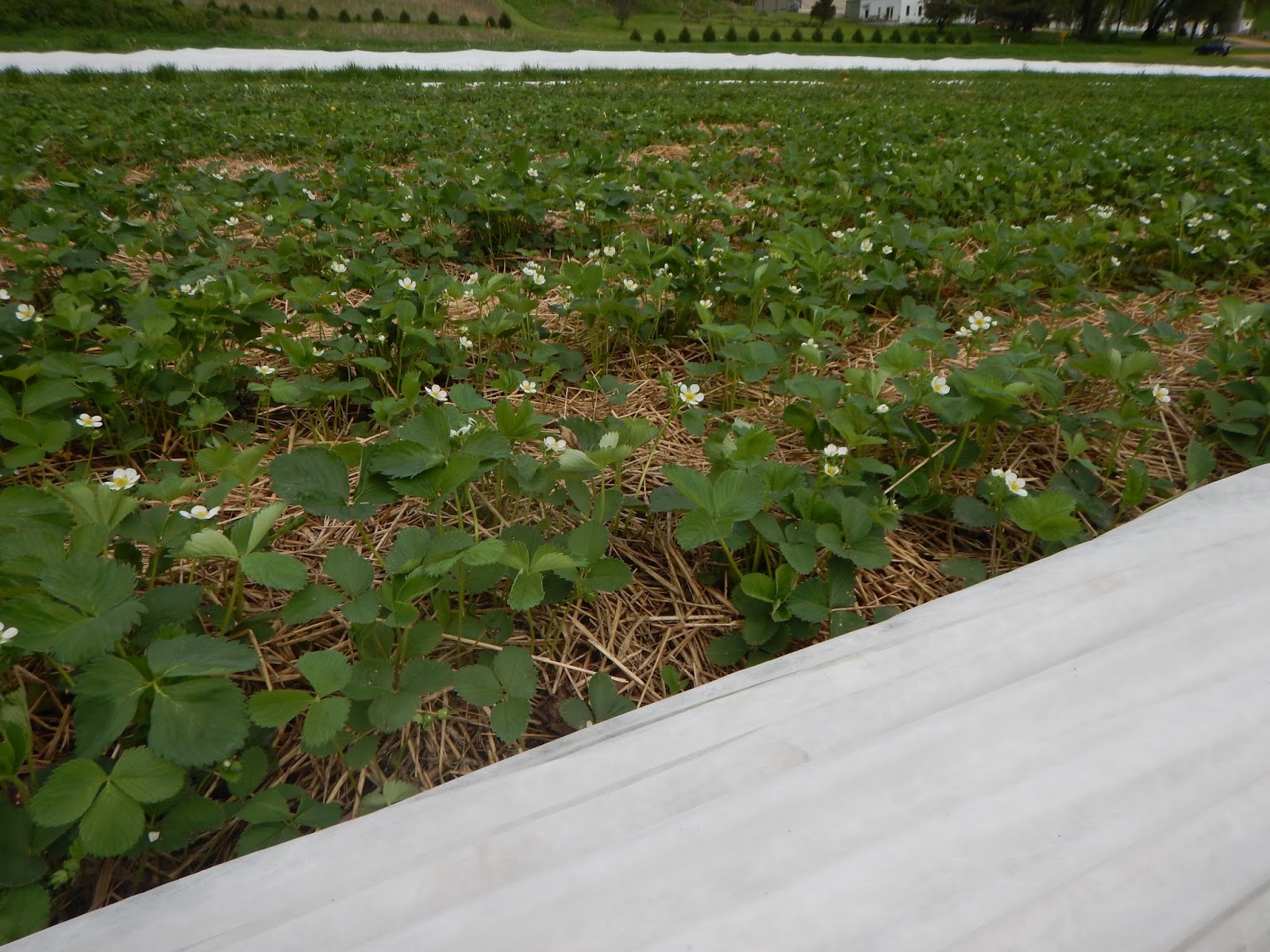
Strawberries right after the covers were taken off.
We are well aware that it is our crew’s dedication to getting the crops planted on time, covered for protection from cold and storms and willingness to work late some nights that has changed the picture from coldest/latest spring to bring us pretty much back on schedule!  Does anyone remember that heat wave we had at the end of May?  We went from cool growing weather to blazing hot!  Those covers we had on everything…..most of them had to come off because now we ran the risk of the crop getting too hot!  We had to uncover the zucchini, cucumbers, tomatoes, peppers and eggplant.  When we did, we were really happy to see beautiful plants that now appear to be growing at a normal rate!

Zucchini plants thriving after being uncovered!
Vicente and the irrigation crew members receive some acknowledgement here as well.  They have worked diligently to set up all the drip irrigation making it possible to give many of our new transplants a small drink of water mixed with fish and kelp fertilizer shortly after they were planted.  The combination of water and nutrients followed by a week of unseasonable, warm temperatures and we really saw some growth under those covers!  We are now ahead of schedule for zucchini, cucumber, melons, tomatoes, eggplants and peppers!! 

We have two crops of sweet corn and beans up and growing and one planting of edamame.  We lost about 25% of the first planting of corn to the Red Wing Black Birds.  Unfortunately they found that they could dig up the corn seed that was planted shallow because the soil was cold and we wanted the seeds closer to the surface so they would receive heat from the sun.  These were pretty determined birds that didn’t seem to mind the “scare eye” balloons and shiny streamers we put in the field to try to deter them.  They ignored our tactics and continued to dig up the seeds.  So our solution was to feed them organic corn on the edge of the field.  That actually did work as a decoy and and we still have 75% of the crop!  It’s hard to get upset with these birds, after all they have babies to feed and we’re always encouraging parents to feed their young ones more organic vegetables! 

Luis and Felix G mastering the new cultivator
If the weather cooperates we can still have a great year!  Right now we’re working really hard to battle the weeds.  Rafael has done a superb job of flaming crops to kill weeds just before a crop comes up.  Our local Cenex crew has been super cooperative in keeping our flamer filled and repaired.  A few gallons of propane used on the precise day saves hours and hours of weeding later!  The result of being diligent and staying on top of flaming is the main reason we have two beautiful crops of early carrots and five acres of parsnips, cilantro & dill!  Rafael has also done a lot of mechanical cultivating and has been instrumental in directing other cultivating crews.  Luis and Felix G have become masters at operating our new Kult/Cress German cultivator.  They’ve learned how to work together to use this machine to mechanically kill a lot of weeds! 

HVF crew hand weeding parsnips.
Andrea gets huge credit for keeping ahead of our frantic spring planting schedule.  Simon has also been a key player in helping us keep the greenhouse plantings on track and has helped with our “hot water” seed treatment for some seeds and biological seed treatments for others.  Andrea has also worked hard to maintain our seed inventory and provides planting plans for each crew every time they go out to plant.  Gwen is now learning the ropes of managing our records once a planting is done.  It’s super important that we have good, complete records both for our own use as well as for maintaining our ability to trace crops back. 

Our Strawberry Day event is coming up on June 17, and yes it looks like we’ll have strawberries!  We hope to see you at the party, or join us for the weekend and do some camping!  We have had a few CSA member visitors this spring and we welcome more.  If you’re interested in camping, we’d love to offer you a spot in one of our two campgrounds or reserve our cabins for your stay. 

Bee pollinating the strawberries
As I write this article on my back porch, I have marveled at the dozens of hummingbirds and the many bumblebees that I see coming to visit the columbine flowers in our yard.  Our strawberries are being pollinated by small bees I collectively call “sweat bees.” As the light dims and the day turns to night, I am in awe of the whippoorwills singing to me.  After a five year absence when we didn’t hear them in our valley, we’re very thankful that they’ve returned!  Every night we listen as they sing us to sleep and every morning they wake us up like an alarm clock, right outside our window.  Despite a challenging spring, life is good!

Wednesday, December 13, 2017

So What Food System Will You Support?

By Farmer Richard

Towards the beginning of this CSA season, we were faced with the buyout of Whole Foods Market by Amazon.  Given we grow a significant amount of produce for Whole Foods Market, this buyout weighed heavy on our minds and left us wondering how this business decision may trickle down and directly impact our farm.  It also left us wondering what may happen to our food system in general as we as a society adapt to the changes in the market place.  We truly believe our future and the future of society is in the hands of the consumers.  Over the course of the season we have tried to report on a variety of  topics to impress upon our readers about how our food purchasing choices affect our health, our community, our downstream communities and more.  Our choices will sculpt our future food system and are based on and related to more than just the basic price of an item.  So what are the issues?

One of the most important issues that plays into the bigger picture view we are seeking is our health.  Choosing to eat more organic vegetables grown locally and in their season is one of the best ways to maximize the nutrition you get from your food as produce received directly from the farm typically is more fresh and thereby has retained more nutrients.  Vegetables grown in nutrient dense soils are especially high in antioxidants and other nutrients.  Just as you would seek out an experienced surgeon with lots of experience to perform a surgery, so it is with finding an experienced farmer to grow your vegetables!  For those who choose to include meat in their diets, choosing to eat only meat produced locally from pastured animals and grass-fed beef may be the healthiest choice.  Eating local and in season is also beneficial for community health.  When food is grown locally, there is an opportunity for any “extras” to go to a local food pantry, thereby opening up access to fresh, nutritious produce in communities that may otherwise have limited access or be unable to afford purchasing fresh food.  This year we donated over 30,000 pounds of fresh vegetables to our local food pantry that picks up weekly at our farm during the growing season. 

More and more people are choosing organic for health reasons including to minimize pesticide residues and to raise healthy children!  We applaud your choice.  But organic is available everywhere now.  Not just the co-ops and farmers markets, but almost every grocery chain including Wal-Mart.  Even convenience stores, ie in our area Kiwk Trip, now carry some organic products.  But is all organic the same?  Unfortunately, the answer is No!

Rooster keeping an eye on his hens!
Muscovy Duck with ducklings.
When I started as an organic farmer in 1973, there were very, very few organic customers.  Now something like 65% say they buy organic at least sometimes.  Organic now represents 10% of food purchases and some 10 billion dollars, enough of an impact on the market to attract the “big business” players.  That is good and yet a huge complicated “bad.”  Money, greed and politics all come into play in what once was our small scale arena of trust and integrity.  Now we have big business, “green washing,” “white wash and hog wash” politics and fraud infiltrating into the organic market place too!  Take eggs as an example.  We have a small flock of chickens in a mobile coop that are totally free range.  They scratch and forage in the pastures and are really healthy and happy birds.  Their eggs are fantastic!  Their yolks are not just yellow, but rich golden in color with the same rich flavor.  Our hens will raise new chicks in the spring to sustain our flock and continually be replacing birds that pass away from old age and the occasional bird that falls victim to predation.  Same with our flock of ducks.  They raise their own replacements, they live on the creek, they fly and only come home at dark to eat a little organic grain and then retire to their safe house that we secure them in for nighttime safety from predators.  We could expand our chicken flock to 400-500 birds housed in a mobile coop the size of a school bus and move them to new pasture every few days and produce those eggs with golden rich yolks, but we are not looking for a new business and with the labor involved, we would need to get $5-$6 per dozen for those wonderfully tasty and nutritious eggs.  How many of you would sign on to that?

So we went to our neighbors who raise organic eggs for a major co-op.  They have 2 chicken barns that hold 10,000 chickens in each and look very much like an industrial egg factory, but with some important distinctions.  They have no cages for laying hens and they give their birds 2.5 sq ft of space inside and provide a nice outdoor yard with shade and dirt to scratch.  Their egg yolks have a little color, but nothing like a totally free range bird.  They need to get $4.00/dozen eggs to survive.  They are lamenting that their co-op has lost market share because the new organic rules for pasture and outside access has again been delayed by large scale factory farm lobbyists who are also producing organic eggs.  While our neighbor is already in compliance with the new organic rules, the factory farm lobbyists want to stick with their 1.5 sq ft of space and little or no meaningful outdoor access.  Those eggs sell for $3.00/dozen at many, many supermarkets. 

So there is my example.  Beware of the sales promos that show young girls in a dress carrying fresh flowers with happy chickens or cows and a red barn in the background!  It is marketing PR, pure and simple and a certain amount of “hogwash.”  On the bright side, at least they are eating organic feed and not being fed antibiotics and/or hormones.  Organic is now “big business” and it is a difficult task for you the consumer to sort out the truth from the hogwash or chicken wash or green wash!

The same is true for vegetables, most of the big players now also do organic including Grimmway, the largest producer of vegetables in the world.  And frankly, they do have the resources to do a pretty good job!  We can’t forget about the home delivery meals and CSA style “look-a-likes” that claim to be helping support local farmers, but substitute cheaper conventional to help their bottom line with less than transparent disclosure.  Read the recent NY Times article about the local farmers left with crops in the field when the delivery service with their sophisticated software to offer “your choice” for “your box” suddenly goes into bankruptcy.  We experienced the same with Door to Door Organics, a home delivery company in Chicago that we grew for previously.

So what about the original, traditional CSA model where consumers, eaters, pledge/commit to support a farm and farmer for better or worse!?  That is the model that is suffering and experiencing decline across the nation.  Why is this? 

It requires a “two way street” and a little give and take between farmer and eater.  The farmer pledges to do their best job, given their experience or inexperience to provide a season of produce or meat, or eggs, etc for the supporting eater.  The CSA member agrees to learn to “eat out of the box” and eat seasonally.  The catch is that a real CSA commitment requires a very experienced farmer team who can grow a very wide variety of crops throughout the season in order to provide a balanced full box for a long season, 30 weeks in our case.  We refer to it as “graduate level” growing, not for beginners, and we are confident that we do the best job of any!  But the two way street?

Harvest Party at Harmony Valley Farm
We read and understand the requests to customize boxes, let us order just what we want.  We looked at the sophisticated software for individual boxes, the crew time to pack those boxes, and the chance of pickup mistakes that we are expected to remedy and those costs are huge!  We can do special orders to help you meet your needs, but for now we are pinning our hopes on our solid, members who have been able to make the transition to seasonal eating.  We hope these successful members will help us find those increasingly rare families that do cook and want to learn about new vegetables.  This is a necessary part of a successful CSA experience. In other words, rather than us transitioning to a personalized delivery service, we need to find those that will make the transition to seasonal eating.

I hesitate to say this, but here it is!  It is not just about “me,” “what I want now,” easy order, delivered to my door, now!  This may be the present climate and there are a world of companies preparing to meet that “me, now” mentality, but we are pinning our survival on a more traditional Community Supported Agriculture, where it is a two-way street of learning, new foods, etc.  Kids can come to the farm, even only once to experience picking all the strawberries they can eat or picking their own pumpkins.  We have seen, and many of you have experienced, the transformation that can come from that experience that changes lives forever.  That is our core, that is our wish.  In this day and age of “me first” please help us continue a historic connection to food and land, our land, your farm, we your farmers.
Farmer Richard and Chef Andrea


Wednesday, November 15, 2017

Carrots & People: What Really Matters?

By Andrea Yoder

Andrea motoring around the cooler!
Waste…it’s hard to face, for some, yet in my day to day work it is inevitable.  Yes, I’m the one scrounging through the bin of vegetable waste and trimmings on the wash line trying to save every last vegetable with thoughts like these rolling through my mind:  Why are there so many carrots being discarded?  These look just fine!  This crew is being too picky….and then I pick them up and realize the crew is doing just fine.  The vegetable may look fine on one side, but was discarded because maybe it had a split, a small bad spot, was shaped funny, maybe slightly discolored, too short, too fat…the list goes on.  Throughout the year, but especially during fall/winter root crop season, my days are filled with tracking inventories—How many bins of carrots do we have?  How many more do we estimate we’ll be able to harvest?  Where will we store them?  How many do we need to reserve for CSA boxes?  Who will buy the extras?  Do we have enough or do we need more?  Along with tracking inventories, I do a lot of forecasting, anticipating what we’ll need for CSA boxes, reading the minds of our buyers to anticipate the items and quantities they might buy between October and the end of December.  Of course, in the midst of inventories, forecasting, packing CSA and wholesale boxes, I’m tracking yields.  This lot of carrots is only yielding 500# per bin instead of the usual 650#....why is that?  Wet harvest day and we brought in a lot of mud?  Too many forked carrots that have to be discarded?  Too many splits? 
Bin of 'funny' carrots.
Earlier this week as I was motoring around the cooler on my forklift pulling bins for the crews to wash, carrots was the subject matter that laid heavy on my mind occupying my brain space.  The pallet of ‘funny carrots’ (the name we lovingly give to odd-shaped carrots) is getting pretty big.  Where are they going?  Will I ever find a buyer for them?  We’re generating more than the food pantry can take, perhaps I should just compost them.  But they’re good carrots!!!  They’re sweet, delicious, and well—they’re interesting and have character!  In the course of washing tons (literally) of carrots, we have to face the sobering fact that they are not all perfect.  Despite the fact that they are perfectly wholesome, delicious, sweet carrots, they are considered of lesser quality and value in the marketplace!  I can’t say I like this reality, but it’s not a bias I can change singlehandedly.  Of course, our goal is to maximize yields and get a favorable return on the crop.  But what do you do when no one wants these less than perfect carrots?  Are they truly worthless?  Who decided the “perfect” carrot is long & straight?

You know, carrots and people have more in common than any of us may ever have taken the time to reflect on.  Carrots, just like people, come in a rainbow of colors…yes, there are more colors of carrots than just orange.  We grow beautiful bright orange carrots, but we also grow some stunning dark purple varieties as well as bright, golden yellow carrots, red carrots and even white carrots!  Carrot seed is produced all around the world, with some seed coming from Oregon state in the US while other seed is produced in France and even South Africa to name just a few locations.  But when someone looks at a carrot or takes a bite of it, does it really matter where that carrot came from originally or what color it is?  I might choose to use purple carrots for roasting and orange carrots to make a soup because these are the preparations where each color will shine the most, but aside from that the color of the carrot doesn’t matter as long as it’s a delicious tasting carrot!   

In the vegetable industry, there is a classification system for sorting vegetables.  Straight carrots are sorted as “number 1,” carrots that are slightly less than perfect end up labeled as “number 2,” really crazy looking carrots are called “number 3,” etc and with each class ranking the value of the carrot decreases.  The reality is that every crop of carrots is different and the perfect, straight, number 1 carrots may only be a small percentage of some crops.  Of course these perfect carrots are what every buyer and customer wants, they’re obviously more desirable and more valuable…is that true?  And those less than perfect carrots that are left behind?  What are we supposed to do with all of those?  Does an imperfection in the shape of how a carrot grew make the carrot bitter or somehow inedible?  In my experience these carrots taste just as good as the straight ones, we just haven’t grown to the point as a society where we can willingly accept and embrace their uniqueness.  Yet every carrot has a purpose and in the hands of the right person, that carrot can realize its purpose. 


'Funny' Shaped vegetaables are beautiful in their own way!
As with carrots, so with people.  We’re not all “perfect,” but we all have purpose and value.  Is it fair to toss aside those people/carrots that aren’t perfect and deem them “less valuable” than the others?  Perhaps they require a little more care and attention to trim them up and make them usable, but if you make a pot of delicious carrot soup, when its done you won’t know if it was made from a straight, perfect carrot or a funny shaped carrot.  If it was a good tasting carrot, that is the characteristic that will leave the lasting impact.  Those funny shaped carrots demonstrate the harsh realities of life in a field.  Sometimes you hit a rock or a hard spot in life that might set you back.  You can give up, wither and fade away, or you can push through and overcome the obstacle.  In the case of a carrot with a funny shape, that doesn’t represent an inferior carrot, the shape demonstrates the fact that this is a carrot that came up against adversity and continued to push through, determined to grow and make something of itself.  Carrots can’t get up and choose to relocate to a different field.  They have to do the best they can with what they have.  This year our carrots had some trying times---first it was too dry, then it was too wet.  Yes, all these life events played a role in shaping their final outcome, just as we too are shaped by our life experiences.  Just because we may look or seem a little different than someone else doesn’t mean we’re less valuable.  Yes, funny carrots require a little more time and attention to trim and clean them, but on the inside they are still sweet and delicious!  Funny and broken carrots that might be tossed to the side, discarded and ignored, may be the most valuable carrots to some.  A farmer might snatch them up…. “Hey I’ll take these.  They’ll be a great source of nutrition for my animals.”  Or another farmer might want them to work into his compost pile to create compost to put on the field to feed another year’s crop.  A chef might spot them and say, “Oh, let me toss these in my stockpot.  They’ll add depth of flavor and a special sweetness to this stock!” 

And so it is with people.  We all have our own purpose in life and while some may seem to have a more glorious purpose than others, at the end of the day it takes all of us to make this world work.    Let us not be too quick to judge, but rather lets embrace the diversity and uniqueness of each person/carrot while focusing on the positive qualities that really matter, offering a little extra time and patience to work with them, and allowing them to become the something beautiful, sweet and valuable that they were meant to be.

No, I never really thought a carrot could teach me anything about life, but there are some important parallels we can embrace.  With open minds, hearts and appetites, I hope we can all move forward into this season of Thanksgiving and a new year with a heart of gratitude and acceptance for all the people of this world and all the carrots of the fields.  Happy Thanksgiving.  

Wednesday, November 1, 2017

Glyphosate: An Important Update

By Andrea Yoder

We’ve included reports about glyphosate in our newsletters in previous years, but sadly this chemical and its issues have not miraculously disappeared from the headlines or from our lives.  We all have reason to be concerned about this chemical as it is now the world’s most widely used herbicide and can be found extensively throughout our environment, our food supply and in human bodies across the country and world.  Glyphosate has been in the headlines recently, including just last week when the European Union held their initial round of votes on October 25, 2017 regarding the proposed 10 year re-license for glyphosate use within the European Union, which expires on December 15, 2017.   The majority voted against the re-license and has voted to ban glyphosate completely by 2022.  Additionally, they have voted to impose restrictions on its use starting in 2018.  While we could write volumes about glyphosate and the controversy and health & environmental impacts it has caused, we wanted to provide you with a brief update.  For those of you who are not as familiar with glyphosate, its use, etc, we’ve also provided several resources for you to further your own understanding of this dilemma we’re all in, whether we like it or not.  As consumers, we need to practice our right to make informed decisions regarding our purchases, and in this case specifically food purchases.  The choices we make can have great implications on our own health and well-being as well as casting a vote in the marketplace.

Glyphosate, the active ingredient in Monsanto’s Roundup herbicide, patented in 1974, is now the world’s most widely used pesticide.  When it was initially introduced into the market, farmers used it as a pre-emergent herbicide to kill weeds before planting their fields as well as for weed control in non-crop areas.  In 1987 6 to 8 million pounds of glyphosate based herbicides (GBH) were applied in the US.  The first genetically modified (GMO) seeds were commercially planted in 1996 and were made to have resistance to glyphosate, thus the two were meant to be used together.  By 2007, the amount of GBH being applied in this country rose to 180-185 million pounds.  In more recent years GBH have been used as a pre-harvest desiccant for small grain crops including wheat, barley, oats, lentils, flax and dried beans with the intention of accelerating the dry down of the crop before harvest.  Because the chemical is applied so close to harvest, high levels of the chemical are found in the crop and the food products made from them.  GBH are now being used quite extensively on both GMO and non-GMO crops which has led to even more chemical being applied on US agricultural land.  In 2014, approximately 240 million pounds of GBH were applied in the US alone.

While the manufacturers of GBH continue to claim it is harmless, there is plenty of evidence to the contrary.  In 2015 the World Health Organization’s (WHO) International Agency for Research on Cancer (IARC) classified glyphosate as a probable carcinogen to humans.  On July 7, 2017, California’s Environmental Protection Agency added glyphosate to their Proposition 65 list of chemicals known to cause cancer.  The IARC’s classification of glyphosate as a probable carcinogen prompted many to file lawsuits against Monsanto by people alleging that exposure to Roundup herbicide caused them or their loved ones to develop cancer.  There are currently more than 50 lawsuits pending in the U.S. District Court in San Francisco.   

There are many problems with the use of glyphosate, making it overwhelming to even know where to start.  The use of GBH as a desiccant so close to harvest has led to a significant increase in glyphosate and its primary metabolite in food products including seemingly benign foods like Cheerios!  While food products are not being extensively tested for glyphosate, Food Democracy Now in coordination with the Detox Project requested testing of some food products at a FDA-registered food safety testing laboratory.  They found extremely high levels of glyphosate in common food products including Cheerios breakfast cereal, Ritz Crackers, Oreos, Doritos and even Goldfish crackers.  Glyphosate has also been found in honey, beer and wine.  Last week a research letter was published in the Journal of the American Medical Association (JAMA) regarding the findings of increased levels of glyphosate in urine specimens collected from participants in a prospective study being conducted in Southern California.  The mean glyphosate levels in urine specimens increased from 0.024 ug/L in 1993-1996 rising to as much as 0.449 ug/L in 2014-2016 for 71 participants with detectable levels.  This was a very small study, but nonetheless it raises concern for the rest of us in the population and demonstrates a need for future research to study the relationship between chronic glyphosate exposure and human health impact.

Monsanto has laced the industry with lies and deceit in exchange for economic gain.  They’ve influenced governments to make regulations, or drop regulations based on their proprietary studies which are not available for independent review and the credibility of which are very questionable. Last week a German publication, Spiegel Online, released an article reporting on the recent release of the “Monsanto Papers” which included internal emails, presentations, and memos suggesting they have participated in ghostwriting, scientific manipulation and withholding important information from government regulatory agencies and the public. 

So, where do we go from here?  Do we really know and understand the full impact glyphosate has and is having on human health and our environment?  If we continue on the current trajectory, where will we be in another 10, 20, 30 years?  Cancer, allergies, birth defects, endocrine disorders and the list of possible health concerns associated with glyphosate goes on.  I mentioned the Detox Project earlier.  This is an organization that has set up a means for testing glyphosate levels in participants all across the nation.  Anyone can participate as long as you’re willing to purchase a test kit and submit a urine sample.The purpose of their study and testing is to start tracking glyphosate levels in the population, but also to help individuals understand what their personal exposure is based on the levels found in their own body.  The Detox Project website also has a lot of informative resources for the general public as well as links to scientific research and papers.

The research group that published the research letter in JAMA mentioned above is expanding their work at the University of California, San Diego.  They have initiated the Herbicide Awareness and Research Project to conduct research in the areas of how glyphosate exposure might have changed over time since the introduction of GMO foods and to set up longitudinal epidemiological studies to look at glyphosate exposure and human health. 

A picture of one of our CSA share boxes.
This has become our medicine!
All of these things are good moves in the right direction, but do we have time to wait for the research?  What can we do in the meantime?  Organic food has become our medicine now more than ever.  For those who do not feel comfortable wondering if the foods they eat have herbicides and pesticides in them and/or don’t want to wait to find out if there really are negative health consequences, choosing to eat certified organic food may be the best choice.  Taking it one step further, knowing more about your food and where it comes from is more important now than ever.  Sadly, there is corruption within the organic industry as well and the organic credibility of some companies, both domestic and  international, have been questioned.  “Know your farmer, Know your food” is not just a catchy phrase to support a feel-good campaign to support local farmers.  It’s an important tool in your tool box to help you make informed food purchasing decisions.

I’ve included several resources below and encourage you to do some further investigation into this topic on your own. There really is something for everyone here.  If you’re interested in health and want to read the scientific papers, I’ve included a consensus statement published in Environmental Health.  If you’re interested in the legal issues, policy, etc you might find it interesting to look into the “Monsanto Papers”.  If you just want some easy to read documents to bring you up to speed and guide you in making decisions for your family, I’ve included several good resources for that as well.  I hope you’ll take the time to become more informed, if you are not already, about the realities of glyphosate in our food and environment today.  It’s an issue that impacts us all and we all have the right to know about it.