Showing posts with label Seeds. Show all posts

Thursday, January 26, 2023

It All Starts With A Single Seed!

By Andrea Yoder

New shipments of seeds for 2023! 
While spring may feel like it is a long ways off, we are only three short weeks away from initiating our first plantings in the greenhouse for our 2023 growing season!  January has been a busy month for us and one of our major tasks has been securing our seed supply for this year.  It doesn’t matter how many growing seasons I’ve been through, I still am in awe of how nature can take a small amount of seed that I can hold in the palm of my hand and turn it into thousands of pounds of food!  As farmers, we hold the utmost respect for the intelligence held within each seed.   Our job is to help each seed obtain its highest level of potential by providing for it and the plant it becomes as it grows and develops into the food we all need to nourish our bodies.  Every year we source seed for over 75 different crops and are able to produce tons of vegetables from our modest 100 tillable acres of land.  While we’re still compiling our production numbers from last year, I can tell you that we produced about 709 tons of produce in 2021!  That is a lot of food! Sourcing the seeds to produce this much food is no small task and usually takes us about two weeks to complete. We finalized our orders earlier this month and the seeds have already started to arrive.  So we thought we’d kick off this year by offering you a little insight into our process for managing our seed purchases and inventory along with some seed stats and a glimpse into some of our plans for the crops we’ll be growing this year!

As certified organic growers,
we do not plant any GMO seed.
We source our seeds from a variety of companies, but as organic growers we focus on those that offer either certified organic seed or untreated seed.  When available, we purchase certified organic seed and undergo a sometimes very extensive seed audit at our annual organic inspection. As we are ordering seeds we document our seed search to demonstrate that we’ve checked with at least three sources and have purchased organic seed as a priority.  We are also required to keep all of our seed tags and have a thorough record of where our seeds come from, when they are being planted, etc.  We maintain all that data in a seed database which comes in handy when our organic inspector hands us a list of 20 different seeds that he wants to review to ensure they meet the standards for organic production.  As organic producers, we never use seeds that are genetically modified or have any type of a chemical seed treatment.  Additionally, most of our suppliers stand behind “The Safe Seed Pledge,” a statement created by a coalition of seed companies that reads as follows:

“Agriculture and seeds provide the basis upon which our lives depend.  We must protect this foundation as a safe and genetically stable source for future generations.  For the benefit of all farmers, gardeners and consumers who want an alternative, we pledge that we do not knowingly buy or sell genetically engineered seeds or plants.  The mechanical transfer of genetic material outside of natural reproductive methods and between generations, families or kingdoms poses great biological risks, as well as economic, political and cultural threats.  We feel that genetically engineered varieties have been insufficiently tested prior to public release.  More research and testing is necessary to further assess the potential risks of genetically engineered seeds.  Further, we wish to support agricultural progress that leads to healthier soils, genetically diverse agricultural ecosystems and ultimately healthy people and communities.”

We purchase our seeds from four main companies along with a handful of other suppliers that offer some unique items and specialty crops.  We have been working with Seedway, Osborne Seeds, High Mowing Organic Seeds and Johnny’s Selected Seeds for many years.  They all have a strong reputation for distributing quality seed that is tested for disease and germination potential.  These are important factors for us as we are looking to source the highest quality seed for the best outcomes!  This month we purchased over $70,000 worth of seeds!  In addition to these purchases, we will plant some of the seed we already have in inventory from previous years.   If stored properly, many seeds will remain viable for several years.  In many cases we like to have a little extra seed on hand just in case something unexpected comes up and we need it in short order.  We also tend to buy a little extra seed for varieties that we highly value and for which there are not suitable substitutes.  From time to time a seed producer may have a crop failure and seed may not be available for 1-2 years.  If that happens, we are covered!

Sugar Ann snap peas have been a customer 
favorite for many years!
Over the years we have trialed a lot of different varieties and have come to know which varieties do best on our farm.  There are some varieties that we plant year after year because they produce a superior product.  Sweet corn is one of these crops. There are literally hundreds of varieties of sweet corn we could grow, but not all varieties will thrive in our region.  We are fortunate to be able to work with Phil Timm from Seedway.  He is our seed rep for the company and is very knowledgeable.  Over the years he has made some excellent recommendations for sweet corn varieties that will do best for us and he has hit the nail on the head with nearly every recommendation!  Every year we order our sweet corn seed early to make sure we can get our favorite varieties with names like “Fantastic” and “Awesome.”  Sugar Ann peas are another variety that are hard to beat and have proven to be a superior Sugar Snap Pea year after year.  We always make sure we order early as this variety has been sold out some years!  

2022 Cilantro Field
Before we make the final purchasing decision, we have to take some time to consider whether we want to duplicate our planting plans from the previous year or if we need or want to make changes.  Once we have an idea of what we want to accomplish, then we evaluate the varieties we’ve been planting.  This is also when we consider availability, take a look at any new varieties on the market and take into account any carryover inventory we may have available from the previous year.   Once we have all this information we can figure out how much seed we need to order.  Every crop is different and has to be figured individually.  For example, cilantro is one of our top three major crops and we plant it weekly starting in the spring for a total of 20-22 plantings per year.  In 2021 we planted 360 pounds of cilantro seed, which is quite a lot of seed.  This is the part of the equation that always amazes me as that 360 pounds of seed produced 53,000 pounds of cilantro!  Baby Bok Choi is another one of our top three crops.  Bok choi seed is very small and while we plant it weekly just like cilantro, we only planted 6.39 pounds of seed to produce 72,656 pounds of bok choi!  Is anyone else amazed by the multiplication potential here?!  
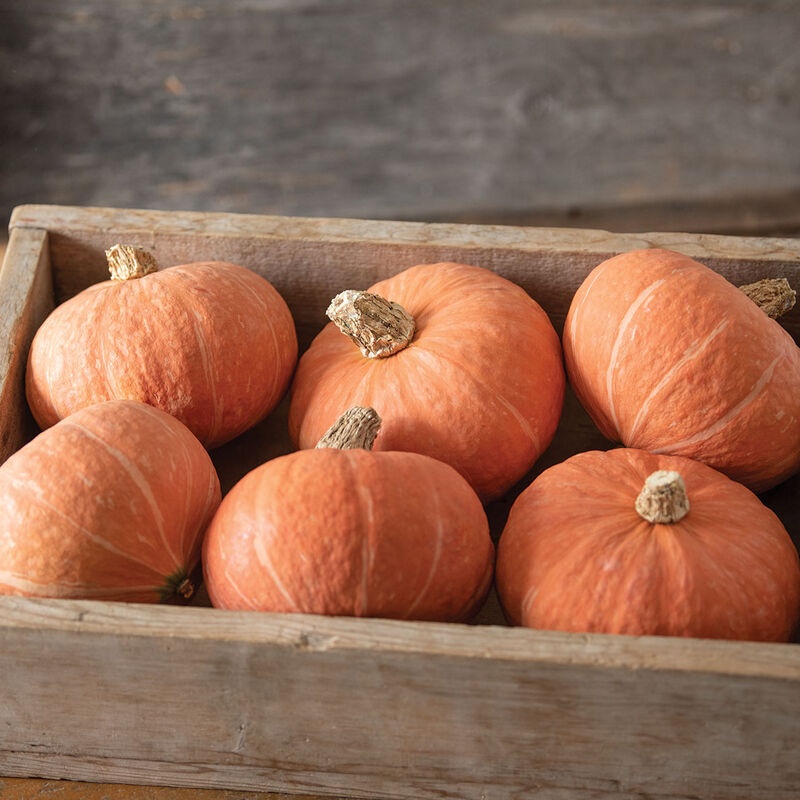
Marmalade Kabocha Squash 
(photo sourced from johnnyseeds.com)
Looking ahead to our upcoming growing season, we have a few fun things we’re planning to plant in addition to our staple items like carrots, broccoli, green beans, tomatoes, sweet corn, etc.  This year we’re planning to plant jicama and lemongrass which are on our list of crops we choose to plant once every few years.  If you have never had freshly harvested jicama, you are in for a treat!  We are also on the search to find a tasty kabocha squash to replace Sunshine, a variety we grew previously.  Sunshine had excellent flavor and sweetness, but it succumbed to disease in challenging growing conditions which subsequently impacted its shelf life.  The last few years we grew it we threw away such a large percentage that went bad and made it hard to justify growing them. This year we’re going to give “Marmalade” a try.  This is a small, coral-colored kabocha variety available from Johnny’s Seed.  They describe it as “….ideal for small family dinners and tucks nicely into CSA boxes….Vibrant color option for late fall, with improved storage life compared to Sunshine.”  Evidently we weren’t the only growers who experienced the shortened shelf life of Sunshine!  We are also trying a cute little green buttercup squash (similar to kabocha) called “Bon Bon.”  It’s described as being “Tasty, uniform and high-yielding,” and weighs in at 4-5 pounds which fits nicely in a CSA box!
Sugar Magnolia Peas
(photo sourced from osborneseed.com)

We are also planning to grow a few new purple vegetables.  We know some of you love purple colored vegetables more than others, but we know that the purple color comes from the presence of a powerful class of plant compounds called anthocyanins.  These compounds function as antioxidants in our bodies and provide a whole host of health benefits.  The first in this class that we hope to share with you is the Sugar Magnolia Pea.  This variety produces dark purple pods with bright green peas that are described as being “…sweet and delicious.  A real stunner!”  The plant for this pea does grow 6-7 feet tall, so we’ll have to trellis the plants to keep them off the ground and make them easier to pick.  We also ordered some “Purple Majesty” potato seed.  We have grown this variety at least one time in the past and our recollection is that it was not only a very tasty potato, but it held its color much better than most purple or blue varieties that turn gray when you cook them.  Lastly, we are trying a new purple sweet potato called “Purple Splendor.”  This looks to be a gorgeous potato with purple skin and dark purple flesh that is described as follows:  “Cooked flesh is on the dry side with notable sweetness.”  We’ve purchased purple sweet potatoes in the grocery store and loved the flavor and sweetness, but have not been able to find plants to grow them.  Hopefully we’ll see favorable outcomes with this variety this year!  
Artemis Cherry Tomatoes
(photo sourced from osborneseeds.com)

Our tomato and pepper line-ups are pretty solid and consistent, but we do have a few new varieties to add to the mix this year.  While we usually focus on grape tomatoes and haven’t grown cherry tomatoes for many years, we were drawn to the “Artemis” cherry tomato from Osborne Seeds.  They are supposed to be bright red and are described as “….Supersweet red cherry consistently our favorite for flavor.”  Sounds like a winner! We are also trying the “Round of Hungary” pimento pepper.  We grew pimento peppers previously, but it’s been awhile.  This is a dark red pepper that has a flattened shape with ribs.  It’s a sweet pepper that is good for stuffing.   

We have our work cut out for us over the next few weeks leading up to our first greenhouse plantings.  We need to give our seed storage cooler its annual “top to bottom” cleaning before we put the new seeds into their storage location.  We will be washing and sterilizing our greenhouse flats, thawing the potting soil and need to take care of a few repair projects before we start preparing the nursery greenhouse.  If you’ve already signed up for your 2023 CSA shares, we thank you and are excited to have you on this year’s journey with us!  If you are yet to sign up for your 2023 CSA shares, I want to remind you to do so before February 28 so you can take advantage of our Early Bird Sign-Up Offer!  We have a great season of vegetables ahead of us and look forward to growing for you and your family this year!

Thursday, March 19, 2020

Seeds, Seeds, Seeds!


By Amy Peterson


Amy, "Maven of the Seeds"
Some of you may have met me at our fall harvest party, but I’m sure many of you are wondering, “Who’s this writing in my newsletter?”  Please allow me to introduce myself: my name is Amy, and I’m the newest member of the Harmony Valley Farm crew and a first time Harmony Valley CSA member.   I started working on the farm this past June after moving from Denver, CO to Viroqua, WI.  This is my first foray into the world of commercial farming, although I’ve been a long-time gardener and supporter of all things organic.  The sheer scale of the operation here at Harmony Valley has definitely taken some getting used to—I’ve learned so much in these last 10 months, and there is still so much more to learn!   My job here on the farm is officially called “packing shed support”, and in practice this means I take care of many behind-the-scenes tasks and also step in to help wherever I am needed.  My job is filled with variety, and there are many roles that I fulfill throughout the year.  However, my hands-down favorite role is "maven of the seeds."  As spring unfolds all around us it seems very appropriate to pay homage to these tiny but mighty building blocks of the farm—seeds!


Our meticulously organized walk-in seed storage cooler
My interest in farming stems from a life-long love of gardening, and anyone with a home garden (which I suspect includes many of you) has experienced the end-of-winter thrill of opening the seed catalogs and planning for next summer’s bounty.  For me this time has always been a beacon of hope after the long cold darkness of winter, and having this experience for the first time on the farm did not disappoint!  The excitement was palpable as the seed catalogs began to arrive in the mail.  My days quickly became filled with seed orders and preparations for the influx of seed to come.  Home gardeners may have a box where seeds are stored, or perhaps a shelf in a cabinet, and you simply push back last year’s seed packets to make room for the new.  We have an entire walk-in cooler devoted entirely to seeds, and even at the end of the growing season there are pounds upon pounds of seeds stored in there.  Preparing for the new year’s seeds to arrive is much more complicated at this scale!  After a full inventory of the seeds for every crop group with all of their corresponding varieties, we temporarily remove all the containers and do our annual cleaning of the cooler.  Floor to ceiling, every surface is washed and sterilized before we return our carry over inventory and start receiving new seeds for the upcoming growing season.  By the end of this process I was finally able to navigate the seed cooler with confidence, no longer overwhelmed by the sheer volume of seed stored in this magical cooler.

Organized carrot seeds packed into one of our totes.
What kind of volume are we talking about, you may wonder. Let’s look at some of the numbers to paint a picture.  From Arugula to Watermelon, our seed cooler currently contains about 70 different crop groups.  We use large plastic tubs, 5 gallon buckets and lots of shelving to store the seed by crop groups.  Organization is key when dealing with this many options in one space!  Within each crop group there are a wide range of varieties and seed lots.  For example, we have 3 different lots for the Burdock crop group, but when it comes to sweet peppers we have 90 different lots!  Some other heavy hitters are the melons (40 lots), and winter squash (30 lots), just to name a few.  There is also a wide range in the weight and number of seeds for each crop group.  Some seed like, broccoli and cauliflower, are measured by the number of seeds per packet and are relatively light. We have about 200,000 broccoli seeds at the moment, but they weigh less than 2 pounds total.  Compare that to our stock of edamame seed which weighs in at just under 1,000 pounds!  Cilantro is a very important crop group since we plant cilantro seed weekly throughout the entire growing season, and we currently have over 11,000,000 (yes, 11 million!) cilantro seeds weighing about 240 pounds.  One last number that I’d like to use to describe the seed collection here is value.  At this point in the year our seed cooler houses around $80,000 worth of seed!  This seed is what makes all those beautiful and delicious CSA boxes possible, so I would say that it is definitely money well spent.

The tedious job of counting out and labeling
seeds for germination tests.
Knowing how valuable these seeds are gives me cause to be very careful while working with them.  It has come in very handy that I have been making beaded jewelry most of my life, because the same techniques that I use for carefully handling my bead collection can be applied to handling seeds. I pour and weigh my beads in the same way that I pour and weigh seed, so my past mistakes that resulted in spilled beads can now be avoided when handling seed! Some crops are prone to certain diseases and insects, so another way that I help protect the seed collection is through seed sterilization.  We have developed our own hot-water seed treatment which is an organic method for mitigating these diseases and pests, and this falls under my job description as well. Also, using proper storage techniques and monitoring the cooler for proper temperature and humidity are some other ways that I do my part to make sure this valuable investment remains viable.

Planting peas for germination tests (left) and
Beet seedlings ready to be counted (right)
Keeping this impressive seed collection in working order is a large part of my job year-round.  We keep a digital database of our entire seed inventory which I update as new seeds arrive, as well as when seeds go out for planting.  This database is a very important tool in determining which seeds will be planted at which times, so it’s imperative that it is maintained accurately so that Andrea and Richard can make the most well-informed decisions when it comes time for purchasing seeds and planting them.  Each seed lot has a unique lot number and seed count per pound that is essentially the fingerprint for that seed.  The seed count is also a valuable tool in determining how many seeds should be planted per foot.  Another important piece of data recorded in the seed inventory is the germination rates for each particular variety.  It would be ideal if every seed that we planted resulted in a corresponding plant, but unfortunately nature is not perfect.  Some especially vivacious varieties of seed have close to a 100% germination rate, but the majority of seed coming onto the farm have between 85% - 95% germination rate as reported by the seed manufacturers.  This number is so important to making planting decisions that we conduct our own germination tests before planting any crop for the year.  As spring has crept in I have begun the process of germ testing our seed collection.  To come up with a germination rate I plant a very specific number of seeds for a certain seed lot (anywhere from 20 to 200 seeds, depending on the variety), and then later I count how many of those seeds result in a seedling.  It’s an easy enough concept, but it takes quite a bit of time to keep the seed organized, labeled and neatly planted so that the information provided by these tests is accurate. Mixing up a label during this germ testing phase could lead to a poor performing field later in the season, so I do my best to be organized and accurate while gathering this important data.  It’s such an uplifting sign of spring to see these trays of seed sprouting and declaring their viability for all to see.

As the year progresses, more and more of my time on the farm will be spent gathering seeds for planting.  For me, this is a really fun part of the whole process.  Every time I open up the storage bin for a particular crop I am flooded with sensory information. The first thing I will notice is the unique smell of each seed type.  Since we use all organic and untreated seed the smell of these seeds is especially aromatic.  My favorite are the carrot seeds—they have a delightful sweet aroma that is very uplifting and does not smell at all like a full grown carrot.  However, cilantro seeds smell exactly like a bunch of full grown cilantro. Fennel seeds smell strongly of anise, which tickles my senses every time! The next sense to be flooded is my visual field.  Each crop variety has a unique looking seed.  Although there is diversity between the seeds of different varieties of a crop, there are always some visual characteristics that remain the same within a crop group.  There may be some color differences or slightly different textures between the varieties, but the basic seed will be recognizable for that crop group.  All lettuce seeds are lightweight, paper thin tiny little pointy-ended ovals, but some are light brown in color, some dark brown. Beet seeds are such an interestingly peculiar shape that I can only describe as a little burr, but with very little visual distinction between varieties.  An interesting side note, these little beet “burrs” are unique in that they each house a group of individual seeds, which means multiple plants can grow from each burr that is planted.  One visual cue that I hope not to find when opening a new bag of seed is an unnatural fluorescent color.  All of the seed we plant is free of chemical treatment, so if I see unnaturally bright colored seed (or a list of long chemical names on the label) I know that we were sent the wrong lot and it must be returned to the manufacturer.  Thankfully, this rarely happens.  Each crop group has its own auditory signature as well.  As I pour out the seed into the proper container for planting I can hear the specific note which that seed plays.  Some seeds create a cascade of seed   All of these observations took me quite by surprise when I first started working here, as I had never before handled seed in the quantity that allows you to notice all of these sensory delights. Now I look forward to my time spent pulling and measuring the seed for all of these reasons, and I’m always on the lookout for new observations of my tiny little friends.

French Breakfast Radishes growing in the field
Once these seeds have left my care and are planted in the soil they will expand exponentially.  It boggles the mind to think of how much growth potential is stored in each of those little seeds.  The 10 pounds of radish seed that I send out into the field will come back as thousands of bunches of beautiful red radishes. A few pounds of turnip seed will come back from the field as literal tons of delicious roots that will provide nutrition all winter long.  Each one of the millions (maybe billions?) of seeds in my care has the potential to become a nutritious and delicious organic masterpiece.  The seeds that I weigh out in pounds will return to the packing shed in tons, which will then end their journey on your tables all season long. To me this is nothing short of a miracle of nature.

I don’t think I will ever tire of handling the bountiful Harmony Valley seed collection, and I hope these insights have passed along some of my enthusiasm for these tiny powerhouses. As spring marches ever forwards, take a moment to appreciate that the bounty which is just beginning to unfold all around us started with these unique and amazing little packages we call seeds.  And the next time you find yourself opening a package of carrot seeds, take a little sniff for me—I promise you will not be disappointed!